Geopolitical risks reignite safe-haven demand, but a plunge in consumer confidence fails to stem the dollar's decline.
2026-03-28 00:47:12
On Friday (March 27) during the New York session, the US dollar index fluctuated slightly higher, maintaining around 100.0664, up 0.14% from the previous day's close. Although the cumulative gains over the past three days have been limited, the overall increase in March has reached nearly 2%, marking the strongest monthly performance in the past eight months.
Despite Trump's announcement that the deadline for striking Iranian energy facilities would be extended by 10 days to April 6, Iranian officials continued to deny substantive progress in negotiations, and concerns about a protracted geopolitical conflict persisted. Safe-haven funds continued to flow into the US dollar, while high oil prices pushed up inflation expectations. These two factors combined to support the resilience of the US dollar.
Fundamental analysis
Geopolitical risks: On Thursday, Trump announced a 10-day extension of the moratorium on strikes against energy facilities at Iran's request, stating that "negotiations are progressing very well." However, Iranian officials made it clear that they had rejected the US's 15-point ceasefire proposal and denied that any substantive dialogue was underway. Market concerns about an escalation of conflict before the weekend or continued obstruction in the Strait of Hormuz did not ease, keeping oil prices firm and further pushing up global inflation expectations. The US dollar, as the world's primary safe-haven asset, naturally benefits from this combination of "risk premium + high interest rates."
The Federal Reserve's policy path remains hawkish: Persistently high oil prices coupled with inflationary pressures have led the market to significantly reduce its expectations for the number of Fed rate cuts this year. Signals released after the March Fed meeting indicate that policymakers remain cautious about the path of inflation decline, and the high-interest-rate environment provides long-term structural support for the dollar. Even if short-term geopolitical factors ease, the dollar is unlikely to fall rapidly.
Today's core economic data had a neutral to weak impact: The final reading of the University of Michigan's March Consumer Sentiment Index came in at 53.3, a significant downward revision from the initial reading of 55.5, and also lower than the final reading of 56.6 in February, marking a new low since the end of 2025. Consumer pessimism about the economic outlook has intensified, which would normally be bearish for the US dollar; however, in a market environment dominated by geopolitical risks, the safe-haven logic completely overshadowed the impact of the economic data, and the US dollar instead consolidated its gains.
The correlation between crude oil and inflation is significant: Crude oil prices remain high due to uncertainty in the Middle East, further solidifying the US dollar's role as an inflation hedge. Each increase in oil prices indirectly reinforces the Federal Reserve's need to maintain restrictive policies, providing additional support for the US dollar.
mainstream view
Barchart analysts clearly pointed out that although Trump announced a 10-day extension of the deadline for the Iranian energy strikes, Iranian officials immediately issued a strong statement denying that any substantive negotiations were underway, causing market optimism about a ceasefire to quickly fade. The US dollar thus received sustained support from safe-haven buying, while widespread weakness in US stocks and a surge in oil prices due to weekend uncertainty further boosted inflation expectations. In the short term, the DXY will likely fluctuate around the 100 level, but as long as geopolitical risks do not substantially ease, the dollar's monthly strength will continue.
Reuters, citing multiple diplomatic sources in Washington and Tehran, reported that Trump's move to extend the deadline by 10 days was widely interpreted by the market as a "temporary delaying tactic." Iran, however, formally rejected the proposal in writing, outlining its five non-negotiable preconditions, indicating that "there is currently no substantive negotiation." This discrepancy between words and actions kept investors highly cautious ahead of the weekend, with risk aversion continuing to build, directly contributing to the resilience of the dollar index in early New York trading. Reuters analysis suggests that the simultaneous rise in oil prices further strengthened the dollar's inflation-hedging properties.
The Trading Economics forex team believes that the DXY is currently fluctuating slightly around 100, primarily driven by the uncertainty surrounding the Middle East conflict and its correlation with oil prices. The DXY has appreciated by 1.78% in March, far exceeding market expectations. Analysts emphasize that if no breakthrough occurs in the Iran negotiations this weekend, the dollar is likely to continue its best monthly performance, with the 100.50 area as the next target. The report also cautions that any unexpected military or diplomatic developments could trigger significant volatility over the weekend.
Investing experts point out that the US dollar has strengthened for three consecutive days, with geopolitical risks completely dominating current market trends. The psychological level of 100 has become the focus of contention between bulls and bears. If the dollar effectively breaks through 100 accompanied by increased trading volume, the technical outlook will open up further upside potential; conversely, if there is unexpected progress in the Iran negotiations before the weekend, the safe-haven premium may fall rapidly. Experts advise investors to maintain flexible positions in the current environment and pay close attention to real-time changes in oil prices and geopolitical news.
Technical Analysis
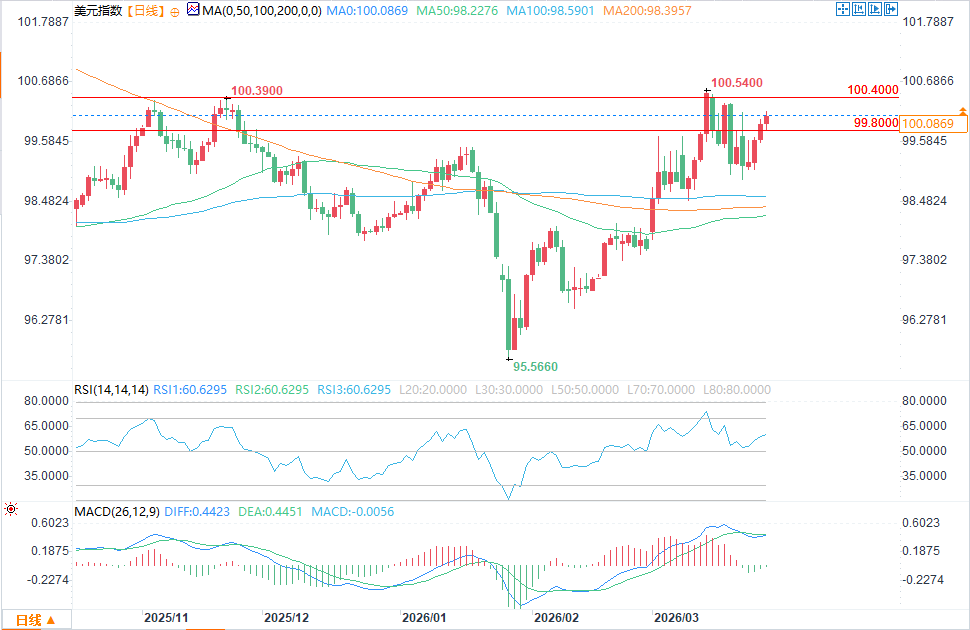
(US Dollar Index Daily Chart Source: FX678)
Moving average system: The short-term MA (5/10/20) shows a clear bullish alignment, and the price has stabilized above 99.80, indicating that the short-term trend is still strong; the medium- and long-term MA (50/200) maintains a good golden cross, supporting the US dollar to continue testing the 100 level.
RSI(14) and MACD: The RSI is currently around 65-67, which is strong but has not yet entered the overbought extreme zone. The MACD histogram continues to expand, and the momentum indicator still supports the bulls. We need to be wary that if the RSI quickly falls back below 60, there may be a short-term profit-taking.
Key levels and patterns: Intraday resistance levels to watch are 100.15-100.40 (recent high and psychological level), while support levels are 99.80 and 99.60.
If the price effectively breaks above 100 with increased trading volume, it will open up further upside potential to the 101.50 area; conversely, if it falls below 99.80, it may pull back in the short term to test the 98.80-99.00 range.
Financial History
Today's main events:
10:00 EDT University of Michigan March Consumer Sentiment Index Final Reading: Actual 53.3 (Expected 55.5, Previous 56.6) - The data was significantly lower than expected, but this has already been factored in by geopolitical factors.
Baker Hughes Oil Rig Count (Weekly Report, Oil Market Related Indicator)
Important Reminder
Geopolitical news is highly sensitive before the weekend, and any breaking news about Iranian negotiations or military action could trigger dramatic fluctuations.
Next week, the focus will be on the US non-farm payroll report, more speeches by Federal Reserve officials, and crude oil inventory data. Investors are advised to maintain position flexibility.
Frequently Asked Questions
Despite Trump's announcement that the deadline for striking Iranian energy facilities would be extended by 10 days to April 6, Iranian officials continued to deny substantive progress in negotiations, and concerns about a protracted geopolitical conflict persisted. Safe-haven funds continued to flow into the US dollar, while high oil prices pushed up inflation expectations. These two factors combined to support the resilience of the US dollar.
Fundamental analysis
Geopolitical risks: On Thursday, Trump announced a 10-day extension of the moratorium on strikes against energy facilities at Iran's request, stating that "negotiations are progressing very well." However, Iranian officials made it clear that they had rejected the US's 15-point ceasefire proposal and denied that any substantive dialogue was underway. Market concerns about an escalation of conflict before the weekend or continued obstruction in the Strait of Hormuz did not ease, keeping oil prices firm and further pushing up global inflation expectations. The US dollar, as the world's primary safe-haven asset, naturally benefits from this combination of "risk premium + high interest rates."
The Federal Reserve's policy path remains hawkish: Persistently high oil prices coupled with inflationary pressures have led the market to significantly reduce its expectations for the number of Fed rate cuts this year. Signals released after the March Fed meeting indicate that policymakers remain cautious about the path of inflation decline, and the high-interest-rate environment provides long-term structural support for the dollar. Even if short-term geopolitical factors ease, the dollar is unlikely to fall rapidly.
Today's core economic data had a neutral to weak impact: The final reading of the University of Michigan's March Consumer Sentiment Index came in at 53.3, a significant downward revision from the initial reading of 55.5, and also lower than the final reading of 56.6 in February, marking a new low since the end of 2025. Consumer pessimism about the economic outlook has intensified, which would normally be bearish for the US dollar; however, in a market environment dominated by geopolitical risks, the safe-haven logic completely overshadowed the impact of the economic data, and the US dollar instead consolidated its gains.
The correlation between crude oil and inflation is significant: Crude oil prices remain high due to uncertainty in the Middle East, further solidifying the US dollar's role as an inflation hedge. Each increase in oil prices indirectly reinforces the Federal Reserve's need to maintain restrictive policies, providing additional support for the US dollar.
mainstream view
Barchart analysts clearly pointed out that although Trump announced a 10-day extension of the deadline for the Iranian energy strikes, Iranian officials immediately issued a strong statement denying that any substantive negotiations were underway, causing market optimism about a ceasefire to quickly fade. The US dollar thus received sustained support from safe-haven buying, while widespread weakness in US stocks and a surge in oil prices due to weekend uncertainty further boosted inflation expectations. In the short term, the DXY will likely fluctuate around the 100 level, but as long as geopolitical risks do not substantially ease, the dollar's monthly strength will continue.
Reuters, citing multiple diplomatic sources in Washington and Tehran, reported that Trump's move to extend the deadline by 10 days was widely interpreted by the market as a "temporary delaying tactic." Iran, however, formally rejected the proposal in writing, outlining its five non-negotiable preconditions, indicating that "there is currently no substantive negotiation." This discrepancy between words and actions kept investors highly cautious ahead of the weekend, with risk aversion continuing to build, directly contributing to the resilience of the dollar index in early New York trading. Reuters analysis suggests that the simultaneous rise in oil prices further strengthened the dollar's inflation-hedging properties.
The Trading Economics forex team believes that the DXY is currently fluctuating slightly around 100, primarily driven by the uncertainty surrounding the Middle East conflict and its correlation with oil prices. The DXY has appreciated by 1.78% in March, far exceeding market expectations. Analysts emphasize that if no breakthrough occurs in the Iran negotiations this weekend, the dollar is likely to continue its best monthly performance, with the 100.50 area as the next target. The report also cautions that any unexpected military or diplomatic developments could trigger significant volatility over the weekend.
Investing experts point out that the US dollar has strengthened for three consecutive days, with geopolitical risks completely dominating current market trends. The psychological level of 100 has become the focus of contention between bulls and bears. If the dollar effectively breaks through 100 accompanied by increased trading volume, the technical outlook will open up further upside potential; conversely, if there is unexpected progress in the Iran negotiations before the weekend, the safe-haven premium may fall rapidly. Experts advise investors to maintain flexible positions in the current environment and pay close attention to real-time changes in oil prices and geopolitical news.
Technical Analysis
(US Dollar Index Daily Chart Source: FX678)
Moving average system: The short-term MA (5/10/20) shows a clear bullish alignment, and the price has stabilized above 99.80, indicating that the short-term trend is still strong; the medium- and long-term MA (50/200) maintains a good golden cross, supporting the US dollar to continue testing the 100 level.
RSI(14) and MACD: The RSI is currently around 65-67, which is strong but has not yet entered the overbought extreme zone. The MACD histogram continues to expand, and the momentum indicator still supports the bulls. We need to be wary that if the RSI quickly falls back below 60, there may be a short-term profit-taking.
Key levels and patterns: Intraday resistance levels to watch are 100.15-100.40 (recent high and psychological level), while support levels are 99.80 and 99.60.
If the price effectively breaks above 100 with increased trading volume, it will open up further upside potential to the 101.50 area; conversely, if it falls below 99.80, it may pull back in the short term to test the 98.80-99.00 range.
Financial History
Today's main events:
10:00 EDT University of Michigan March Consumer Sentiment Index Final Reading: Actual 53.3 (Expected 55.5, Previous 56.6) - The data was significantly lower than expected, but this has already been factored in by geopolitical factors.
Baker Hughes Oil Rig Count (Weekly Report, Oil Market Related Indicator)
Important Reminder
Geopolitical news is highly sensitive before the weekend, and any breaking news about Iranian negotiations or military action could trigger dramatic fluctuations.
Next week, the focus will be on the US non-farm payroll report, more speeches by Federal Reserve officials, and crude oil inventory data. Investors are advised to maintain position flexibility.
Frequently Asked Questions
Q1: Why did the dollar still strengthen after Trump extended the deadline?
A: The core issue lies in the market's skepticism regarding "substantial progress." Although Trump announced a 10-day pause and claimed that "negotiations are progressing well," Iranian officials repeatedly denied any substantive dialogue and rejected the US's 15-point proposal. This inconsistency between words and actions led investors to believe that the risk of a prolonged conflict remained, causing safe-haven funds to continue flowing into the US dollar rather than withdrawing quickly.
Q2: How much actual impact does the situation in Iran have on the US dollar?
A: The impact is direct and lasting. Uncertainty surrounding the Middle East conflict directly pushes up oil prices, thereby raising global inflation expectations and reducing the probability of a rapid interest rate cut by the Federal Reserve. As the global reserve currency and a traditional safe-haven asset, the US dollar naturally commands a premium in the context of "geopolitical risk + high interest rates." Even with weakening consumer confidence data, the safe-haven logic completely outweighs the negative fundamentals.
Q3: What does the sharp drop in the Michigan Consumer Sentiment Index to 53.3 mean?
A: This reflects a significant increase in pessimism among US consumers regarding the economic outlook, reaching a recent low. Typically, such data is bearish for the dollar and risk assets. However, in the current market environment, geopolitical risk premiums dominate, and safe-haven demand outweighs domestic economic concerns. Therefore, the dollar has not retreated as a result; instead, it has consolidated its gains.
Q4: How has the Fed’s recent policy stance affected the US dollar?
A: In March, the Federal Reserve kept interest rates unchanged and emphasized inflation risks, leading the market to significantly lower its expectations for a rate cut this year. The high-interest-rate environment itself is a long-term supporting factor for the US dollar. Coupled with inflationary pressures driven by rising oil prices, the probability of the Fed delaying rate cuts has further increased, providing a solid fundamental backing for the US dollar.
Q5: What are the main risks and opportunities facing the US dollar this weekend and next week?
A: Geopolitical uncertainty is highest over the weekend. If there is an unexpected breakthrough in the Iran negotiations, the safe-haven premium may fall rapidly, putting downward pressure on the dollar. Conversely, if signs of conflict escalate or oil prices continue to rise, the dollar will benefit further. Next week's non-farm payroll report will be key. If the data is strong and inflationary pressures persist, the structural strength of the dollar is likely to continue.
- Risk Warning and Disclaimer
- The market involves risk, and trading may not be suitable for all investors. This article is for reference only and does not constitute personal investment advice, nor does it take into account certain users’ specific investment objectives, financial situation, or other needs. Any investment decisions made based on this information are at your own risk.