Rebound or a bull trap? Gold sees technical recovery after Thursday's sharp drop.
2026-03-27 22:33:44
As March 2026 drew to a close, global investors' attention was firmly focused on the tensions in the Persian Gulf. On Friday, gold prices saw a technical rebound after Thursday's sharp decline. This rebound appeared more like a "natural correction after a major drop" than a trend reversal.
Looking back on this week, gold bulls and bears engaged in a tug-of-war between "safe-haven demand" and "negative inflationary pressures." US President Trump's statements on social media temporarily eased the tensions. He announced a 10-day postponement of the deadline for the energy strikes against Iran, extending it to April 6, 2026, and revealed that the US and Iran were in contact. However, this "ten-day agreement" did not truly quell market anxiety.
In contrast, the Pentagon's cold, hard war preparedness data reveals that, according to the Wall Street Journal, the U.S. military is considering deploying up to 10,000 additional troops to the region and is even exploring the possibility of using ground forces to seize Kharg Island, Iran's strategic oil hub. Iran retaliated with restrictions on the Strait of Hormuz, preventing three ships of different nationalities from passing, and even forcing Chinese container ships to turn back due to shipping safety concerns. This blockade of the global energy lifeline directly drove up oil prices, prompting Macquarie Bank to issue an extreme warning of "$200 oil prices." For gold, war is both fuel supporting its status as a safe haven and a fuse that, by pushing up inflation, triggers the Federal Reserve's "interest rate hammer."
Inflation becomes a shackle on gold prices.
If war is a boon to gold, then the inflation it triggers is its poison. In 2026, the traditional logic of gold as a safe-haven asset is facing unprecedented challenges.
Despite a nearly 1% rise in gold prices on Friday, returning above $4,410.70 per ounce, a 1.5% decline is still expected for the week. The root cause lies in the market's understanding of the monetary logic behind geopolitics: soaring oil prices and resulting hyperinflation are forcing central banks to abandon interest rate cuts.
Federal Reserve Governor Michael Barr's hawkish stance provides a real-world example of this logic. He explicitly stated that due to the combined effects of the Middle East conflict and tariff policies, inflation will not only remain high in non-housing services, but its duration may also exceed expectations. Under the monitoring of the CME FedWatch tool, traders' psychological expectations have undergone a dramatic reversal—before the outbreak of war, the market was certain of two rate cuts in 2026; now, rate cut expectations have completely vanished, and the probability of a rate hike before the end of the year has surged to 40% to 50%.
Gold's position became extremely precarious when the 10-year U.S. Treasury yield climbed to 4.45%, its highest level since July 2025. As a non-yielding asset, the "opportunity cost" of holding gold has become prohibitively high in an environment of extremely high interest rates. As analyst Christopher Lewis stated, "You can get substantial interest returns by holding paper assets (U.S. Treasuries), while holding physical gold not only yields no interest but also incurs storage costs." This repricing of liquidity is the core driver behind the four consecutive weeks of weakness in gold prices.
Institutional Liquidity Game: Gold Becomes an ATM
At the micro level of the market, another reason for gold's recent lackluster performance lies in the operational strategies of institutional investors. Christopher Lewis points out that many retail traders simply view gold as a "safe haven," but in practice, the logic of commercial users and large hedge funds is completely different.
When war causes global stock markets to fall and leveraged positions face margin calls, gold, being the most liquid asset, often becomes an "ATM" for institutions. Large institutions sell gold to raise cash in order to cover losses in other risky markets. This phenomenon was particularly evident in the market rally in March 2026.
However, not all institutions are pessimistic. Commerzbank maintains its long-term optimistic outlook, setting a gold price target of $5,000 per ounce by the end of 2026. Their assumption is clear: if the Middle East conflict ends in the spring and the Federal Reserve eventually returns to interest rate cuts due to economic growth pressures, then gold's ultimate property as a store of value will once again be realized. But in the current volatile market, WisdomTree strategist Nitsh Shah believes that only "savvy investors" are taking advantage of price dips to build positions.
Technical Analysis: The Path to Bottom Amidst Moving Average Resistance
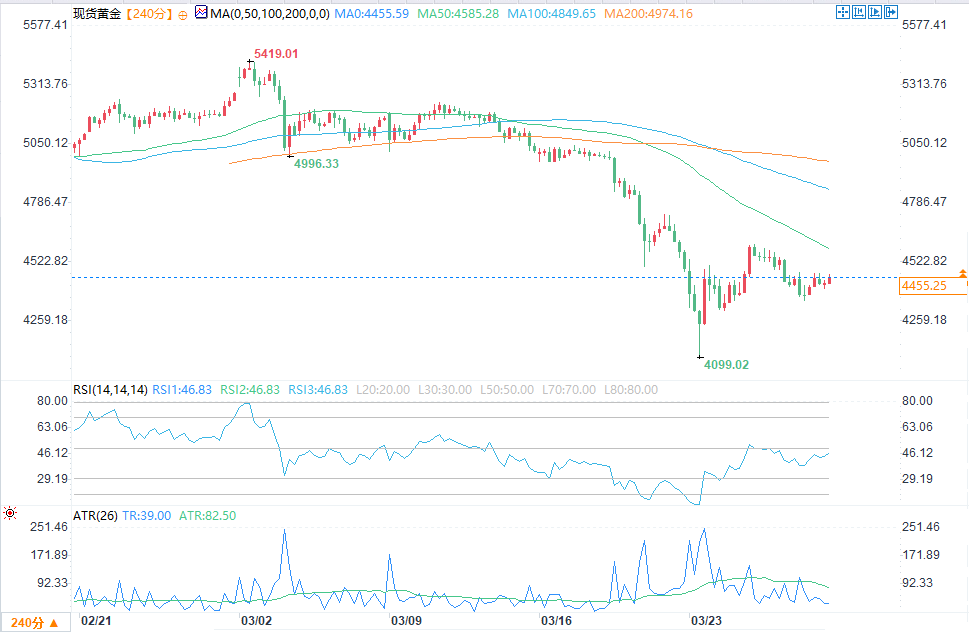
(4-hour chart of spot gold source: EasyForex)
From a technical analysis perspective, although gold has experienced significant intraday volatility, the overall downtrend structure remains intact. Gold/USD (XAU/USD) is currently in a "lack of momentum" rebound.
Key resistance levels: The 4-hour chart shows that gold remains under pressure from the combined forces of the 50-period simple moving average (SMA) and the 100-period SMA. The 50-period SMA is located around $4,579, while stronger resistance lies at $4,842. Any rally is likely to be seen as a "bull trap" until the price effectively holds above these key moving averages.
Support Test: The $4,098 level reached on Monday is currently the most important psychological support level. If the US-Iran conflict escalates beyond expectations and inflation data spirals further out of control, the strength of this support level will face a severe test.
After rebounding from the oversold zone, the RSI indicator is currently fluctuating around 40, indicating that the market's selling momentum has slowed somewhat, but buying confidence remains weak. Although the MACD has shown initial signs of bullish divergence, this technical correction appears somewhat weak in the face of broader macroeconomic headwinds.
Summary and Outlook
The gold market in March 2026 is undergoing a debate over its "attribute definition." Is it a hard currency of wartime, or an outcast of the high-interest-rate era? Currently, the latter seems to be gaining the upper hand.
While Trump's ten-day extension provided some breathing room for the market, as long as the threat of a Strait of Hormuz blockade remains, the upward pressure of oil prices on inflation will continue to suppress gold price gains. In the short term, it is advisable to closely monitor the University of Michigan's consumer confidence data and public statements from several Federal Reserve officials, as this information will determine whether the market fully prices in the extreme expectation of a "rate hike at the end of the year."
Gold prices are currently trading within a range of $4,300 to $4,600. Until the US-China summit in mid-May or a significant shift in the Middle East situation occurs, it is advisable to view gold's price action with a "sell on rallies, trade within the range" approach, rather than blindly betting on a one-sided breakout.
Looking back on this week, gold bulls and bears engaged in a tug-of-war between "safe-haven demand" and "negative inflationary pressures." US President Trump's statements on social media temporarily eased the tensions. He announced a 10-day postponement of the deadline for the energy strikes against Iran, extending it to April 6, 2026, and revealed that the US and Iran were in contact. However, this "ten-day agreement" did not truly quell market anxiety.
In contrast, the Pentagon's cold, hard war preparedness data reveals that, according to the Wall Street Journal, the U.S. military is considering deploying up to 10,000 additional troops to the region and is even exploring the possibility of using ground forces to seize Kharg Island, Iran's strategic oil hub. Iran retaliated with restrictions on the Strait of Hormuz, preventing three ships of different nationalities from passing, and even forcing Chinese container ships to turn back due to shipping safety concerns. This blockade of the global energy lifeline directly drove up oil prices, prompting Macquarie Bank to issue an extreme warning of "$200 oil prices." For gold, war is both fuel supporting its status as a safe haven and a fuse that, by pushing up inflation, triggers the Federal Reserve's "interest rate hammer."
Inflation becomes a shackle on gold prices.
If war is a boon to gold, then the inflation it triggers is its poison. In 2026, the traditional logic of gold as a safe-haven asset is facing unprecedented challenges.
Despite a nearly 1% rise in gold prices on Friday, returning above $4,410.70 per ounce, a 1.5% decline is still expected for the week. The root cause lies in the market's understanding of the monetary logic behind geopolitics: soaring oil prices and resulting hyperinflation are forcing central banks to abandon interest rate cuts.
Federal Reserve Governor Michael Barr's hawkish stance provides a real-world example of this logic. He explicitly stated that due to the combined effects of the Middle East conflict and tariff policies, inflation will not only remain high in non-housing services, but its duration may also exceed expectations. Under the monitoring of the CME FedWatch tool, traders' psychological expectations have undergone a dramatic reversal—before the outbreak of war, the market was certain of two rate cuts in 2026; now, rate cut expectations have completely vanished, and the probability of a rate hike before the end of the year has surged to 40% to 50%.
Gold's position became extremely precarious when the 10-year U.S. Treasury yield climbed to 4.45%, its highest level since July 2025. As a non-yielding asset, the "opportunity cost" of holding gold has become prohibitively high in an environment of extremely high interest rates. As analyst Christopher Lewis stated, "You can get substantial interest returns by holding paper assets (U.S. Treasuries), while holding physical gold not only yields no interest but also incurs storage costs." This repricing of liquidity is the core driver behind the four consecutive weeks of weakness in gold prices.
Institutional Liquidity Game: Gold Becomes an ATM
At the micro level of the market, another reason for gold's recent lackluster performance lies in the operational strategies of institutional investors. Christopher Lewis points out that many retail traders simply view gold as a "safe haven," but in practice, the logic of commercial users and large hedge funds is completely different.
When war causes global stock markets to fall and leveraged positions face margin calls, gold, being the most liquid asset, often becomes an "ATM" for institutions. Large institutions sell gold to raise cash in order to cover losses in other risky markets. This phenomenon was particularly evident in the market rally in March 2026.
However, not all institutions are pessimistic. Commerzbank maintains its long-term optimistic outlook, setting a gold price target of $5,000 per ounce by the end of 2026. Their assumption is clear: if the Middle East conflict ends in the spring and the Federal Reserve eventually returns to interest rate cuts due to economic growth pressures, then gold's ultimate property as a store of value will once again be realized. But in the current volatile market, WisdomTree strategist Nitsh Shah believes that only "savvy investors" are taking advantage of price dips to build positions.
Technical Analysis: The Path to Bottom Amidst Moving Average Resistance
(4-hour chart of spot gold source: EasyForex)
From a technical analysis perspective, although gold has experienced significant intraday volatility, the overall downtrend structure remains intact. Gold/USD (XAU/USD) is currently in a "lack of momentum" rebound.
Key resistance levels: The 4-hour chart shows that gold remains under pressure from the combined forces of the 50-period simple moving average (SMA) and the 100-period SMA. The 50-period SMA is located around $4,579, while stronger resistance lies at $4,842. Any rally is likely to be seen as a "bull trap" until the price effectively holds above these key moving averages.
Support Test: The $4,098 level reached on Monday is currently the most important psychological support level. If the US-Iran conflict escalates beyond expectations and inflation data spirals further out of control, the strength of this support level will face a severe test.
After rebounding from the oversold zone, the RSI indicator is currently fluctuating around 40, indicating that the market's selling momentum has slowed somewhat, but buying confidence remains weak. Although the MACD has shown initial signs of bullish divergence, this technical correction appears somewhat weak in the face of broader macroeconomic headwinds.
Summary and Outlook
The gold market in March 2026 is undergoing a debate over its "attribute definition." Is it a hard currency of wartime, or an outcast of the high-interest-rate era? Currently, the latter seems to be gaining the upper hand.
While Trump's ten-day extension provided some breathing room for the market, as long as the threat of a Strait of Hormuz blockade remains, the upward pressure of oil prices on inflation will continue to suppress gold price gains. In the short term, it is advisable to closely monitor the University of Michigan's consumer confidence data and public statements from several Federal Reserve officials, as this information will determine whether the market fully prices in the extreme expectation of a "rate hike at the end of the year."
Gold prices are currently trading within a range of $4,300 to $4,600. Until the US-China summit in mid-May or a significant shift in the Middle East situation occurs, it is advisable to view gold's price action with a "sell on rallies, trade within the range" approach, rather than blindly betting on a one-sided breakout.
- Risk Warning and Disclaimer
- The market involves risk, and trading may not be suitable for all investors. This article is for reference only and does not constitute personal investment advice, nor does it take into account certain users’ specific investment objectives, financial situation, or other needs. Any investment decisions made based on this information are at your own risk.