Three major signals for reconciliation were ignored, so why did the oil market surge in the opposite direction? The countdown to a million-barrel shortfall has begun!
2026-03-28 12:15:04
This week, the international oil market experienced a highly volatile and volatile period. Despite headlines about geopolitical conflicts constantly signaling reconciliation, the actual market movement exhibited a cold, defensive expansion. Brent crude and US crude both recorded significant gains on Friday, not only recovering some of the losses from the beginning of the week but also revealing traders' deep skepticism about the so-called "ceasefire prospects." The core contradiction lies in the optimistic rhetoric of reconciliation from mainstream overseas institutions on one hand, and the substantial increase in military reinforcements and the risk of damage to energy infrastructure on the other. Currently, global oil supply is decreasing by approximately 11 million barrels per day, a gap exceeding the combined shortfall of the two oil crises of the 1970s. The market is at an extremely sensitive tipping point: investors have begun to develop "immunity" to verbal diplomatic mediation, instead using real-money positions to gamble on the extremely high risk premium brought about by a protracted war.

I. Review of International Crude Oil Trends
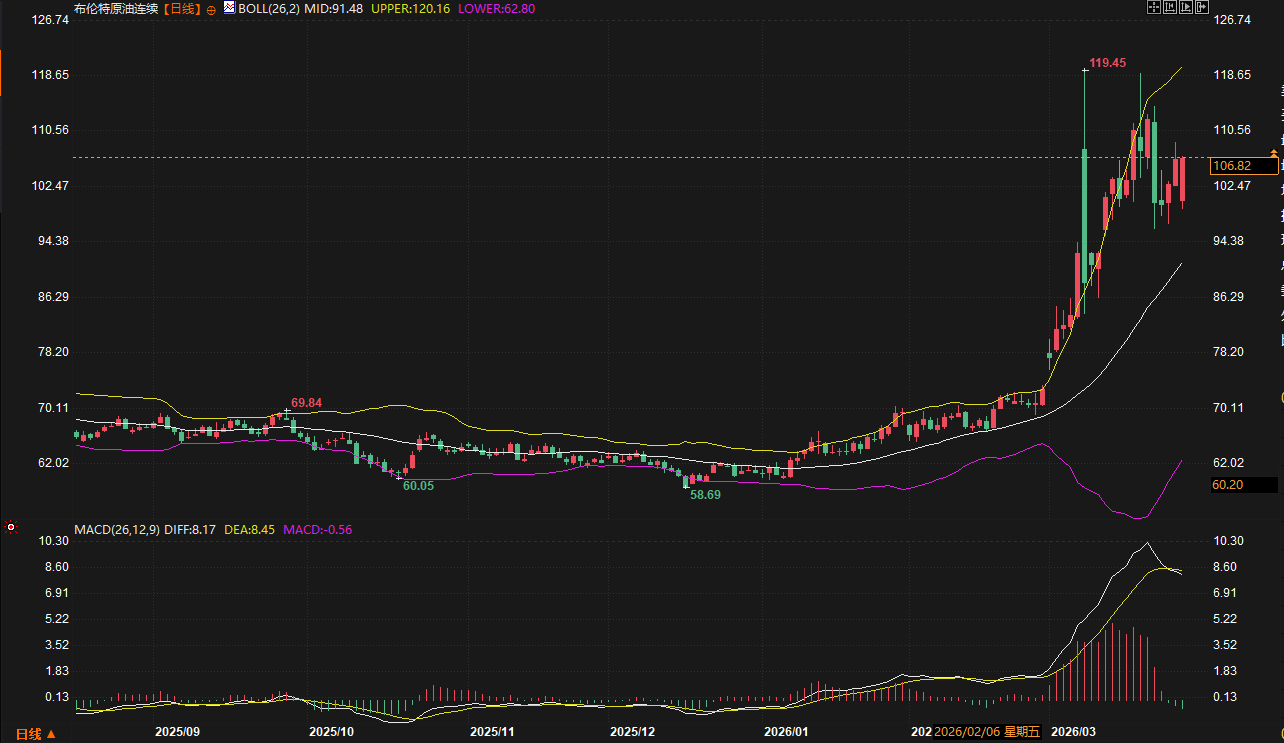
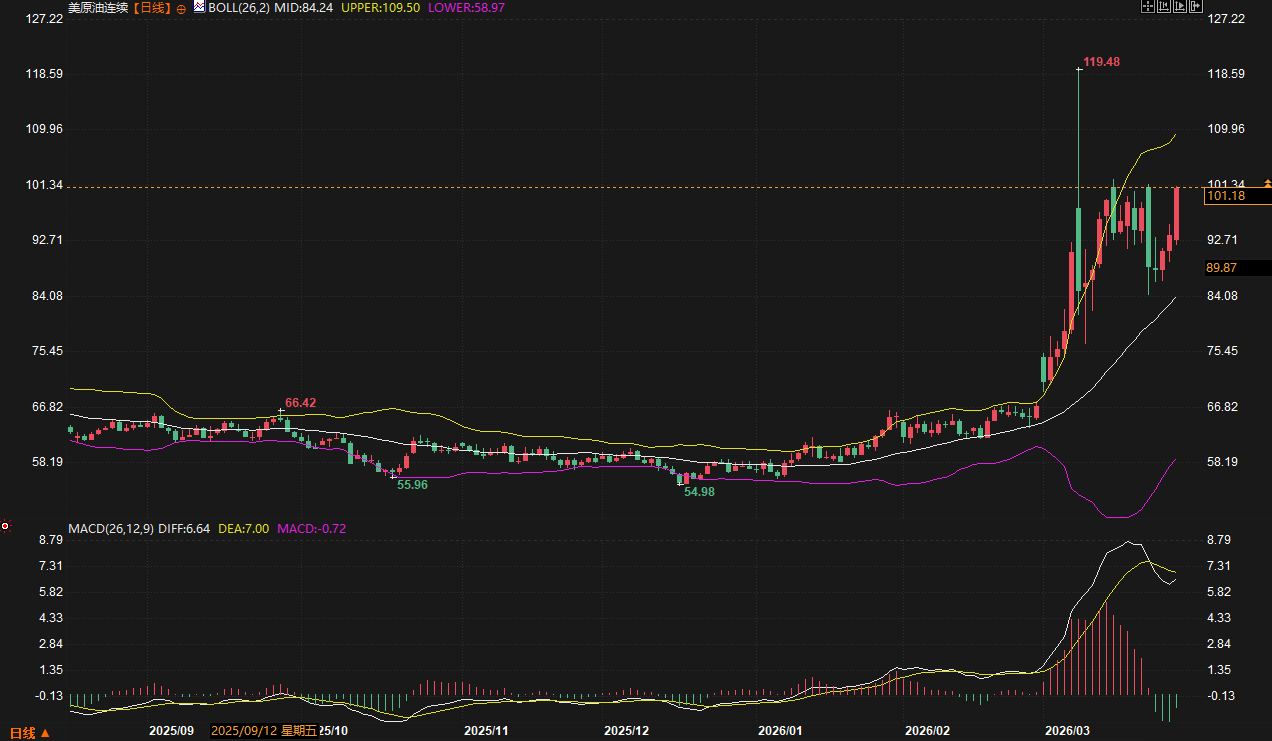
The crude oil market experienced wide fluctuations at high levels this week. By Friday's close, Brent crude futures rose $4.56, or 4.2%, to settle at $112.57 per barrel; U.S. crude futures rebounded strongly by $5.16, or 5.5%, to settle at $99.64 per barrel. Looking at a longer timeframe, since late February, before the escalation of tensions, Brent crude benchmark prices have surged by 53%, while U.S. crude has risen by a staggering 45% over the same period. Although there was a brief pullback this week due to tariff comments and rumors of diplomatic contacts, Brent and U.S. crude still recorded weekly gains of over 0.3% and 1%, respectively. The price center of gravity has slowly shifted upwards amidst fluctuations, reflecting the extreme vulnerability of short sellers in the face of a significant supply gap.
II. Summary of Economic Data and Geopolitical Events
This week's market was entirely driven by geopolitical tensions. First, while the deadline for Iran to reopen the Strait of Hormuz was extended to some extent, this was countered by an escalation of military deployments. Leading foreign media reports indicated that relevant countries are weighing whether to use ground forces to seize the strategically important oil hub of Hargh Island, a move that directly negates the conciliatory signals released on the diplomatic front. Second, Iran has characterized the current negotiating proposals as "unacceptable," deeming them unilateral and unfair. Furthermore, energy security in Eastern Europe is also precarious, with major oil producers warning buyers that supplies to key Baltic ports may face force majeure due to infrastructure attacks. These events collectively create a highly uncertain supply environment, placing the global energy supply chain under extreme strain.
III. Summary of viewpoints from mainstream overseas institutions
In response to the current turmoil, assessments from major overseas institutions show significant caution and divergence. A prominent foreign media outlet, citing StoneX analysts, stated that investors' focus has shifted from rapidly changing headlines to the "protracted nature" of the war. As long as the Strait of Hormuz remains under prolonged blockade or infrastructure damage is possible, the risk premium in prices cannot be removed. Macquarie analysts offered a more extreme scenario: if the current conflict continues until the end of June, oil prices are highly likely to break the $200 mark; conversely, if the war quickly subsides, prices will fall, but are unlikely to return to pre-conflict levels. Meanwhile, Ritterbusch & Associates, in a report to clients, bluntly pointed out that the oil market is becoming immune to conciliatory rhetoric, especially considering the significant discrepancy between military reinforcements and peace talks. The International Energy Agency (IEA) has even characterized this crisis as the most severe supply disruption in history.
In summary, international oil prices are currently transitioning from a "panic-driven" to a "logic reshaping" phase. Technically, Brent crude closed above $106.70 per barrel, having reached a weekly high of $119.45. Although it retreated slightly at the close, the extremely wide Bollinger Bands indicate that volatility will remain high. While the MACD indicator shows a contraction in the red bars, indicating a slowdown in short-term upward momentum, this is largely a technical correction based on the previous overbought condition. Next week, the market's attention will be focused on the psychological and technical level of $100. If US oil can effectively hold above three digits, it will mean that the market has fully priced in the possibility of diplomatic easing and is now pricing in long-term energy scarcity. Faced with the ironclad rule of a global daily supply reduction of 11 million barrels, any rhetoric lacking substantial ceasefire action will appear weak and ineffective.
1. Why did the market react mutedly to Trump's "conciliatory remarks," or even see a reverse upward movement?
A: The core reason for the lukewarm market reaction lies in the discrepancy between words and actions. While verbally signaling an extension of the deadline and a push for negotiations, the government has actually been deploying thousands of troops to the Middle East, even involving ground operations to seize Hargh Island. This strategic pressure has made traders realize that the so-called negotiations are more of a means of exerting maximum pressure than a genuine opportunity for peace. Major mainstream institutions generally believe that until the risk of infrastructure damage is substantially eliminated, the market is more inclined to believe the long-term signal conveyed by the military deployments than diplomatic rhetoric.
2. Does Macquarie's prediction of a "$200 oil price" have any basis in reality?
A: This prediction is not alarmist; its core logic is based on a "supply vacuum." The current supply gap of 11 million barrels per day caused by the Iranian crisis has already brought global inventories to extremely low levels. If the conflict continues until the end of June, it means the Northern Hemisphere's summer travel peak will face the most severe fuel shortage in history. Coupled with the force majeure events at Baltic ports in Eastern Europe due to the Russia-Ukraine conflict, global crude oil flows will experience systemic disruption. When the gap cannot be filled by OPEC+ spare capacity, prices must rise to a level sufficient to suppress consumption; $200 is the endpoint of this premium under such extreme supply-demand mismatch.
3. What chain reactions have occurred in the global oil refining industry due to the current blockade of the Strait of Hormuz?
A: The blockade is not just a problem of crude oil prices, but a disaster for logistics costs and the continuity of feedstock for refineries. As the strait is the world's most important energy chokepoint, any expectation of a "long-term blockade" will lead to a surge in freight and insurance costs. Currently, many buyers have begun to seek alternative sources in Africa or the Americas, but this has not only driven up landed prices but also left refineries facing reduced production efficiency due to mismatched crude oil quality. Major overseas institutions have observed that this anxiety has spread from crude oil futures to the refined oil market, further intensifying inflationary pressures.
4. How has the intertwining of the Russia-Ukraine situation and the Middle East crisis altered the global energy landscape?
A: These two factors are creating a "dual-core" supply crisis. This week, Russian oil producers warned of force majeure, signaling a new substantial disruption to Eastern European energy exports. With European and Asian buyers simultaneously facing supply disruptions from the Middle East and attacks on Eastern European exports, the global oil market has lost all flexibility. The consequence of this situation is that inventories, originally intended to balance the market, are being rapidly depleted, forcing the market into a "de-globalized" energy trading model, with countries increasingly favoring strategic reserves rather than open market transactions.
5. What key technical and fundamental indicators should investors focus on monitoring in the coming week?
A: In terms of technical indicators, close attention should be paid to the struggle around the $100 mark for WTI crude oil, and the support level of the Bollinger Band's middle line for Brent crude oil. If the price breaks below the middle line, it may indicate a temporary decline in the risk premium; if the price remains above the middle line and the MACD DIFF line flattens out again, it suggests a new round of upward movement. Fundamentally, in addition to monitoring the further developments in the "tariff rhetoric," military developments on Harge Island will be decisive. Any substantial actions involving ground troops will instantly trigger extreme market fears of a complete supply disruption.
Detailed review by variety
I. Review of International Crude Oil Trends
The crude oil market experienced wide fluctuations at high levels this week. By Friday's close, Brent crude futures rose $4.56, or 4.2%, to settle at $112.57 per barrel; U.S. crude futures rebounded strongly by $5.16, or 5.5%, to settle at $99.64 per barrel. Looking at a longer timeframe, since late February, before the escalation of tensions, Brent crude benchmark prices have surged by 53%, while U.S. crude has risen by a staggering 45% over the same period. Although there was a brief pullback this week due to tariff comments and rumors of diplomatic contacts, Brent and U.S. crude still recorded weekly gains of over 0.3% and 1%, respectively. The price center of gravity has slowly shifted upwards amidst fluctuations, reflecting the extreme vulnerability of short sellers in the face of a significant supply gap.
II. Summary of Economic Data and Geopolitical Events
This week's market was entirely driven by geopolitical tensions. First, while the deadline for Iran to reopen the Strait of Hormuz was extended to some extent, this was countered by an escalation of military deployments. Leading foreign media reports indicated that relevant countries are weighing whether to use ground forces to seize the strategically important oil hub of Hargh Island, a move that directly negates the conciliatory signals released on the diplomatic front. Second, Iran has characterized the current negotiating proposals as "unacceptable," deeming them unilateral and unfair. Furthermore, energy security in Eastern Europe is also precarious, with major oil producers warning buyers that supplies to key Baltic ports may face force majeure due to infrastructure attacks. These events collectively create a highly uncertain supply environment, placing the global energy supply chain under extreme strain.
III. Summary of viewpoints from mainstream overseas institutions
In response to the current turmoil, assessments from major overseas institutions show significant caution and divergence. A prominent foreign media outlet, citing StoneX analysts, stated that investors' focus has shifted from rapidly changing headlines to the "protracted nature" of the war. As long as the Strait of Hormuz remains under prolonged blockade or infrastructure damage is possible, the risk premium in prices cannot be removed. Macquarie analysts offered a more extreme scenario: if the current conflict continues until the end of June, oil prices are highly likely to break the $200 mark; conversely, if the war quickly subsides, prices will fall, but are unlikely to return to pre-conflict levels. Meanwhile, Ritterbusch & Associates, in a report to clients, bluntly pointed out that the oil market is becoming immune to conciliatory rhetoric, especially considering the significant discrepancy between military reinforcements and peace talks. The International Energy Agency (IEA) has even characterized this crisis as the most severe supply disruption in history.
In summary, international oil prices are currently transitioning from a "panic-driven" to a "logic reshaping" phase. Technically, Brent crude closed above $106.70 per barrel, having reached a weekly high of $119.45. Although it retreated slightly at the close, the extremely wide Bollinger Bands indicate that volatility will remain high. While the MACD indicator shows a contraction in the red bars, indicating a slowdown in short-term upward momentum, this is largely a technical correction based on the previous overbought condition. Next week, the market's attention will be focused on the psychological and technical level of $100. If US oil can effectively hold above three digits, it will mean that the market has fully priced in the possibility of diplomatic easing and is now pricing in long-term energy scarcity. Faced with the ironclad rule of a global daily supply reduction of 11 million barrels, any rhetoric lacking substantial ceasefire action will appear weak and ineffective.
QA module
1. Why did the market react mutedly to Trump's "conciliatory remarks," or even see a reverse upward movement?
A: The core reason for the lukewarm market reaction lies in the discrepancy between words and actions. While verbally signaling an extension of the deadline and a push for negotiations, the government has actually been deploying thousands of troops to the Middle East, even involving ground operations to seize Hargh Island. This strategic pressure has made traders realize that the so-called negotiations are more of a means of exerting maximum pressure than a genuine opportunity for peace. Major mainstream institutions generally believe that until the risk of infrastructure damage is substantially eliminated, the market is more inclined to believe the long-term signal conveyed by the military deployments than diplomatic rhetoric.
2. Does Macquarie's prediction of a "$200 oil price" have any basis in reality?
A: This prediction is not alarmist; its core logic is based on a "supply vacuum." The current supply gap of 11 million barrels per day caused by the Iranian crisis has already brought global inventories to extremely low levels. If the conflict continues until the end of June, it means the Northern Hemisphere's summer travel peak will face the most severe fuel shortage in history. Coupled with the force majeure events at Baltic ports in Eastern Europe due to the Russia-Ukraine conflict, global crude oil flows will experience systemic disruption. When the gap cannot be filled by OPEC+ spare capacity, prices must rise to a level sufficient to suppress consumption; $200 is the endpoint of this premium under such extreme supply-demand mismatch.
3. What chain reactions have occurred in the global oil refining industry due to the current blockade of the Strait of Hormuz?
A: The blockade is not just a problem of crude oil prices, but a disaster for logistics costs and the continuity of feedstock for refineries. As the strait is the world's most important energy chokepoint, any expectation of a "long-term blockade" will lead to a surge in freight and insurance costs. Currently, many buyers have begun to seek alternative sources in Africa or the Americas, but this has not only driven up landed prices but also left refineries facing reduced production efficiency due to mismatched crude oil quality. Major overseas institutions have observed that this anxiety has spread from crude oil futures to the refined oil market, further intensifying inflationary pressures.
4. How has the intertwining of the Russia-Ukraine situation and the Middle East crisis altered the global energy landscape?
A: These two factors are creating a "dual-core" supply crisis. This week, Russian oil producers warned of force majeure, signaling a new substantial disruption to Eastern European energy exports. With European and Asian buyers simultaneously facing supply disruptions from the Middle East and attacks on Eastern European exports, the global oil market has lost all flexibility. The consequence of this situation is that inventories, originally intended to balance the market, are being rapidly depleted, forcing the market into a "de-globalized" energy trading model, with countries increasingly favoring strategic reserves rather than open market transactions.
5. What key technical and fundamental indicators should investors focus on monitoring in the coming week?
A: In terms of technical indicators, close attention should be paid to the struggle around the $100 mark for WTI crude oil, and the support level of the Bollinger Band's middle line for Brent crude oil. If the price breaks below the middle line, it may indicate a temporary decline in the risk premium; if the price remains above the middle line and the MACD DIFF line flattens out again, it suggests a new round of upward movement. Fundamentally, in addition to monitoring the further developments in the "tariff rhetoric," military developments on Harge Island will be decisive. Any substantial actions involving ground troops will instantly trigger extreme market fears of a complete supply disruption.
- Risk Warning and Disclaimer
- The market involves risk, and trading may not be suitable for all investors. This article is for reference only and does not constitute personal investment advice, nor does it take into account certain users’ specific investment objectives, financial situation, or other needs. Any investment decisions made based on this information are at your own risk.