The US Secretary of State claims that military operations will be completed in a few weeks, and the war with Iran will end in a flash.
2026-03-30 10:12:00
The US military action against Iran is entering a critical phase, with senior US officials sending clear signals that the conflict is likely to end in the near future, while global energy markets are experiencing sharp fluctuations due to the ongoing tensions.
Washington emphasizes that the operation is progressing faster than expected, but with successive attacks on Iranian nuclear facilities and industrial targets, Tehran's response remains unclear. These latest developments not only test regional stability but also directly push up international oil prices, triggering global economic concerns.
U.S. Secretary of State Marco Rubio told reporters after attending the G7 foreign ministers' meeting in France that the U.S. expects its action against Iran to conclude within weeks, not months, and that Washington can achieve all its objectives without deploying ground troops. Rubio added that Washington is proceeding on schedule, even ahead of time, in this operation and expects it to conclude in due course.
He also acknowledged that the United States is deploying some ground troops to the region in order to give the president maximum options and flexibility in responding to various contingencies.
Currently, the United States has deployed two detachments of several thousand Marines to the region. The first detachment is expected to arrive by the end of March aboard a large amphibious assault ship, and the Pentagon also plans to deploy several thousand elite paratroopers. These deployments are primarily for maintaining flexibility rather than for direct ground combat.
The conflict began on February 28 with a joint U.S.-Israeli airstrike that killed Iran's Supreme Leader and other senior officials. In response, Iran launched numerous attacks on U.S. and Israeli targets in the region, as well as civilian targets and shipping routes in the Gulf Arab states, severely disrupting global trade in energy and other commodities and exacerbating concerns about rising prices and an economic recession.
US President Trump appears eager to end the unpopular war. Last week, he emphasized productive talks aimed at resolving the war through diplomatic means, but Tehran has repeatedly claimed that no such dialogue has been initiated. Last Thursday (March 26), Trump extended the deadline for Iran to reopen the blocked Strait of Hormuz, or face damage to its civilian power grid, by another 10 days.
Iranian media reported Friday evening that a decommissioned heavy water nuclear research reactor and a yellowcake uranium production facility in Iran had been attacked, but neither attack caused any radiation leaks or danger. The International Atomic Energy Agency (IAEA) stated on the social media platform X that Iran had reported no increase in off-site radiation levels at the yellowcake facility, and the agency would conduct an investigation.
Iranian Foreign Minister Alagzi stated on the X platform that Israel, in coordination with the United States, also attacked two steel mills and a power plant. He said the attacks contradicted the US president's decision to extend deadlines for diplomatic efforts, and that Iran would make Israel pay a heavy price for its crimes.
A senior Iranian official revealed that Tehran has not yet decided whether to respond to the 15-point proposal issued by the United States last week, following the attacks on industrial and nuclear infrastructure last Friday.
The official stated that Iran had originally expected to submit a response last Friday or Saturday, but the US continuing its attacks while seeking dialogue was intolerable. The US proposal, reportedly delivered two days prior via Pakistan, reportedly demands the dismantling of Iran's nuclear and missile programs, as well as relinquishing control of this crucial global energy trade route.
According to five people familiar with U.S. intelligence, while the U.S. is committed to weakening Iran's long-range strike capabilities, it has only confirmed that about one-third of the country's missile arsenal has been destroyed. Another third is likely damaged or buried in underground tunnels, some of which may be recoverable after the fighting ceases. A similar assessment of Iran's drone capabilities suggests that about one-third has been destroyed.
Four Gulf sources said that as the devastation continues and the conflict shows no end in sight, Gulf Arab states are telling the United States that any agreement must not only end the war but also permanently limit Iran’s missile and drone capabilities and ensure that global energy supplies are no longer weaponized.
Rubio discussed with the G7 foreign ministers the possibility that Iran might still attempt to impose tolls on shipping through the Strait of Hormuz, even after the conflict ends. He stated that European and Asian countries that benefit from trade along this waterway should contribute to ensuring free passage through the strait, while downplaying the United States' dependence on related trade.
Overall, senior U.S. officials are optimistic about the progress of the Iranian operation, emphasizing that the objectives can be achieved without large-scale ground intervention, while extending the deadline through diplomatic channels to gain more room for negotiation.
However, the repeated attacks on Iranian nuclear facilities and industrial targets, coupled with the continued threat posed by its remaining missile and drone capabilities, and the unclear stance of Tehran's response, have collectively contributed to the ongoing regional tensions and severely tested the global energy supply chain.
The conflict with Iran has directly impacted the security of the Strait of Hormuz, a key global energy trade route. Iran's retaliatory attacks on shipping and Gulf targets have further amplified the risk of supply disruptions, causing Brent crude oil prices to rise by more than 50% since the outbreak of the war, currently surpassing the $100 mark.
In the short term, if the US concludes its major actions within weeks as Rubio suggested, oil prices may see a certain correction, and market expectations for a swift diplomatic solution could alleviate some of the panic.
However, in the medium to long term, approximately two-thirds of Iran's missile capabilities may remain intact or recoverable, and the calls from Gulf Arab states for permanent limitations on its military power indicate that concerns about future stability have not yet been eliminated. If Iran continues its asymmetric retaliation or blocks the Strait of Hormuz, Brent crude oil prices are susceptible to continued upward volatility driven by unforeseen events. Rising global energy prices will also transmit to inflationary pressures, particularly impacting import-dependent economies in Asia and Europe, potentially exacerbating the risk of economic recession.
Although the United States is downplaying its dependence on oil, the international oil market is highly interconnected. Investors need to pay close attention to the progress of subsequent diplomatic negotiations, Iran's actual response, and the passage status of the Strait of Hormuz. The probability of increased short-term volatility in oil prices is relatively high, but the medium-term trend remains strong.
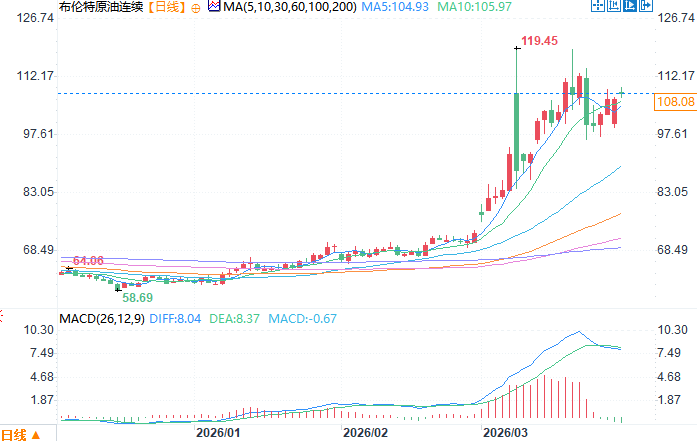
Brent crude oil daily chart source: EasyForex
At 10:11 AM Beijing time on March 30, Brent crude oil futures for June delivery were trading at $108.51 per barrel.
Washington emphasizes that the operation is progressing faster than expected, but with successive attacks on Iranian nuclear facilities and industrial targets, Tehran's response remains unclear. These latest developments not only test regional stability but also directly push up international oil prices, triggering global economic concerns.
US high-level optimistic assessment: The war is progressing far beyond plan.
U.S. Secretary of State Marco Rubio told reporters after attending the G7 foreign ministers' meeting in France that the U.S. expects its action against Iran to conclude within weeks, not months, and that Washington can achieve all its objectives without deploying ground troops. Rubio added that Washington is proceeding on schedule, even ahead of time, in this operation and expects it to conclude in due course.
He also acknowledged that the United States is deploying some ground troops to the region in order to give the president maximum options and flexibility in responding to various contingencies.
Currently, the United States has deployed two detachments of several thousand Marines to the region. The first detachment is expected to arrive by the end of March aboard a large amphibious assault ship, and the Pentagon also plans to deploy several thousand elite paratroopers. These deployments are primarily for maintaining flexibility rather than for direct ground combat.
Origins of the conflict and Iran's latest counterattack
The conflict began on February 28 with a joint U.S.-Israeli airstrike that killed Iran's Supreme Leader and other senior officials. In response, Iran launched numerous attacks on U.S. and Israeli targets in the region, as well as civilian targets and shipping routes in the Gulf Arab states, severely disrupting global trade in energy and other commodities and exacerbating concerns about rising prices and an economic recession.
US President Trump appears eager to end the unpopular war. Last week, he emphasized productive talks aimed at resolving the war through diplomatic means, but Tehran has repeatedly claimed that no such dialogue has been initiated. Last Thursday (March 26), Trump extended the deadline for Iran to reopen the blocked Strait of Hormuz, or face damage to its civilian power grid, by another 10 days.
Iran's nuclear facilities and industrial targets have suffered another major blow.
Iranian media reported Friday evening that a decommissioned heavy water nuclear research reactor and a yellowcake uranium production facility in Iran had been attacked, but neither attack caused any radiation leaks or danger. The International Atomic Energy Agency (IAEA) stated on the social media platform X that Iran had reported no increase in off-site radiation levels at the yellowcake facility, and the agency would conduct an investigation.
Iranian Foreign Minister Alagzi stated on the X platform that Israel, in coordination with the United States, also attacked two steel mills and a power plant. He said the attacks contradicted the US president's decision to extend deadlines for diplomatic efforts, and that Iran would make Israel pay a heavy price for its crimes.
Iran adopts a cautious approach to the US's 15-point proposal; its missile capabilities have not been completely destroyed.
A senior Iranian official revealed that Tehran has not yet decided whether to respond to the 15-point proposal issued by the United States last week, following the attacks on industrial and nuclear infrastructure last Friday.
The official stated that Iran had originally expected to submit a response last Friday or Saturday, but the US continuing its attacks while seeking dialogue was intolerable. The US proposal, reportedly delivered two days prior via Pakistan, reportedly demands the dismantling of Iran's nuclear and missile programs, as well as relinquishing control of this crucial global energy trade route.
According to five people familiar with U.S. intelligence, while the U.S. is committed to weakening Iran's long-range strike capabilities, it has only confirmed that about one-third of the country's missile arsenal has been destroyed. Another third is likely damaged or buried in underground tunnels, some of which may be recoverable after the fighting ceases. A similar assessment of Iran's drone capabilities suggests that about one-third has been destroyed.
Four Gulf sources said that as the devastation continues and the conflict shows no end in sight, Gulf Arab states are telling the United States that any agreement must not only end the war but also permanently limit Iran’s missile and drone capabilities and ensure that global energy supplies are no longer weaponized.
Global trade concerns are intensifying, and Gulf states are calling for joint efforts to safeguard the security of the Taiwan Strait.
Rubio discussed with the G7 foreign ministers the possibility that Iran might still attempt to impose tolls on shipping through the Strait of Hormuz, even after the conflict ends. He stated that European and Asian countries that benefit from trade along this waterway should contribute to ensuring free passage through the strait, while downplaying the United States' dependence on related trade.
In summary, the current situation suggests a possible short-term end, but uncertainties remain.
Overall, senior U.S. officials are optimistic about the progress of the Iranian operation, emphasizing that the objectives can be achieved without large-scale ground intervention, while extending the deadline through diplomatic channels to gain more room for negotiation.
However, the repeated attacks on Iranian nuclear facilities and industrial targets, coupled with the continued threat posed by its remaining missile and drone capabilities, and the unclear stance of Tehran's response, have collectively contributed to the ongoing regional tensions and severely tested the global energy supply chain.
Analysis of the impact on oil price trends
The conflict with Iran has directly impacted the security of the Strait of Hormuz, a key global energy trade route. Iran's retaliatory attacks on shipping and Gulf targets have further amplified the risk of supply disruptions, causing Brent crude oil prices to rise by more than 50% since the outbreak of the war, currently surpassing the $100 mark.
In the short term, if the US concludes its major actions within weeks as Rubio suggested, oil prices may see a certain correction, and market expectations for a swift diplomatic solution could alleviate some of the panic.
However, in the medium to long term, approximately two-thirds of Iran's missile capabilities may remain intact or recoverable, and the calls from Gulf Arab states for permanent limitations on its military power indicate that concerns about future stability have not yet been eliminated. If Iran continues its asymmetric retaliation or blocks the Strait of Hormuz, Brent crude oil prices are susceptible to continued upward volatility driven by unforeseen events. Rising global energy prices will also transmit to inflationary pressures, particularly impacting import-dependent economies in Asia and Europe, potentially exacerbating the risk of economic recession.
Although the United States is downplaying its dependence on oil, the international oil market is highly interconnected. Investors need to pay close attention to the progress of subsequent diplomatic negotiations, Iran's actual response, and the passage status of the Strait of Hormuz. The probability of increased short-term volatility in oil prices is relatively high, but the medium-term trend remains strong.
Brent crude oil daily chart source: EasyForex
At 10:11 AM Beijing time on March 30, Brent crude oil futures for June delivery were trading at $108.51 per barrel.
- Risk Warning and Disclaimer
- The market involves risk, and trading may not be suitable for all investors. This article is for reference only and does not constitute personal investment advice, nor does it take into account certain users’ specific investment objectives, financial situation, or other needs. Any investment decisions made based on this information are at your own risk.