"Weeks, not months"? Rubio claims to be ahead of schedule, but attacks continue and the Strait remains blocked.
2026-03-30 10:29:49
U.S. Secretary of State Marco Rubio said last Friday (March 27) after meeting with G7 foreign ministers in France that the U.S. military action against Iran is proceeding as planned, even ahead of schedule, and is expected to end within weeks rather than months.
Rubio emphasized that Washington can achieve all its objectives without deploying ground troops, but acknowledged that it is deploying some ground troops to the Middle East to provide the president with maximum options and flexibility in responding to various contingencies. He also mentioned that even after the conflict ends, Iran may still attempt to impose tolls on shipping through the Strait of Hormuz, and called on European and Asian countries to contribute to ensuring freedom of passage through the strait.
On Monday (March 30) during the Asian session, US crude oil prices fluctuated upwards and are currently trading around $102.90 per barrel, up about 3.2% from the previous trading day's settlement price.
Washington has deployed two detachments of several thousand Marines to the Middle East, with the first detachment expected to arrive by the end of March aboard a large amphibious assault ship. The Pentagon also plans to deploy several thousand elite paratroopers from the Army's 82nd Airborne Division.
These deployments have raised concerns that the conflict, which began on February 28 with airstrikes launched by the United States and Israel that killed Iran’s Supreme Leader and other senior officials, could escalate into a protracted ground war.
Iranian media reported Friday evening that a decommissioned heavy water nuclear research reactor and a yellowcake uranium production facility in Iran had been attacked, but neither attack caused any radiation leaks or danger. The International Atomic Energy Agency (IAEA) stated that it had received reports from Iran that off-site radiation levels had not increased and would conduct inspections.
Iranian Foreign Minister Araqchi stated on the X platform that Israel, in coordination with the United States, also attacked two steel mills and a power plant. He criticized the attacks as contradicting the US president's decision to extend deadlines for diplomatic efforts, and said that Iran would make Israel pay a heavy price for its crimes.
According to five people familiar with U.S. intelligence, despite U.S. efforts to weaken Iran's long-range strike capabilities, only about one-third of Iran's missile stockpile has been confirmed destroyed so far. Another third of the missiles may have been damaged or buried in underground tunnels, some of which may be recoverable after the fighting ends.
Four people familiar with U.S. intelligence said the assessment of Iran's drone capabilities was similar, with about one-third already destroyed. Gulf Arab states, however, demanded that any agreement not only end the war but also permanently limit Iran's missile and drone capabilities and ensure that global energy supplies are no longer weaponized.
The United States this week delivered a 15-point proposal to Iran through Pakistan, demanding measures including the dismantling of Iran's nuclear and missile programs and the relinquishment of control over the Strait of Hormuz, one of the world's most important energy trade routes.
A senior Iranian official said that Tehran has not yet decided whether to respond following the attacks on industrial and nuclear infrastructure last Friday.
International oil prices are fluctuating at high levels, and the conflict has severely disrupted global trade in energy and other commodities, exacerbating concerns about rising prices and economic recession.
Trump appears eager to end the unpopular war, repeatedly emphasizing this week that “productive” diplomatic talks are underway, but Iran has repeatedly denied initiating any such dialogue.
US Secretary of State Marco Rubio has made it clear that the war with Iran will end within weeks and that the objectives can be achieved without ground troops, but the actual deployment of thousands of Marines and paratroopers shows that the US still retains room for maneuver.
Iran's nuclear facilities and industrial targets continue to suffer attacks, and it retains approximately two-thirds of its remaining missile capability. The blockade of the Strait of Hormuz has caused a sharp rise in oil prices. The future situation depends on Iran's response to the 15-point proposal and the actual progress of diplomatic negotiations. Global energy markets and economic stability still face significant uncertainty.
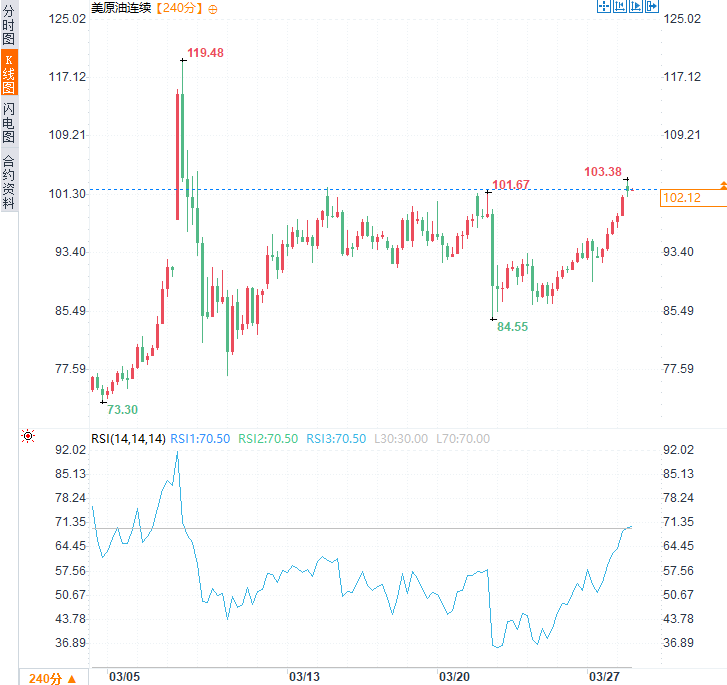
(US crude oil 4-hour chart, source: FX678)
At 10:29 Beijing time, US crude oil futures were trading at $102.90 per barrel.
Rubio emphasized that Washington can achieve all its objectives without deploying ground troops, but acknowledged that it is deploying some ground troops to the Middle East to provide the president with maximum options and flexibility in responding to various contingencies. He also mentioned that even after the conflict ends, Iran may still attempt to impose tolls on shipping through the Strait of Hormuz, and called on European and Asian countries to contribute to ensuring freedom of passage through the strait.
On Monday (March 30) during the Asian session, US crude oil prices fluctuated upwards and are currently trading around $102.90 per barrel, up about 3.2% from the previous trading day's settlement price.
U.S. ground troop deployment
Washington has deployed two detachments of several thousand Marines to the Middle East, with the first detachment expected to arrive by the end of March aboard a large amphibious assault ship. The Pentagon also plans to deploy several thousand elite paratroopers from the Army's 82nd Airborne Division.
These deployments have raised concerns that the conflict, which began on February 28 with airstrikes launched by the United States and Israel that killed Iran’s Supreme Leader and other senior officials, could escalate into a protracted ground war.
Iran's nuclear facilities and industrial targets suffer another attack
Iranian media reported Friday evening that a decommissioned heavy water nuclear research reactor and a yellowcake uranium production facility in Iran had been attacked, but neither attack caused any radiation leaks or danger. The International Atomic Energy Agency (IAEA) stated that it had received reports from Iran that off-site radiation levels had not increased and would conduct inspections.
Iranian Foreign Minister Araqchi stated on the X platform that Israel, in coordination with the United States, also attacked two steel mills and a power plant. He criticized the attacks as contradicting the US president's decision to extend deadlines for diplomatic efforts, and said that Iran would make Israel pay a heavy price for its crimes.
Assessment of Iran's Remaining Missile and Drone Capabilities
According to five people familiar with U.S. intelligence, despite U.S. efforts to weaken Iran's long-range strike capabilities, only about one-third of Iran's missile stockpile has been confirmed destroyed so far. Another third of the missiles may have been damaged or buried in underground tunnels, some of which may be recoverable after the fighting ends.
Four people familiar with U.S. intelligence said the assessment of Iran's drone capabilities was similar, with about one-third already destroyed. Gulf Arab states, however, demanded that any agreement not only end the war but also permanently limit Iran's missile and drone capabilities and ensure that global energy supplies are no longer weaponized.
The US's 15-point proposal and Iran's response
The United States this week delivered a 15-point proposal to Iran through Pakistan, demanding measures including the dismantling of Iran's nuclear and missile programs and the relinquishment of control over the Strait of Hormuz, one of the world's most important energy trade routes.
A senior Iranian official said that Tehran has not yet decided whether to respond following the attacks on industrial and nuclear infrastructure last Friday.
High oil prices and their impact on the global market
International oil prices are fluctuating at high levels, and the conflict has severely disrupted global trade in energy and other commodities, exacerbating concerns about rising prices and economic recession.
Trump appears eager to end the unpopular war, repeatedly emphasizing this week that “productive” diplomatic talks are underway, but Iran has repeatedly denied initiating any such dialogue.
Editor's Summary
US Secretary of State Marco Rubio has made it clear that the war with Iran will end within weeks and that the objectives can be achieved without ground troops, but the actual deployment of thousands of Marines and paratroopers shows that the US still retains room for maneuver.
Iran's nuclear facilities and industrial targets continue to suffer attacks, and it retains approximately two-thirds of its remaining missile capability. The blockade of the Strait of Hormuz has caused a sharp rise in oil prices. The future situation depends on Iran's response to the 15-point proposal and the actual progress of diplomatic negotiations. Global energy markets and economic stability still face significant uncertainty.
(US crude oil 4-hour chart, source: FX678)
At 10:29 Beijing time, US crude oil futures were trading at $102.90 per barrel.
- Risk Warning and Disclaimer
- The market involves risk, and trading may not be suitable for all investors. This article is for reference only and does not constitute personal investment advice, nor does it take into account certain users’ specific investment objectives, financial situation, or other needs. Any investment decisions made based on this information are at your own risk.