













Crude oil experienced significant overnight volatility: was it profit-taking or an adjustment in expectations?
2026-04-01 02:36:40
On Wednesday (March 31), during the US trading session, which was early morning on April 1 Beijing time, the crude oil market suddenly reversed course after reaching a temporary high. The bullish camp, which had initially attempted to maintain its strength, encountered concentrated selling pressure in a very short period, with both WTI and Brent crude oil prices turning from gains to losses, and intraday volatility significantly amplified. This "high-level plunge" is not a typical trend reversal signal, but rather more like a natural adjustment driven by profit-taking and fear of high prices – near key psychological price levels, any slight movement is easily amplified and interpreted by the market, triggering a chain reaction.
Trigger: How do true and false news affect prices?
The immediate trigger for this round of adjustments came from a news flash. Market rumors suggested that Iran had signaled its willingness to end the war. Although this was conditional and had not yet been officially confirmed, in the current highly tense geopolitical environment, such mixed information, both true and false, was enough to quickly alter short-term market expectations.
The key is that the veracity of such news is difficult to ascertain, and it doesn't need to ultimately materialize; it only needs to briefly disrupt marginal expectations. When the market has already heavily priced in the logic of "escalating conflict + tightening supply," any sign of easing could trigger a conditioned reflex of long positions liquidation, resulting in a sudden downward pressure on prices. This is not essentially a reversal of fundamentals, but rather a momentary rearrangement of expectations and a release of liquidity.
Key Structure: Game Theory Attributes of High-Integer Price Levels
The reason for this dramatic fluctuation lies in the fact that the current cyclical high point itself possesses significant structural importance. It is not only a crucial psychological level but also a watershed moment for capital flows.
On the one hand, the continuous rise in the previous period has accumulated a large amount of floating profits, and the bulls naturally have the urge to take profits at high levels; on the other hand, a large number of algorithmic trading, stop-loss and take-profit orders and option structures often gather near round number price levels, and once the relevant thresholds are triggered, the volatility will be significantly amplified.
More importantly, this decline exhibits typical characteristics of a "technical deep squat": a rapid sell-off clears out some highly leveraged long positions while simultaneously testing the strength of genuine buying support below. This type of movement completes the redistribution of shares and natural market turnover through profit-taking at high levels and the release of pent-up emotions.
The veracity of the news and market reaction
Currently, this news remains in the "unconfirmed" stage, with its veracity and authenticity difficult to discern, making it a typical example of noise. In a market with information asymmetry and heightened emotional sensitivity, such mixed news can easily amplify short-term sentiment—bulls may choose to take profits due to concerns about changing expectations, while bears may take advantage of the situation to exert downward pressure, creating temporary selling pressure.
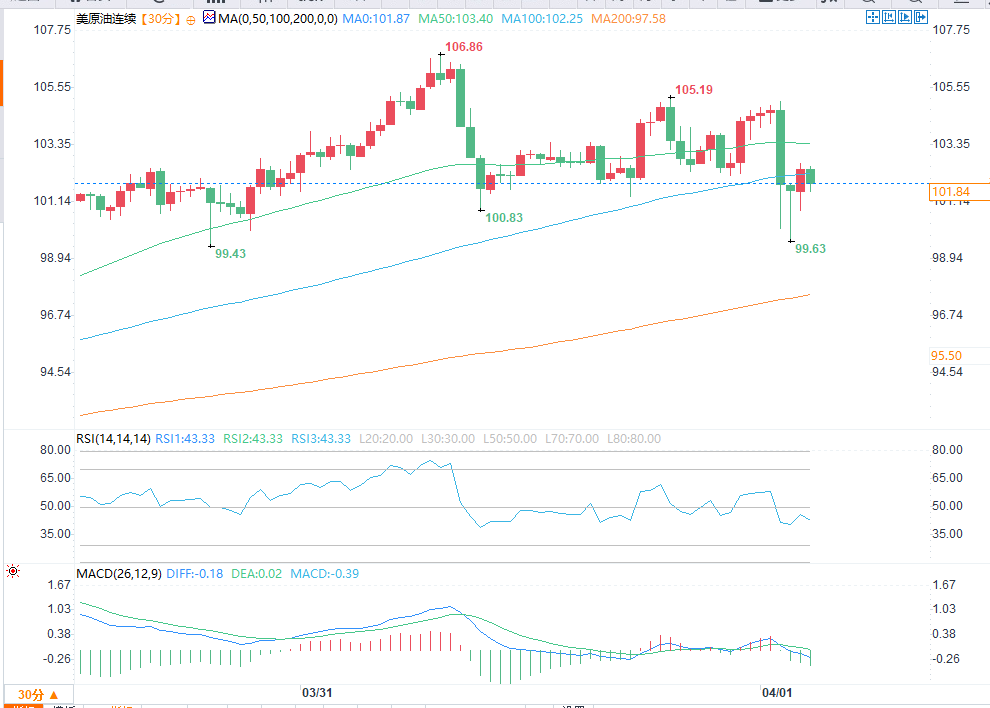
(WTI crude oil 30-minute chart source: EasyForex)
If subsequent news is proven false, downplayed, or overshadowed by stronger statements, then this round of adjustment is likely just a normal profit-taking and natural pullback driven by fear at high levels during the upward trend, rather than a trend reversal.
The core contradiction has not fundamentally changed.
From a broader perspective, the core contradictions in the current crude oil market have not fundamentally changed. Global crude oil inventories remain tight, OPEC+ supply elasticity is limited, and a genuine easing of geopolitical conflicts typically requires substantial agreements, time to verify, and compromises from multiple parties, rather than a single statement to reverse the situation. Therefore, short-term price fluctuations are more about trading behavior based on expectations of true and false news, rather than a restructuring of fundamentals.
Furthermore, it is worth noting that the continued tension surrounding the Strait of Hormuz, a crucial global energy transport chokepoint, has further reinforced expectations of tightening supply, providing a solid floor for oil prices. As of March 31, the Iranian parliament had formally passed a bill to charge passage through the Strait of Hormuz, prohibiting ships from the US and countries involved in sanctions against Iran from passing through. This marks the beginning of the legislative process for the institutional shift of the strait from an international waterway to one controlled by Iran. Morgan Stanley's tracking data shows that on March 29 (Sunday), there were zero ships passing through the strait, and only three ships passed through on Saturday, far below normal levels. Moreover, more than 50 container ships are already stranded, further exacerbating the supply disruptions. Simultaneously, the continued spillover of regional conflict and the Houthi military operations have increased risks in the Red Sea shipping lanes. The combined risks of these two major shipping chokepoints have further amplified the uncertainty of global crude oil supply, becoming a core fundamental factor supporting oil prices.
Conclusion: In a noise-driven phase, trends are unlikely to experience a "straight-line surge."
In the current environment of deliberately amplified and mixed information, the market is shifting from being "driven by a single narrative" to being "pulled by multiple expectations." True and false news, rapidly reversing public opinion signals, and speculative trading by funds are constantly disrupting the originally smooth upward trend.
This means that even if the medium- to long-term supply and demand dynamics continue to support oil prices, it is unlikely that we will see the kind of one-sided, smooth, and rapid surge seen in the past in the short term. Instead, we are more likely to see repeated testing and fluctuations at high levels – with upward movements requiring the digestion of uncertainty, and downward movements frequently encountering fundamental support.
In other words, the market has entered a phase where "rising prices are more difficult, volatility is greater, and the pace is more fragmented." Under this structure, genuine trading opportunities no longer stem solely from directional predictions, but rather from precise execution of timing, trading based on anticipated price discrepancies, and risk management. Investors need to remain cautious, wary of misleading or false information, and closely monitor subsequent official statements and fundamental data for verification.
Trigger: How do true and false news affect prices?
The immediate trigger for this round of adjustments came from a news flash. Market rumors suggested that Iran had signaled its willingness to end the war. Although this was conditional and had not yet been officially confirmed, in the current highly tense geopolitical environment, such mixed information, both true and false, was enough to quickly alter short-term market expectations.
The key is that the veracity of such news is difficult to ascertain, and it doesn't need to ultimately materialize; it only needs to briefly disrupt marginal expectations. When the market has already heavily priced in the logic of "escalating conflict + tightening supply," any sign of easing could trigger a conditioned reflex of long positions liquidation, resulting in a sudden downward pressure on prices. This is not essentially a reversal of fundamentals, but rather a momentary rearrangement of expectations and a release of liquidity.
Key Structure: Game Theory Attributes of High-Integer Price Levels
The reason for this dramatic fluctuation lies in the fact that the current cyclical high point itself possesses significant structural importance. It is not only a crucial psychological level but also a watershed moment for capital flows.
On the one hand, the continuous rise in the previous period has accumulated a large amount of floating profits, and the bulls naturally have the urge to take profits at high levels; on the other hand, a large number of algorithmic trading, stop-loss and take-profit orders and option structures often gather near round number price levels, and once the relevant thresholds are triggered, the volatility will be significantly amplified.
More importantly, this decline exhibits typical characteristics of a "technical deep squat": a rapid sell-off clears out some highly leveraged long positions while simultaneously testing the strength of genuine buying support below. This type of movement completes the redistribution of shares and natural market turnover through profit-taking at high levels and the release of pent-up emotions.
The veracity of the news and market reaction
Currently, this news remains in the "unconfirmed" stage, with its veracity and authenticity difficult to discern, making it a typical example of noise. In a market with information asymmetry and heightened emotional sensitivity, such mixed news can easily amplify short-term sentiment—bulls may choose to take profits due to concerns about changing expectations, while bears may take advantage of the situation to exert downward pressure, creating temporary selling pressure.
(WTI crude oil 30-minute chart source: EasyForex)
If subsequent news is proven false, downplayed, or overshadowed by stronger statements, then this round of adjustment is likely just a normal profit-taking and natural pullback driven by fear at high levels during the upward trend, rather than a trend reversal.
The core contradiction has not fundamentally changed.
From a broader perspective, the core contradictions in the current crude oil market have not fundamentally changed. Global crude oil inventories remain tight, OPEC+ supply elasticity is limited, and a genuine easing of geopolitical conflicts typically requires substantial agreements, time to verify, and compromises from multiple parties, rather than a single statement to reverse the situation. Therefore, short-term price fluctuations are more about trading behavior based on expectations of true and false news, rather than a restructuring of fundamentals.
Furthermore, it is worth noting that the continued tension surrounding the Strait of Hormuz, a crucial global energy transport chokepoint, has further reinforced expectations of tightening supply, providing a solid floor for oil prices. As of March 31, the Iranian parliament had formally passed a bill to charge passage through the Strait of Hormuz, prohibiting ships from the US and countries involved in sanctions against Iran from passing through. This marks the beginning of the legislative process for the institutional shift of the strait from an international waterway to one controlled by Iran. Morgan Stanley's tracking data shows that on March 29 (Sunday), there were zero ships passing through the strait, and only three ships passed through on Saturday, far below normal levels. Moreover, more than 50 container ships are already stranded, further exacerbating the supply disruptions. Simultaneously, the continued spillover of regional conflict and the Houthi military operations have increased risks in the Red Sea shipping lanes. The combined risks of these two major shipping chokepoints have further amplified the uncertainty of global crude oil supply, becoming a core fundamental factor supporting oil prices.
Conclusion: In a noise-driven phase, trends are unlikely to experience a "straight-line surge."
In the current environment of deliberately amplified and mixed information, the market is shifting from being "driven by a single narrative" to being "pulled by multiple expectations." True and false news, rapidly reversing public opinion signals, and speculative trading by funds are constantly disrupting the originally smooth upward trend.
This means that even if the medium- to long-term supply and demand dynamics continue to support oil prices, it is unlikely that we will see the kind of one-sided, smooth, and rapid surge seen in the past in the short term. Instead, we are more likely to see repeated testing and fluctuations at high levels – with upward movements requiring the digestion of uncertainty, and downward movements frequently encountering fundamental support.
In other words, the market has entered a phase where "rising prices are more difficult, volatility is greater, and the pace is more fragmented." Under this structure, genuine trading opportunities no longer stem solely from directional predictions, but rather from precise execution of timing, trading based on anticipated price discrepancies, and risk management. Investors need to remain cautious, wary of misleading or false information, and closely monitor subsequent official statements and fundamental data for verification.
- Risk Warning and Disclaimer
- The market involves risk, and trading may not be suitable for all investors. This article is for reference only and does not constitute personal investment advice, nor does it take into account certain users’ specific investment objectives, financial situation, or other needs. Any investment decisions made based on this information are at your own risk.

