Gold Trading Alert: Gold Prices Surge 3.5% Yet Mark the Worst Month in 16 Years! Will the Easing of Conflict in Iran or a Double Whammy of Inflation and Interest Rate Hikes Prove the Bulls Can Turn the Tide?
2026-04-01 07:44:00
On Tuesday (March 31), spot gold surged as much as 3.5%, reaching a high of $4,687 per ounce, before closing near $4,667. US gold futures also jumped 2.7% to $4,678.60. This strong single-day rebound, while seemingly encouraging, cannot mask a harsh reality: gold prices have plummeted 11.8% in March, poised to record their worst monthly performance since October 2008. In just one month, gold has gone from a safe-haven asset at the beginning of geopolitical conflicts to a victim of high interest rates and inflation expectations, while market sentiment is swinging wildly with the Trump administration's "de-escalation signals" regarding military action against Iran.
On Monday, The Wall Street Journal reported that President Trump was willing to end military action against Iran even though the Strait of Hormuz remained largely blocked, a piece of news that instantly ignited market optimism.
Although U.S. Defense Secretary Hergsays warned that "the next few days will be a decisive moment" and that the conflict would escalate if Iran did not compromise, investors are more willing to bet on "an imminent ceasefire."
The US dollar index fell 0.6% to 99.88 as a result, temporarily easing the cost pressure of holding gold as a non-interest-bearing asset. Coupled with a recovery in risk appetite, gold prices achieved a long-awaited single-day surge.
Peter Grant, senior precious metals strategist at Zaner Metals, stated, "Gold's current rally is encouraging, stemming from increased market optimism regarding easing tensions in the Middle East." However, he also cautioned that stronger upward momentum is needed for a sustained upward trend to materialize. Currently, this rebound appears more like a technical correction than a trend reversal.
Despite a single-day surge, gold still suffered a severe correction in March, primarily due to the cascading inflationary effects triggered by the Iranian conflict pushing up oil prices. Over the past month, global oil prices have soared by more than 50%, and US retail gasoline prices have broken through $4 per gallon for the first time in over three years. This has led to a sharp increase in business costs, and consumer inflation expectations jumped from a median of 4.5% to 5.2%, a new high since May 2025.
The high-interest-rate environment directly increases the opportunity cost of holding gold – the Federal Reserve had previously ruled out the possibility of a rate cut in 2026 due to war and inflation, and the market had even priced in a higher probability of a rate hike before the end of the year.
BNP Paribas analysts' assessment of silver also corroborates this logic: silver prices will fluctuate between $65 and $75 in 2026, and the physical market may shift to oversupply in 2027. Gold and silver are both precious metals, and silver's 20.4% monthly decline further highlights its vulnerability under the dual pressures of weak industrial demand and its financial attributes.
On the same day that gold prices rebounded, the U.S. Department of Labor's JOLTS report showed that job openings plummeted by 358,000 to 6.882 million in February, with hiring falling to 4.849 million, the lowest levels since the pandemic began and since August 2014. Small and medium-sized enterprises, as well as the accommodation and catering and manufacturing sectors, suffered the most severe job losses, with the job vacancy rate falling from 4.4% to 4.2%.
Although the consumer confidence index unexpectedly rose slightly to 91.8, households have become significantly more cautious about their future purchase plans for big-ticket items, and the proportion of people in the labor market who are "unable to find work" has risen to its highest level since February 2021.
Morgan Stanley chief economist Michael Gapen warned: "The 'four horsemen' of indicators—hiring, layoffs, job openings, and unemployment—suggest that the economic situation was already deteriorating even before the oil shock."
This series of weak data caused the interest rate futures market to quickly shift – Tuesday's forecast was for a rate cut of about 7 basis points in 2026, after pricing in a 10 basis point rate hike the previous day.
The two-year Treasury yield fell 3.3 basis points, and the 10-year yield fell 3.1 basis points, resulting in a steepening yield curve. The bond market has begun to digest the logic of "demand destruction caused by high oil prices." The "zero-job growth equilibrium" previously described by Federal Reserve Chairman Powell is facing real downside risks, which may become the most powerful reversal factor for gold bulls.
Short-term volatility is high, but the long-term narrative for gold remains intact. Goldman Sachs maintains its aggressive forecast of $5,500/oz for gold by the end of 2026, while BMI gives a conservative target of $4,600/oz for the average price throughout the year.
The wave of de-dollarization, continued gold purchases by global central banks, and geopolitical uncertainty continue to provide underlying support for gold.
Peter Grant emphasized: "In the long term, the underlying trend remains bullish, with key fundamental support such as de-dollarization and central bank buying still in place."
Even if the Trump administration tries to ease the conflict with Iran, it will still take time for the Strait of Hormuz to fully return to normal navigation, and the risks of high oil prices and recurring inflation will not disappear instantly.
Although the US dollar rose 2.3% in a month, the largest increase since July, its safe-haven attributes and advantages as an energy exporter are being repriced in by the uncertainty of "the conflict may become protracted".
Spot silver surged 7% to $75.67 on Tuesday, but this couldn't mask a dismal 20.4% monthly decline. BNP Paribas predicts silver prices will fluctuate between $65 and $75 in 2026, with oversupply pressures emerging in 2027. Silver possesses both monetary and industrial attributes; its rebound has been weaker than gold's amid slowing demand in sectors like semiconductors and photovoltaics, reflecting the current market divergence regarding a "soft landing" versus a "hard landing."
Overall, gold is currently caught in a tug-of-war between short-term sentiment-driven rebounds, medium-term inflationary pressures, and long-term bullish fundamentals. While the 11.8% monthly drop in March was a record, it also largely released valuation pressures. If substantial progress is made in US-Iran negotiations and the Strait of Hormuz reopens in the coming days, the decline in oil prices will quickly alleviate inflation expectations, and gold prices are expected to continue their rebound. Conversely, if the "conflict escalation" warned by Hergész materializes, safe-haven buying may engage in a more intense struggle with the high-interest-rate environment.
Regardless, the $4,600-$5,500 price range for 2026 has become the consensus floor for institutions, and the March non-farm payroll report to be released on Friday will be the most critical variable determining the short-term fate of gold. What investors need to focus on now is not a single-day 3.5% increase, but whether gold can truly upgrade from a "safe-haven asset" to a "trend-driven bullish asset" in this triple whammy of "war, inflation, and employment."
On Wednesday (April 1) in early Asian trading, spot gold fluctuated at high levels, once hitting a high of $4,696 per ounce, the highest level since March 20.
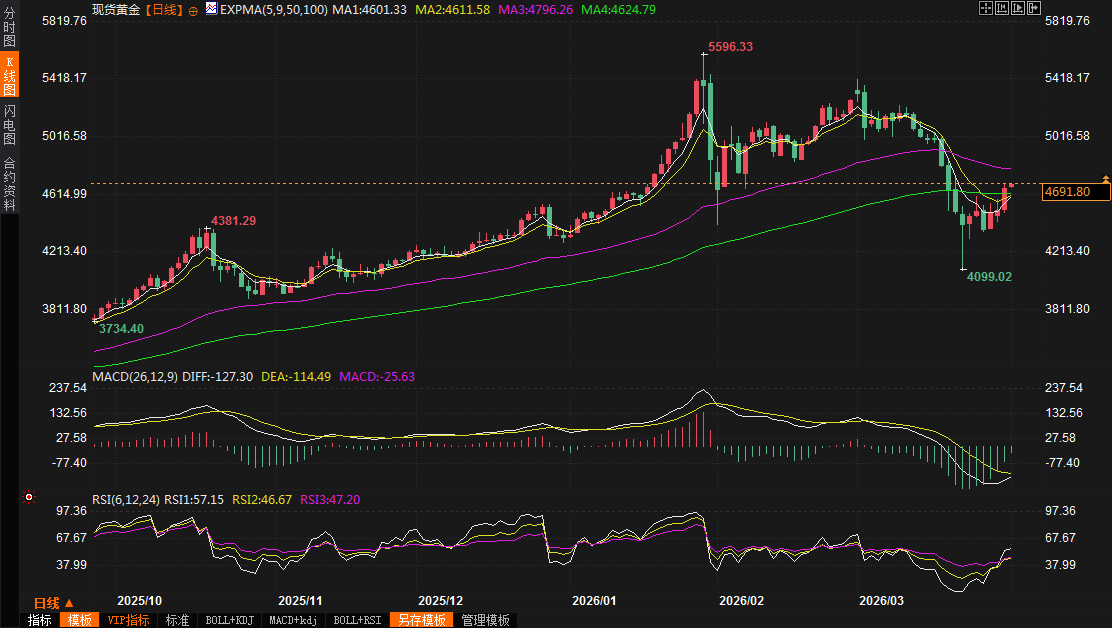
(Spot gold daily chart, source: FX678)
At 07:42 Beijing time, spot gold was trading at $4691.80 per ounce.
The expectation of easing tensions in the Middle East ignites a short-term rebound.
On Monday, The Wall Street Journal reported that President Trump was willing to end military action against Iran even though the Strait of Hormuz remained largely blocked, a piece of news that instantly ignited market optimism.
Although U.S. Defense Secretary Hergsays warned that "the next few days will be a decisive moment" and that the conflict would escalate if Iran did not compromise, investors are more willing to bet on "an imminent ceasefire."
The US dollar index fell 0.6% to 99.88 as a result, temporarily easing the cost pressure of holding gold as a non-interest-bearing asset. Coupled with a recovery in risk appetite, gold prices achieved a long-awaited single-day surge.
Peter Grant, senior precious metals strategist at Zaner Metals, stated, "Gold's current rally is encouraging, stemming from increased market optimism regarding easing tensions in the Middle East." However, he also cautioned that stronger upward momentum is needed for a sustained upward trend to materialize. Currently, this rebound appears more like a technical correction than a trend reversal.
The specter of inflation and expectations of interest rate hikes remain the biggest "killers" of gold.
Despite a single-day surge, gold still suffered a severe correction in March, primarily due to the cascading inflationary effects triggered by the Iranian conflict pushing up oil prices. Over the past month, global oil prices have soared by more than 50%, and US retail gasoline prices have broken through $4 per gallon for the first time in over three years. This has led to a sharp increase in business costs, and consumer inflation expectations jumped from a median of 4.5% to 5.2%, a new high since May 2025.
The high-interest-rate environment directly increases the opportunity cost of holding gold – the Federal Reserve had previously ruled out the possibility of a rate cut in 2026 due to war and inflation, and the market had even priced in a higher probability of a rate hike before the end of the year.
BNP Paribas analysts' assessment of silver also corroborates this logic: silver prices will fluctuate between $65 and $75 in 2026, and the physical market may shift to oversupply in 2027. Gold and silver are both precious metals, and silver's 20.4% monthly decline further highlights its vulnerability under the dual pressures of weak industrial demand and its financial attributes.
Employment data flashes red, and expectations for interest rate cuts quietly rise.
On the same day that gold prices rebounded, the U.S. Department of Labor's JOLTS report showed that job openings plummeted by 358,000 to 6.882 million in February, with hiring falling to 4.849 million, the lowest levels since the pandemic began and since August 2014. Small and medium-sized enterprises, as well as the accommodation and catering and manufacturing sectors, suffered the most severe job losses, with the job vacancy rate falling from 4.4% to 4.2%.
Although the consumer confidence index unexpectedly rose slightly to 91.8, households have become significantly more cautious about their future purchase plans for big-ticket items, and the proportion of people in the labor market who are "unable to find work" has risen to its highest level since February 2021.
Morgan Stanley chief economist Michael Gapen warned: "The 'four horsemen' of indicators—hiring, layoffs, job openings, and unemployment—suggest that the economic situation was already deteriorating even before the oil shock."
This series of weak data caused the interest rate futures market to quickly shift – Tuesday's forecast was for a rate cut of about 7 basis points in 2026, after pricing in a 10 basis point rate hike the previous day.
The two-year Treasury yield fell 3.3 basis points, and the 10-year yield fell 3.1 basis points, resulting in a steepening yield curve. The bond market has begun to digest the logic of "demand destruction caused by high oil prices." The "zero-job growth equilibrium" previously described by Federal Reserve Chairman Powell is facing real downside risks, which may become the most powerful reversal factor for gold bulls.
The long-term fundamentals remain rock solid.
Short-term volatility is high, but the long-term narrative for gold remains intact. Goldman Sachs maintains its aggressive forecast of $5,500/oz for gold by the end of 2026, while BMI gives a conservative target of $4,600/oz for the average price throughout the year.
The wave of de-dollarization, continued gold purchases by global central banks, and geopolitical uncertainty continue to provide underlying support for gold.
Peter Grant emphasized: "In the long term, the underlying trend remains bullish, with key fundamental support such as de-dollarization and central bank buying still in place."
Even if the Trump administration tries to ease the conflict with Iran, it will still take time for the Strait of Hormuz to fully return to normal navigation, and the risks of high oil prices and recurring inflation will not disappear instantly.
Although the US dollar rose 2.3% in a month, the largest increase since July, its safe-haven attributes and advantages as an energy exporter are being repriced in by the uncertainty of "the conflict may become protracted".
Silver prices diverged, and the precious metals sector awaits confirmation of direction.
Spot silver surged 7% to $75.67 on Tuesday, but this couldn't mask a dismal 20.4% monthly decline. BNP Paribas predicts silver prices will fluctuate between $65 and $75 in 2026, with oversupply pressures emerging in 2027. Silver possesses both monetary and industrial attributes; its rebound has been weaker than gold's amid slowing demand in sectors like semiconductors and photovoltaics, reflecting the current market divergence regarding a "soft landing" versus a "hard landing."
Overall, gold is currently caught in a tug-of-war between short-term sentiment-driven rebounds, medium-term inflationary pressures, and long-term bullish fundamentals. While the 11.8% monthly drop in March was a record, it also largely released valuation pressures. If substantial progress is made in US-Iran negotiations and the Strait of Hormuz reopens in the coming days, the decline in oil prices will quickly alleviate inflation expectations, and gold prices are expected to continue their rebound. Conversely, if the "conflict escalation" warned by Hergész materializes, safe-haven buying may engage in a more intense struggle with the high-interest-rate environment.
Regardless, the $4,600-$5,500 price range for 2026 has become the consensus floor for institutions, and the March non-farm payroll report to be released on Friday will be the most critical variable determining the short-term fate of gold. What investors need to focus on now is not a single-day 3.5% increase, but whether gold can truly upgrade from a "safe-haven asset" to a "trend-driven bullish asset" in this triple whammy of "war, inflation, and employment."
On Wednesday (April 1) in early Asian trading, spot gold fluctuated at high levels, once hitting a high of $4,696 per ounce, the highest level since March 20.
(Spot gold daily chart, source: FX678)
At 07:42 Beijing time, spot gold was trading at $4691.80 per ounce.
- Risk Warning and Disclaimer
- The market involves risk, and trading may not be suitable for all investors. This article is for reference only and does not constitute personal investment advice, nor does it take into account certain users’ specific investment objectives, financial situation, or other needs. Any investment decisions made based on this information are at your own risk.