Crude oil trading alert: With geopolitical tensions volatile, oil prices may remain range-bound at high levels.
2026-04-01 09:32:30
Latest data shows that US crude oil production has declined from its previous peak, with January 2026 output projected at approximately 13.2 million barrels per day , a significant decrease from 13.9 million barrels per day in October 2025. This three-month consecutive decline is a relatively rare phenomenon in recent years outside of the pandemic, indicating that US shale oil supply capacity is entering a plateau phase. Meanwhile, weekly data also shows no significant recovery in production, further reinforcing market expectations of declining supply elasticity.

The significance of this change for the global crude oil market lies in the fact that US shale oil previously acted as a "supply buffer" after the Russia-Ukraine conflict in 2022, rapidly increasing production to mitigate market volatility during periods of rising oil prices. However, the situation has now shifted. High oil prices have not significantly stimulated a rebound in production; instead, they reflect the impact of capital constraints, rising costs, and companies prioritizing returns, resulting in a slower supply-side response. The ability of US shale oil to regulate oil prices is clearly weakening .
Meanwhile, the situation in the Middle East continues to unsettle markets. Tensions between Iran and the West, coupled with regional conflicts, have significantly heightened market concerns about the security of shipping through the Strait of Hormuz. This strait handles approximately 20% of global seaborne crude oil transport ; any disruption to this transport would directly impact the stability of the global supply chain. Although the United States has signaled that it may end its military operations within weeks, uncertainty remains high, and the market is still pricing in a risk premium for potential supply disruptions.
From a price-driven perspective, the current rise in oil prices is not due to a significant expansion in demand. Global economic growth has been generally stable, crude oil consumption has not seen an unexpected increase, and the supply-demand balance has not undergone a trend change. The core driver of oil prices has shifted from fundamentals to geopolitical sentiment . This structure means that price fluctuations are more dependent on event-driven factors than on long-term supply-demand changes.
In terms of market sentiment, investors are highly sensitive. On the one hand, declining supply elasticity in the US strengthens the bullish logic in the medium term; on the other hand, if the situation in the Middle East eases, the current risk premium will be quickly reversed. Frequent switching between bullish and bearish sentiment has caused oil prices to exhibit a high-level oscillation pattern.
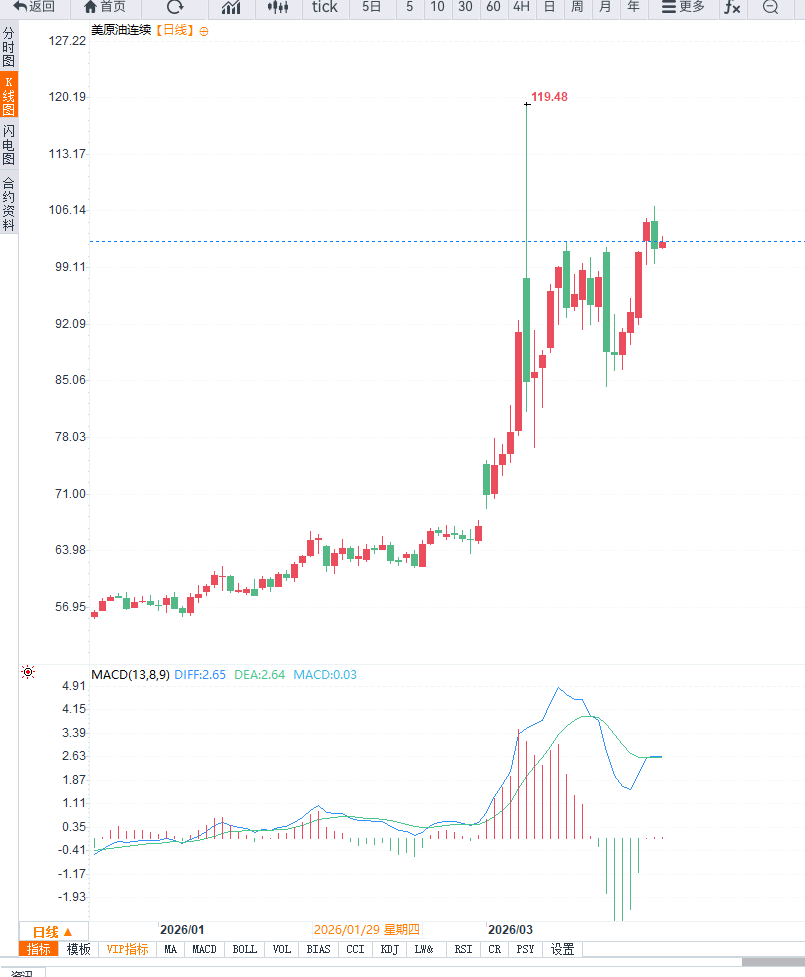
From a technical perspective, oil prices on the daily chart remain within a high-level consolidation range, with prices repeatedly encountering resistance near $108 , indicating heavy selling pressure. The $100 level forms a key support area, reflecting the bulls' defensive stance. Momentum indicators suggest weakening upward momentum, but a trend reversal signal has not yet formed. On the 4-hour chart, the short-term trend shows a slightly weak, oscillating structure, with prices repeatedly testing support and resistance within a range. A decisive break below $100 could trigger technical stop-loss orders and accelerate the decline; conversely, if geopolitical risks escalate again and push prices above $108, new upward potential could be unlocked.
Editor's Summary : Overall, the decline in US shale oil production is weakening the global crude oil market's supply buffer, while uncertainty in the Middle East amplifies the market's sensitivity to supply risks. The current oil price dynamic has clearly shifted from being driven by fundamentals to being driven by sentiment. Without significant changes in supply and demand trends, prices are more susceptible to sudden events. In the short term, oil prices are likely to maintain a high-level consolidation pattern, while the medium-term direction still depends on the evolution of the geopolitical situation. For investors, it is crucial to pay close attention to the pace of changes in risk premiums, seize structural opportunities in volatile markets, and be wary of the volatility risks brought about by rapid reversals in sentiment.
The significance of this change for the global crude oil market lies in the fact that US shale oil previously acted as a "supply buffer" after the Russia-Ukraine conflict in 2022, rapidly increasing production to mitigate market volatility during periods of rising oil prices. However, the situation has now shifted. High oil prices have not significantly stimulated a rebound in production; instead, they reflect the impact of capital constraints, rising costs, and companies prioritizing returns, resulting in a slower supply-side response. The ability of US shale oil to regulate oil prices is clearly weakening .
Meanwhile, the situation in the Middle East continues to unsettle markets. Tensions between Iran and the West, coupled with regional conflicts, have significantly heightened market concerns about the security of shipping through the Strait of Hormuz. This strait handles approximately 20% of global seaborne crude oil transport ; any disruption to this transport would directly impact the stability of the global supply chain. Although the United States has signaled that it may end its military operations within weeks, uncertainty remains high, and the market is still pricing in a risk premium for potential supply disruptions.
From a price-driven perspective, the current rise in oil prices is not due to a significant expansion in demand. Global economic growth has been generally stable, crude oil consumption has not seen an unexpected increase, and the supply-demand balance has not undergone a trend change. The core driver of oil prices has shifted from fundamentals to geopolitical sentiment . This structure means that price fluctuations are more dependent on event-driven factors than on long-term supply-demand changes.
In terms of market sentiment, investors are highly sensitive. On the one hand, declining supply elasticity in the US strengthens the bullish logic in the medium term; on the other hand, if the situation in the Middle East eases, the current risk premium will be quickly reversed. Frequent switching between bullish and bearish sentiment has caused oil prices to exhibit a high-level oscillation pattern.
From a technical perspective, oil prices on the daily chart remain within a high-level consolidation range, with prices repeatedly encountering resistance near $108 , indicating heavy selling pressure. The $100 level forms a key support area, reflecting the bulls' defensive stance. Momentum indicators suggest weakening upward momentum, but a trend reversal signal has not yet formed. On the 4-hour chart, the short-term trend shows a slightly weak, oscillating structure, with prices repeatedly testing support and resistance within a range. A decisive break below $100 could trigger technical stop-loss orders and accelerate the decline; conversely, if geopolitical risks escalate again and push prices above $108, new upward potential could be unlocked.
Editor's Summary : Overall, the decline in US shale oil production is weakening the global crude oil market's supply buffer, while uncertainty in the Middle East amplifies the market's sensitivity to supply risks. The current oil price dynamic has clearly shifted from being driven by fundamentals to being driven by sentiment. Without significant changes in supply and demand trends, prices are more susceptible to sudden events. In the short term, oil prices are likely to maintain a high-level consolidation pattern, while the medium-term direction still depends on the evolution of the geopolitical situation. For investors, it is crucial to pay close attention to the pace of changes in risk premiums, seize structural opportunities in volatile markets, and be wary of the volatility risks brought about by rapid reversals in sentiment.
- Risk Warning and Disclaimer
- The market involves risk, and trading may not be suitable for all investors. This article is for reference only and does not constitute personal investment advice, nor does it take into account certain users’ specific investment objectives, financial situation, or other needs. Any investment decisions made based on this information are at your own risk.