Iranian Foreign Minister: Confirmed communication with the US, but denied resumption of nuclear negotiations.
2026-04-01 18:11:31
As the US-Israel joint strike against Iran entered its 33rd day, Iranian Foreign Minister Abbas Araqchi gave an exclusive interview to Al Jazeera, making clear statements on key issues such as the nature of US-Iran communication, the ownership of the Strait of Hormuz, and responses to ground incursions. His remarks revealed the core contradictions of the current conflict and highlighted the complexity and uncertainty of the situation.
At the diplomatic level, Araghshi confirmed that he maintained direct communication with Steve Witkov, President Trump’s chief envoy, during the conflict, but firmly denied that such interactions constituted negotiations.
Iranian Foreign Minister Araqchi emphasized that "my direct communication with Witkov is as usual, which in no way means that we are negotiating," and that all information is transmitted through the official channels of the Iranian Ministry of Foreign Affairs, with only necessary coordination between security agencies. "The claims that Iran is negotiating with any party are untrue."
Behind this stance lies Iran's deep distrust of the United States—Araqchi bluntly stated that trust between the two sides has plummeted to rock bottom, and the US has shown no sincerity whatsoever.
The root of this distrust lies not only in the Trump administration's withdrawal from the Joint Comprehensive Plan of Action (JCPOA) reached during Obama's first term, but also in decades of energy interest maneuvering.
In 1953, Mohammad Mossadegh, Iran’s first democratically elected prime minister, nationalized the British-controlled Anglo-Iranian Oil Company (the predecessor of modern BP), which threatened Western energy interests. The CIA then orchestrated Operation Ajax to overthrow the Mossadegh government and restore the Shah’s dictatorship, marking a significant turning point in Iran-US relations.
After the Islamic Revolution in 1979 overthrew the pro-American regime, the hostage crisis at the US embassy broke out, and the US and Iran formally severed diplomatic relations, beginning a long period of hostility. Oil resources have always been the core bargaining chip in the game between the two sides.
Araghshi recalled that the United States had launched two attacks on Iran during the negotiation process in the past nine months: the raid in June 2025 and the attack that broke out on February 28, when the mediator Oman claimed that the two countries were close to a breakthrough in the nuclear issue.
Pakistan is currently providing coordination support for communication between Iran and the United States. Last week, it also facilitated talks involving Saudi Arabia, Egypt, and Turkey. Pakistan’s Deputy Prime Minister and Foreign Minister Ishaq Dar visited Beijing on the same day as the interview to seek China’s support for the mediation efforts. China and Pakistan had previously jointly put forward a five-point peace initiative, calling for a ceasefire and the restoration of navigation in the Strait of Hormuz.
Regarding the future of the Strait of Hormuz, a vital global energy artery, Araghshi explicitly asserted that the waters of the strait fall under the jurisdiction of both Iran and Oman, and that post-war arrangements should be jointly decided by the two countries. However, he also emphasized that the strait should become an "international waterway for peaceful navigation."
This statement diverges from the demands of Gulf states such as Qatar, which insist on participating in the future consultation process across the Strait.
From Iran's perspective, Araghchi clarified that the strait remains open to ships from most countries, with restrictions imposed only on warring parties. "This is a normal measure during wartime, and we cannot allow hostile countries to use our territorial waters for commercial activities."
He explained that some countries' ships have voluntarily suspended the use of the strait due to safety concerns and rising insurance costs, while some ships from India, Pakistan, Turkey, China, and other countries have successfully navigated the strait after negotiations with the Iranian government.
It is noteworthy that behind this struggle for control of the Strait lies Iran's crucial energy position.
According to data from the U.S. Energy Information Administration (EIA), Iran has proven crude oil reserves of up to 157 billion barrels, accounting for about 24% of the Middle East's reserves and 12% of the global total, ranking third in the world; its natural gas reserves rank second in the world, highlighting its strategic energy importance.
In terms of production capacity, Iran currently produces approximately 3.3 million barrels of crude oil per day, ranking ninth globally and fourth in OPEC, thus having a profound impact on the global oil supply landscape. The Strait of Hormuz handles over 20% of global oil shipments and one-fifth of liquefied natural gas shipments, including Iran's own energy exports—before the war, Iran exported approximately 2 million barrels of crude oil and refined fuels per day, with net oil export revenue accounting for 12% of its GDP (estimated at $53 billion in 2023), making it a core source of foreign exchange reserves.
Currently, the US-Israel war in Iraq has triggered significant fluctuations in global oil prices. The benchmark Brent crude oil price has risen from $65 per barrel before the war to $116, an increase of over 75%, which has had a major impact on global inflation and monetary policy formulation.
With shipping disruptions, Gulf oil-producing countries such as Saudi Arabia and the UAE are seeking alternative export routes, including land-based pipelines, further highlighting the critical importance of strait navigation safety to the global energy market.
Araghshi has adopted a tough stance in the face of a potential U.S. ground invasion threat.
Despite Trump's recent statement that the U.S. military might withdraw from Iran within two or three weeks and his demand that allies "solve their own oil supply problems," the Pentagon is still developing ground combat plans. The U.S. military's third aircraft carrier is en route to the Middle East, and the 82nd Airborne Division's rapid reaction force has also been deployed to the region.
The US military actions are driven by its covetousness for Middle Eastern oil resources. This is not the first time the US has interfered in Iranian oil affairs. The precedent of Iraq provides a clear reference: more than 20 years after the US invasion of Iraq, Iraq's oil export revenue still needs to be deposited into the US Federal Reserve Bank account before being gradually transferred to the Baghdad government.
In response, Araghshi was equally defiant: "We are on high alert, and I don't think they would dare to take such action rashly. We have deployed sufficient forces to deal with any provocation."
He confidently stated that Iran is well-versed in self-defense and has an advantage in ground warfare, and is "fully prepared to deal with any form of ground attack. We hope the US will not make such a serious strategic mistake."
Iran's tough stance stems from both its defense of territorial sovereignty and the strategic importance of its oil resources—if its territory were occupied, its core energy assets would face the risk of being controlled.
It is worth noting that the US is facing pressure due to oil prices exceeding $4 per gallon, with Trump stating that "oil prices will plummet after the US military withdraws." From a market perspective, if the US seizes Iranian oil and lifts related sanctions, a large influx of Iranian oil into the global market could suppress oil prices in the short term, alleviating the inflationary pressure caused by current high oil prices. This has become an important factor in US policy considerations.
However, there are clear divisions within its government regarding its policy toward Iran. While signaling a withdrawal from the war, it continues to increase troop deployments and exert pressure. Furthermore, allies such as Spain and Italy have prohibited the US military from using its airspace and bases to launch attacks, further isolating Washington.
Currently, the conflict between the US and Iran continues. Iranian attacks have caused fires in Kuwait and Bahrain, and casualties in the UAE. The US and Israel continue to attack Iranian infrastructure, and the Iranian military has responded by targeting US-affiliated companies in Israel.
The ongoing conflict not only threatens regional security but also continues to undermine the stability of the global energy market.
As one of the world's most severely sanctioned countries, Iran has long faced US sanctions since the 1979 hostage crisis. After the Trump administration withdrew from the JCPOA and reinstated sanctions in 2018, its oil exports shrank significantly.
During the JCPOA agreement period, the lifting of sanctions against Iran brought stability to the global energy market, which also indirectly confirms the importance of resolving disputes through diplomatic means.
Despite the mediation efforts of China, Pakistan, and other countries, diplomatic channels have not been closed. However, the differences between Iran and the United States on the definition of negotiations and core demands, as well as Israel's continued military operations, still cast a shadow over the peaceful resolution of the dispute.
Looking ahead, the safety of navigation in the Strait of Hormuz, the follow-up handling of the Iranian nuclear issue, and the long-term stability of the region depend not only on pragmatic dialogue among all parties but also on recognizing the strategic value of Iran's oil resources. Only by respecting the energy sovereignty and economic interests of all countries can we truly break the deadlock in geopolitical competition and lay the foundation for global energy security and geopolitical stability.
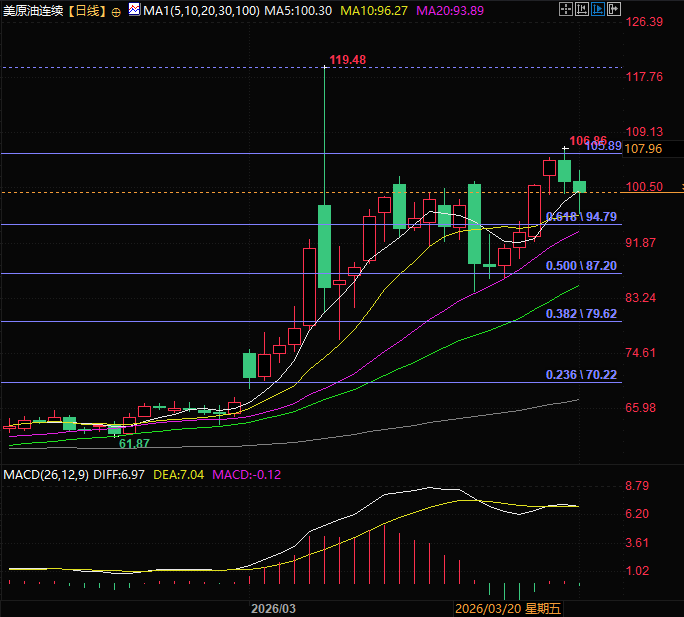
(WIT futures contract daily chart, source: EasyForex subsidiary)
At 18:05 Beijing time, WTI futures were trading at $100.13 per barrel.
Diplomatic contacts: Information exchange occurred, but no substantive negotiations took place.
At the diplomatic level, Araghshi confirmed that he maintained direct communication with Steve Witkov, President Trump’s chief envoy, during the conflict, but firmly denied that such interactions constituted negotiations.
Iranian Foreign Minister Araqchi emphasized that "my direct communication with Witkov is as usual, which in no way means that we are negotiating," and that all information is transmitted through the official channels of the Iranian Ministry of Foreign Affairs, with only necessary coordination between security agencies. "The claims that Iran is negotiating with any party are untrue."
Behind this stance lies Iran's deep distrust of the United States—Araqchi bluntly stated that trust between the two sides has plummeted to rock bottom, and the US has shown no sincerity whatsoever.
The root of this distrust lies not only in the Trump administration's withdrawal from the Joint Comprehensive Plan of Action (JCPOA) reached during Obama's first term, but also in decades of energy interest maneuvering.
In 1953, Mohammad Mossadegh, Iran’s first democratically elected prime minister, nationalized the British-controlled Anglo-Iranian Oil Company (the predecessor of modern BP), which threatened Western energy interests. The CIA then orchestrated Operation Ajax to overthrow the Mossadegh government and restore the Shah’s dictatorship, marking a significant turning point in Iran-US relations.
After the Islamic Revolution in 1979 overthrew the pro-American regime, the hostage crisis at the US embassy broke out, and the US and Iran formally severed diplomatic relations, beginning a long period of hostility. Oil resources have always been the core bargaining chip in the game between the two sides.
Araghshi recalled that the United States had launched two attacks on Iran during the negotiation process in the past nine months: the raid in June 2025 and the attack that broke out on February 28, when the mediator Oman claimed that the two countries were close to a breakthrough in the nuclear issue.
Pakistan is currently providing coordination support for communication between Iran and the United States. Last week, it also facilitated talks involving Saudi Arabia, Egypt, and Turkey. Pakistan’s Deputy Prime Minister and Foreign Minister Ishaq Dar visited Beijing on the same day as the interview to seek China’s support for the mediation efforts. China and Pakistan had previously jointly put forward a five-point peace initiative, calling for a ceasefire and the restoration of navigation in the Strait of Hormuz.
Cross-Strait Game: The Struggle for Ownership and the New Navigation Landscape – A Battle for Control of the Energy Lifeline
Regarding the future of the Strait of Hormuz, a vital global energy artery, Araghshi explicitly asserted that the waters of the strait fall under the jurisdiction of both Iran and Oman, and that post-war arrangements should be jointly decided by the two countries. However, he also emphasized that the strait should become an "international waterway for peaceful navigation."
This statement diverges from the demands of Gulf states such as Qatar, which insist on participating in the future consultation process across the Strait.
From Iran's perspective, Araghchi clarified that the strait remains open to ships from most countries, with restrictions imposed only on warring parties. "This is a normal measure during wartime, and we cannot allow hostile countries to use our territorial waters for commercial activities."
He explained that some countries' ships have voluntarily suspended the use of the strait due to safety concerns and rising insurance costs, while some ships from India, Pakistan, Turkey, China, and other countries have successfully navigated the strait after negotiations with the Iranian government.
It is noteworthy that behind this struggle for control of the Strait lies Iran's crucial energy position.
According to data from the U.S. Energy Information Administration (EIA), Iran has proven crude oil reserves of up to 157 billion barrels, accounting for about 24% of the Middle East's reserves and 12% of the global total, ranking third in the world; its natural gas reserves rank second in the world, highlighting its strategic energy importance.
In terms of production capacity, Iran currently produces approximately 3.3 million barrels of crude oil per day, ranking ninth globally and fourth in OPEC, thus having a profound impact on the global oil supply landscape. The Strait of Hormuz handles over 20% of global oil shipments and one-fifth of liquefied natural gas shipments, including Iran's own energy exports—before the war, Iran exported approximately 2 million barrels of crude oil and refined fuels per day, with net oil export revenue accounting for 12% of its GDP (estimated at $53 billion in 2023), making it a core source of foreign exchange reserves.
Currently, the US-Israel war in Iraq has triggered significant fluctuations in global oil prices. The benchmark Brent crude oil price has risen from $65 per barrel before the war to $116, an increase of over 75%, which has had a major impact on global inflation and monetary policy formulation.
With shipping disruptions, Gulf oil-producing countries such as Saudi Arabia and the UAE are seeking alternative export routes, including land-based pipelines, further highlighting the critical importance of strait navigation safety to the global energy market.
Military standoff: Iran on high alert, US policy wavering
Araghshi has adopted a tough stance in the face of a potential U.S. ground invasion threat.
Despite Trump's recent statement that the U.S. military might withdraw from Iran within two or three weeks and his demand that allies "solve their own oil supply problems," the Pentagon is still developing ground combat plans. The U.S. military's third aircraft carrier is en route to the Middle East, and the 82nd Airborne Division's rapid reaction force has also been deployed to the region.
The US military actions are driven by its covetousness for Middle Eastern oil resources. This is not the first time the US has interfered in Iranian oil affairs. The precedent of Iraq provides a clear reference: more than 20 years after the US invasion of Iraq, Iraq's oil export revenue still needs to be deposited into the US Federal Reserve Bank account before being gradually transferred to the Baghdad government.
In response, Araghshi was equally defiant: "We are on high alert, and I don't think they would dare to take such action rashly. We have deployed sufficient forces to deal with any provocation."
He confidently stated that Iran is well-versed in self-defense and has an advantage in ground warfare, and is "fully prepared to deal with any form of ground attack. We hope the US will not make such a serious strategic mistake."
Iran's tough stance stems from both its defense of territorial sovereignty and the strategic importance of its oil resources—if its territory were occupied, its core energy assets would face the risk of being controlled.
It is worth noting that the US is facing pressure due to oil prices exceeding $4 per gallon, with Trump stating that "oil prices will plummet after the US military withdraws." From a market perspective, if the US seizes Iranian oil and lifts related sanctions, a large influx of Iranian oil into the global market could suppress oil prices in the short term, alleviating the inflationary pressure caused by current high oil prices. This has become an important factor in US policy considerations.
However, there are clear divisions within its government regarding its policy toward Iran. While signaling a withdrawal from the war, it continues to increase troop deployments and exert pressure. Furthermore, allies such as Spain and Italy have prohibited the US military from using its airspace and bases to launch attacks, further isolating Washington.
Outlook: Conflicts continue, with a dual demand for energy security and geopolitical stability.
Currently, the conflict between the US and Iran continues. Iranian attacks have caused fires in Kuwait and Bahrain, and casualties in the UAE. The US and Israel continue to attack Iranian infrastructure, and the Iranian military has responded by targeting US-affiliated companies in Israel.
The ongoing conflict not only threatens regional security but also continues to undermine the stability of the global energy market.
As one of the world's most severely sanctioned countries, Iran has long faced US sanctions since the 1979 hostage crisis. After the Trump administration withdrew from the JCPOA and reinstated sanctions in 2018, its oil exports shrank significantly.
During the JCPOA agreement period, the lifting of sanctions against Iran brought stability to the global energy market, which also indirectly confirms the importance of resolving disputes through diplomatic means.
Despite the mediation efforts of China, Pakistan, and other countries, diplomatic channels have not been closed. However, the differences between Iran and the United States on the definition of negotiations and core demands, as well as Israel's continued military operations, still cast a shadow over the peaceful resolution of the dispute.
Looking ahead, the safety of navigation in the Strait of Hormuz, the follow-up handling of the Iranian nuclear issue, and the long-term stability of the region depend not only on pragmatic dialogue among all parties but also on recognizing the strategic value of Iran's oil resources. Only by respecting the energy sovereignty and economic interests of all countries can we truly break the deadlock in geopolitical competition and lay the foundation for global energy security and geopolitical stability.
(WIT futures contract daily chart, source: EasyForex subsidiary)
At 18:05 Beijing time, WTI futures were trading at $100.13 per barrel.
- Risk Warning and Disclaimer
- The market involves risk, and trading may not be suitable for all investors. This article is for reference only and does not constitute personal investment advice, nor does it take into account certain users’ specific investment objectives, financial situation, or other needs. Any investment decisions made based on this information are at your own risk.