Will Trump's showdown tomorrow mark the end of the oil bull market?
2026-04-01 19:51:37
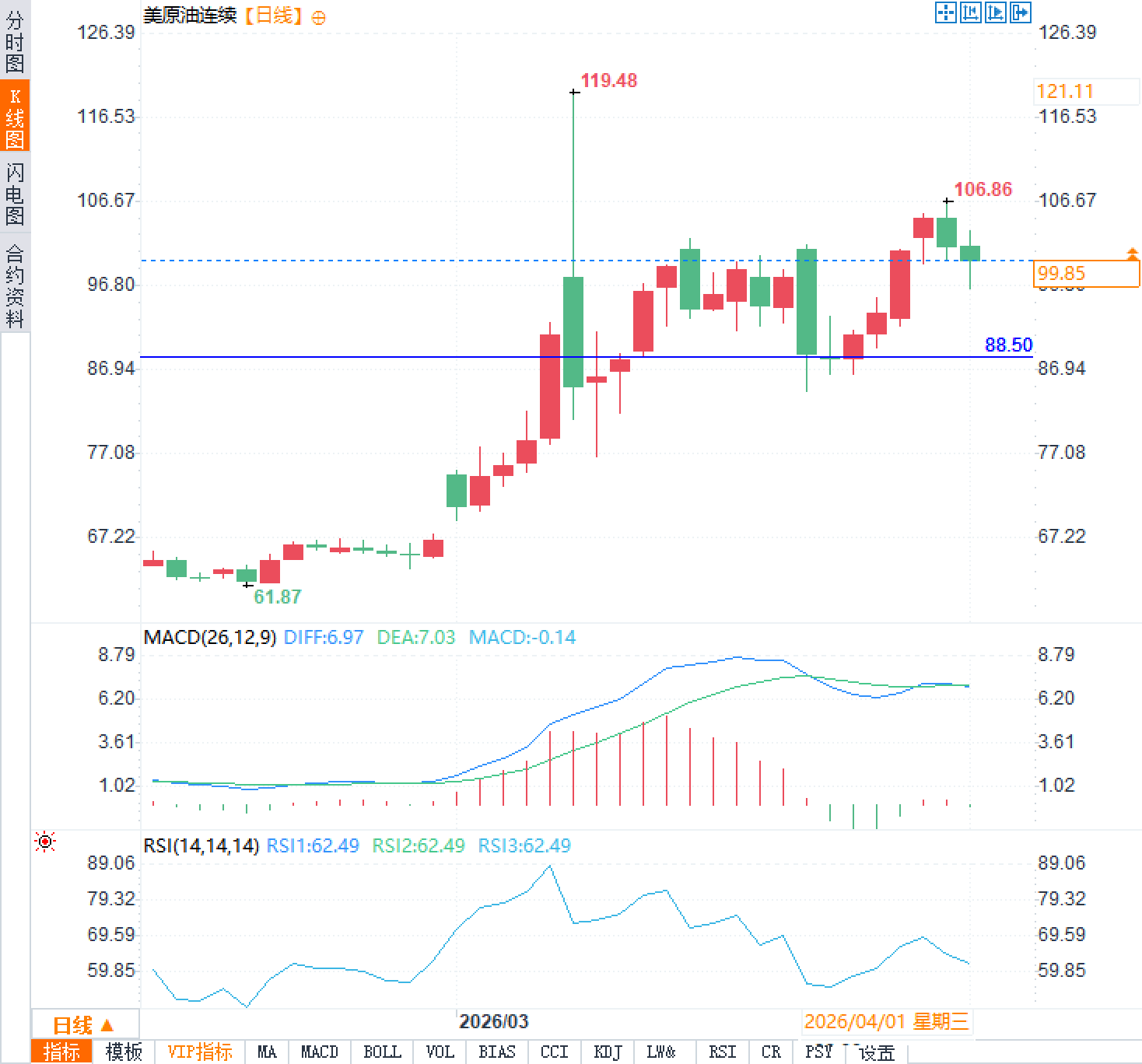
On Wednesday, April 1st, crude oil futures fell under pressure. WTI crude oil was last quoted at $99.90 per barrel, down 1.50%. Brent crude also declined to $102.86 per barrel, down 0.4%. This change was mainly due to market optimism regarding potential progress in negotiations between the US and Iran, although signals from both sides remained highly mixed. The latest data from the American Petroleum Institute showed that US crude oil inventories surged by 10.263 million barrels last week, far exceeding expectations, further reinforcing the pressure of ample supply. Traders are closely watching geopolitical headlines, as any substantial breakthrough could trigger a sharp correction in oil prices, while potential escalation risks continue to support upside potential.
Current oil price movements are showing clear signs of a short-term correction. WTI crude oil has fallen more than 5% from its highs over the past week, primarily due to the compression of risk premiums driven by optimism surrounding negotiations. Nevertheless, prices remain in a relatively high range, reflecting continued market concerns about supply disruptions. This volatility is directly linked to geopolitical events, and traders need to be wary of the impact of breaking news on immediate pricing.
Inventory data further confirmed the pressure. The American Petroleum Institute reported that crude oil inventories rose by 10.263 million barrels last week, a much larger increase than the market's average expectation, suggesting a slowdown in refinery activity or increased imports. Traders generally believe that if negotiations continue to send positive signals, inventory pressure could further push down the price level.
The progress of negotiations constitutes the core driving factor for the current market. US President Trump stated on social media that he was willing to end the conflict with Iran, without preconditions for opening the Strait of Hormuz. This statement was interpreted by the market as a positive signal of potential reconciliation, causing oil prices to quickly come under pressure. The Iranian president subsequently responded, stating that he was prepared to end the war but demanded necessary security guarantees. However, sources in the Iranian parliament clearly stated that no negotiations had been held with the US and that the Strait would not be opened. This mixed signal has caused market expectations to fluctuate repeatedly, making it difficult to form a unilateral trend in the short term.
The negotiations remain in an indirect phase with no signs of a substantial breakthrough. Trump is expected to deliver a significant update on Iran at 9:00 AM tomorrow, the content of which will directly determine the short-term risk premium. If the speech reinforces optimism, oil prices may continue to decline; conversely, if it emphasizes a hardline stance, it could reignite upward momentum.
The Strait of Hormuz, a crucial chokepoint for global crude oil transportation, directly shapes the current supply landscape. Normally, the strait handles about one-fifth of the world's seaborne oil trade daily, approximately 16 to 20 million barrels. The conflict has disrupted transportation, creating a substantial supply gap and driving a sharp short-term increase in oil prices. Any signs of recovery will release a significant amount of potential supply, thereby compressing risk premiums.
Current disruptions have already limited some Middle Eastern crude oil exports, and while increased production from non-OPEC+ countries has partially offset this, the overall global supply remains tight. Traders observe that if an agreement is reached, the gradual reopening of the Straits could release millions of barrels per day of capacity within weeks, significantly altering the supply-demand curve. Conversely, if negotiations stall, continued disruptions will maintain support at high prices. Fundamental data shows that supply losses are nearing historical peaks, and any marginal improvement could trigger a rapid price correction.
Data from the International Energy Agency shows that global oil demand growth in 2026 is projected at 640,000 barrels per day, a downward revision from previous forecasts, mainly due to the dampening effect of high oil prices on consumption. On the supply side, non-OPEC+ output growth is expected to reach 2.4 million barrels per day, but the situation in the Middle East will dominate short-term dynamics.
While OPEC+ production policies offer some buffer, the current conflict has transcended the conventional quota framework. Traders are focusing on macroeconomic correlations: high oil prices could further dampen demand by dragging down global economic growth, while the policy direction of central banks such as the Federal Reserve will indirectly affect the attractiveness of dollar-denominated commodities. Overall, the progress of negotiations will be the decisive variable; without a substantial breakthrough, upside risks to oil prices remain; conversely, a recovery in supply will accelerate the return of prices to equilibrium levels.
Latest Crude Oil Market Trends and Volatility Analysis
Current oil price movements are showing clear signs of a short-term correction. WTI crude oil has fallen more than 5% from its highs over the past week, primarily due to the compression of risk premiums driven by optimism surrounding negotiations. Nevertheless, prices remain in a relatively high range, reflecting continued market concerns about supply disruptions. This volatility is directly linked to geopolitical events, and traders need to be wary of the impact of breaking news on immediate pricing.
Inventory data further confirmed the pressure. The American Petroleum Institute reported that crude oil inventories rose by 10.263 million barrels last week, a much larger increase than the market's average expectation, suggesting a slowdown in refinery activity or increased imports. Traders generally believe that if negotiations continue to send positive signals, inventory pressure could further push down the price level.
In-depth analysis of the dynamics of the US-Iran negotiations
The progress of negotiations constitutes the core driving factor for the current market. US President Trump stated on social media that he was willing to end the conflict with Iran, without preconditions for opening the Strait of Hormuz. This statement was interpreted by the market as a positive signal of potential reconciliation, causing oil prices to quickly come under pressure. The Iranian president subsequently responded, stating that he was prepared to end the war but demanded necessary security guarantees. However, sources in the Iranian parliament clearly stated that no negotiations had been held with the US and that the Strait would not be opened. This mixed signal has caused market expectations to fluctuate repeatedly, making it difficult to form a unilateral trend in the short term.
The negotiations remain in an indirect phase with no signs of a substantial breakthrough. Trump is expected to deliver a significant update on Iran at 9:00 AM tomorrow, the content of which will directly determine the short-term risk premium. If the speech reinforces optimism, oil prices may continue to decline; conversely, if it emphasizes a hardline stance, it could reignite upward momentum.
Long-term impact of Strait of Hormuz disruption on supply
The Strait of Hormuz, a crucial chokepoint for global crude oil transportation, directly shapes the current supply landscape. Normally, the strait handles about one-fifth of the world's seaborne oil trade daily, approximately 16 to 20 million barrels. The conflict has disrupted transportation, creating a substantial supply gap and driving a sharp short-term increase in oil prices. Any signs of recovery will release a significant amount of potential supply, thereby compressing risk premiums.
Current disruptions have already limited some Middle Eastern crude oil exports, and while increased production from non-OPEC+ countries has partially offset this, the overall global supply remains tight. Traders observe that if an agreement is reached, the gradual reopening of the Straits could release millions of barrels per day of capacity within weeks, significantly altering the supply-demand curve. Conversely, if negotiations stall, continued disruptions will maintain support at high prices. Fundamental data shows that supply losses are nearing historical peaks, and any marginal improvement could trigger a rapid price correction.
Oil Market Fundamentals Outlook
Data from the International Energy Agency shows that global oil demand growth in 2026 is projected at 640,000 barrels per day, a downward revision from previous forecasts, mainly due to the dampening effect of high oil prices on consumption. On the supply side, non-OPEC+ output growth is expected to reach 2.4 million barrels per day, but the situation in the Middle East will dominate short-term dynamics.
While OPEC+ production policies offer some buffer, the current conflict has transcended the conventional quota framework. Traders are focusing on macroeconomic correlations: high oil prices could further dampen demand by dragging down global economic growth, while the policy direction of central banks such as the Federal Reserve will indirectly affect the attractiveness of dollar-denominated commodities. Overall, the progress of negotiations will be the decisive variable; without a substantial breakthrough, upside risks to oil prices remain; conversely, a recovery in supply will accelerate the return of prices to equilibrium levels.
Frequently Asked Questions
Question 1: Why did the progress in US-Iran negotiations lead to a decline in crude oil prices?
A: Market optimism surrounding a potential peace agreement quickly reduced geopolitical risk premiums. Traders believed that if the war ended, Iranian oil exports could resume, and increased global supply would ease current tensions. However, uncertainty surrounding an agreement remained due to Iran's insistence on security guarantees and denial of formal negotiations, limiting the decline in oil prices. Meanwhile, a significant increase in inventories by 10.263 million barrels further amplified the signal of ample supply, putting short-term downward pressure on prices.
Question 2: What are the main uncertainties facing future oil prices?
A: This mainly includes substantive progress in negotiations, the content of Trump's speech, ongoing inventory changes, and the global demand outlook. Mixed signals indicate high market volatility, with traders wary of the immediate impact of breaking news on prices. If the speech reinforces optimism, the risk premium will continue to decline; conversely, it could push prices to new highs. Fundamentals show that demand growth will slow to 640,000 barrels per day in 2026, with increased non-OPEC+ production providing a buffer on the supply side, but geopolitical factors will still dominate short-term pricing logic.
- Risk Warning and Disclaimer
- The market involves risk, and trading may not be suitable for all investors. This article is for reference only and does not constitute personal investment advice, nor does it take into account certain users’ specific investment objectives, financial situation, or other needs. Any investment decisions made based on this information are at your own risk.