Crude oil trading reminder: Even the resurgence of TACO cannot mask the fact that oil prices are in a correction phase; a medium-term adjustment is now a certainty.
2026-04-02 09:22:38
US President Trump delivered a speech stating that the US is "close to achieving its core strategic objectives" in its actions against Iran, and emphasized that it will not allow Iran to possess nuclear weapons. This statement quickly triggered a chain reaction in financial markets. Investors generally interpreted it as a signal of a possible temporary easing of geopolitical tensions, leading to a significant cooling of demand for safe-haven assets.

The gold market reacted first, with prices falling rapidly in a short period, indicating that the previously accumulated safe-haven premium was being released. Meanwhile, the oil market showed the opposite trend, with international oil prices rising sharply, and both WTI and Brent crude rising by more than 1% . This divergence between gold and oil reflects the market's complex interpretation of the current situation: on the one hand, the easing of conflict has weakened safe-haven demand; on the other hand, the continued uncertainty surrounding energy supplies in the Middle East is supporting oil prices.
At a deeper level, the stability of the Middle East, as a core region for global energy supply, directly impacts crude oil transportation and pricing systems. The market is widely concerned about the security of the Strait of Hormuz, which handles approximately 20% of global seaborne crude oil transport. Any disruption would rapidly drive up global oil prices. Therefore, even with expectations of easing tensions, the supply risk premium is unlikely to completely disappear.
Regarding risk assets, futures for the three major U.S. stock indices all turned lower, indicating that investors remain cautious about the future economic and policy path. However, volatility indicators, which measure market fear, did not rise significantly, suggesting that the market has not yet entered a stage of systemic risk and is more inclined towards short-term event-driven volatility.
Overall, the market is currently at a crossroads between "expectation repair" and "risk repricing." On the one hand, a potential de-escalation of geopolitical tensions could put pressure on safe-haven assets; on the other hand, uncertainty surrounding energy supply continues to support oil prices. Against this backdrop, market sentiment is exhibiting a clear oscillating characteristic, with investors repeatedly weighing risks against opportunities.
From a technical perspective, crude oil maintains a slightly bullish, oscillating structure on the daily chart, but upward momentum has clearly weakened. Prices face significant resistance around $105 , a region of concentrated previous highs; repeated failures to break through this level could form a temporary top. Support lies around $95 , a previous consolidation platform; a break below this level would open up further downside potential. Momentum indicators show a slowing upward slope on the daily chart, suggesting a weakening of bullish momentum.
On the 4-hour chart, the short-term rebound in oil prices is largely driven by sentiment recovery. Technical indicators such as the RSI are near the neutral zone, with no obvious overbought signals, but the sustainability of the momentum is questionable. If prices fail to break through the $105 level effectively, they may enter a period of consolidation and decline in the short term; conversely, if a breakout with significant volume occurs, it may trigger a new round of upward trend, but the probability is relatively limited.
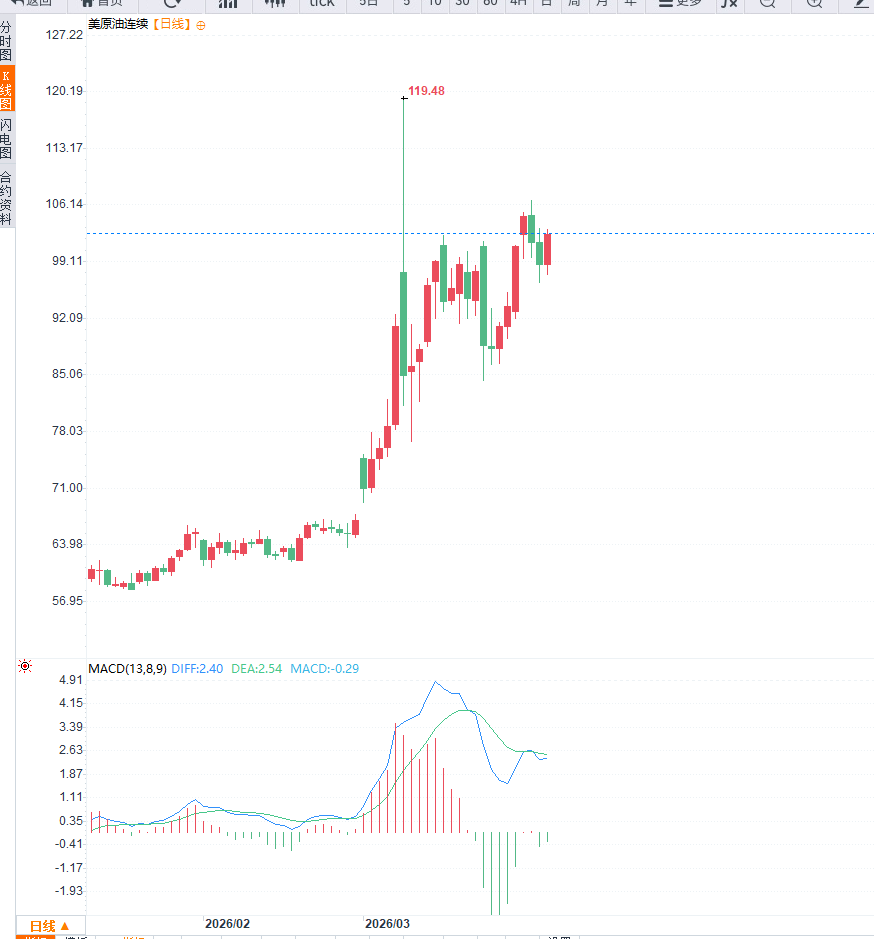
Editor's Summary : Overall, Trump's speech was more of a guide to market expectations than a fundamental turning point in the situation. In the short term, market volatility will continue to be dominated by news, and oil and gold prices may continue to fluctuate. From a medium-term perspective, as geopolitical risks are gradually digested by the market, coupled with weak global economic growth expectations, oil prices may enter a period of adjustment. Investors should pay close attention to breakouts of key price ranges and combine this with changes in macroeconomic data to judge the continuation of the trend. At this stage, controlling position size and avoiding chasing highs and lows remains a more prudent strategy.
The gold market reacted first, with prices falling rapidly in a short period, indicating that the previously accumulated safe-haven premium was being released. Meanwhile, the oil market showed the opposite trend, with international oil prices rising sharply, and both WTI and Brent crude rising by more than 1% . This divergence between gold and oil reflects the market's complex interpretation of the current situation: on the one hand, the easing of conflict has weakened safe-haven demand; on the other hand, the continued uncertainty surrounding energy supplies in the Middle East is supporting oil prices.
At a deeper level, the stability of the Middle East, as a core region for global energy supply, directly impacts crude oil transportation and pricing systems. The market is widely concerned about the security of the Strait of Hormuz, which handles approximately 20% of global seaborne crude oil transport. Any disruption would rapidly drive up global oil prices. Therefore, even with expectations of easing tensions, the supply risk premium is unlikely to completely disappear.
Regarding risk assets, futures for the three major U.S. stock indices all turned lower, indicating that investors remain cautious about the future economic and policy path. However, volatility indicators, which measure market fear, did not rise significantly, suggesting that the market has not yet entered a stage of systemic risk and is more inclined towards short-term event-driven volatility.
Overall, the market is currently at a crossroads between "expectation repair" and "risk repricing." On the one hand, a potential de-escalation of geopolitical tensions could put pressure on safe-haven assets; on the other hand, uncertainty surrounding energy supply continues to support oil prices. Against this backdrop, market sentiment is exhibiting a clear oscillating characteristic, with investors repeatedly weighing risks against opportunities.
From a technical perspective, crude oil maintains a slightly bullish, oscillating structure on the daily chart, but upward momentum has clearly weakened. Prices face significant resistance around $105 , a region of concentrated previous highs; repeated failures to break through this level could form a temporary top. Support lies around $95 , a previous consolidation platform; a break below this level would open up further downside potential. Momentum indicators show a slowing upward slope on the daily chart, suggesting a weakening of bullish momentum.
On the 4-hour chart, the short-term rebound in oil prices is largely driven by sentiment recovery. Technical indicators such as the RSI are near the neutral zone, with no obvious overbought signals, but the sustainability of the momentum is questionable. If prices fail to break through the $105 level effectively, they may enter a period of consolidation and decline in the short term; conversely, if a breakout with significant volume occurs, it may trigger a new round of upward trend, but the probability is relatively limited.
Editor's Summary : Overall, Trump's speech was more of a guide to market expectations than a fundamental turning point in the situation. In the short term, market volatility will continue to be dominated by news, and oil and gold prices may continue to fluctuate. From a medium-term perspective, as geopolitical risks are gradually digested by the market, coupled with weak global economic growth expectations, oil prices may enter a period of adjustment. Investors should pay close attention to breakouts of key price ranges and combine this with changes in macroeconomic data to judge the continuation of the trend. At this stage, controlling position size and avoiding chasing highs and lows remains a more prudent strategy.
- Risk Warning and Disclaimer
- The market involves risk, and trading may not be suitable for all investors. This article is for reference only and does not constitute personal investment advice, nor does it take into account certain users’ specific investment objectives, financial situation, or other needs. Any investment decisions made based on this information are at your own risk.