Why did oil prices skyrocket even though Trump said the war was almost over?
2026-04-02 15:35:44
U.S. President Donald Trump delivered a prime-time national televised address at 9 a.m. Beijing time on Thursday, declaring to the public that the U.S. military action against Iran had largely achieved its strategic objectives amid rising anti-war sentiment at home and a continued decline in his personal approval ratings due to the conflict with Iran, and that the conflict was nearing its end.
Trump stated that the U.S. military has completely destroyed Iran's naval and air forces, severely weakened its ballistic missile and nuclear program capabilities, and that core strategic objectives have been nearly fully achieved, with the war rapidly entering its final stages.
He also stated explicitly that the U.S. military will continue to strike targets within Iran in the next two to three weeks, and if the situation requires, the strikes will be expanded to include Iranian energy and oil facilities.
In response to concerns from the public about soaring gasoline prices, Trump stated that the price increase was due to Iran's attack on a commercial oil tanker in a neighboring country, and that the short-term price increase would soon ease.
However, the entire speech offered virtually no solution to the Strait of Hormuz issue, barely mentioned the possibility of enriched uranium underground, and suggested that the stock market decline was tolerable, implying that no supportive policies might be introduced. Furthermore, the vague description of the actual war objectives made the timing and reasons for the US troop withdrawal seem unfounded.
Faced with military pressure and statements from the United States, Iran has adopted an extremely tough stance. According to Tasnim News Agency, a spokesperson for the Iranian Armed Forces declared that the conflict will continue until the enemy submits and genuinely repents.
NBC News, citing official intelligence assessments, indicated that the Iranian regime shows no signs of collapse, the current leadership is more hardline than its predecessors, and the Iranian Revolutionary Guard remains firmly in control of the domestic situation. The US attempt to destabilize Iran through military strikes has not succeeded.
In addition, the US had previously revealed that Trump was weighing whether to take military action to transfer nearly 453.6 kilograms of highly enriched uranium from Iran. However, the plan was warned by experts and former US government officials that it was complex, dangerous, and extremely time-consuming. Trump eventually changed his tune on April 1, declaring that Iran's highly enriched uranium was no longer a concern.
From a strategic and market perspective, this national address was extremely lacking in substance, offering no feasible solutions to the conflict. The speech made no mention of any measures to clear or resolve the obstructed navigation in the Strait of Hormuz, a crucial global energy chokepoint ; and it completely ignored the issue of the possible disposal of highly enriched uranium hidden underground by Iran.
Trump's statement that a stock market decline was tolerable further suggests that the US government would not introduce economic support or bailout policies to address the conflict.
In addition, its vague description of the actual war objectives and the lack of reasonable basis for the timing and reasons for the US withdrawal have further postponed the timeframe for resolving the conflict.
There is widespread skepticism about Trump's lack of basic understanding of the oil market. His logic that the United States does not need to worry about oil prices because it does not rely on Middle Eastern oil is completely untenable. Retired U.S. Colonel and geopolitical risk advisor McGregor questioned Trump's claims about energy independence, saying that he "does not understand the global oil market at all."
As a global essential commodity, crude oil has extremely rigid demand. Even if the United States increases its domestic crude oil production and reduces its direct imports of crude oil from the Middle East, a small disturbance on the global crude oil supply side, such as a production cut of 3%-5%, can still cause a large fluctuation in international oil prices of 30%-50%.
The structural mismatch between the US refining system and domestic shale oil products, coupled with the deep linkage between refined oil pricing and the international crude oil market, means that supply gaps caused by supply disruptions in the Middle East will continue to directly push up domestic gasoline prices in the US, leading to increased living costs and inflationary pressures for the public.
Crude oil and global financial markets have reacted clearly to this empty speech.
Australia's fuel supply remains tight, and the prolongation of the conflict may further promote the adoption of working from home. A senior market analyst at StoneX bluntly stated that without plans to reopen the Strait of Hormuz, international oil prices will remain high indefinitely, and a new round of global inflation is inevitable.
A senior portfolio manager at Pictet Asset Management also pointed out that the speech did not provide the timeframe the market was looking for. Coupled with the continued military strikes in the coming weeks, the possibility of ground troop intervention not being ruled out, and the reiterated threat of attacks on energy facilities, financial markets will return to a defensive posture, and the volatility risk of commodities such as crude oil will be further exacerbated.
With the US continuing its offensive for another three weeks, the Strait of Hormuz will remain effectively closed (unable to trade in crude oil and natural gas). As long as the conflict continues, there is a possibility of escalation in the Middle East. Furthermore, as countries deplete their crude oil reserves and reduce their corporate inventory levels, the marginal impact on oil prices will accelerate.
As mentioned in previous articles, from a technical perspective, as long as oil prices hold above 97, the market remains in a healthy bullish pattern. As expected, oil prices surged after holding above 97. The key level is currently at 105.89, the 0.786 Fibonacci retracement level, with support around 102.5, near the 5-day moving average.
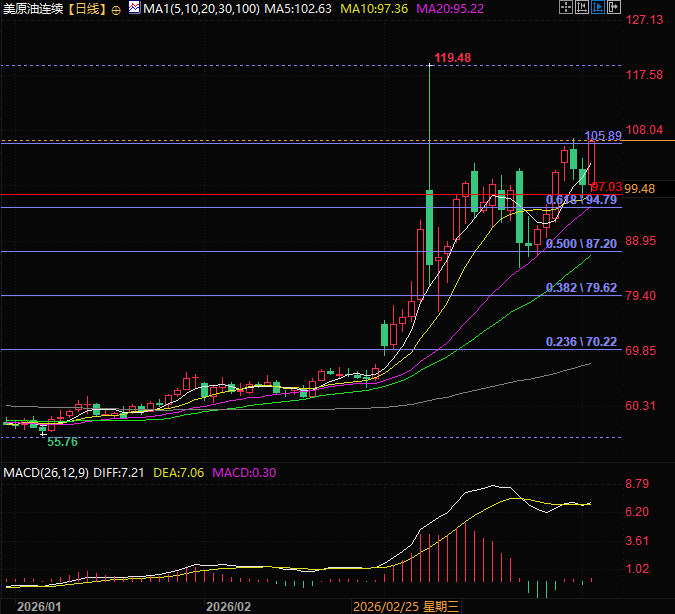
(WTI crude oil futures daily chart, source: EasyForex)
At 15:31 Beijing time, WTI crude oil futures were trading at $106.5 per barrel.
Trump stated that the U.S. military has completely destroyed Iran's naval and air forces, severely weakened its ballistic missile and nuclear program capabilities, and that core strategic objectives have been nearly fully achieved, with the war rapidly entering its final stages.
He also stated explicitly that the U.S. military will continue to strike targets within Iran in the next two to three weeks, and if the situation requires, the strikes will be expanded to include Iranian energy and oil facilities.
In response to concerns from the public about soaring gasoline prices, Trump stated that the price increase was due to Iran's attack on a commercial oil tanker in a neighboring country, and that the short-term price increase would soon ease.
However, the entire speech offered virtually no solution to the Strait of Hormuz issue, barely mentioned the possibility of enriched uranium underground, and suggested that the stock market decline was tolerable, implying that no supportive policies might be introduced. Furthermore, the vague description of the actual war objectives made the timing and reasons for the US troop withdrawal seem unfounded.
Iran's hardline stance, coupled with US intelligence indicating a stable regime with no signs of collapse, suggests a clear US stance.
Faced with military pressure and statements from the United States, Iran has adopted an extremely tough stance. According to Tasnim News Agency, a spokesperson for the Iranian Armed Forces declared that the conflict will continue until the enemy submits and genuinely repents.
NBC News, citing official intelligence assessments, indicated that the Iranian regime shows no signs of collapse, the current leadership is more hardline than its predecessors, and the Iranian Revolutionary Guard remains firmly in control of the domestic situation. The US attempt to destabilize Iran through military strikes has not succeeded.
In addition, the US had previously revealed that Trump was weighing whether to take military action to transfer nearly 453.6 kilograms of highly enriched uranium from Iran. However, the plan was warned by experts and former US government officials that it was complex, dangerous, and extremely time-consuming. Trump eventually changed his tune on April 1, declaring that Iran's highly enriched uranium was no longer a concern.
The speech lacked substantive content, key issues were absent, and the logic of withdrawing troops was untenable.
From a strategic and market perspective, this national address was extremely lacking in substance, offering no feasible solutions to the conflict. The speech made no mention of any measures to clear or resolve the obstructed navigation in the Strait of Hormuz, a crucial global energy chokepoint ; and it completely ignored the issue of the possible disposal of highly enriched uranium hidden underground by Iran.
Trump's statement that a stock market decline was tolerable further suggests that the US government would not introduce economic support or bailout policies to address the conflict.
In addition, its vague description of the actual war objectives and the lack of reasonable basis for the timing and reasons for the US withdrawal have further postponed the timeframe for resolving the conflict.
Common misconceptions about the oil market: Not relying on Middle Eastern crude oil still cannot prevent oil price increases.
There is widespread skepticism about Trump's lack of basic understanding of the oil market. His logic that the United States does not need to worry about oil prices because it does not rely on Middle Eastern oil is completely untenable. Retired U.S. Colonel and geopolitical risk advisor McGregor questioned Trump's claims about energy independence, saying that he "does not understand the global oil market at all."
As a global essential commodity, crude oil has extremely rigid demand. Even if the United States increases its domestic crude oil production and reduces its direct imports of crude oil from the Middle East, a small disturbance on the global crude oil supply side, such as a production cut of 3%-5%, can still cause a large fluctuation in international oil prices of 30%-50%.
The structural mismatch between the US refining system and domestic shale oil products, coupled with the deep linkage between refined oil pricing and the international crude oil market, means that supply gaps caused by supply disruptions in the Middle East will continue to directly push up domestic gasoline prices in the US, leading to increased living costs and inflationary pressures for the public.
Geopolitical stalemate continues to escalate, putting pressure on the oil market and raising inflation risks.
Crude oil and global financial markets have reacted clearly to this empty speech.
Australia's fuel supply remains tight, and the prolongation of the conflict may further promote the adoption of working from home. A senior market analyst at StoneX bluntly stated that without plans to reopen the Strait of Hormuz, international oil prices will remain high indefinitely, and a new round of global inflation is inevitable.
A senior portfolio manager at Pictet Asset Management also pointed out that the speech did not provide the timeframe the market was looking for. Coupled with the continued military strikes in the coming weeks, the possibility of ground troop intervention not being ruled out, and the reiterated threat of attacks on energy facilities, financial markets will return to a defensive posture, and the volatility risk of commodities such as crude oil will be further exacerbated.
Summary and Technical Analysis:
With the US continuing its offensive for another three weeks, the Strait of Hormuz will remain effectively closed (unable to trade in crude oil and natural gas). As long as the conflict continues, there is a possibility of escalation in the Middle East. Furthermore, as countries deplete their crude oil reserves and reduce their corporate inventory levels, the marginal impact on oil prices will accelerate.
As mentioned in previous articles, from a technical perspective, as long as oil prices hold above 97, the market remains in a healthy bullish pattern. As expected, oil prices surged after holding above 97. The key level is currently at 105.89, the 0.786 Fibonacci retracement level, with support around 102.5, near the 5-day moving average.
(WTI crude oil futures daily chart, source: EasyForex)
At 15:31 Beijing time, WTI crude oil futures were trading at $106.5 per barrel.
- Risk Warning and Disclaimer
- The market involves risk, and trading may not be suitable for all investors. This article is for reference only and does not constitute personal investment advice, nor does it take into account certain users’ specific investment objectives, financial situation, or other needs. Any investment decisions made based on this information are at your own risk.