Inventory is running low! High aluminum prices are consolidating, but there's a hidden danger.
2026-04-02 21:30:29
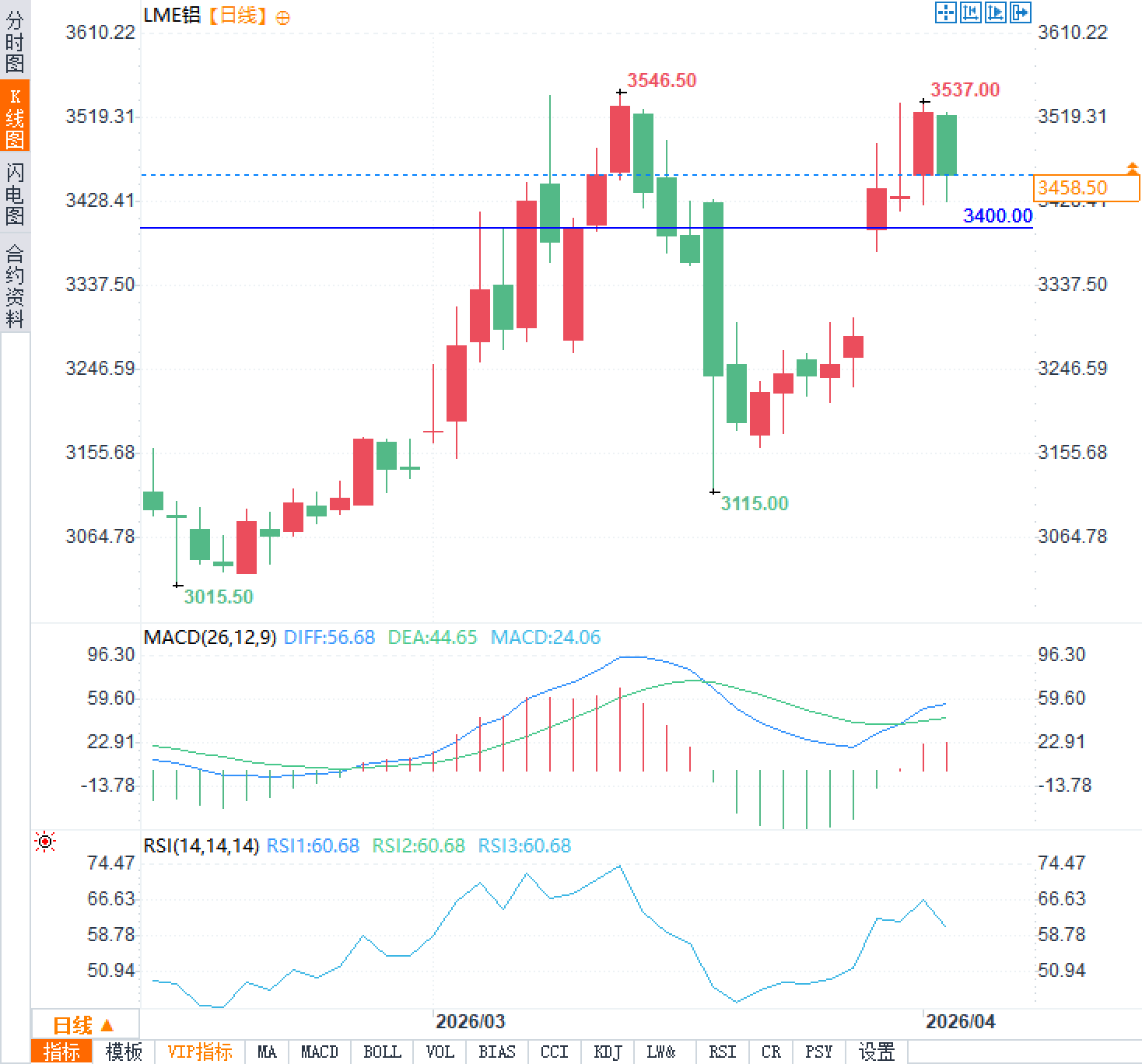
On Thursday, April 2nd, aluminum prices on the London Metal Exchange consolidated at high levels, with the three-month contract trading around $3460 per tonne. Although down 1.9% from the previous trading day, it remained near recent highs. News of smelting capacity disruptions caused by Middle East geopolitical events continued to unfold, resulting in a supply shortage far exceeding expectations. This, coupled with Indonesian power bottlenecks restricting new capacity additions, supported the fundamentals of the aluminum market. While concerns about global economic growth may lead to a slowdown in some demand, short-term supply shocks have dominated price movements.

The Middle East accounts for approximately 8% to 9% of global aluminum smelting capacity, with an estimated output of 6.16 million tons in 2025. The missile and drone attacks at the end of March this year damaged facilities of the region's two major producers, dramatically expanding supply disruptions. Market monitoring indicates that Emeritus Global Aluminium's Altawira smelter in Abu Dhabi, with an annual capacity of 1.6 million tons, has completely ceased production. Simultaneously, Bahrain Aluminium's smelter capacity utilization rate plummeted from 81% to approximately 30%, and Qatar Aluminium also implemented premature production cuts. If these disruptions are fully confirmed, the three companies will collectively withdraw approximately 3 million tons of annual capacity, equivalent to nearly half of the Middle East's total production. This represents a significant escalation from the 8% to 9% disruption level estimated by the market in mid-March, directly widening the global aluminum supply gap.
The sudden contraction in supply has a rapid impact on the industrial chain. Following the shutdown of the Altavira smelter, the company has begun selling off a large amount of alumina inventory, further confirming that production facilities are unlikely to resume operations in the short term. Such events not only affect primary aluminum production but may also lead to raw material shortages in downstream processing, amplifying pressure on spot premiums. Currently, aluminum inventories on the London Metal Exchange remain low, with warehouse stocks at approximately 414,000 tons as of April 1st. A high proportion of cancelled warrants reflects a continued tight balance in the physical market.
The table above shows that the disruption has covered core production capacity in the Middle East and is unlikely to be quickly compensated for in the short term by other regions.
The global primary aluminum market was initially in a state of mild shortage, with a deficit of approximately 1 million tons projected under the baseline scenario for 2026. The events in the Middle East have significantly amplified this deficit, potentially reaching 2 million to 2.5 million tons in a severe scenario. Even under the baseline scenario, the deficit has already risen to approximately 1 million tons. On the supply side, new capacity expansion in Indonesia is severely constrained by power supply restrictions, and the progress of new smelting projects in other regions is slow, resulting in limited global alternative capacity. On the demand side, while facing pressure from slowing economic growth, structural demand for aluminum from the aerospace, automotive, packaging, and renewable energy sectors continues to grow steadily and is unlikely to be completely suppressed by short-term price increases.
The widening supply-demand gap has directly driven a steep futures curve with a premium to the spot price, indicating that near-term contracts are trading at a significant premium to longer-term contracts. This suggests that the market is highly sensitive to pricing in tight spot demand. Traders have observed that LME aluminum prices have risen nearly 17% year-to-date, but have recently seen some pullback, indicating that the market is gradually pricing in the risk of demand disruption. In the long term, if the Middle East disruption lasts for more than three months, the pace of global aluminum inventory reduction will accelerate, further supporting an upward shift in the price center.
Aluminum prices have recently broken through the $3,500 per ton mark, reaching a new high in recent years, but volatility has increased accordingly. Under the spot premium structure, traders holding spot or near-month contracts face positive holding profits, while sellers of far-month contracts bear higher rollover costs. This market structure generally indicates continued tight supply, but external macroeconomic factors should also be watched closely. Concerns about global economic growth leading to a slowdown in industrial activity could partially offset supply shocks; meanwhile, energy price fluctuations will indirectly affect smelting costs. Traders are closely monitoring changes in inventory data, alumina spot market dynamics, and industrial production indicators in major consuming countries to determine the actual evolution of the supply-demand balance.
Although supply will dominate the market in the short term, the elasticity of demand cannot be ignored. Some downstream industries may cope with high prices by adjusting inventory or using alternative materials, which is expected to exert some downward pressure on prices. Overall, the tight balance of fundamentals remains unchanged, and the central price of aluminum has risen significantly compared to before the event.
Detailed Explanation of Middle East Smelter Disruptions and Their Impact on Production Capacity
The Middle East accounts for approximately 8% to 9% of global aluminum smelting capacity, with an estimated output of 6.16 million tons in 2025. The missile and drone attacks at the end of March this year damaged facilities of the region's two major producers, dramatically expanding supply disruptions. Market monitoring indicates that Emeritus Global Aluminium's Altawira smelter in Abu Dhabi, with an annual capacity of 1.6 million tons, has completely ceased production. Simultaneously, Bahrain Aluminium's smelter capacity utilization rate plummeted from 81% to approximately 30%, and Qatar Aluminium also implemented premature production cuts. If these disruptions are fully confirmed, the three companies will collectively withdraw approximately 3 million tons of annual capacity, equivalent to nearly half of the Middle East's total production. This represents a significant escalation from the 8% to 9% disruption level estimated by the market in mid-March, directly widening the global aluminum supply gap.
The sudden contraction in supply has a rapid impact on the industrial chain. Following the shutdown of the Altavira smelter, the company has begun selling off a large amount of alumina inventory, further confirming that production facilities are unlikely to resume operations in the short term. Such events not only affect primary aluminum production but may also lead to raw material shortages in downstream processing, amplifying pressure on spot premiums. Currently, aluminum inventories on the London Metal Exchange remain low, with warehouse stocks at approximately 414,000 tons as of April 1st. A high proportion of cancelled warrants reflects a continued tight balance in the physical market.
| major smelters | Annual production capacity (10,000 tons) | Utilization before interruption | Current situation |
|---|---|---|---|
| Altavira | 160 | Near full production | Complete shutdown |
| Bahrain Aluminum | Approximately 170 | 81% | Utilization rate dropped to 30% |
| Qatar Aluminium | Approximately 60 | higher | Premature production cuts |
A profound adjustment in the global aluminum supply and demand balance
The global primary aluminum market was initially in a state of mild shortage, with a deficit of approximately 1 million tons projected under the baseline scenario for 2026. The events in the Middle East have significantly amplified this deficit, potentially reaching 2 million to 2.5 million tons in a severe scenario. Even under the baseline scenario, the deficit has already risen to approximately 1 million tons. On the supply side, new capacity expansion in Indonesia is severely constrained by power supply restrictions, and the progress of new smelting projects in other regions is slow, resulting in limited global alternative capacity. On the demand side, while facing pressure from slowing economic growth, structural demand for aluminum from the aerospace, automotive, packaging, and renewable energy sectors continues to grow steadily and is unlikely to be completely suppressed by short-term price increases.
The widening supply-demand gap has directly driven a steep futures curve with a premium to the spot price, indicating that near-term contracts are trading at a significant premium to longer-term contracts. This suggests that the market is highly sensitive to pricing in tight spot demand. Traders have observed that LME aluminum prices have risen nearly 17% year-to-date, but have recently seen some pullback, indicating that the market is gradually pricing in the risk of demand disruption. In the long term, if the Middle East disruption lasts for more than three months, the pace of global aluminum inventory reduction will accelerate, further supporting an upward shift in the price center.
Price trend characteristics and macroeconomic risk transmission
Aluminum prices have recently broken through the $3,500 per ton mark, reaching a new high in recent years, but volatility has increased accordingly. Under the spot premium structure, traders holding spot or near-month contracts face positive holding profits, while sellers of far-month contracts bear higher rollover costs. This market structure generally indicates continued tight supply, but external macroeconomic factors should also be watched closely. Concerns about global economic growth leading to a slowdown in industrial activity could partially offset supply shocks; meanwhile, energy price fluctuations will indirectly affect smelting costs. Traders are closely monitoring changes in inventory data, alumina spot market dynamics, and industrial production indicators in major consuming countries to determine the actual evolution of the supply-demand balance.
Although supply will dominate the market in the short term, the elasticity of demand cannot be ignored. Some downstream industries may cope with high prices by adjusting inventory or using alternative materials, which is expected to exert some downward pressure on prices. Overall, the tight balance of fundamentals remains unchanged, and the central price of aluminum has risen significantly compared to before the event.
Frequently Asked Questions
Question 1: How much impact will the Middle East smelter disruptions have on the global aluminum market supply and demand balance?
A: This event has resulted in the withdrawal of approximately 3 million tons of annual production capacity, equivalent to about 4% of global primary aluminum production. This directly pushes the market gap in 2026 from 1 million tons in the base case scenario to the range of 1 million to 2.5 million tons. As a key supply source, the sharp decline in production in the Middle East is unlikely to be compensated for by new capacity from Indonesia or other regions in the short term. Inventory depletion is accelerating, and the tight balance in the spot market will continue.
Question 2: With aluminum prices recently reaching over $3,500 per ton, is there a risk of demand disruption going forward?
A: Short-term supply shocks are driving prices up, but a slowdown in global economic growth may lead to a slowdown in demand from some industries, thus partially offsetting the supply shortage effect. The steep futures curve and the premium structure between futures and spot prices indicate that the market remains optimistic about the supply side, but if macroeconomic interest rate expectations continue to rise, demand elasticity may gradually emerge, and price volatility will increase.
Question 3: What signal does alumina sales activity send to aluminum price trends?
A: Emerys Global Aluminium's sale of a large amount of alumina inventory indicates that smelter shutdowns may extend beyond the short term, and the restoration of production facilities will take a considerable amount of time. This move signals continued supply tightness and provides downstream processing companies with a short-term opportunity to replenish raw materials, but it cannot change the overall shortage of primary aluminum, and price support remains strong.
- Risk Warning and Disclaimer
- The market involves risk, and trading may not be suitable for all investors. This article is for reference only and does not constitute personal investment advice, nor does it take into account certain users’ specific investment objectives, financial situation, or other needs. Any investment decisions made based on this information are at your own risk.