Crude oil surges 12%! Risk premiums explode, traders frantically buy.
2026-04-02 21:54:02
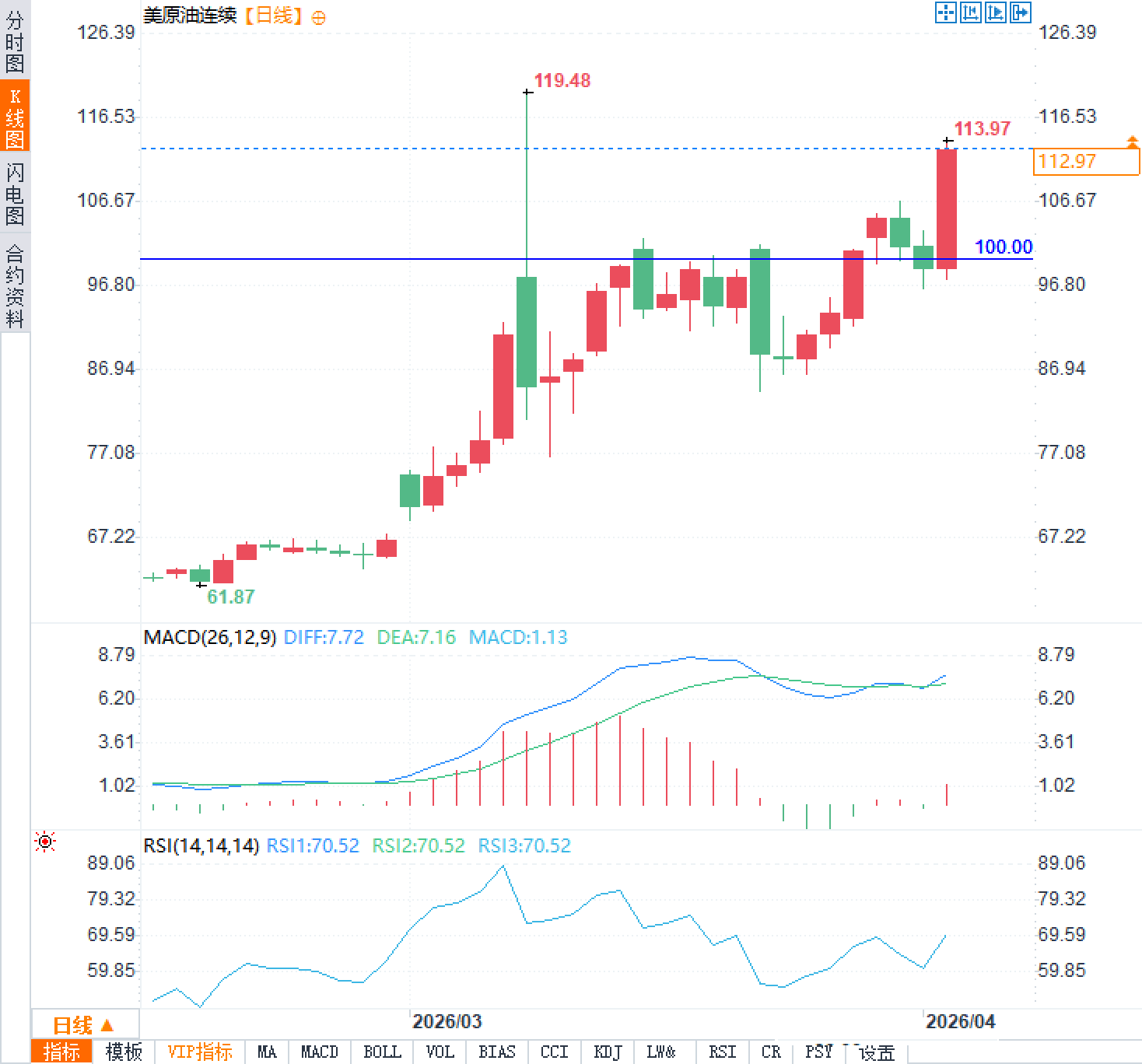
On Thursday, April 2nd, WTI crude oil futures prices surged more than 12% during North American trading hours, reaching above $112 per barrel, the highest level since June 2022. This surge was directly driven by US President Trump's latest remarks on the situation with Iran, in which he explicitly warned that the conflict could continue for weeks and pledged extremely severe military action in the coming weeks. Market concerns about continued disruptions to global oil supplies intensified sharply, especially given the lack of a clear path to reopening or diplomatic de-escalation signals in the crucial Strait of Hormuz.
The UK is hosting a virtual meeting of about 40 countries to discuss feasible options for reopening the shipping route, but the US is not expected to participate. Meanwhile, OPEC is considering potential production increases; however, additional supply is unlikely to reach the market in the short term, global oil inventories are low, and the supply-demand balance is tightening further.
In his recent national address, Trump emphasized a drastic strike against Iran within the next two to three weeks, without providing a clear path to a ceasefire or progress in negotiations. This statement directly amplified market expectations of supply disruptions. Traders observed a rapid expansion of risk premiums in the crude oil futures market, with the near-month contract premium widening, reflecting that concerns about immediate supply shortages dominated pricing logic. Geopolitical events often influence prices through expectations rather than solely relying on actual production losses. In this event, the vulnerability of the Strait of Hormuz as a choke point for global oil trade was once again highlighted, and any signal of shipping disruption could amplify volatility. Compared to similar tensions in the past, the lack of a multilateral diplomatic buffer mechanism further strengthened upward pressure on prices. Traders are closely monitoring subsequent military developments, as even if the short-term conflict eases, the speed at which risk premiums fall depends on the actual restoration of shipping lanes, not just verbal promises. Overall, this round of price increases reflects the market's pricing adjustment for long-term supply uncertainty, rather than being driven by short-term speculation.
The Strait of Hormuz carries approximately 20 million barrels of oil daily, accounting for about one-fifth of global seaborne oil trade. A sustained disruption would directly lead to a structural supply gap of millions of barrels per day globally. Given the current conflict, shipping security risks in Iranian-controlled areas have significantly increased, and alternative routes such as the Saudi Arabia-Red Sea pipeline or the northern Iraqi pipeline have limited capacity and cannot fully compensate for the losses. Traders are primarily concerned that this disruption will not only affect export volumes but will also be passed on to downstream refining through increased freight rates and insurance premiums, thereby pushing up global benchmark price spreads. Trump's explicit mention of tough action in the coming weeks has further extended market expectations for the duration of the disruption. In similar periods of shipping tension, crude oil prices typically accumulate most of their gains in the first week, followed by a period of consolidation. However, in this situation, global inventory levels are below seasonal averages, resulting in weaker buffering capacity. Traders are assessing the actual scale of the disruption, rather than just relying on statements, as the reopening of shipping lanes depends on multilateral coordination.
OPEC+ is assessing the possibility of gradually increasing production by approximately 206,000 barrels per day in April, but any actual production increase would require multiple rounds of coordination, and logistical and inventory release cycles mean that supply pressure is unlikely to be substantially alleviated in the short term. While global oil inventories are currently low, a structural surplus is still expected; however, geopolitical risks have completely dominated pricing. However, OPEC+ decisions typically lag behind unforeseen events, and the recent UK multinational meeting focused on reopening shipping lanes rather than production coordination, further highlighting the limitations of policy tools. From a supply and demand perspective, global demand growth remains moderate, seasonal factors such as the peak summer travel season in the Northern Hemisphere have not yet fully materialized, and economic data does not show significant downside risks. Therefore, price increases are mainly driven by supply-side uncertainty rather than demand. In the long term, if the conflict continues, OPEC+ may accelerate production increases to fill the gap, but in the short term, the market will remain dominated by risk premiums, and the price fluctuation range of WTI crude oil may widen to above $10 per barrel.
The UK is hosting a virtual meeting of about 40 countries to discuss feasible options for reopening the shipping route, but the US is not expected to participate. Meanwhile, OPEC is considering potential production increases; however, additional supply is unlikely to reach the market in the short term, global oil inventories are low, and the supply-demand balance is tightening further.
Geopolitical tensions drive up crude oil risk premium
In his recent national address, Trump emphasized a drastic strike against Iran within the next two to three weeks, without providing a clear path to a ceasefire or progress in negotiations. This statement directly amplified market expectations of supply disruptions. Traders observed a rapid expansion of risk premiums in the crude oil futures market, with the near-month contract premium widening, reflecting that concerns about immediate supply shortages dominated pricing logic. Geopolitical events often influence prices through expectations rather than solely relying on actual production losses. In this event, the vulnerability of the Strait of Hormuz as a choke point for global oil trade was once again highlighted, and any signal of shipping disruption could amplify volatility. Compared to similar tensions in the past, the lack of a multilateral diplomatic buffer mechanism further strengthened upward pressure on prices. Traders are closely monitoring subsequent military developments, as even if the short-term conflict eases, the speed at which risk premiums fall depends on the actual restoration of shipping lanes, not just verbal promises. Overall, this round of price increases reflects the market's pricing adjustment for long-term supply uncertainty, rather than being driven by short-term speculation.
Supply shock analysis of the Strait of Hormuz disruption
The Strait of Hormuz carries approximately 20 million barrels of oil daily, accounting for about one-fifth of global seaborne oil trade. A sustained disruption would directly lead to a structural supply gap of millions of barrels per day globally. Given the current conflict, shipping security risks in Iranian-controlled areas have significantly increased, and alternative routes such as the Saudi Arabia-Red Sea pipeline or the northern Iraqi pipeline have limited capacity and cannot fully compensate for the losses. Traders are primarily concerned that this disruption will not only affect export volumes but will also be passed on to downstream refining through increased freight rates and insurance premiums, thereby pushing up global benchmark price spreads. Trump's explicit mention of tough action in the coming weeks has further extended market expectations for the duration of the disruption. In similar periods of shipping tension, crude oil prices typically accumulate most of their gains in the first week, followed by a period of consolidation. However, in this situation, global inventory levels are below seasonal averages, resulting in weaker buffering capacity. Traders are assessing the actual scale of the disruption, rather than just relying on statements, as the reopening of shipping lanes depends on multilateral coordination.
OPEC+ policy response and global supply and demand rebalancing
OPEC+ is assessing the possibility of gradually increasing production by approximately 206,000 barrels per day in April, but any actual production increase would require multiple rounds of coordination, and logistical and inventory release cycles mean that supply pressure is unlikely to be substantially alleviated in the short term. While global oil inventories are currently low, a structural surplus is still expected; however, geopolitical risks have completely dominated pricing. However, OPEC+ decisions typically lag behind unforeseen events, and the recent UK multinational meeting focused on reopening shipping lanes rather than production coordination, further highlighting the limitations of policy tools. From a supply and demand perspective, global demand growth remains moderate, seasonal factors such as the peak summer travel season in the Northern Hemisphere have not yet fully materialized, and economic data does not show significant downside risks. Therefore, price increases are mainly driven by supply-side uncertainty rather than demand. In the long term, if the conflict continues, OPEC+ may accelerate production increases to fill the gap, but in the short term, the market will remain dominated by risk premiums, and the price fluctuation range of WTI crude oil may widen to above $10 per barrel.
Frequently Asked Questions
Question 1: Why did Trump's remarks about the conflict with Iran directly trigger a single-day increase of more than 12% in WTI crude oil prices?
A: Trump warned that the conflict could last for weeks and that he would take extremely harsh military action. The market immediately interpreted this as a significant increase in the risk of supply disruptions in the Strait of Hormuz. The lack of any ceasefire signal led to a rapid accumulation of risk premiums. Traders concentrated on buying near-month contracts to hedge against potential shortages, pushing prices up from around $100/barrel to above $112/barrel.
Question 2: What is the actual impact of a disruption in the Strait of Hormuz on global oil supply?
A: The strait transports approximately 20 million barrels of crude oil daily, accounting for one-fifth of global maritime trade. Disruption would create a structural supply gap, which the capacity of alternative pipelines would not be sufficient to fill. This would accelerate the depletion of global inventories, thereby amplifying benchmark price differences and freight costs. It would be difficult to find a quick alternative through other channels in the short term.
Question 3: Can the production increase considered by OPEC+ stabilize oil prices in the short term?
A: Although OPEC+ plans to gradually increase by about 206,000 barrels per day in April, the actual implementation will take time and the scale will be limited. It cannot immediately offset the uncertainty caused by geopolitical disruptions. The market is still dominated by supply risks, and policy adjustments will play a more long-term stabilizing role than a short-term market rescue.
- Risk Warning and Disclaimer
- The market involves risk, and trading may not be suitable for all investors. This article is for reference only and does not constitute personal investment advice, nor does it take into account certain users’ specific investment objectives, financial situation, or other needs. Any investment decisions made based on this information are at your own risk.