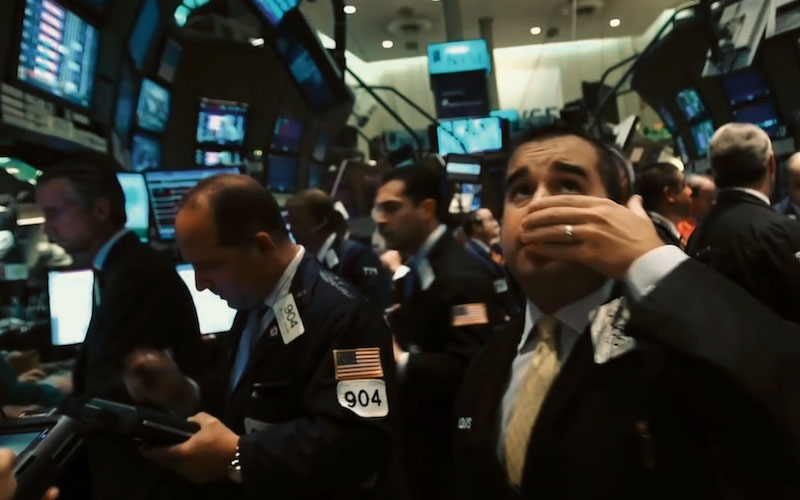
After a nearly 11% surge in US crude oil prices: WTI crude is trading at a rare $3 premium to Brent crude, with a breakout countdown imminent next week?
2026-04-03 18:19:08
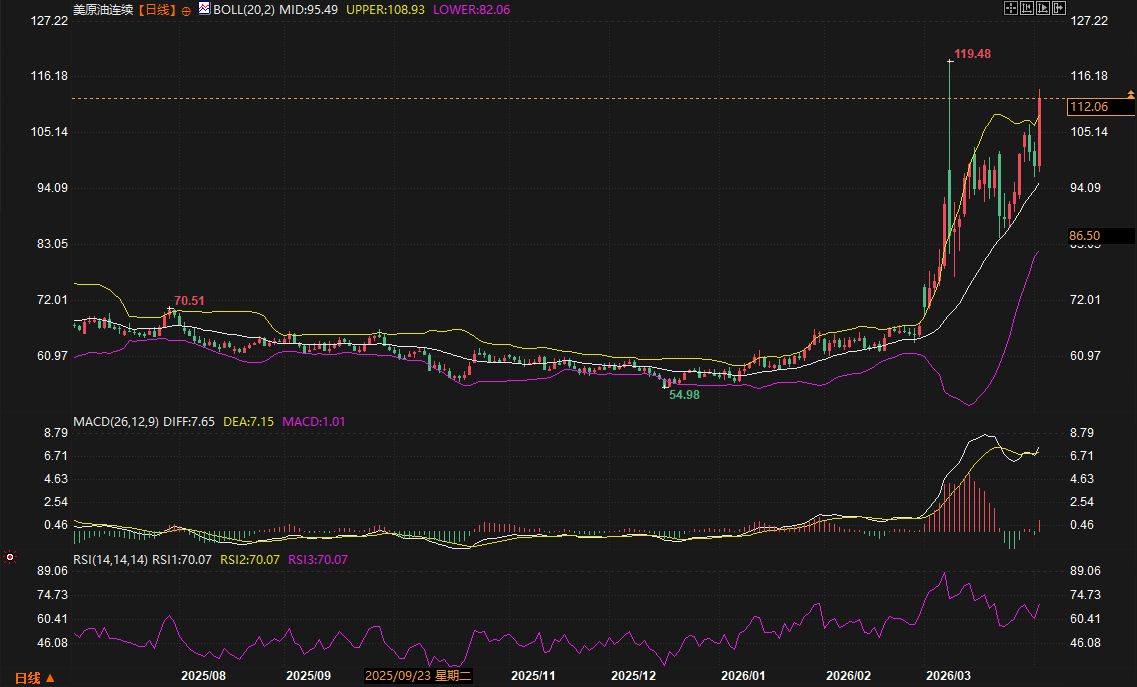
Due to the Good Friday holiday, the global crude oil market only experienced four trading days this week, but the volatility was unprecedented in recent years. The two major benchmark oil prices showed a significant divergence this week. Brent crude rose 2.06% for the week, while WTI crude surged, rising 10.75% to close at $112.06 per barrel. WTI crude saw an unusual premium of nearly $3 over Brent crude, marking its highest level in a year.
From a trend perspective, at the beginning of the week, the market was suppressed by rising expectations of a Fed rate hike and a stronger dollar, leading to strong profit-taking among bulls, with Brent crude oil retreating by more than 15% at one point. However, as geopolitical tensions escalated again mid-week, US crude oil surged by more than 11% on Thursday , marking the highest single-day gain since 2020. This V-shaped reversal, characterized by an initial decline followed by a rise, not only recovered the losses from the beginning of the week but also pushed market volatility to its highest level in nearly six months.
This week, the market's main focus shifted from macroeconomic pressures to expectations of severe supply disruptions. Firstly, the unexpected decline in U.S. domestic crude oil inventories laid the foundation for the strength of U.S. oil prices. With the summer travel peak approaching, domestic demand in the U.S. remains robust.
A more critical variable stems from geopolitical shocks. According to prominent foreign media reports, the US administration recently made strong statements targeting specific oil-producing countries in the Middle East, threatening even more aggressive military action and using extremely harsh language to describe the intensity of future sanctions. This stance has directly led to a surge in traders' concerns about prolonged supply disruptions . Although there are reports that Iran is drafting a monitoring agreement with Oman regarding vessel passage through the Strait of Hormuz, the market is clearly skeptical about the strait's ability to remain unobstructed.
On the macro level, Dallas Fed officials publicly stated that while the U.S. economy has some buffer against the current localized situation, the uncertainty surrounding the outlook is increasing significantly. If oil infrastructure in the affected regions faces direct risks, the expected resumption of oil flows will be forced to be significantly delayed. This uncertainty premium became the dominant force supporting the simultaneous rise in gold and oil prices over the weekend.
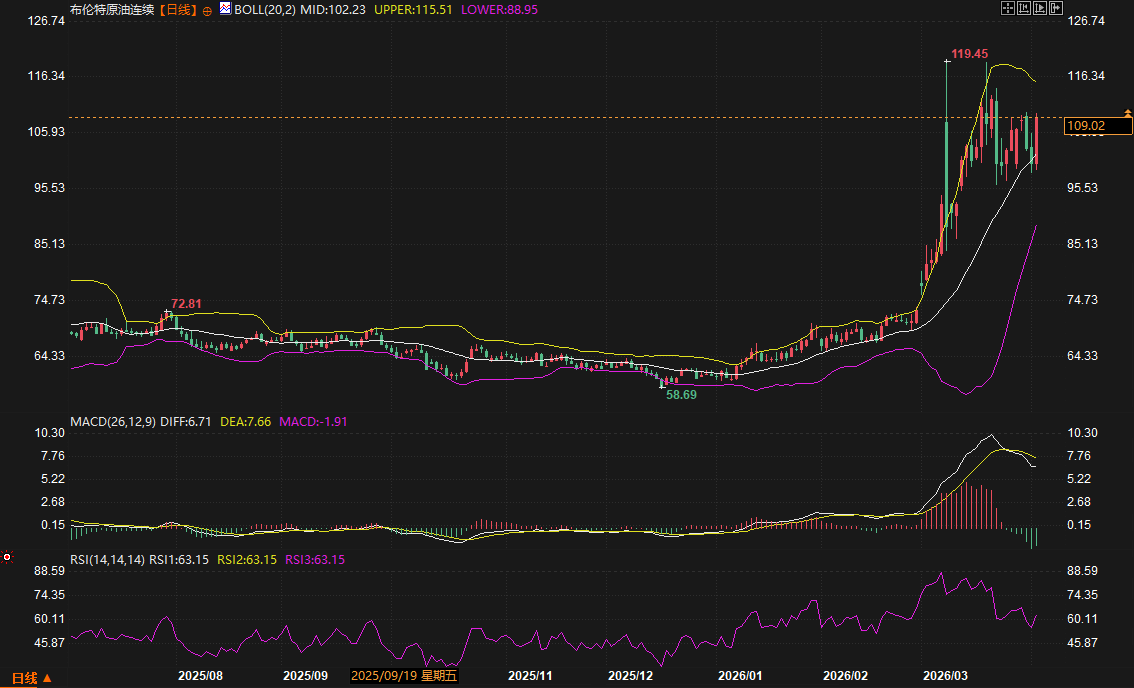
From a technical perspective, the medium- to long-term upward channel for crude oil remains intact since the lows of December 2025. Although this week's sharp fluctuations briefly broke through the Bollinger Band's middle line, buying interest at lower levels emerged very quickly , indicating a strong defensive stance near the $100 mark.
Currently, WTI crude oil's upper Bollinger Band is at $108.93 per barrel, a level that has been effectively broken, indicating a clear short-term overbought condition. Looking at the MACD indicator, the red bars for WTI crude oil are expanding again, and the DIFF and DEA lines are turning upwards again from high levels, showing a second wave of bullish momentum. In contrast, Brent crude oil's MACD shows a death cross pattern, with the DIFF line crossing below the DEA line, reflecting that international benchmark oil prices are struggling more in the face of macroeconomic headwinds , and the divergence between bulls and bears is extremely pronounced across different commodities. The RSI indicator shows that WTI crude oil is once again approaching the overbought threshold of 70, suggesting that short-term risks are accumulating, and investors should be wary of sudden sell-offs due to profit-taking at higher levels.
In anticipation of future market movements, major overseas institutions have generally raised their forecasts for the volatility range. A prominent foreign media outlet quoted a trading director at BOK Financial as saying that the market's core concern has shifted from "whether the Strait of Hormuz will be closed" to "whether oil infrastructure will suffer irreversible damage." This expectation of damage to physical assets is the fundamental reason for the increased risk premium .
In its latest report, Citigroup stated that under the baseline scenario, the average price of Brent crude oil is expected to remain at $95 per barrel in the second half of this year; however, in an optimistic scenario (extremely tight supply), oil prices could reach $130 per barrel. JPMorgan Chase's assessment is even more aggressive, believing that if the restrictions in the Strait of Hormuz continue until mid-May, it is not impossible for global oil prices to reach $150 per barrel .
Furthermore, analysts from institutions such as Again Capital believe that the current extreme premium structure of cross-month contracts reflects panic pricing in the market due to a shortage of physical goods. This premium could collapse rapidly in a short period once geopolitical signals ease. The market is currently in a state of "extreme stress testing," where any rumors about open shipping lanes or changes in production cut policies could trigger price jumps of tens of dollars.
This week's performance in the crude oil market perfectly illustrated the characteristic of "fundamentals giving way to sentiment." Although the Federal Reserve's monetary policy path remains hawkish, macroeconomic pressures appear weak in the face of expectations of a near-shutdown on the supply side. The significant outperformance of WTI crude oil compared to Brent crude is not only due to inventory data, but also because geopolitical conflicts directly threaten the core arteries of global energy supply .
Looking ahead to next week, given the market's irrational surge on Thursday, a technical pullback for confirmation is expected. The $100-$105 range will be a key support level for the bulls, while $120 presents significant psychological and technical resistance. Amidst the intertwined backdrop of tariff rhetoric and geopolitical maneuvering, crude oil is no longer simply a commodity but has become a bargaining chip in geopolitics . Investors should closely monitor the actual passage through the Strait of Hormuz and the diplomatic rhetoric of major oil-producing countries, maintain a range-bound trading strategy, and exercise caution when using leverage until volatility returns to normal.
Question 1: Why did WTI crude oil outperform Brent crude oil this week, even showing a rare inverted premium?
This phenomenon reflects a deep interplay between supply-demand mismatch and geopolitical premiums. First, the difference in delivery dates between the May US crude oil contract and the June Brent crude oil contract means that US oil more directly absorbs the impact of short-term geopolitical deterioration. Second, this week's unexpected decline in US crude oil inventories, coupled with the US government's extremely tough stance towards Middle Eastern oil-producing countries, has led the market to anticipate that if Middle Eastern supplies are disrupted, US crude oil will become the world's primary alternative source, resulting in a concentration of funds in US oil. This premium reflects panic pricing driven by an extreme thirst for near-term spot prices, rather than a long-term improvement in supply and demand.
Question 2: How should we interpret the impact of the US administration's remarks on "military strikes" against the Middle East on the oil market?
These statements shattered previous market hopes for a possible de-escalation of geopolitical tensions. Traders shifted their focus from the progress of diplomatic negotiations to the security of oil infrastructure. If the attack expands to oil production facilities or ports, global oil supply will face an irreversible disruption. This "Stone Age" threat increased tail risk in the market, forcing a large-scale liquidation of short positions before the market closed. As long as this hardline stance remains unchanged, the geopolitical support below oil prices will be difficult to remove.
Question 3: From a technical perspective, the RSI of US crude oil has reached 70. Does this mean that the market will face a sharp drop at the opening next week?
The RSI overbought condition did indeed signal overheating, but this often leads to indicator stagnation in extreme trending markets. With markets closed on Friday, Thursday's explosive rise has released a significant amount of pent-up sentiment. If no substantial positive developments emerge regarding geopolitical tensions over the weekend, a technical pullback is possible early next week to correct the divergence. However, considering the MACD histogram is still expanding and the DIFF line is turning upwards again, this pullback is more likely to be seen as an opportunity for long positions to accumulate rather than a trend reversal, unless the price decisively breaks below the Bollinger Band's middle support.
Question 4: Is the "$150" oil price target proposed by mainstream institutions logically feasible?
Achieving $150 requires the strait's blockade to become the norm. This strait handles about one-fifth of global oil traffic, and if a shutdown lasts longer than a month, there is no spare global production capacity to fully compensate for the shortfall. JPMorgan Chase's view is based on the extreme assumption of an "absolute supply disruption." While this is a low-probability event, its pricing weight is increasing as US rhetoric escalates. Institutions are issuing such predictions primarily to hedge against energy inflation risks in extreme scenarios.
Question 5: For ordinary investors, what is the most critical risk given that volatility has risen to a six-month high?
The core risk lies in "two-way stop-loss triggered by liquidity depletion." In the current political and macroeconomic environment, gaps up or down in crude oil prices will become the norm, with daily fluctuations often reaching $10. In this environment, traditional stop-loss orders are highly susceptible to failure during gaps, leading to slippage risk. Simultaneously, due to the market's highly sensitive state, any unverified social media message can trigger violent price swings. Therefore, controlling position sizing, reducing leverage, and avoiding heavy betting before long weekends are more crucial survival rules than predicting market direction.
From a trend perspective, at the beginning of the week, the market was suppressed by rising expectations of a Fed rate hike and a stronger dollar, leading to strong profit-taking among bulls, with Brent crude oil retreating by more than 15% at one point. However, as geopolitical tensions escalated again mid-week, US crude oil surged by more than 11% on Thursday , marking the highest single-day gain since 2020. This V-shaped reversal, characterized by an initial decline followed by a rise, not only recovered the losses from the beginning of the week but also pushed market volatility to its highest level in nearly six months.
Summary of Economic Data and Key Geopolitical Events
This week, the market's main focus shifted from macroeconomic pressures to expectations of severe supply disruptions. Firstly, the unexpected decline in U.S. domestic crude oil inventories laid the foundation for the strength of U.S. oil prices. With the summer travel peak approaching, domestic demand in the U.S. remains robust.
A more critical variable stems from geopolitical shocks. According to prominent foreign media reports, the US administration recently made strong statements targeting specific oil-producing countries in the Middle East, threatening even more aggressive military action and using extremely harsh language to describe the intensity of future sanctions. This stance has directly led to a surge in traders' concerns about prolonged supply disruptions . Although there are reports that Iran is drafting a monitoring agreement with Oman regarding vessel passage through the Strait of Hormuz, the market is clearly skeptical about the strait's ability to remain unobstructed.
On the macro level, Dallas Fed officials publicly stated that while the U.S. economy has some buffer against the current localized situation, the uncertainty surrounding the outlook is increasing significantly. If oil infrastructure in the affected regions faces direct risks, the expected resumption of oil flows will be forced to be significantly delayed. This uncertainty premium became the dominant force supporting the simultaneous rise in gold and oil prices over the weekend.
Technical Analysis and Key Indicators
From a technical perspective, the medium- to long-term upward channel for crude oil remains intact since the lows of December 2025. Although this week's sharp fluctuations briefly broke through the Bollinger Band's middle line, buying interest at lower levels emerged very quickly , indicating a strong defensive stance near the $100 mark.
Currently, WTI crude oil's upper Bollinger Band is at $108.93 per barrel, a level that has been effectively broken, indicating a clear short-term overbought condition. Looking at the MACD indicator, the red bars for WTI crude oil are expanding again, and the DIFF and DEA lines are turning upwards again from high levels, showing a second wave of bullish momentum. In contrast, Brent crude oil's MACD shows a death cross pattern, with the DIFF line crossing below the DEA line, reflecting that international benchmark oil prices are struggling more in the face of macroeconomic headwinds , and the divergence between bulls and bears is extremely pronounced across different commodities. The RSI indicator shows that WTI crude oil is once again approaching the overbought threshold of 70, suggesting that short-term risks are accumulating, and investors should be wary of sudden sell-offs due to profit-taking at higher levels.
Summary of Analyst and Mainstream Overseas Institutional Views
In anticipation of future market movements, major overseas institutions have generally raised their forecasts for the volatility range. A prominent foreign media outlet quoted a trading director at BOK Financial as saying that the market's core concern has shifted from "whether the Strait of Hormuz will be closed" to "whether oil infrastructure will suffer irreversible damage." This expectation of damage to physical assets is the fundamental reason for the increased risk premium .
In its latest report, Citigroup stated that under the baseline scenario, the average price of Brent crude oil is expected to remain at $95 per barrel in the second half of this year; however, in an optimistic scenario (extremely tight supply), oil prices could reach $130 per barrel. JPMorgan Chase's assessment is even more aggressive, believing that if the restrictions in the Strait of Hormuz continue until mid-May, it is not impossible for global oil prices to reach $150 per barrel .
Furthermore, analysts from institutions such as Again Capital believe that the current extreme premium structure of cross-month contracts reflects panic pricing in the market due to a shortage of physical goods. This premium could collapse rapidly in a short period once geopolitical signals ease. The market is currently in a state of "extreme stress testing," where any rumors about open shipping lanes or changes in production cut policies could trigger price jumps of tens of dollars.
Market Outlook
This week's performance in the crude oil market perfectly illustrated the characteristic of "fundamentals giving way to sentiment." Although the Federal Reserve's monetary policy path remains hawkish, macroeconomic pressures appear weak in the face of expectations of a near-shutdown on the supply side. The significant outperformance of WTI crude oil compared to Brent crude is not only due to inventory data, but also because geopolitical conflicts directly threaten the core arteries of global energy supply .
Looking ahead to next week, given the market's irrational surge on Thursday, a technical pullback for confirmation is expected. The $100-$105 range will be a key support level for the bulls, while $120 presents significant psychological and technical resistance. Amidst the intertwined backdrop of tariff rhetoric and geopolitical maneuvering, crude oil is no longer simply a commodity but has become a bargaining chip in geopolitics . Investors should closely monitor the actual passage through the Strait of Hormuz and the diplomatic rhetoric of major oil-producing countries, maintain a range-bound trading strategy, and exercise caution when using leverage until volatility returns to normal.
QA module
Question 1: Why did WTI crude oil outperform Brent crude oil this week, even showing a rare inverted premium?
This phenomenon reflects a deep interplay between supply-demand mismatch and geopolitical premiums. First, the difference in delivery dates between the May US crude oil contract and the June Brent crude oil contract means that US oil more directly absorbs the impact of short-term geopolitical deterioration. Second, this week's unexpected decline in US crude oil inventories, coupled with the US government's extremely tough stance towards Middle Eastern oil-producing countries, has led the market to anticipate that if Middle Eastern supplies are disrupted, US crude oil will become the world's primary alternative source, resulting in a concentration of funds in US oil. This premium reflects panic pricing driven by an extreme thirst for near-term spot prices, rather than a long-term improvement in supply and demand.
Question 2: How should we interpret the impact of the US administration's remarks on "military strikes" against the Middle East on the oil market?
These statements shattered previous market hopes for a possible de-escalation of geopolitical tensions. Traders shifted their focus from the progress of diplomatic negotiations to the security of oil infrastructure. If the attack expands to oil production facilities or ports, global oil supply will face an irreversible disruption. This "Stone Age" threat increased tail risk in the market, forcing a large-scale liquidation of short positions before the market closed. As long as this hardline stance remains unchanged, the geopolitical support below oil prices will be difficult to remove.
Question 3: From a technical perspective, the RSI of US crude oil has reached 70. Does this mean that the market will face a sharp drop at the opening next week?
The RSI overbought condition did indeed signal overheating, but this often leads to indicator stagnation in extreme trending markets. With markets closed on Friday, Thursday's explosive rise has released a significant amount of pent-up sentiment. If no substantial positive developments emerge regarding geopolitical tensions over the weekend, a technical pullback is possible early next week to correct the divergence. However, considering the MACD histogram is still expanding and the DIFF line is turning upwards again, this pullback is more likely to be seen as an opportunity for long positions to accumulate rather than a trend reversal, unless the price decisively breaks below the Bollinger Band's middle support.
Question 4: Is the "$150" oil price target proposed by mainstream institutions logically feasible?
Achieving $150 requires the strait's blockade to become the norm. This strait handles about one-fifth of global oil traffic, and if a shutdown lasts longer than a month, there is no spare global production capacity to fully compensate for the shortfall. JPMorgan Chase's view is based on the extreme assumption of an "absolute supply disruption." While this is a low-probability event, its pricing weight is increasing as US rhetoric escalates. Institutions are issuing such predictions primarily to hedge against energy inflation risks in extreme scenarios.
Question 5: For ordinary investors, what is the most critical risk given that volatility has risen to a six-month high?
The core risk lies in "two-way stop-loss triggered by liquidity depletion." In the current political and macroeconomic environment, gaps up or down in crude oil prices will become the norm, with daily fluctuations often reaching $10. In this environment, traditional stop-loss orders are highly susceptible to failure during gaps, leading to slippage risk. Simultaneously, due to the market's highly sensitive state, any unverified social media message can trigger violent price swings. Therefore, controlling position sizing, reducing leverage, and avoiding heavy betting before long weekends are more crucial survival rules than predicting market direction.
- Risk Warning and Disclaimer
- The market involves risk, and trading may not be suitable for all investors. This article is for reference only and does not constitute personal investment advice, nor does it take into account certain users’ specific investment objectives, financial situation, or other needs. Any investment decisions made based on this information are at your own risk.