A New Narrative for the US Dollar in the Era of High Oil Prices: Traders Shouldn't Miss Out!
2026-04-03 20:27:09
On Friday, April 3rd, during the Good Friday holiday, trading volumes in major global financial markets are expected to decrease significantly, with liquidity conditions remaining tight. The US dollar index, after rising more than 2% in March, is currently hovering around the 100 mark. Geopolitical factors have driven oil prices significantly higher, and concerns about renewed inflationary pressures continue to intensify, all of which have exacerbated the uncertainty surrounding the Federal Reserve's policy path. In this low-volume environment, traders should focus on analyzing the marginal impact of fundamental signals on exchange rates, rather than relying on short-term price fluctuations.

The US dollar index rebounded from near its year-to-date lows in March, accumulating a gain of over 2%, and maintained a high-level consolidation around the 100 mark during the first trading session of April. This trend was mainly driven by risk aversion dominating the market and renewed inflation concerns triggered by a sharp rise in oil prices. Traders observed that the dollar performed steadily against a basket of major currencies, especially during the European and Asian sessions when safe-haven demand was concentrated. In contrast, other major currencies faced pressure from divergent central bank policies. At current levels, the dollar index has moved away from its late 2025 lows, but its upward momentum remains limited by the Federal Reserve's overall cautious stance. Any further rise in oil prices or escalation of geopolitical tensions could strengthen the dollar's safe-haven appeal, while a recovery in risk appetite could trigger profit-taking, leading to a temporary pullback in the index.
Crude oil prices have been significantly driven up by geopolitical factors, and market concerns about runaway inflation have become a major support for the strengthening of the US dollar index. Traders generally believe that rising energy prices will quickly transmit to the overall price level through production costs and the consumption chain, thereby affecting the Federal Reserve's assessment of price stability. The rebound of the US dollar index in March unfolded against this backdrop, and the index volatility also increased accordingly in early April. Compared with the same period in history, current oil prices have clearly moved out of the low range, which has not only amplified the pressure on the global supply chain but also provided additional nominal support for the US dollar. Traders need to closely monitor the structure of the crude oil futures curve and inventory data to determine whether this transmission will continue to strengthen the defensive attributes of the US dollar index, rather than simply attributing it to a single event shock.
Federal Reserve Chairman Jerome Powell pointed out this week that there is an inherent tension between the two mandates of maximum employment and price stability, and that the current position is appropriate for a wait-and-see approach. He emphasized that the current situation is complex and requires more data to confirm trends. New York Fed President John Williams also stated that the job market is sending clear signals, and low hiring rates could further exacerbate economic pessimism. These statements have reinforced market expectations that the Fed will maintain its current interest rate range. According to the latest pricing, the probability of the Fed's policy rate remaining in the 3.5%-3.75% range until the end of 2026 is approximately 80%, a significant decrease from the multiple rate cut expectations in early March. Traders need to assess whether oil-driven inflation risks will change this pricing logic: if inflationary pressures continue to exceed expectations, it may prompt the market to repric for a longer period of high interest rates, thus providing additional upward momentum for the dollar index; conversely, if the risks gradually ease, it may weaken the relative attractiveness of the dollar.
The current global market is gripped by risk aversion, providing significant support for the US dollar index. Traders have noted that safe-haven funds tend to concentrate on dollar assets before the holidays, resulting in strong technical support for the index at the 100 level. Statements from Federal Reserve officials have further solidified the "data-dependent" framework, leading traders to prefer waiting for confirmation of subsequent inflation and growth signals rather than betting on a directional breakout in advance. Under this framework, the dollar index may continue to fluctuate around 100 in the short term, but any unexpected changes in geopolitical or inflation data could quickly amplify volatility, testing market pricing efficiency.
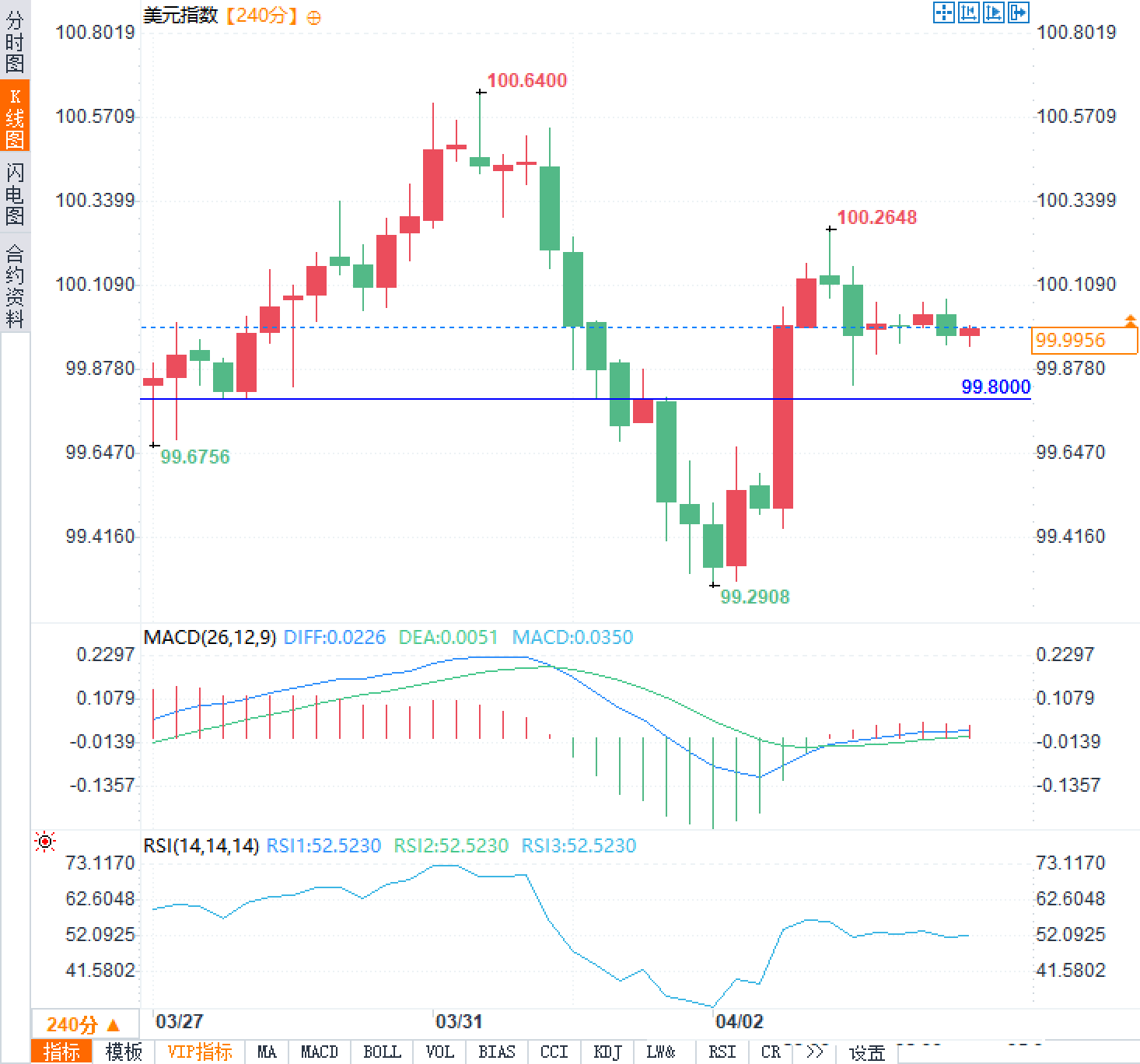
US Dollar Index Performance in March and Key Drivers
The US dollar index rebounded from near its year-to-date lows in March, accumulating a gain of over 2%, and maintained a high-level consolidation around the 100 mark during the first trading session of April. This trend was mainly driven by risk aversion dominating the market and renewed inflation concerns triggered by a sharp rise in oil prices. Traders observed that the dollar performed steadily against a basket of major currencies, especially during the European and Asian sessions when safe-haven demand was concentrated. In contrast, other major currencies faced pressure from divergent central bank policies. At current levels, the dollar index has moved away from its late 2025 lows, but its upward momentum remains limited by the Federal Reserve's overall cautious stance. Any further rise in oil prices or escalation of geopolitical tensions could strengthen the dollar's safe-haven appeal, while a recovery in risk appetite could trigger profit-taking, leading to a temporary pullback in the index.
The transmission of rising oil prices to inflation expectations and the US dollar
Crude oil prices have been significantly driven up by geopolitical factors, and market concerns about runaway inflation have become a major support for the strengthening of the US dollar index. Traders generally believe that rising energy prices will quickly transmit to the overall price level through production costs and the consumption chain, thereby affecting the Federal Reserve's assessment of price stability. The rebound of the US dollar index in March unfolded against this backdrop, and the index volatility also increased accordingly in early April. Compared with the same period in history, current oil prices have clearly moved out of the low range, which has not only amplified the pressure on the global supply chain but also provided additional nominal support for the US dollar. Traders need to closely monitor the structure of the crude oil futures curve and inventory data to determine whether this transmission will continue to strengthen the defensive attributes of the US dollar index, rather than simply attributing it to a single event shock.
Uncertainty surrounding the Federal Reserve's policy path
Federal Reserve Chairman Jerome Powell pointed out this week that there is an inherent tension between the two mandates of maximum employment and price stability, and that the current position is appropriate for a wait-and-see approach. He emphasized that the current situation is complex and requires more data to confirm trends. New York Fed President John Williams also stated that the job market is sending clear signals, and low hiring rates could further exacerbate economic pessimism. These statements have reinforced market expectations that the Fed will maintain its current interest rate range. According to the latest pricing, the probability of the Fed's policy rate remaining in the 3.5%-3.75% range until the end of 2026 is approximately 80%, a significant decrease from the multiple rate cut expectations in early March. Traders need to assess whether oil-driven inflation risks will change this pricing logic: if inflationary pressures continue to exceed expectations, it may prompt the market to repric for a longer period of high interest rates, thus providing additional upward momentum for the dollar index; conversely, if the risks gradually ease, it may weaken the relative attractiveness of the dollar.
Market dynamics in a risk-averse environment
The current global market is gripped by risk aversion, providing significant support for the US dollar index. Traders have noted that safe-haven funds tend to concentrate on dollar assets before the holidays, resulting in strong technical support for the index at the 100 level. Statements from Federal Reserve officials have further solidified the "data-dependent" framework, leading traders to prefer waiting for confirmation of subsequent inflation and growth signals rather than betting on a directional breakout in advance. Under this framework, the dollar index may continue to fluctuate around 100 in the short term, but any unexpected changes in geopolitical or inflation data could quickly amplify volatility, testing market pricing efficiency.
- Risk Warning and Disclaimer
- The market involves risk, and trading may not be suitable for all investors. This article is for reference only and does not constitute personal investment advice, nor does it take into account certain users’ specific investment objectives, financial situation, or other needs. Any investment decisions made based on this information are at your own risk.