The tensions between the US and Iran are palpable, yet these central banks are selling gold? The reason might surprise you.
2026-04-07 21:20:25
On Tuesday (April 7th), global financial markets were on edge, watching the unfolding situation in the Middle East. The conflict, which began on February 28th, 2026, has entered its sixth week since the escalation of tensions between the US and Iran. Despite rumors last week that Pakistan's mediation efforts had entered a "critical phase," the US's "April 8th ultimatum" hung like a Damocles' sword over the markets.
This highly uncertain environment should have been a prime time for gold to shine as a safe-haven asset, but the market has presented a strange divergence: While tensions between the US and Iran have escalated, international gold prices recorded their worst monthly performance since 2008 in March. Meanwhile, US crude oil prices have hovered at high levels, and the US dollar and US Treasury yields have maintained strong volatility. This phenomenon has puzzled many investors: Is the situation about to reverse? Or have central banks lost faith in gold?
In fact, this divergence is not a failure of the hedging logic, but rather a secondary disaster brought about by war—liquidity crisis and soaring energy costs are reshaping the short-term trends of major asset classes.
To understand this seemingly contradictory phenomenon, we must look beyond the surface to the essence: some countries are selling gold not because they are "bearish," but because they are "in dire need."
1. War Costs Take Priority Over Reserve Diversification <br />The stalemate between the US and Iran has directly resulted in disrupted shipping in the Strait of Hormuz, causing US crude oil prices to remain above $100 per barrel for an extended period, reaching $ 115.04 on April 7th. For energy-dependent countries like Turkey, high oil prices mean a sharp widening of the trade deficit. To pay exorbitant energy bills and defend their currencies which are teetering on the brink of collapse, selling highly liquid gold has become the most desperate yet quickest option. Turkey has sold approximately 60 tons of gold since the war began, essentially due to the economic pressure caused by the conflict.
2. Gold's "Emergency Cash" Attribute is Aroused <br />Gold serves as a "strategic reserve" for de-dollarization during peacetime, but in the face of inflationary crises triggered by war, it becomes "life-saving money in the end times." With the US dollar index currently hovering around 99.9165 and the market widely expecting the Federal Reserve not to cut interest rates this year, the opportunity cost of holding gold (its non-interest-bearing asset attribute) is amplified against the backdrop of a 10-year US Treasury yield as high as 4.332% . For economies facing sanctions and financing pressures, selling gold to obtain dollar cash to maintain defense and basic fiscal needs is a more urgent task than long-term reserves.
3. Structural buying has not stopped . It needs to be clarified that central banks as a whole have not shifted their stance. Data from well-known institutions shows that global central banks are expected to continue net buying 850 tons of gold in 2026. Major countries like China have been increasing their holdings for 17 consecutive months. This divergence in operations between large and small countries, and between importing and exporting countries, precisely illustrates the uneven impact of war on the global economy.
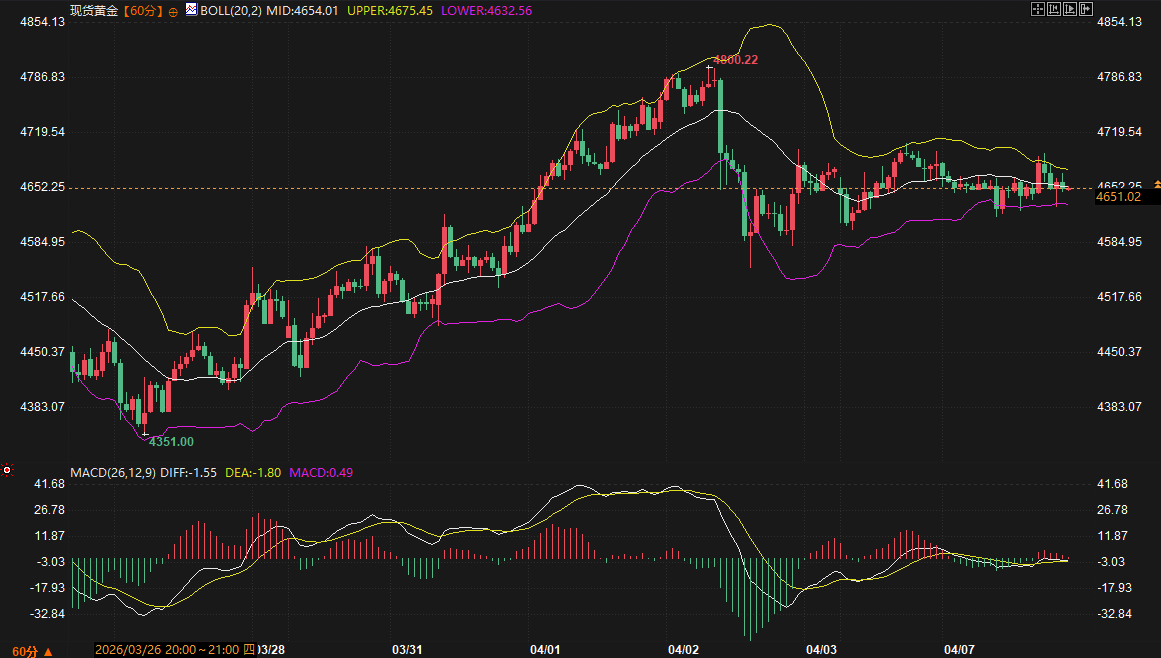
Spot Gold: Choosing Direction Amidst High-Level Consolidation <br/>From a 60-minute chart perspective, spot gold is currently priced at 4651.02 , in a delicate balance. Technically, the Bollinger Bands have converged and flattened, with the price oscillating closely around the middle band. Although the MACD has formed a golden cross below the zero line, the histogram is weak, indicating that the rebound momentum is constrained by strong resistance in the 4675-4680 range.
Resistance range : Short-term resistance is located at the upper Bollinger Band at 4675 and the extended resistance level of the April 2 high at 4700 .
Support range : Watch the lower support level at 4632. If it breaks below this level, it may retest the previous low of 4351 .
Logic : Gold prices are currently caught in a tug-of-war between "safe-haven demand" and "liquidity sell-offs under high interest rates," and are highly susceptible to the impact of the April 8th ultimatum outcome in the short term.
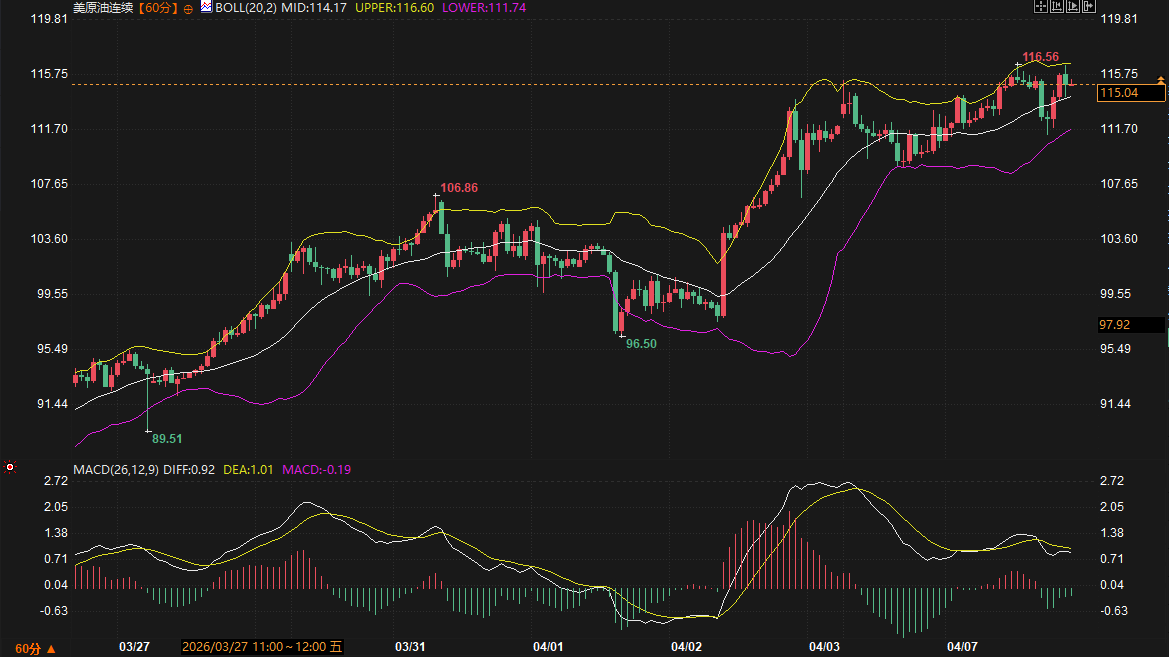
US Crude Oil: Fear of Heights Amidst a Bullish Trend <br />Crude oil prices have recently shown extreme strength, exhibiting a V-shaped reversal. On the 60-minute chart, the price is at 115.04 , with the Bollinger Bands widening upwards, exhibiting a typical bullish alignment. Although the MACD lines are above the zero line, the histogram has slightly turned negative, suggesting a need for correction after the rapid short-term upward movement.
Resistance zone : The upper Bollinger Band at 116.60 and the previous high are the key resistance levels.
Support range : The first support level is at the middle Bollinger Band at 114.17 , and the strong support level is at 111.74 .
Logic : The expectation of a blockade of the Strait of Hormuz is the strongest geopolitical premium for oil prices. As long as there is no substantial progress in negotiations, oil prices are more likely to rise than fall.
US Dollar and US Treasuries: Consolidating at High Levels Awaiting Signals
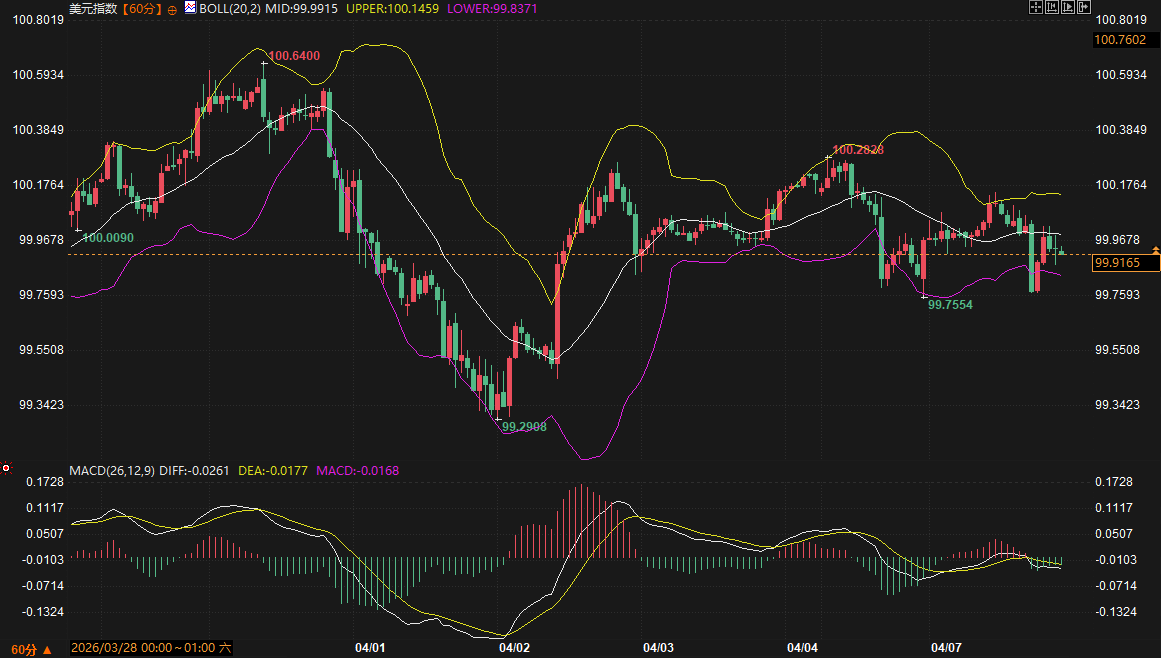
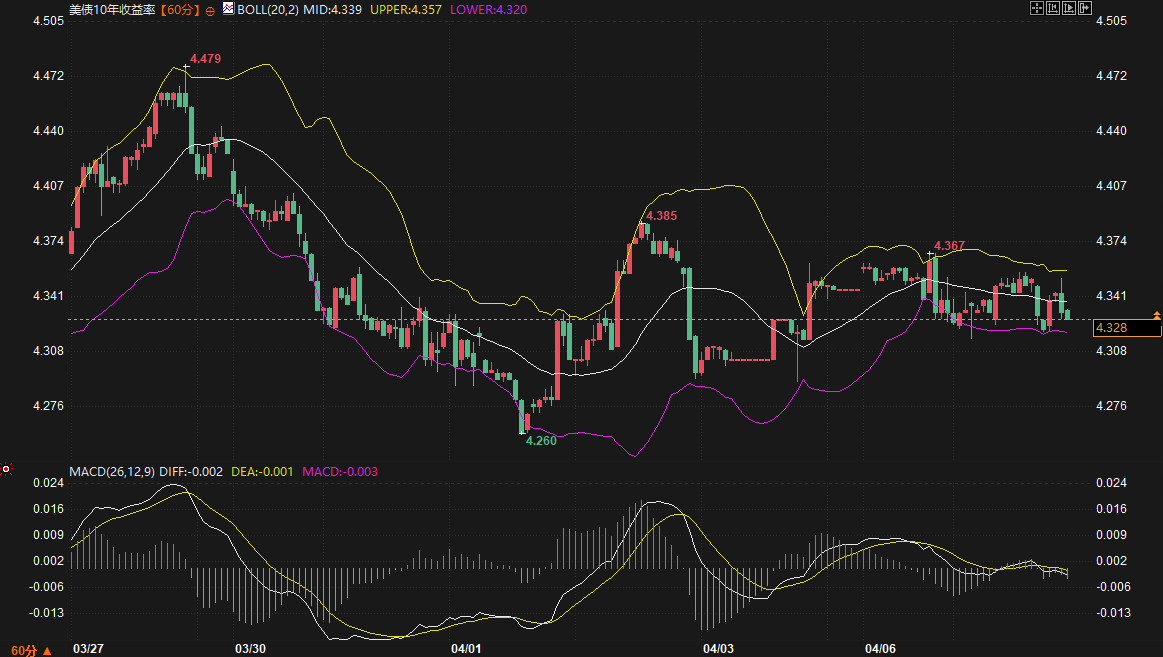
The US dollar index (latest at 99.9165 ) and the 10-year US Treasury yield ( 4.332% ) show a very high degree of consistency. The 4-hour chart shows that the Bollinger Bands for the US Treasury yield are severely narrowing, and the MACD lines are converging, reflecting a temporary "terror balance" reached in the market between the Fed's policy signals and geopolitical risks.
US Dollar Range Forecast : The trading range is locked at 99.80 - 100.20 . A break below 99.83 will open up downside potential; conversely, if safe-haven buying intensifies, it will return above 100 .
US Treasury yield range : fluctuating between 4.26% and 4.38% .
The next 48-72 hours will be a window of opportunity to determine short-term trends.
First, crude oil is expected to maintain a slightly bullish trend with fluctuations. As the April 8th ultimatum deadline approaches, market concerns about supply disruptions will peak, and oil prices may seek a breakout opportunity around $ 116 . If the situation changes abruptly, further upward movement cannot be ruled out.
Secondly, spot gold is likely to maintain high volatility within the 4630-4680 range. On the one hand, selling by some central banks and the strength of the US dollar have suppressed gains; on the other hand, the sense of urgency in geopolitical tensions provides bottom support. Without seeing signs of a substantial ceasefire or a full-blown escalation of the war, gold is unlikely to establish a unilateral trend.
Finally, due to the frozen expectations of a Fed rate cut, the US dollar will remain a safe haven for global liquidity in the short term, fluctuating around the 100 mark.
1. Does the central bank's sale of gold mean that gold is no longer a safe-haven asset?
A: No, that's not the case. The current selling activity is primarily driven by countries like Turkey seeking to liquidate assets to address currency crises and energy deficits caused by war; it's a forced liquidity operation. Meanwhile, countries like China and India continue to increase their holdings, indicating that gold's strategic position as a hedge against dollar credit risk remains unshaken.
2. Why did oil prices see a slight correction even though the Iraq War hasn't ended?
A: The current slight pullback is a technical correction. Oil prices have risen significantly from around $ 89 at the end of March to above $ 116 , and some profit-takers are choosing to cash in before the April 8th ultimatum expires. As long as the expectation of a blockade of the Strait of Hormuz persists, the structural support for oil prices remains very strong.
3. What does a 4.33% US Treasury yield mean for gold?
A: This creates a "ceiling" effect. High yields mean that holding non-interest-bearing gold will result in a significant loss of interest income. Therefore, unless risk aversion can overcome interest rate pressures, gold prices will find it difficult to break through previous highs.
4. Will Trump's tariff rhetoric affect these assets?
A: Tariff-related comments typically boost inflation expectations and benefit the US dollar. In the current context of war, such comments further reinforce market expectations that the high-interest-rate environment will persist for longer, indirectly suppressing gold's valuation.
5. What data or news should we pay the most attention to in the next two or three days?
A: The most crucial variables are Iran's response to the US ultimatum of April 8th and the actual navigation status of the Strait of Hormuz. Any news regarding an escalation of the blockade or an unexpected ceasefire would instantly shatter the current trading range for various commodities.
This highly uncertain environment should have been a prime time for gold to shine as a safe-haven asset, but the market has presented a strange divergence: While tensions between the US and Iran have escalated, international gold prices recorded their worst monthly performance since 2008 in March. Meanwhile, US crude oil prices have hovered at high levels, and the US dollar and US Treasury yields have maintained strong volatility. This phenomenon has puzzled many investors: Is the situation about to reverse? Or have central banks lost faith in gold?
In fact, this divergence is not a failure of the hedging logic, but rather a secondary disaster brought about by war—liquidity crisis and soaring energy costs are reshaping the short-term trends of major asset classes.
Why are some central banks selling gold despite the escalating tensions?
To understand this seemingly contradictory phenomenon, we must look beyond the surface to the essence: some countries are selling gold not because they are "bearish," but because they are "in dire need."
1. War Costs Take Priority Over Reserve Diversification <br />The stalemate between the US and Iran has directly resulted in disrupted shipping in the Strait of Hormuz, causing US crude oil prices to remain above $100 per barrel for an extended period, reaching $ 115.04 on April 7th. For energy-dependent countries like Turkey, high oil prices mean a sharp widening of the trade deficit. To pay exorbitant energy bills and defend their currencies which are teetering on the brink of collapse, selling highly liquid gold has become the most desperate yet quickest option. Turkey has sold approximately 60 tons of gold since the war began, essentially due to the economic pressure caused by the conflict.
2. Gold's "Emergency Cash" Attribute is Aroused <br />Gold serves as a "strategic reserve" for de-dollarization during peacetime, but in the face of inflationary crises triggered by war, it becomes "life-saving money in the end times." With the US dollar index currently hovering around 99.9165 and the market widely expecting the Federal Reserve not to cut interest rates this year, the opportunity cost of holding gold (its non-interest-bearing asset attribute) is amplified against the backdrop of a 10-year US Treasury yield as high as 4.332% . For economies facing sanctions and financing pressures, selling gold to obtain dollar cash to maintain defense and basic fiscal needs is a more urgent task than long-term reserves.
3. Structural buying has not stopped . It needs to be clarified that central banks as a whole have not shifted their stance. Data from well-known institutions shows that global central banks are expected to continue net buying 850 tons of gold in 2026. Major countries like China have been increasing their holdings for 17 consecutive months. This divergence in operations between large and small countries, and between importing and exporting countries, precisely illustrates the uneven impact of war on the global economy.
In-depth technical analysis and range forecast for each commodity
Spot Gold: Choosing Direction Amidst High-Level Consolidation <br/>From a 60-minute chart perspective, spot gold is currently priced at 4651.02 , in a delicate balance. Technically, the Bollinger Bands have converged and flattened, with the price oscillating closely around the middle band. Although the MACD has formed a golden cross below the zero line, the histogram is weak, indicating that the rebound momentum is constrained by strong resistance in the 4675-4680 range.
Resistance range : Short-term resistance is located at the upper Bollinger Band at 4675 and the extended resistance level of the April 2 high at 4700 .
Support range : Watch the lower support level at 4632. If it breaks below this level, it may retest the previous low of 4351 .
Logic : Gold prices are currently caught in a tug-of-war between "safe-haven demand" and "liquidity sell-offs under high interest rates," and are highly susceptible to the impact of the April 8th ultimatum outcome in the short term.
US Crude Oil: Fear of Heights Amidst a Bullish Trend <br />Crude oil prices have recently shown extreme strength, exhibiting a V-shaped reversal. On the 60-minute chart, the price is at 115.04 , with the Bollinger Bands widening upwards, exhibiting a typical bullish alignment. Although the MACD lines are above the zero line, the histogram has slightly turned negative, suggesting a need for correction after the rapid short-term upward movement.
Resistance zone : The upper Bollinger Band at 116.60 and the previous high are the key resistance levels.
Support range : The first support level is at the middle Bollinger Band at 114.17 , and the strong support level is at 111.74 .
Logic : The expectation of a blockade of the Strait of Hormuz is the strongest geopolitical premium for oil prices. As long as there is no substantial progress in negotiations, oil prices are more likely to rise than fall.
US Dollar and US Treasuries: Consolidating at High Levels Awaiting Signals
The US dollar index (latest at 99.9165 ) and the 10-year US Treasury yield ( 4.332% ) show a very high degree of consistency. The 4-hour chart shows that the Bollinger Bands for the US Treasury yield are severely narrowing, and the MACD lines are converging, reflecting a temporary "terror balance" reached in the market between the Fed's policy signals and geopolitical risks.
US Dollar Range Forecast : The trading range is locked at 99.80 - 100.20 . A break below 99.83 will open up downside potential; conversely, if safe-haven buying intensifies, it will return above 100 .
US Treasury yield range : fluctuating between 4.26% and 4.38% .
Outlook for the next 2-3 days
The next 48-72 hours will be a window of opportunity to determine short-term trends.
First, crude oil is expected to maintain a slightly bullish trend with fluctuations. As the April 8th ultimatum deadline approaches, market concerns about supply disruptions will peak, and oil prices may seek a breakout opportunity around $ 116 . If the situation changes abruptly, further upward movement cannot be ruled out.
Secondly, spot gold is likely to maintain high volatility within the 4630-4680 range. On the one hand, selling by some central banks and the strength of the US dollar have suppressed gains; on the other hand, the sense of urgency in geopolitical tensions provides bottom support. Without seeing signs of a substantial ceasefire or a full-blown escalation of the war, gold is unlikely to establish a unilateral trend.
Finally, due to the frozen expectations of a Fed rate cut, the US dollar will remain a safe haven for global liquidity in the short term, fluctuating around the 100 mark.
Frequently Asked Questions
1. Does the central bank's sale of gold mean that gold is no longer a safe-haven asset?
A: No, that's not the case. The current selling activity is primarily driven by countries like Turkey seeking to liquidate assets to address currency crises and energy deficits caused by war; it's a forced liquidity operation. Meanwhile, countries like China and India continue to increase their holdings, indicating that gold's strategic position as a hedge against dollar credit risk remains unshaken.
2. Why did oil prices see a slight correction even though the Iraq War hasn't ended?
A: The current slight pullback is a technical correction. Oil prices have risen significantly from around $ 89 at the end of March to above $ 116 , and some profit-takers are choosing to cash in before the April 8th ultimatum expires. As long as the expectation of a blockade of the Strait of Hormuz persists, the structural support for oil prices remains very strong.
3. What does a 4.33% US Treasury yield mean for gold?
A: This creates a "ceiling" effect. High yields mean that holding non-interest-bearing gold will result in a significant loss of interest income. Therefore, unless risk aversion can overcome interest rate pressures, gold prices will find it difficult to break through previous highs.
4. Will Trump's tariff rhetoric affect these assets?
A: Tariff-related comments typically boost inflation expectations and benefit the US dollar. In the current context of war, such comments further reinforce market expectations that the high-interest-rate environment will persist for longer, indirectly suppressing gold's valuation.
5. What data or news should we pay the most attention to in the next two or three days?
A: The most crucial variables are Iran's response to the US ultimatum of April 8th and the actual navigation status of the Strait of Hormuz. Any news regarding an escalation of the blockade or an unexpected ceasefire would instantly shatter the current trading range for various commodities.
- Risk Warning and Disclaimer
- The market involves risk, and trading may not be suitable for all investors. This article is for reference only and does not constitute personal investment advice, nor does it take into account certain users’ specific investment objectives, financial situation, or other needs. Any investment decisions made based on this information are at your own risk.