Risk aversion subsided, and the dollar index fell to near the 99 level, awaiting guidance from the Federal Reserve minutes.
2026-04-08 09:41:10
The US dollar index remained under pressure during Wednesday's Asian session, currently trading around 99.05 , continuing the decline from the previous trading day. The main factor driving the dollar's weakness is the temporary easing of tensions in the Middle East, with US President Trump announcing a two-week suspension of military action against Iran. This decision significantly reduced market demand for safe-haven assets.
A foreign exchange strategist pointed out: "As the conflict cools down in the short term and market risk appetite rebounds, the attractiveness of the US dollar as a safe-haven asset has clearly declined."
Judging from the developments, this suspension of operations came with a condition: Iran must reopen the Strait of Hormuz for passage. Iran stated that, in coordination with its armed forces, it would allow safe passage through this crucial waterway within the next two weeks. This statement alleviated market concerns about energy supply disruptions to some extent, thereby weakening the safe-haven support for the US dollar.
The Strait of Hormuz handles approximately 20% of global maritime energy transport , and its navigation status directly impacts global market stability expectations. As expectations for the strait's reopening rise, market risk sentiment has improved significantly, with funds flowing from safe-haven assets to risk assets, further suppressing the US dollar's performance.
Meanwhile, market focus is gradually shifting to the upcoming release of the Federal Reserve meeting minutes. These minutes will reveal policymakers' assessment of the recent energy shock and the path of inflation, thus providing clues for future policy direction. Particularly given the current backdrop of heightened energy price volatility, the market hopes to glean more information from the minutes regarding the sustainability of inflation and the path of interest rates.
Some institutions believe that "if the minutes release a hawkish signal, the US dollar may receive some support in the short term, but the overall trend will still depend on changes in risk sentiment."
From the perspective of interest rate expectations, the market remains divided on the policy path. Market surveys indicate that the current market expects a probability of an interest rate cut this year of approximately 40% , which to some extent limits the upside potential of the US dollar. If subsequent data further confirms an economic slowdown or a decline in inflation, expectations of an interest rate cut may continue to rise, thus putting sustained pressure on the US dollar.
From a market sentiment perspective, the current dollar trend is clearly influenced by both a weakening of its safe-haven appeal and increased policy uncertainty. On the one hand, easing geopolitical risks have reduced demand for the dollar; on the other hand, the Federal Reserve's policy path remains unclear, keeping investors cautious.
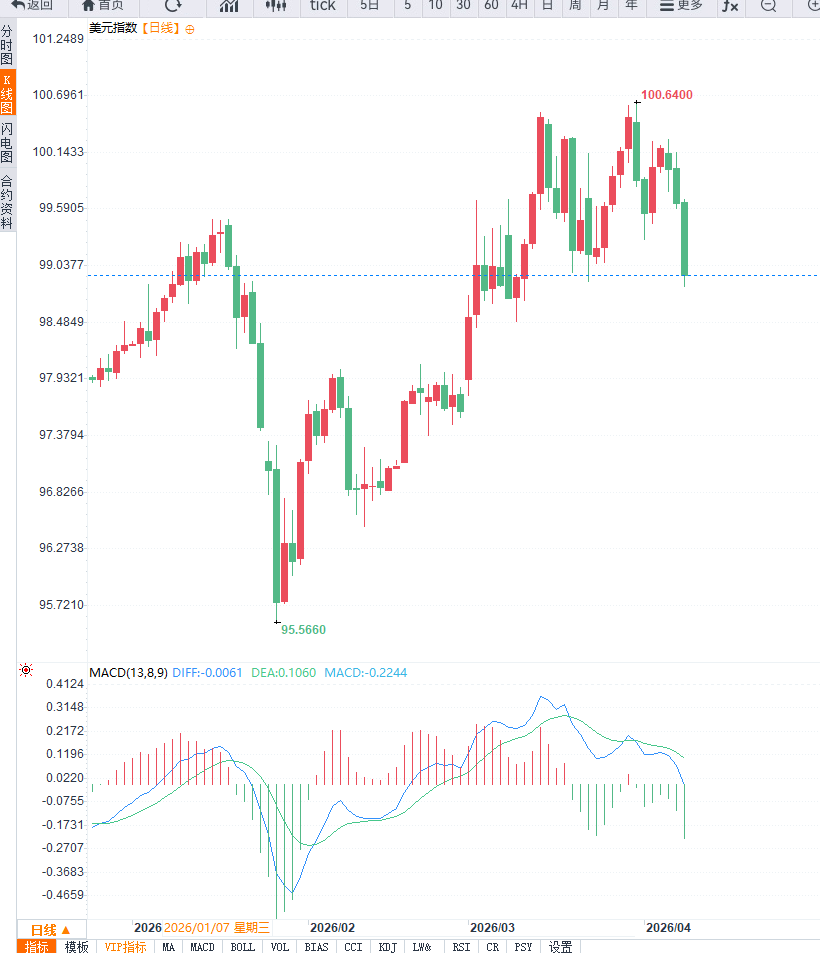
From a technical perspective, the daily chart shows that the US dollar index has entered a weak and volatile pattern after falling from its highs. It has now broken below its short-term equilibrium range, and the overall trend has shifted from strong to weak. The 98.50 area forms key support ; a further break below this level could open up new downside potential. Resistance is concentrated around the 100 level, which serves as both a psychological barrier and technical resistance. Momentum-wise, bearish forces are gradually increasing, but a clear trend has not yet formed. The 4-hour chart shows a short-term downward trend; if the rebound fails to break through the 100 level, the market will likely remain in a weak consolidation phase. However, an unexpected recovery above this level could trigger a technical rebound.
Overall, the US dollar index is currently at a critical juncture where fundamentals and sentiment are intertwined. If geopolitical tensions ease further and the Federal Reserve releases dovish signals, the dollar may continue to decline; conversely, if policies become hawkish or tensions escalate again, the dollar still has room to rebound.
Editor's Summary : The core driver of this round of dollar decline is the decrease in safe-haven demand due to the easing of tensions in the Middle East, coupled with market uncertainty regarding the Federal Reserve's policy path, putting short-term pressure on the dollar. Structurally, the dollar's trajectory is gradually shifting from a single safe-haven-driven model to a dual-driven model of "policy + sentiment." Whether the dollar can stabilize and rebound in the future will depend on two key variables: first, whether geopolitical risks continue to cool; and second, whether the Federal Reserve releases clearer policy signals. Against this backdrop, the dollar may maintain a volatile pattern in the short term, while its medium- to long-term direction still needs further confirmation from macroeconomic data.
A foreign exchange strategist pointed out: "As the conflict cools down in the short term and market risk appetite rebounds, the attractiveness of the US dollar as a safe-haven asset has clearly declined."
Judging from the developments, this suspension of operations came with a condition: Iran must reopen the Strait of Hormuz for passage. Iran stated that, in coordination with its armed forces, it would allow safe passage through this crucial waterway within the next two weeks. This statement alleviated market concerns about energy supply disruptions to some extent, thereby weakening the safe-haven support for the US dollar.
The Strait of Hormuz handles approximately 20% of global maritime energy transport , and its navigation status directly impacts global market stability expectations. As expectations for the strait's reopening rise, market risk sentiment has improved significantly, with funds flowing from safe-haven assets to risk assets, further suppressing the US dollar's performance.
Meanwhile, market focus is gradually shifting to the upcoming release of the Federal Reserve meeting minutes. These minutes will reveal policymakers' assessment of the recent energy shock and the path of inflation, thus providing clues for future policy direction. Particularly given the current backdrop of heightened energy price volatility, the market hopes to glean more information from the minutes regarding the sustainability of inflation and the path of interest rates.
Some institutions believe that "if the minutes release a hawkish signal, the US dollar may receive some support in the short term, but the overall trend will still depend on changes in risk sentiment."
From the perspective of interest rate expectations, the market remains divided on the policy path. Market surveys indicate that the current market expects a probability of an interest rate cut this year of approximately 40% , which to some extent limits the upside potential of the US dollar. If subsequent data further confirms an economic slowdown or a decline in inflation, expectations of an interest rate cut may continue to rise, thus putting sustained pressure on the US dollar.
From a market sentiment perspective, the current dollar trend is clearly influenced by both a weakening of its safe-haven appeal and increased policy uncertainty. On the one hand, easing geopolitical risks have reduced demand for the dollar; on the other hand, the Federal Reserve's policy path remains unclear, keeping investors cautious.
From a technical perspective, the daily chart shows that the US dollar index has entered a weak and volatile pattern after falling from its highs. It has now broken below its short-term equilibrium range, and the overall trend has shifted from strong to weak. The 98.50 area forms key support ; a further break below this level could open up new downside potential. Resistance is concentrated around the 100 level, which serves as both a psychological barrier and technical resistance. Momentum-wise, bearish forces are gradually increasing, but a clear trend has not yet formed. The 4-hour chart shows a short-term downward trend; if the rebound fails to break through the 100 level, the market will likely remain in a weak consolidation phase. However, an unexpected recovery above this level could trigger a technical rebound.
Overall, the US dollar index is currently at a critical juncture where fundamentals and sentiment are intertwined. If geopolitical tensions ease further and the Federal Reserve releases dovish signals, the dollar may continue to decline; conversely, if policies become hawkish or tensions escalate again, the dollar still has room to rebound.
Editor's Summary : The core driver of this round of dollar decline is the decrease in safe-haven demand due to the easing of tensions in the Middle East, coupled with market uncertainty regarding the Federal Reserve's policy path, putting short-term pressure on the dollar. Structurally, the dollar's trajectory is gradually shifting from a single safe-haven-driven model to a dual-driven model of "policy + sentiment." Whether the dollar can stabilize and rebound in the future will depend on two key variables: first, whether geopolitical risks continue to cool; and second, whether the Federal Reserve releases clearer policy signals. Against this backdrop, the dollar may maintain a volatile pattern in the short term, while its medium- to long-term direction still needs further confirmation from macroeconomic data.
- Risk Warning and Disclaimer
- The market involves risk, and trading may not be suitable for all investors. This article is for reference only and does not constitute personal investment advice, nor does it take into account certain users’ specific investment objectives, financial situation, or other needs. Any investment decisions made based on this information are at your own risk.