Eurozone PMI fell to a nine-month low in March as Middle East conflict pushed up energy costs and threatened economic growth.
2026-04-08 15:05:09
According to APP, data released by Standard & Poor's Global on March 7 showed that private sector economic activity in the Eurozone slowed significantly in March, affected by factors such as rising energy costs and supply chain disruptions caused by the Middle East conflict. The data showed that the final reading of the Eurozone's composite Purchasing Managers' Index (PMI) for March fell to 50.7 from 51.9 in February, the lowest level in nine months. By sector, the final reading of the Eurozone's services PMI for March declined to 50.2 from 51.9 in February, the lowest level in ten months. Chris Williamson, chief business economist at the survey agency, believes that the March PMI data indicates that the Middle East conflict has dealt a heavy blow to the Eurozone economy. He pointed out that the growth signs that appeared in the Eurozone at the beginning of this year have disappeared due to factors such as soaring energy prices, supply chain disruptions, financial market turmoil, and a renewed decline in demand. Rising prices have raised concerns about stagflation or even a worse situation in the short term. Chris Williamson further stated that unless the Middle East conflict is resolved quickly, the Eurozone economy may face the risk of contraction in the second quarter of this year; even if the conflict ends quickly, the destructive impact of the war on the energy market may last for months.

This data change reflects the rapid transmission of external shocks to the Eurozone's real economy. The Purchasing Managers' Index (PMI), a leading indicator, represents expansion above 50 and contraction below 50. While the March composite index remained barely above the 50-point mark, it was approaching the critical threshold, indicating a significant weakening of expansionary momentum. The services sector index declined even more significantly, suggesting that consumer and service demand was weakened by rising energy costs and uncertainty. Although manufacturing was not listed separately, the ripple effects of supply chain disruptions have already impacted the entire private sector.
From a macroeconomic perspective, the Middle East conflict has directly driven up crude oil and natural gas prices, leading to a sharp increase in corporate production costs. Simultaneously, disruptions to logistics and raw material supply chains have further squeezed profit margins and suppressed new order growth. The ensuing volatility in financial markets has exacerbated corporate hesitation in investment, and consumer confidence has declined simultaneously, creating a combined pressure of shrinking demand and rising costs. This stagflationary trend is testing the Eurozone's monetary policy maneuvering space: if the central bank continues to maintain current interest rates to curb inflation, it may exacerbate the slowdown in growth; if it eases monetary policy prematurely, it may fuel expectations of rising prices.
To visually represent recent changes in the Purchasing Managers' Index, the following table presents key comparative data:
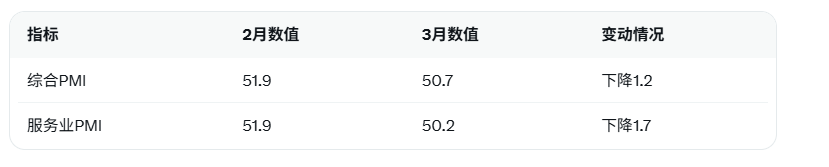
The table clearly shows that both indicators declined significantly in March, with the service sector having a more pronounced drag effect, highlighting the intensity of the impact of the conflict on the non-manufacturing sector.
Overall, the survey results not only quantified the short-term negative impact of external geopolitical risks on the Eurozone economy, but also provided important reference for subsequent policy-making and market expectation adjustments. Investors need to continue to monitor energy price trends, developments in the Middle East, and the ECB's subsequent interest rate decisions to assess whether the economy will enter contraction territory in the second quarter as Chris Williamson warned.
Editor's Summary : S&P Global Purchasing Managers' Index data for March shows that the Middle East conflict is exerting substantial pressure on the Eurozone economy through energy and supply chain channels, causing a rapid reversal of growth momentum at the beginning of the year. Against the backdrop of rising stagflation risks, the Eurozone needs to find a more delicate balance between stabilizing prices and supporting growth. The progress of conflict resolution and the extent of energy market recovery will be key variables determining the economic outlook in the coming months.
This data change reflects the rapid transmission of external shocks to the Eurozone's real economy. The Purchasing Managers' Index (PMI), a leading indicator, represents expansion above 50 and contraction below 50. While the March composite index remained barely above the 50-point mark, it was approaching the critical threshold, indicating a significant weakening of expansionary momentum. The services sector index declined even more significantly, suggesting that consumer and service demand was weakened by rising energy costs and uncertainty. Although manufacturing was not listed separately, the ripple effects of supply chain disruptions have already impacted the entire private sector.
From a macroeconomic perspective, the Middle East conflict has directly driven up crude oil and natural gas prices, leading to a sharp increase in corporate production costs. Simultaneously, disruptions to logistics and raw material supply chains have further squeezed profit margins and suppressed new order growth. The ensuing volatility in financial markets has exacerbated corporate hesitation in investment, and consumer confidence has declined simultaneously, creating a combined pressure of shrinking demand and rising costs. This stagflationary trend is testing the Eurozone's monetary policy maneuvering space: if the central bank continues to maintain current interest rates to curb inflation, it may exacerbate the slowdown in growth; if it eases monetary policy prematurely, it may fuel expectations of rising prices.
To visually represent recent changes in the Purchasing Managers' Index, the following table presents key comparative data:
The table clearly shows that both indicators declined significantly in March, with the service sector having a more pronounced drag effect, highlighting the intensity of the impact of the conflict on the non-manufacturing sector.
Overall, the survey results not only quantified the short-term negative impact of external geopolitical risks on the Eurozone economy, but also provided important reference for subsequent policy-making and market expectation adjustments. Investors need to continue to monitor energy price trends, developments in the Middle East, and the ECB's subsequent interest rate decisions to assess whether the economy will enter contraction territory in the second quarter as Chris Williamson warned.
Editor's Summary : S&P Global Purchasing Managers' Index data for March shows that the Middle East conflict is exerting substantial pressure on the Eurozone economy through energy and supply chain channels, causing a rapid reversal of growth momentum at the beginning of the year. Against the backdrop of rising stagflation risks, the Eurozone needs to find a more delicate balance between stabilizing prices and supporting growth. The progress of conflict resolution and the extent of energy market recovery will be key variables determining the economic outlook in the coming months.
- Risk Warning and Disclaimer
- The market involves risk, and trading may not be suitable for all investors. This article is for reference only and does not constitute personal investment advice, nor does it take into account certain users’ specific investment objectives, financial situation, or other needs. Any investment decisions made based on this information are at your own risk.