Geopolitical tensions ease? How long will the dollar's weakness last?
2026-04-08 15:48:34
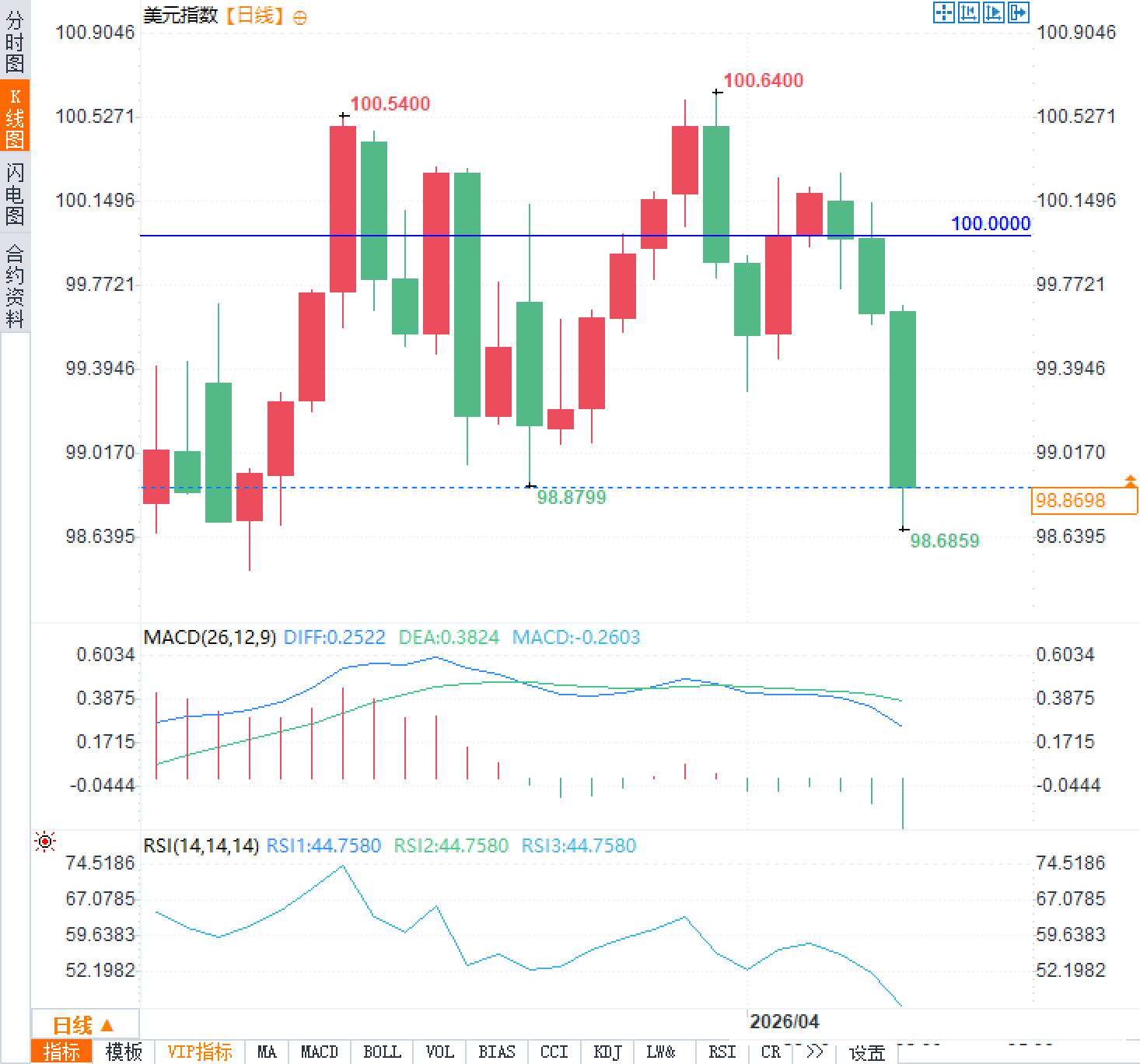
On Wednesday, April 8th, global financial markets experienced significant adjustments as news of a temporary ceasefire agreement between the US and Iran spread rapidly. The US dollar index is currently trading around 98.85, down approximately 0.81% from the previous trading day's close. Meanwhile, risk assets rebounded collectively, with the main crude oil futures contract falling sharply. WTI crude oil fell to $96.15 per barrel, a single-day drop of 16%, while Brent crude oil was around $94.00 per barrel, a drop of about 10%.

This shift reflects a short-term easing of geopolitical tensions and a cooling of market risk aversion. Traders are assessing the long-term transmission effects of subsequent negotiations on the currency and commodity markets. On the fundamental front, news of the potential resumption of navigation in the Strait of Hormuz further suppressed energy prices, while expectations for the Federal Reserve's policy path were also slightly adjusted, resulting in a significant decline in the safe-haven premium for the US dollar.
The sharp correction in the US dollar index was primarily driven by a rebound in risk appetite. The ceasefire agreement eased worst-case scenario expectations, prompting funds to flow out of traditional safe-haven assets like the dollar and into riskier stocks and commodities. Data shows that the dollar index touched a low of 98.68 and a high of 99.70 during the day, with the trading range significantly wider than in previous days. For major currency pairs, the euro rose to 1.1557 against the dollar, a 0.3% increase on the day; the dollar fell to 158.40 against the yen, a 0.85% decrease; and the pound strengthened by 0.47% against the dollar. These changes indicate that the dollar is generally under pressure within the G10 currency basket, and traders are focusing on the secondary impact of high-frequency data on exchange rates.
From a technical perspective, the US dollar index has fallen below the 99 level, with short-term support around 98.50. If subsequent negotiation details are favorable for risk assets, the dollar may test the 97.50-98.00 range. Traders observe that the dollar's weakness is closely linked to oil prices; falling energy prices have reduced global inflationary pressures, thus diminishing the dollar's attractiveness.
The sharp correction in crude oil prices has impacted the US dollar through inflation expectations. Market analysts believe that every $10/barrel drop in oil prices typically lowers US core PCE inflation expectations by approximately 0.2-0.3 percentage points, thereby increasing the probability of a Federal Reserve rate cut and weakening interest rate support for the dollar. The anticipated resumption of navigation in the Strait of Hormuz has further amplified signals of supply easing; although insurance premiums remain high, short-term vessel traffic data will be a key point of observation.
Furthermore, the currencies of commodity-exporting countries have strengthened in tandem, with the Norwegian krone and Canadian dollar experiencing a ripple effect against the US dollar. Traders should be wary that if actual traffic flow in the Strait of Hormuz is lower than expected, a rebound in oil prices could lead to a rapid recovery in the US dollar's losses. However, the current market consensus leans towards increased short-term volatility rather than a trend reversal.
Market focus quickly shifted to the ongoing US-Iran negotiations. While the interim agreement averted an extreme scenario, its potential to translate into a permanent solution remains questionable. Analysts point out that investors will not fully shift to a risk-averse mode, and crude oil futures or the US dollar will not return to pre-war levels unless a permanent agreement is reached. Ship traffic in the Strait of Hormuz continues to face uncertainty due to high insurance premiums and the risk of potential attacks; volatility is expected to remain high in the coming days, with traders closely monitoring negotiation details and actual navigation data. If negotiations falter or activity in the Strait diminishes, oil prices and the US dollar could quickly reverse course. Currently, the implied volatility of the US dollar index has risen to recent highs, reflecting traders' cautious attitude towards expectations of permanent peace. On the fundamental data front, recent US economic indicators have been stable, but geopolitical factors have dominated short-term pricing logic.
This shift reflects a short-term easing of geopolitical tensions and a cooling of market risk aversion. Traders are assessing the long-term transmission effects of subsequent negotiations on the currency and commodity markets. On the fundamental front, news of the potential resumption of navigation in the Strait of Hormuz further suppressed energy prices, while expectations for the Federal Reserve's policy path were also slightly adjusted, resulting in a significant decline in the safe-haven premium for the US dollar.
Real-time movement of the US dollar index and performance of major currency pairs
The sharp correction in the US dollar index was primarily driven by a rebound in risk appetite. The ceasefire agreement eased worst-case scenario expectations, prompting funds to flow out of traditional safe-haven assets like the dollar and into riskier stocks and commodities. Data shows that the dollar index touched a low of 98.68 and a high of 99.70 during the day, with the trading range significantly wider than in previous days. For major currency pairs, the euro rose to 1.1557 against the dollar, a 0.3% increase on the day; the dollar fell to 158.40 against the yen, a 0.85% decrease; and the pound strengthened by 0.47% against the dollar. These changes indicate that the dollar is generally under pressure within the G10 currency basket, and traders are focusing on the secondary impact of high-frequency data on exchange rates.
From a technical perspective, the US dollar index has fallen below the 99 level, with short-term support around 98.50. If subsequent negotiation details are favorable for risk assets, the dollar may test the 97.50-98.00 range. Traders observe that the dollar's weakness is closely linked to oil prices; falling energy prices have reduced global inflationary pressures, thus diminishing the dollar's attractiveness.
The underlying logic of the oil price decline's transmission to the US dollar
The sharp correction in crude oil prices has impacted the US dollar through inflation expectations. Market analysts believe that every $10/barrel drop in oil prices typically lowers US core PCE inflation expectations by approximately 0.2-0.3 percentage points, thereby increasing the probability of a Federal Reserve rate cut and weakening interest rate support for the dollar. The anticipated resumption of navigation in the Strait of Hormuz has further amplified signals of supply easing; although insurance premiums remain high, short-term vessel traffic data will be a key point of observation.
Furthermore, the currencies of commodity-exporting countries have strengthened in tandem, with the Norwegian krone and Canadian dollar experiencing a ripple effect against the US dollar. Traders should be wary that if actual traffic flow in the Strait of Hormuz is lower than expected, a rebound in oil prices could lead to a rapid recovery in the US dollar's losses. However, the current market consensus leans towards increased short-term volatility rather than a trend reversal.
Uncertainty surrounding the negotiation prospects and expectations of dollar volatility
Market focus quickly shifted to the ongoing US-Iran negotiations. While the interim agreement averted an extreme scenario, its potential to translate into a permanent solution remains questionable. Analysts point out that investors will not fully shift to a risk-averse mode, and crude oil futures or the US dollar will not return to pre-war levels unless a permanent agreement is reached. Ship traffic in the Strait of Hormuz continues to face uncertainty due to high insurance premiums and the risk of potential attacks; volatility is expected to remain high in the coming days, with traders closely monitoring negotiation details and actual navigation data. If negotiations falter or activity in the Strait diminishes, oil prices and the US dollar could quickly reverse course. Currently, the implied volatility of the US dollar index has risen to recent highs, reflecting traders' cautious attitude towards expectations of permanent peace. On the fundamental data front, recent US economic indicators have been stable, but geopolitical factors have dominated short-term pricing logic.
Frequently Asked Questions
Question 1: Why did this ceasefire agreement directly cause the US dollar index to decline by about 0.8%?
A: The ceasefire news eased the risk of escalating geopolitical conflict, causing a sharp drop in market demand for safe-haven assets. Funds flowed out of the US dollar and into riskier assets. As a traditional safe-haven currency, the premium of the US dollar naturally declined as risk appetite recovered. At the same time, improved expectations for oil supply further suppressed energy inflation, indirectly weakening the support for US dollar interest rates.
Question 2: What is the mechanism by which the sharp drop in oil prices indirectly affects the US dollar?
A: Reduced global inflationary pressures and rising expectations of a Fed rate cut have weakened the relative attractiveness of the dollar. Meanwhile, the strengthening of commodity currencies is creating cross-pressure, putting pressure on the dollar index within the basket. Traders should note that this transmission is not linear; if cross-strait shipping data falls short of expectations, a rebound in oil prices could lead to a short-term recovery in the dollar, but the overall logic still points to volatility rather than a one-sided trend.
- Risk Warning and Disclaimer
- The market involves risk, and trading may not be suitable for all investors. This article is for reference only and does not constitute personal investment advice, nor does it take into account certain users’ specific investment objectives, financial situation, or other needs. Any investment decisions made based on this information are at your own risk.