Is the crude oil market in a bloodbath? The real cards haven't been revealed yet.
2026-04-08 20:40:06
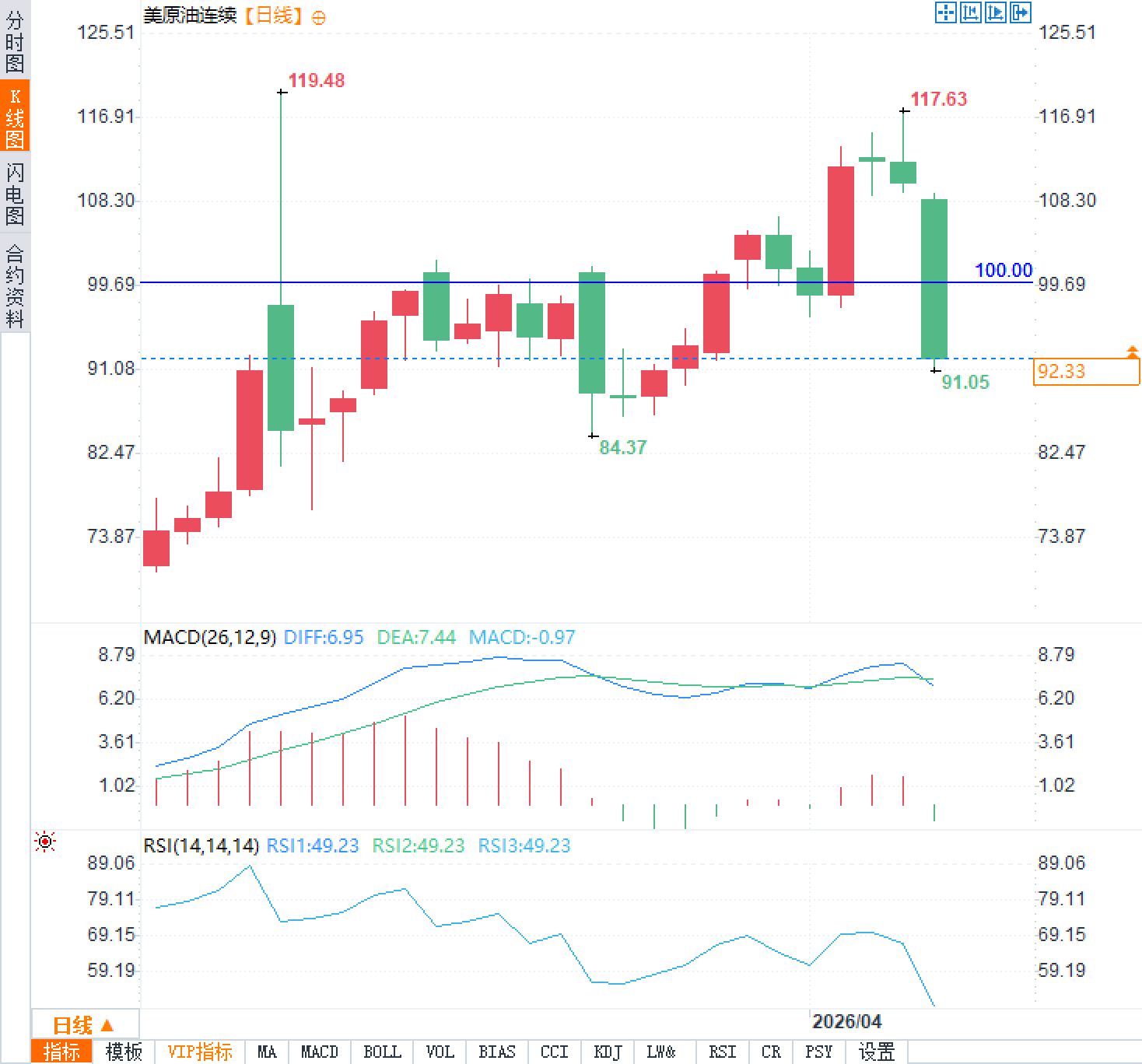
On Wednesday, April 8th, the international crude oil market experienced significant volatility. Following the news of the two-week ceasefire agreement between the US and Iran, concerns about supply disruptions quickly subsided, causing WTI crude oil prices to plummet below $100 per barrel. The latest price is currently hovering around $92 per barrel, marking the largest single-day drop in nearly six years. Brent crude oil also fell sharply to around $91 per barrel. This trend stemmed directly from expectations of the reopening of the Strait of Hormuz, coupled with the combined effects of OPEC production data and the US inventory report, indicating a rapid reshaping of the market's supply and demand balance.

The ceasefire agreement marks a significant easing of short-term geopolitical tensions, and the reopening of the Strait of Hormuz, a key global oil shipping route, directly alleviates export disruptions caused by the conflict. The agreement explicitly requires full and safe navigation through the strait, which had previously blocked approximately one-fifth of global oil and liquefied natural gas traffic after its closure. Shipowners remain highly cautious, fearing a sudden resurgence of hostilities during negotiations, leading to a much slower-than-expected recovery in actual traffic. Analysts point out that further price movements will depend on whether subsequent negotiations this week can translate into a lasting agreement, and the normalization of traffic through the strait is likely to be accompanied by continued volatility. Following the announcement of the agreement, Brent crude fell by as much as 16%, and WTI crude recorded its steepest drop in recent years; however, this is not a complete market capitulation, but rather a short-term respite. Restoring energy infrastructure will take months, during which time the spot market will remain supported, as North American and Asian buyers previously pushed spot prices to record levels due to panic.
OPEC production contracted sharply in March, with preliminary surveys showing a decrease of 7.6 million barrels per day (bpd) from the previous month to a multi-year low of 22.1 million bpd, mainly due to war-related disruptions and restrictions on exports through the Strait of Hormuz. Iraq saw the largest drop in production, falling by 2.8 million bpd to 1.6 million bpd; Saudi Arabia's production decreased by 2.1 million bpd to 8.4 million bpd; and the UAE's production declined by 1.4 million bpd to 2.2 million bpd, with the latter partially easing pressure through bypass pipelines. With the reopening of the Strait of Hormuz, some of the lost production is expected to gradually return in the coming weeks, but full normalization will be gradual, as infrastructure damage repair will be a lengthy process. The following is a comparison of production changes in major member countries in March:
This production gap will continue to support oil prices in the short term, but traders need to closely monitor subsequent survey updates to assess the impact of the actual pace of recovery on the global supply balance.
The US inventory report further reinforced the bearish tone. Data from the American Petroleum Institute showed that crude oil inventories increased by 3.7 million barrels last week, far exceeding market expectations of a 780,000-barrel increase. Meanwhile, gasoline inventories decreased by 4 million barrels, and distillate fuel inventories decreased by 600,000 barrels, resulting in a relatively favorable balance on the refining product side. The US Energy Information Administration's inventory report will be released later, and the market is awaiting official confirmation to verify the trend. The accumulation of crude oil inventories reflects easing short-term supply pressure, while the reduction in product inventories suggests that refinery operating rates remain resilient, and crack spreads may face narrowing pressure in the short term.
Despite short-term downward pressure on oil prices, the tight supply-demand balance in the medium term remains fundamentally unchanged. The U.S. Energy Information Administration estimates the current supply deficit at 7.5 million barrels per day (bpd), which could widen to 9.1 million bpd in April. If the conflict is resolved this month, the deficit will fall back to 6.7 million bpd in May, and it will not return to pre-war levels until the end of 2026. Against this backdrop, institutions have raised their average Brent crude oil price forecast for this year from $79/barrel to $96/barrel. Infrastructure repairs are time-consuming, and the spot market previously saw panic push North American Brent Forties crude oil to record highs of $146/barrel and Arab Light crude oil to record highs of $150/barrel. Uncertainty surrounding negotiations will maintain high volatility, and the mismatch between shipowners' cautious attitude and the actual recovery speed of traffic may cause oil prices to repeatedly test support levels. Overall, the market is transitioning from extreme geopolitical premiums to a fundamental supply-demand rebalancing, but the long-term tight balance still provides a floor for prices.
The ceasefire agreement drove a sharp drop in oil prices and raised expectations of the Straits reopening.
The ceasefire agreement marks a significant easing of short-term geopolitical tensions, and the reopening of the Strait of Hormuz, a key global oil shipping route, directly alleviates export disruptions caused by the conflict. The agreement explicitly requires full and safe navigation through the strait, which had previously blocked approximately one-fifth of global oil and liquefied natural gas traffic after its closure. Shipowners remain highly cautious, fearing a sudden resurgence of hostilities during negotiations, leading to a much slower-than-expected recovery in actual traffic. Analysts point out that further price movements will depend on whether subsequent negotiations this week can translate into a lasting agreement, and the normalization of traffic through the strait is likely to be accompanied by continued volatility. Following the announcement of the agreement, Brent crude fell by as much as 16%, and WTI crude recorded its steepest drop in recent years; however, this is not a complete market capitulation, but rather a short-term respite. Restoring energy infrastructure will take months, during which time the spot market will remain supported, as North American and Asian buyers previously pushed spot prices to record levels due to panic.
Analysis of OPEC's sharp production decline and supply recovery path
OPEC production contracted sharply in March, with preliminary surveys showing a decrease of 7.6 million barrels per day (bpd) from the previous month to a multi-year low of 22.1 million bpd, mainly due to war-related disruptions and restrictions on exports through the Strait of Hormuz. Iraq saw the largest drop in production, falling by 2.8 million bpd to 1.6 million bpd; Saudi Arabia's production decreased by 2.1 million bpd to 8.4 million bpd; and the UAE's production declined by 1.4 million bpd to 2.2 million bpd, with the latter partially easing pressure through bypass pipelines. With the reopening of the Strait of Hormuz, some of the lost production is expected to gradually return in the coming weeks, but full normalization will be gradual, as infrastructure damage repair will be a lengthy process. The following is a comparison of production changes in major member countries in March:
| Member States | Production declined (in tens of thousands of barrels per day) | Current production (10,000 barrels/day) |
|---|---|---|
| Iraq | 280 | 160 |
| Saudi Arabia | 210 | 840 |
| UAE | 140 | 220 |
US inventory data combined with changes in refined product balance
The US inventory report further reinforced the bearish tone. Data from the American Petroleum Institute showed that crude oil inventories increased by 3.7 million barrels last week, far exceeding market expectations of a 780,000-barrel increase. Meanwhile, gasoline inventories decreased by 4 million barrels, and distillate fuel inventories decreased by 600,000 barrels, resulting in a relatively favorable balance on the refining product side. The US Energy Information Administration's inventory report will be released later, and the market is awaiting official confirmation to verify the trend. The accumulation of crude oil inventories reflects easing short-term supply pressure, while the reduction in product inventories suggests that refinery operating rates remain resilient, and crack spreads may face narrowing pressure in the short term.
Medium-term supply gap and price volatility risk assessment
Despite short-term downward pressure on oil prices, the tight supply-demand balance in the medium term remains fundamentally unchanged. The U.S. Energy Information Administration estimates the current supply deficit at 7.5 million barrels per day (bpd), which could widen to 9.1 million bpd in April. If the conflict is resolved this month, the deficit will fall back to 6.7 million bpd in May, and it will not return to pre-war levels until the end of 2026. Against this backdrop, institutions have raised their average Brent crude oil price forecast for this year from $79/barrel to $96/barrel. Infrastructure repairs are time-consuming, and the spot market previously saw panic push North American Brent Forties crude oil to record highs of $146/barrel and Arab Light crude oil to record highs of $150/barrel. Uncertainty surrounding negotiations will maintain high volatility, and the mismatch between shipowners' cautious attitude and the actual recovery speed of traffic may cause oil prices to repeatedly test support levels. Overall, the market is transitioning from extreme geopolitical premiums to a fundamental supply-demand rebalancing, but the long-term tight balance still provides a floor for prices.
Frequently Asked Questions
Question 1: Does the ceasefire agreement mean that crude oil supply will immediately return to normal?
A: Not at all. While the agreement has facilitated the reopening of the Straits, the infrastructure damage will take months to repair. OPEC's March production has already plummeted by 7.6 million barrels per day to a multi-year low, and the return of actual flow will be gradual. Short-term gaps still exist, and price adjustments are more driven by sentiment than a complete reversal of supply and demand.
Question 2: What is the core impact of US inventory data on oil price trends?
A: The API crude oil inventory increase of 3.7 million barrels, which exceeded expectations, is a direct bearish factor. However, gasoline and distillate fuel inventories decreased by 4 million barrels and 600,000 barrels respectively, indicating resilience in the refining sector. The crack spread may narrow, which strengthens the short-term bearish outlook rather than a long-term collapse. Traders need to distinguish between signals from crude oil and product sectors.
- Risk Warning and Disclaimer
- The market involves risk, and trading may not be suitable for all investors. This article is for reference only and does not constitute personal investment advice, nor does it take into account certain users’ specific investment objectives, financial situation, or other needs. Any investment decisions made based on this information are at your own risk.