Gold prices surged and then retreated due to a combination of risk aversion and speculation surrounding interest rate cuts.
2026-04-09 09:34:17
International gold prices weakened slightly in early Asian trading, currently hovering around $4,705. The core driver of the previous sustained gold price increase—safe-haven demand stemming from geopolitical conflicts—has shown signs of cooling in the short term. The two-week temporary ceasefire agreement reached between the United States and Iran became a key trigger for the shift in market sentiment. According to related statements, the US agreed to suspend military operations on the condition that Iran reopen the Strait of Hormuz, a development that significantly eased market concerns about energy supply disruptions.

The ceasefire announcement directly weakened gold's safe-haven appeal. As a typical safe-haven asset, gold is usually sought after when geopolitical conflicts escalate, but faces capital outflow pressure when the situation eases. Therefore, after the ceasefire announcement, market risk appetite rebounded, and some funds withdrew from the gold market, causing a price correction.
"The ceasefire is calming the market and easing pressure, which could help reduce inflationary pressures and open up room for the Federal Reserve to cut interest rates, which is good for gold."
However, the market has not yet formed a one-sided expectation. Although the ceasefire has temporarily eased tensions, the conflict in the Middle East has not completely stopped, with sporadic clashes still occurring in Lebanon and other places, and Iran has stated that some ceasefire clauses have been violated. This means that geopolitical risks remain recurring, thus limiting the downside potential for gold.
From the perspective of inflation expectations, another important reason for the previous pressure on gold was the rise in energy prices. The conflict in the Middle East pushed up oil prices, triggering market concerns about a rebound in inflation. As rising inflationary pressures may prompt central banks to maintain higher interest rates, thereby weakening the attractiveness of gold as a non-interest-bearing asset, gold prices faced some selling pressure in the previous period.
However, with the emergence of ceasefire expectations, energy price increases have moderated, and inflationary pressures have marginally decreased, providing room for a shift in monetary policy. Market surveys indicate that the Federal Reserve, in its March meeting minutes, still anticipates a rate cut this year, despite current high levels of uncertainty. Policymakers emphasized the need for flexibility in assessing the impact of the war on inflation and employment. Currently, employment growth is stagnating, while inflation remains above target, making the policy path more dependent on data changes.
Against this backdrop, the logic driving gold prices has gradually shifted from being solely driven by safe-haven demand to a dual driver of "safe-haven demand + interest rate expectations." On the one hand, geopolitical uncertainties continue to provide a floor for gold prices; on the other hand, the existence of expectations for interest rate cuts enhances the medium- to long-term attractiveness of gold.
From a market sentiment perspective, investors are currently clearly divided. Some believe the ceasefire will continue, thus weakening the upward momentum of gold; others believe the situation still carries the risk of recurrence and prefer to continue allocating gold as a hedging tool. This divergence has directly led to increased volatility in gold prices, but overall they remain within a high range.
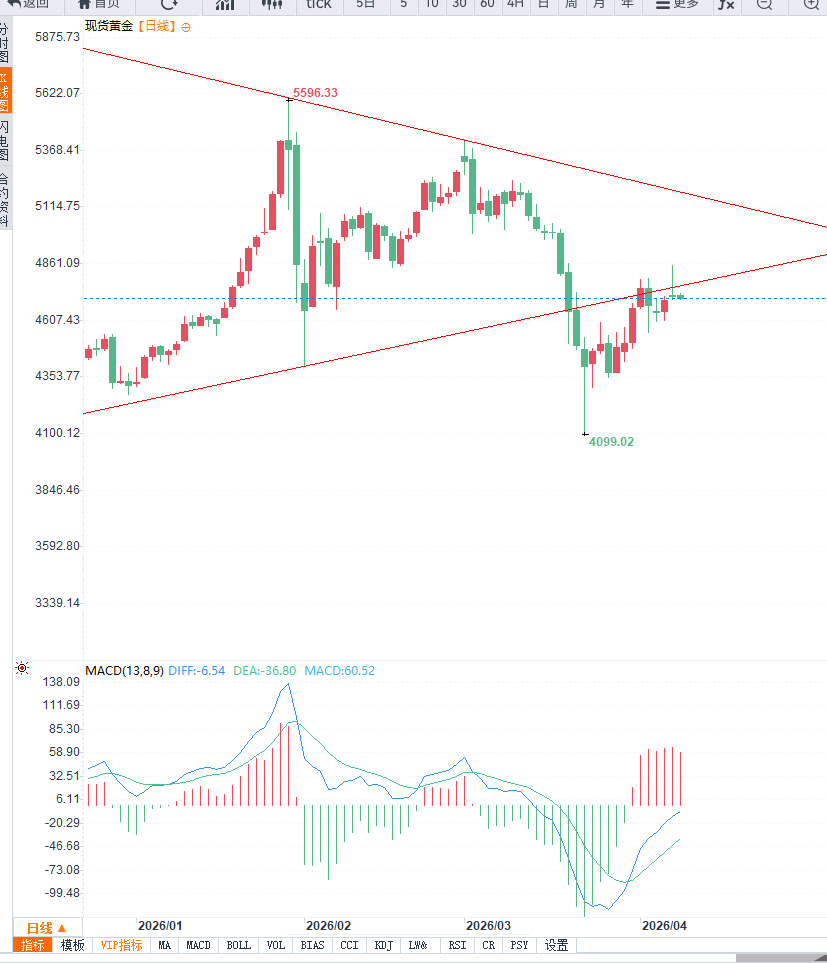
From a technical perspective, the daily chart shows that gold has shown signs of a pullback after consolidating at high levels, but the overall upward trend remains intact, and the structure is still dominated by bulls. The current level around $4700 forms a key short-term support; a break below this level could trigger further pullback. On the upside, watch the $4800 area for resistance, which is near the previous high and faces significant selling pressure. In terms of momentum, daily indicators show that bullish momentum has weakened, but a trend reversal has not yet formed. On the 4-hour chart, the price is trading within a short-term descending channel. If it cannot quickly recover above $4750, the short-term correction may continue; however, if it regains a foothold, it could retest the previous high. Overall, gold is likely to experience short-term consolidation, but maintains a bullish structure in the medium term.
Editor's Summary:
Gold is currently in a phase of complex interplay among multiple factors. In the short term, the Middle East ceasefire has weakened safe-haven demand, putting downward pressure on gold prices. However, in the longer term, the uncertainty surrounding geopolitical risks and the potential path of interest rate cuts by the Federal Reserve continue to provide solid support for gold. The market is shifting from being driven solely by safe-haven demand to being driven by macroeconomic expectations, meaning that future gold price movements will be more dependent on changes in the interest rate environment and inflation expectations. Given the continued high level of uncertainty, gold maintaining a high level of fluctuation or even experiencing periods of strength remains a more logical development.
The ceasefire announcement directly weakened gold's safe-haven appeal. As a typical safe-haven asset, gold is usually sought after when geopolitical conflicts escalate, but faces capital outflow pressure when the situation eases. Therefore, after the ceasefire announcement, market risk appetite rebounded, and some funds withdrew from the gold market, causing a price correction.
"The ceasefire is calming the market and easing pressure, which could help reduce inflationary pressures and open up room for the Federal Reserve to cut interest rates, which is good for gold."
However, the market has not yet formed a one-sided expectation. Although the ceasefire has temporarily eased tensions, the conflict in the Middle East has not completely stopped, with sporadic clashes still occurring in Lebanon and other places, and Iran has stated that some ceasefire clauses have been violated. This means that geopolitical risks remain recurring, thus limiting the downside potential for gold.
From the perspective of inflation expectations, another important reason for the previous pressure on gold was the rise in energy prices. The conflict in the Middle East pushed up oil prices, triggering market concerns about a rebound in inflation. As rising inflationary pressures may prompt central banks to maintain higher interest rates, thereby weakening the attractiveness of gold as a non-interest-bearing asset, gold prices faced some selling pressure in the previous period.
However, with the emergence of ceasefire expectations, energy price increases have moderated, and inflationary pressures have marginally decreased, providing room for a shift in monetary policy. Market surveys indicate that the Federal Reserve, in its March meeting minutes, still anticipates a rate cut this year, despite current high levels of uncertainty. Policymakers emphasized the need for flexibility in assessing the impact of the war on inflation and employment. Currently, employment growth is stagnating, while inflation remains above target, making the policy path more dependent on data changes.
Against this backdrop, the logic driving gold prices has gradually shifted from being solely driven by safe-haven demand to a dual driver of "safe-haven demand + interest rate expectations." On the one hand, geopolitical uncertainties continue to provide a floor for gold prices; on the other hand, the existence of expectations for interest rate cuts enhances the medium- to long-term attractiveness of gold.
From a market sentiment perspective, investors are currently clearly divided. Some believe the ceasefire will continue, thus weakening the upward momentum of gold; others believe the situation still carries the risk of recurrence and prefer to continue allocating gold as a hedging tool. This divergence has directly led to increased volatility in gold prices, but overall they remain within a high range.
From a technical perspective, the daily chart shows that gold has shown signs of a pullback after consolidating at high levels, but the overall upward trend remains intact, and the structure is still dominated by bulls. The current level around $4700 forms a key short-term support; a break below this level could trigger further pullback. On the upside, watch the $4800 area for resistance, which is near the previous high and faces significant selling pressure. In terms of momentum, daily indicators show that bullish momentum has weakened, but a trend reversal has not yet formed. On the 4-hour chart, the price is trading within a short-term descending channel. If it cannot quickly recover above $4750, the short-term correction may continue; however, if it regains a foothold, it could retest the previous high. Overall, gold is likely to experience short-term consolidation, but maintains a bullish structure in the medium term.
Editor's Summary:
Gold is currently in a phase of complex interplay among multiple factors. In the short term, the Middle East ceasefire has weakened safe-haven demand, putting downward pressure on gold prices. However, in the longer term, the uncertainty surrounding geopolitical risks and the potential path of interest rate cuts by the Federal Reserve continue to provide solid support for gold. The market is shifting from being driven solely by safe-haven demand to being driven by macroeconomic expectations, meaning that future gold price movements will be more dependent on changes in the interest rate environment and inflation expectations. Given the continued high level of uncertainty, gold maintaining a high level of fluctuation or even experiencing periods of strength remains a more logical development.
- Risk Warning and Disclaimer
- The market involves risk, and trading may not be suitable for all investors. This article is for reference only and does not constitute personal investment advice, nor does it take into account certain users’ specific investment objectives, financial situation, or other needs. Any investment decisions made based on this information are at your own risk.