With the UK speaking out and the US and Iran focusing on three key issues, gold's safe-haven value is highlighted.
2026-04-09 17:12:00
On Thursday (April 9), spot gold remained in a narrow range during the Asian and European sessions, currently trading around 4727. Gold prices rose and then fell during the New York session on Wednesday due to the Israeli bombing of Hezbollah in Lebanon casting a shadow over ceasefire negotiations.
The current US-Iran rivalry remains focused on three key issues: the status of navigation in the Strait of Hormuz, Israel's military offensive against Hezbollah in Lebanon, and whether Iran will adopt a tougher negotiating stance following the attack on Hezbollah's leader.
The previous night, Israel launched a heavy bombing of Hezbollah, putting Iran in a passive position. Britain then launched diplomatic lobbying, precisely targeting the three major geopolitical pain points mentioned above.
British Foreign Secretary Yvette Cooper will deliver her annual foreign policy speech at London City Hall on Thursday, explicitly calling for free passage through the Strait of Hormuz and advocating for Lebanon to be included in the relevant ceasefire framework between the US and Iran.
She will formally demand the guarantee of free passage for ships in this strategically vital waterway in response to Iran's intention to control the global oil shipping chokepoint.
In his speech, Cooper will emphasize that since the outbreak of this round of conflict, the Strait of Hormuz has been effectively blocked by Iran, and the basic freedom of navigation at sea cannot be unilaterally deprived or ceded. There is absolutely no room for setting tolls on international waterways.
According to the Financial Times, Iran has planned to impose tolls on transit vessels and even intends to require shipping companies to pay for oil tanker transits in digital currency.
The Strait of Hormuz, a crucial passage connecting the Persian Gulf and the Gulf of Oman, handles about 20% of global oil and gas trade, and its navigation status directly affects the stability of the global energy supply chain.
Cooper will also strongly advocate for including Lebanon in the two-week ceasefire agreement reached between the US and Iran on Tuesday.
She stated that the ceasefire agreement between the US, Israel, and Iran is of positive significance and is a key step in promoting regional security and stability and alleviating global economic pressures and the cost of living in the UK.
She called for a substantial breakthrough in the negotiations to prevent a resurgence of conflict, and urged Iran to cease its security threats against neighboring countries. The core priority was to achieve full resumption of navigation in the Strait of Hormuz.
She will also highlight the economic impact of the Middle East geopolitical crisis on Britain, including rising mortgage rates and increased fuel and food prices.
While Cooper delivered his diplomatic speech, British Prime Minister Keir Starmer was engaged in diplomatic consultations with several Gulf states, discussing specific measures to maintain and implement the ceasefire agreement in an attempt to de-escalate the ongoing tensions in the Middle East through multilateral diplomatic mediation.
From a financial market perspective, the uncertainty surrounding the opening of the Strait of Hormuz, the renewed risk of conflict on the Lebanese-Israeli border, and the potential hardening of Iran's negotiating stance will continue to push up short-term inflation, thereby raising the global interest rate level and suppressing gold prices.
As a traditional safe-haven asset, gold's short-term price movements are highly correlated with the development of the situation in the Middle East: if the UK's mediation is successful, or if the US-Iran negotiations proceed smoothly, or if the escalation of the Strait blockade or the expansion of regional conflicts slows down, the market will return to the logic of global easing, which will directly boost gold prices.
From a technical perspective, spot gold has held above the upper channel line and the 5-day moving average, suggesting a potential for further rebound.
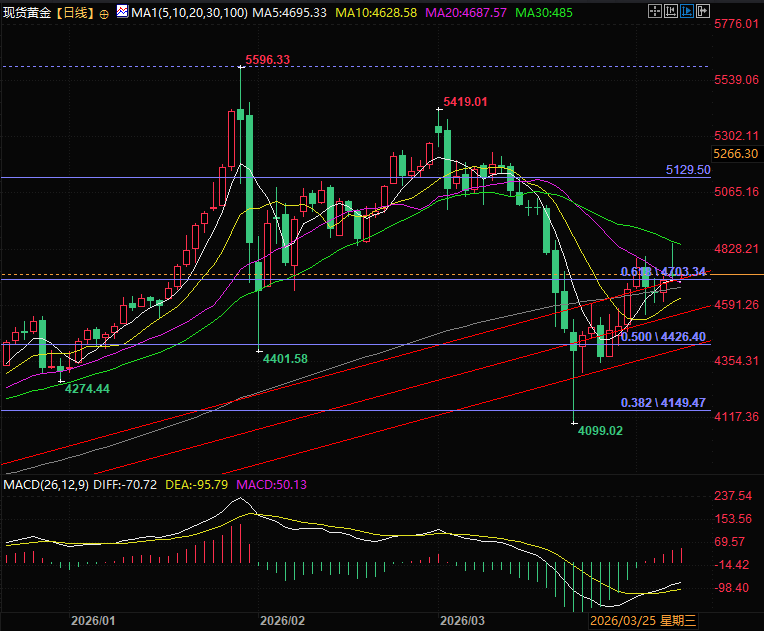
(Spot gold daily chart, source: EasyForex subsidiary)
At 17:07 Beijing time, spot gold was trading at $4,724 per ounce.
The current US-Iran rivalry remains focused on three key issues: the status of navigation in the Strait of Hormuz, Israel's military offensive against Hezbollah in Lebanon, and whether Iran will adopt a tougher negotiating stance following the attack on Hezbollah's leader.
The previous night, Israel launched a heavy bombing of Hezbollah, putting Iran in a passive position. Britain then launched diplomatic lobbying, precisely targeting the three major geopolitical pain points mentioned above.
British diplomacy sets the tone for core demands.
British Foreign Secretary Yvette Cooper will deliver her annual foreign policy speech at London City Hall on Thursday, explicitly calling for free passage through the Strait of Hormuz and advocating for Lebanon to be included in the relevant ceasefire framework between the US and Iran.
She will formally demand the guarantee of free passage for ships in this strategically vital waterway in response to Iran's intention to control the global oil shipping chokepoint.
Strait of Hormuz: A Battle for Global Energy Lifeline
In his speech, Cooper will emphasize that since the outbreak of this round of conflict, the Strait of Hormuz has been effectively blocked by Iran, and the basic freedom of navigation at sea cannot be unilaterally deprived or ceded. There is absolutely no room for setting tolls on international waterways.
According to the Financial Times, Iran has planned to impose tolls on transit vessels and even intends to require shipping companies to pay for oil tanker transits in digital currency.
The Strait of Hormuz, a crucial passage connecting the Persian Gulf and the Gulf of Oman, handles about 20% of global oil and gas trade, and its navigation status directly affects the stability of the global energy supply chain.
Ceasefire agreement extended: Lebanon included in negotiations
Cooper will also strongly advocate for including Lebanon in the two-week ceasefire agreement reached between the US and Iran on Tuesday.
She stated that the ceasefire agreement between the US, Israel, and Iran is of positive significance and is a key step in promoting regional security and stability and alleviating global economic pressures and the cost of living in the UK.
She called for a substantial breakthrough in the negotiations to prevent a resurgence of conflict, and urged Iran to cease its security threats against neighboring countries. The core priority was to achieve full resumption of navigation in the Strait of Hormuz.
She will also highlight the economic impact of the Middle East geopolitical crisis on Britain, including rising mortgage rates and increased fuel and food prices.
While Cooper delivered his diplomatic speech, British Prime Minister Keir Starmer was engaged in diplomatic consultations with several Gulf states, discussing specific measures to maintain and implement the ceasefire agreement in an attempt to de-escalate the ongoing tensions in the Middle East through multilateral diplomatic mediation.
Summary and Technical Analysis:
From a financial market perspective, the uncertainty surrounding the opening of the Strait of Hormuz, the renewed risk of conflict on the Lebanese-Israeli border, and the potential hardening of Iran's negotiating stance will continue to push up short-term inflation, thereby raising the global interest rate level and suppressing gold prices.
As a traditional safe-haven asset, gold's short-term price movements are highly correlated with the development of the situation in the Middle East: if the UK's mediation is successful, or if the US-Iran negotiations proceed smoothly, or if the escalation of the Strait blockade or the expansion of regional conflicts slows down, the market will return to the logic of global easing, which will directly boost gold prices.
From a technical perspective, spot gold has held above the upper channel line and the 5-day moving average, suggesting a potential for further rebound.
(Spot gold daily chart, source: EasyForex subsidiary)
At 17:07 Beijing time, spot gold was trading at $4,724 per ounce.
- Risk Warning and Disclaimer
- The market involves risk, and trading may not be suitable for all investors. This article is for reference only and does not constitute personal investment advice, nor does it take into account certain users’ specific investment objectives, financial situation, or other needs. Any investment decisions made based on this information are at your own risk.