The Middle East situation is fueling inflation expectations and suppressing the prospect of interest rate cuts, leaving gold in a dilemma.
2026-04-10 09:42:14
Gold prices retreated slightly during Friday's Asian session, with XAU/USD trading around $4770. Despite continued geopolitical tensions, gold failed to sustain its gains, reflecting a shift in market pricing logic from "safe-haven driven" to "interest rate driven."

From a geopolitical perspective, the situation in the Middle East remains complex. Market research indicates that Israel is seeking direct dialogue with Lebanon, but the conflict continues to escalate, and regional tensions have not yet been substantially eased. Furthermore, the obstruction of shipping through the Strait of Hormuz is severely impacting global energy supplies; this passage handles approximately 20% of global seaborne crude oil transport, and its disruption further amplifies market uncertainty.
Typically, geopolitical conflicts enhance gold's safe-haven appeal, but the current market exhibits a clear divergence. On one hand, the uncertainty stemming from these conflicts continues to support gold demand; on the other hand, soaring energy prices are exerting downward pressure on gold through inflation. As crude oil prices approach their peak, global energy costs are rising rapidly, prompting the market to reassess the inflation trajectory.
The market widely expects the US March CPI to rise to approximately 3.3% year-on-year, higher than the previous value of 2.4% , mainly driven by rising oil prices. Against this backdrop, investor expectations for a Federal Reserve interest rate cut have cooled significantly. Changes in interest rate expectations directly impact gold, as gold itself does not generate interest income, and its attractiveness decreases relatively when interest rates remain high.
Market analysts point out that "the core of the current gold price movement is no longer simply a safe-haven logic, but rather a repricing of inflation and interest rate paths."
In addition, the US dollar's performance is also an important factor affecting gold prices. If inflation data is stronger than expected, it may push the dollar higher, thereby further suppressing the price of gold denominated in US dollars; conversely, if the data is lower than expected, it may provide upward momentum for gold prices.
From a technical perspective, gold remains in a high-level consolidation structure on the daily chart. The overall trend has not yet turned bearish, but short-term momentum has weakened. The current price is finding support above $4700, which forms a key medium-term support level . A break below this level could lead to a further pullback to the $4650 area. Resistance is located around $4800; a break above this level could lead to a retest of historical highs. Momentum indicators suggest that upward momentum has slowed, and the market has entered a consolidation phase.
On the 4-hour chart, gold is showing a slightly weak, oscillating trend, with short-term moving averages beginning to flatten, indicating a near balance between bullish and bearish forces. Short-term support is around $4740, while resistance is around $4800 . A break below support could trigger further correction; a break above resistance could lead to a short-term rebound.
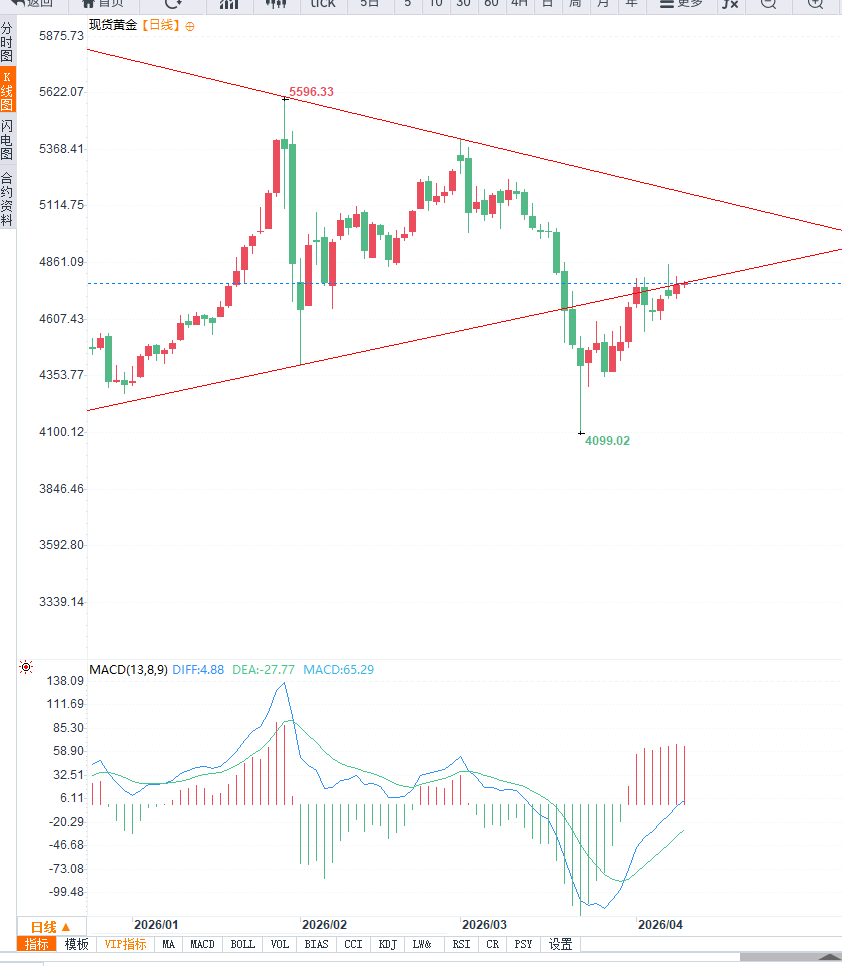
Overall, gold is currently in a phase of balancing between "safe-haven support" and "interest rate suppression," with its price movements highly dependent on macroeconomic data.
Editor's Summary : The core contradiction in the current gold market lies in the hedging between geopolitical risks and interest rate expectations. On the one hand, the Middle East situation and energy crisis provide a floor for gold; on the other hand, rising oil prices push up inflation expectations, reducing the room for interest rate cuts and thus suppressing gold price increases. Future trends will depend on US inflation data and the Federal Reserve's policy path. If inflation remains high, gold may remain volatile or even under pressure; if inflation falls, gold prices are expected to regain upward momentum. In the current environment, gold may maintain a short-term range of $4700 to $4800.
From a geopolitical perspective, the situation in the Middle East remains complex. Market research indicates that Israel is seeking direct dialogue with Lebanon, but the conflict continues to escalate, and regional tensions have not yet been substantially eased. Furthermore, the obstruction of shipping through the Strait of Hormuz is severely impacting global energy supplies; this passage handles approximately 20% of global seaborne crude oil transport, and its disruption further amplifies market uncertainty.
Typically, geopolitical conflicts enhance gold's safe-haven appeal, but the current market exhibits a clear divergence. On one hand, the uncertainty stemming from these conflicts continues to support gold demand; on the other hand, soaring energy prices are exerting downward pressure on gold through inflation. As crude oil prices approach their peak, global energy costs are rising rapidly, prompting the market to reassess the inflation trajectory.
The market widely expects the US March CPI to rise to approximately 3.3% year-on-year, higher than the previous value of 2.4% , mainly driven by rising oil prices. Against this backdrop, investor expectations for a Federal Reserve interest rate cut have cooled significantly. Changes in interest rate expectations directly impact gold, as gold itself does not generate interest income, and its attractiveness decreases relatively when interest rates remain high.
Market analysts point out that "the core of the current gold price movement is no longer simply a safe-haven logic, but rather a repricing of inflation and interest rate paths."
In addition, the US dollar's performance is also an important factor affecting gold prices. If inflation data is stronger than expected, it may push the dollar higher, thereby further suppressing the price of gold denominated in US dollars; conversely, if the data is lower than expected, it may provide upward momentum for gold prices.
From a technical perspective, gold remains in a high-level consolidation structure on the daily chart. The overall trend has not yet turned bearish, but short-term momentum has weakened. The current price is finding support above $4700, which forms a key medium-term support level . A break below this level could lead to a further pullback to the $4650 area. Resistance is located around $4800; a break above this level could lead to a retest of historical highs. Momentum indicators suggest that upward momentum has slowed, and the market has entered a consolidation phase.
On the 4-hour chart, gold is showing a slightly weak, oscillating trend, with short-term moving averages beginning to flatten, indicating a near balance between bullish and bearish forces. Short-term support is around $4740, while resistance is around $4800 . A break below support could trigger further correction; a break above resistance could lead to a short-term rebound.
Overall, gold is currently in a phase of balancing between "safe-haven support" and "interest rate suppression," with its price movements highly dependent on macroeconomic data.
Editor's Summary : The core contradiction in the current gold market lies in the hedging between geopolitical risks and interest rate expectations. On the one hand, the Middle East situation and energy crisis provide a floor for gold; on the other hand, rising oil prices push up inflation expectations, reducing the room for interest rate cuts and thus suppressing gold price increases. Future trends will depend on US inflation data and the Federal Reserve's policy path. If inflation remains high, gold may remain volatile or even under pressure; if inflation falls, gold prices are expected to regain upward momentum. In the current environment, gold may maintain a short-term range of $4700 to $4800.
- Risk Warning and Disclaimer
- The market involves risk, and trading may not be suitable for all investors. This article is for reference only and does not constitute personal investment advice, nor does it take into account certain users’ specific investment objectives, financial situation, or other needs. Any investment decisions made based on this information are at your own risk.