Institutions: Despite short-term pressure, gold is still expected to break through $5,000 by the end of the year.
2026-04-10 10:18:51
Despite some short-term headwinds facing the gold market, with high oil prices continuing to drive up inflation expectations and push up interest rate expectations, a well-known investment institution believes that gold prices could still break through $5,000 per ounce by the end of this year.
The commodities analyst team at State Street Investment Management, led by Aakash Doshi, emphasized that they remain bullish on gold and continue to believe there is a 50% probability that gold will trade in the $4,750 to $5,500 per ounce range for the remainder of the year.
At the same time, the institution has moderately adjusted its previously more aggressive bullish expectations, but still believes that the market has a relatively solid level of support.
In their monthly report, analysts stated, "We have lowered the probability of our most optimistic scenario of $5,500-$6,250 per ounce from 35% to 30%, but believe that $4,000-$4,100 per ounce will serve as a significant bottom support level for the market, and that gold's all-time high could be retested before 2027. In our outlook, the probability of the bearish scenario of $4,000-$4,750 per ounce (i.e., the range where the closing price was at the end of March) is 20%."
Despite State Street Investment Management's continued bullish outlook on gold's long-term prospects, analysts point out that last month's pullback and the current consolidation are not unexpected, mainly because global financial market sentiment has shifted significantly due to the US-Israel war against Iran.
Analysts recall that at the beginning of the new year, the market had expected the Federal Reserve to implement a total of 58 basis points of easing policy this year.
However, the turmoil in the Middle East triggered severe supply chain problems in the energy market, significantly altering previous interest rate expectations. Analysts stated, "In mid-to-late March, the market was pricing in a greater than 60% probability of the Federal Reserve raising interest rates this year!"
Currently, according to the CME FedWatch Tool, there is a 71% probability that interest rates will remain at current levels by the end of this year. Despite the neutral monetary policy stance, gold prices have shown strong resilience below $4,800 per ounce.
Despite short-term pressures such as oil prices, State Street Investment Management still advises investors to focus on broader long-term market trends rather than getting overly concerned about short-term interest rate expectations.
The analysis report states: "The pullback in gold prices in March was primarily a result of the Federal Reserve's repricing of interest rates and rising real yields, which simultaneously supported a stronger dollar. This pullback is unlikely to be a collapse of the core logic behind global gold demand, which mainly stems from concerns about currency devaluation and demand for alternative non-dollar assets. Therefore, investors should carefully distinguish between cyclical pressures (the opportunity cost of holding gold increases temporarily due to rising real yields) and structural dynamics. In our view, these structural factors remain generally favorable for gold."
While higher oil prices will continue to exacerbate inflationary pressures, Doshi's team cautions that this environment is a double-edged sword.
Analysts added, "If the conflict persists and causes ICE Brent crude prices to rise above $150 per barrel, gold could be suppressed through the Fed's policy path and the dollar channel; however, this would also significantly increase the risk of an economic recession or stagflation. On the other hand, if oil prices fall back to the normal range of $80-85 per barrel, we believe gold prices could quickly return above $5,000 per ounce."
Besides US monetary policy factors, State Street Investment Management also pointed to another long-term structural advantage supporting gold: the unsustainable growth of government debt levels in various countries . The firm cited estimates from the US Congressional Budget Office, noting that net interest payments on US federal debt exceed $1 trillion annually. However, the US is not the only economy facing a worsening debt problem.
Analysts stated, "The widening fiscal deficits (including war spending, higher interest costs, and declining revenues) further reinforce the macroeconomic backdrop of high debt and long-term currency devaluation risks, a backdrop that has historically boosted gold demand. Global total debt has grown to a record level of approximately $348 trillion, equivalent to three to four times the world's GDP, with debt growth concentrated primarily in the government sector rather than the private sector. This trend may foreshadow more embedded fiscal pressures in the future."
Overall, although gold has been suppressed in the short term by factors such as oil-driven inflation and interest rate expectations, State Street Investment Management's analysis shows that its long-term bullish logic has not fundamentally changed. Structural factors, including concerns about currency devaluation, global debt expansion, and demand for alternative assets, continue to provide strong support for gold.
Investors who can move beyond short-term fluctuations and focus on these long-term trends may be able to seize more lasting opportunities in the gold market. Future oil price movements and adjustments to Federal Reserve policy will remain key variables influencing the path of gold prices.
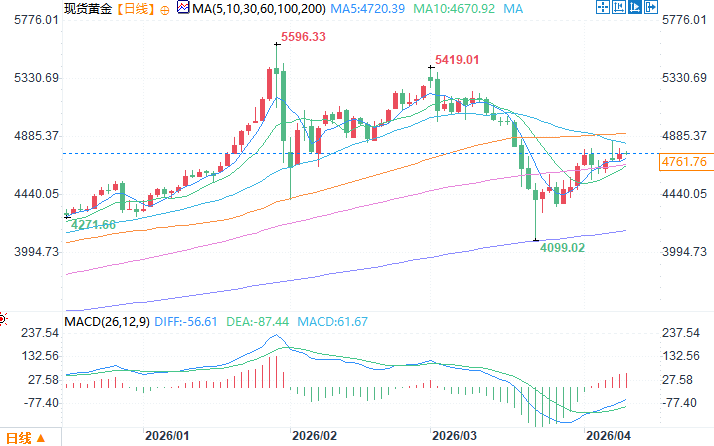
Spot gold daily chart source: EasyForex
At 10:18 AM Beijing time on April 10, spot gold was trading at $4751.76 per ounce.
The commodities analyst team at State Street Investment Management, led by Aakash Doshi, emphasized that they remain bullish on gold and continue to believe there is a 50% probability that gold will trade in the $4,750 to $5,500 per ounce range for the remainder of the year.
At the same time, the institution has moderately adjusted its previously more aggressive bullish expectations, but still believes that the market has a relatively solid level of support.
In their monthly report, analysts stated, "We have lowered the probability of our most optimistic scenario of $5,500-$6,250 per ounce from 35% to 30%, but believe that $4,000-$4,100 per ounce will serve as a significant bottom support level for the market, and that gold's all-time high could be retested before 2027. In our outlook, the probability of the bearish scenario of $4,000-$4,750 per ounce (i.e., the range where the closing price was at the end of March) is 20%."
The short-term pullback was in line with market expectations; the situation in the Middle East has altered the interest rate outlook.
Despite State Street Investment Management's continued bullish outlook on gold's long-term prospects, analysts point out that last month's pullback and the current consolidation are not unexpected, mainly because global financial market sentiment has shifted significantly due to the US-Israel war against Iran.
Analysts recall that at the beginning of the new year, the market had expected the Federal Reserve to implement a total of 58 basis points of easing policy this year.
However, the turmoil in the Middle East triggered severe supply chain problems in the energy market, significantly altering previous interest rate expectations. Analysts stated, "In mid-to-late March, the market was pricing in a greater than 60% probability of the Federal Reserve raising interest rates this year!"
Currently, according to the CME FedWatch Tool, there is a 71% probability that interest rates will remain at current levels by the end of this year. Despite the neutral monetary policy stance, gold prices have shown strong resilience below $4,800 per ounce.
Investors should focus on long-term trends rather than short-term interest rate expectations.
Despite short-term pressures such as oil prices, State Street Investment Management still advises investors to focus on broader long-term market trends rather than getting overly concerned about short-term interest rate expectations.
The analysis report states: "The pullback in gold prices in March was primarily a result of the Federal Reserve's repricing of interest rates and rising real yields, which simultaneously supported a stronger dollar. This pullback is unlikely to be a collapse of the core logic behind global gold demand, which mainly stems from concerns about currency devaluation and demand for alternative non-dollar assets. Therefore, investors should carefully distinguish between cyclical pressures (the opportunity cost of holding gold increases temporarily due to rising real yields) and structural dynamics. In our view, these structural factors remain generally favorable for gold."
High oil prices are a double-edged sword: inflationary pressures and the risk of recession coexist.
While higher oil prices will continue to exacerbate inflationary pressures, Doshi's team cautions that this environment is a double-edged sword.
Analysts added, "If the conflict persists and causes ICE Brent crude prices to rise above $150 per barrel, gold could be suppressed through the Fed's policy path and the dollar channel; however, this would also significantly increase the risk of an economic recession or stagflation. On the other hand, if oil prices fall back to the normal range of $80-85 per barrel, we believe gold prices could quickly return above $5,000 per ounce."
The continued expansion of government debt constitutes a long-term positive factor.
Besides US monetary policy factors, State Street Investment Management also pointed to another long-term structural advantage supporting gold: the unsustainable growth of government debt levels in various countries . The firm cited estimates from the US Congressional Budget Office, noting that net interest payments on US federal debt exceed $1 trillion annually. However, the US is not the only economy facing a worsening debt problem.
Analysts stated, "The widening fiscal deficits (including war spending, higher interest costs, and declining revenues) further reinforce the macroeconomic backdrop of high debt and long-term currency devaluation risks, a backdrop that has historically boosted gold demand. Global total debt has grown to a record level of approximately $348 trillion, equivalent to three to four times the world's GDP, with debt growth concentrated primarily in the government sector rather than the private sector. This trend may foreshadow more embedded fiscal pressures in the future."
Conclusion: The logic of a structural bull market remains solid.
Overall, although gold has been suppressed in the short term by factors such as oil-driven inflation and interest rate expectations, State Street Investment Management's analysis shows that its long-term bullish logic has not fundamentally changed. Structural factors, including concerns about currency devaluation, global debt expansion, and demand for alternative assets, continue to provide strong support for gold.
Investors who can move beyond short-term fluctuations and focus on these long-term trends may be able to seize more lasting opportunities in the gold market. Future oil price movements and adjustments to Federal Reserve policy will remain key variables influencing the path of gold prices.
Spot gold daily chart source: EasyForex
At 10:18 AM Beijing time on April 10, spot gold was trading at $4751.76 per ounce.
- Risk Warning and Disclaimer
- The market involves risk, and trading may not be suitable for all investors. This article is for reference only and does not constitute personal investment advice, nor does it take into account certain users’ specific investment objectives, financial situation, or other needs. Any investment decisions made based on this information are at your own risk.