The breakdown of US-Iran negotiations reignites geopolitical risks and inflation concerns, casting a bearish shadow over the outlook for gold.
2026-04-13 14:55:33
As we enter the new week, the outlook for the gold market has shifted somewhat towards the downside, with the main driver of this change remaining the latest developments in the Middle East geopolitical situation.
The ceasefire agreement announced earlier by the United States and Iran had temporarily eased market tensions, and investors were cautiously optimistic about the weekend's negotiations in Islamabad, believing that the initial two-week ceasefire agreement could be extended. However, the weekend negotiations ultimately ended without any agreement, meaning that the Strait of Hormuz, a key global oil shipping route, is unlikely to reopen in the short term, and energy prices are unlikely to see further easing.
High energy prices could reignite market expectations of inflation, pushing up bond yields and potentially putting new pressure on gold, stocks, and the foreign exchange market. Because the market had already priced in much of this optimism, Monday's opening saw a gap down, while oil prices gapped up. Such rapid fading of geopolitical optimism is not uncommon.

There were initial expectations for the marathon talks in Islamabad, with some believing that the lengthy and intensive consultations might yield some substantial results. However, these expectations have now been temporarily shelved, as the fundamental issue remains the long-standing mutual distrust between the two sides. As long-standing adversaries, the United States and Iran are still quite far from reaching a consensus.
The main points of contention have not changed significantly enough to bring the two sides together. Nevertheless, the Iranian Foreign Ministry offered a realistic reminder: no matter how high the level of negotiations or how long they last, the outside world should not expect a comprehensive agreement to be reached in a single round of talks. Iran stated that although the US put forward some initiatives, it failed to win the full trust of the Iranian delegation, and the final decision remains in Washington's hands.
The bigger question now is whether a foundation has been laid for subsequent dialogue? Has this round of negotiations at least paved the way for further consultations within the remaining two-week ceasefire window? More importantly, to what extent are both sides actually willing to make concessions? While reaching an agreement is not only in the interests of both sides but also in the broader interests of the international community, the road to an agreement is clearly far from smooth.
Besides geopolitical factors, traditional macroeconomic drivers such as the dollar exchange rate and bond yields are still playing a role, but their influence has diminished. Last week's rise in gold prices was mainly due to a weaker dollar, lower yields, and a relatively strong overall stock market performance.
However, it's worth noting that the influence of recent macroeconomic data has clearly taken a backseat. Even with important economic data releases on the calendar, the market reacts far more sensitively to headlines from the Middle East than to regular data. This doesn't mean the data is completely unimportant, but at this stage, it's no longer the primary force dominating the market.
The inability of energy prices to fall effectively will continue to support global inflation expectations, thereby pushing up bond yields and putting some pressure on safe-haven assets such as gold.
From a technical perspective, the outline of gold's price movement has become clearer. Gold has indeed seen a relatively strong rebound, that's undeniable, but it's currently struggling to break through the important resistance zone of $4800 to $4850. This area is converging with multiple technical signals, including a previous support level that has now become resistance, the lower trendline of a broken trend, and the 61.8% Fibonacci retracement level of the March decline. These factors combined make this area extremely strong resistance.
Until gold prices break through this area decisively, it's difficult to argue for sustained upward movement. If a breakout is successful, the next key psychological and technical level will be around $5,000, which also coincides with the 78.6% Fibonacci retracement level of the March decline. Once gold prices cleanly and decisively break through $5,000, the overall market tone will more clearly shift in favor of the bulls.
On the downside, there is currently a relatively solid sequence of support levels. First, there's the area around $4700, which provides immediate support for prices in the short term. If this level is broken, $4600 will become the next focus; this area previously acted as resistance and may now turn into support. Additionally, $4500 is another psychologically significant level.
However, the truly crucial support level lies at $4,400. This level held firm in early February, and although it was briefly breached in March, prices quickly rebounded above it, indicating its continued significance. A clean break below $4,400 and a close below it would constitute a clear trend reversal and would not be a positive sign.
In conclusion, the short-term outlook for gold remains largely unchanged. As long as prices continue to trade between the support level below $4,400 and the resistance level above $5,000, the market will remain in a range-bound pattern. This isn't necessarily a bad thing; it just requires an adjustment in trading strategies.
Given the recent high market volatility, gold still offers good trading opportunities, but it's more about range trading rather than holding positions in hopes of a continuation of the long-term trend.
Only when the price breaks out of this range (whether upwards or downwards) will the market provide a clearer directional signal. Until then, traders need to remain flexible.
Until a clear breakthrough occurs, gold will remain a headline-driven, range-bound market. It's suitable for active trading, but once a position is established, caution is advised.
The failure of the US-Iran negotiations to reach an agreement further highlights the complexity and uncertainty of the Middle East situation. The obstruction of passage through the Strait of Hormuz could continue to push up energy prices, which in turn could lead to global inflation expectations and financial markets. While gold, as a traditional safe-haven asset, faces some pressure in the short term, its inherent safe-haven properties have not disappeared. Its future trajectory will depend heavily on the continued progress of geopolitical negotiations, the actual performance of energy prices, and marginal changes in macroeconomic data.
In the current environment, investors need to closely monitor the latest developments, balance risks and opportunities, and prudently deal with this market environment full of uncertainty.
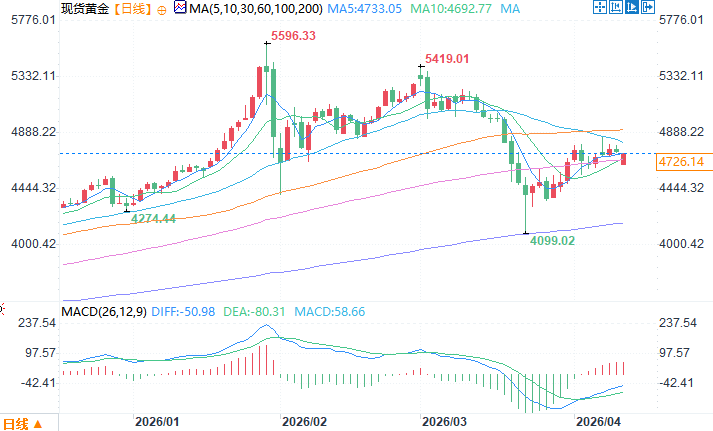
Spot gold daily chart source: EasyForex
At 14:55 Beijing time on April 13, spot gold was trading at $4725.14 per ounce.
The ceasefire agreement announced earlier by the United States and Iran had temporarily eased market tensions, and investors were cautiously optimistic about the weekend's negotiations in Islamabad, believing that the initial two-week ceasefire agreement could be extended. However, the weekend negotiations ultimately ended without any agreement, meaning that the Strait of Hormuz, a key global oil shipping route, is unlikely to reopen in the short term, and energy prices are unlikely to see further easing.
High energy prices could reignite market expectations of inflation, pushing up bond yields and potentially putting new pressure on gold, stocks, and the foreign exchange market. Because the market had already priced in much of this optimism, Monday's opening saw a gap down, while oil prices gapped up. Such rapid fading of geopolitical optimism is not uncommon.
The Islamabad negotiations ended without result.
There were initial expectations for the marathon talks in Islamabad, with some believing that the lengthy and intensive consultations might yield some substantial results. However, these expectations have now been temporarily shelved, as the fundamental issue remains the long-standing mutual distrust between the two sides. As long-standing adversaries, the United States and Iran are still quite far from reaching a consensus.
The main points of contention have not changed significantly enough to bring the two sides together. Nevertheless, the Iranian Foreign Ministry offered a realistic reminder: no matter how high the level of negotiations or how long they last, the outside world should not expect a comprehensive agreement to be reached in a single round of talks. Iran stated that although the US put forward some initiatives, it failed to win the full trust of the Iranian delegation, and the final decision remains in Washington's hands.
The bigger question now is whether a foundation has been laid for subsequent dialogue? Has this round of negotiations at least paved the way for further consultations within the remaining two-week ceasefire window? More importantly, to what extent are both sides actually willing to make concessions? While reaching an agreement is not only in the interests of both sides but also in the broader interests of the international community, the road to an agreement is clearly far from smooth.
Macroeconomic factors have less impact, while geopolitical risks dominate the market.
Besides geopolitical factors, traditional macroeconomic drivers such as the dollar exchange rate and bond yields are still playing a role, but their influence has diminished. Last week's rise in gold prices was mainly due to a weaker dollar, lower yields, and a relatively strong overall stock market performance.
However, it's worth noting that the influence of recent macroeconomic data has clearly taken a backseat. Even with important economic data releases on the calendar, the market reacts far more sensitively to headlines from the Middle East than to regular data. This doesn't mean the data is completely unimportant, but at this stage, it's no longer the primary force dominating the market.
The inability of energy prices to fall effectively will continue to support global inflation expectations, thereby pushing up bond yields and putting some pressure on safe-haven assets such as gold.
Technical Analysis: Key resistance levels continue to limit upside potential
From a technical perspective, the outline of gold's price movement has become clearer. Gold has indeed seen a relatively strong rebound, that's undeniable, but it's currently struggling to break through the important resistance zone of $4800 to $4850. This area is converging with multiple technical signals, including a previous support level that has now become resistance, the lower trendline of a broken trend, and the 61.8% Fibonacci retracement level of the March decline. These factors combined make this area extremely strong resistance.
Until gold prices break through this area decisively, it's difficult to argue for sustained upward movement. If a breakout is successful, the next key psychological and technical level will be around $5,000, which also coincides with the 78.6% Fibonacci retracement level of the March decline. Once gold prices cleanly and decisively break through $5,000, the overall market tone will more clearly shift in favor of the bulls.
On the downside, there is currently a relatively solid sequence of support levels. First, there's the area around $4700, which provides immediate support for prices in the short term. If this level is broken, $4600 will become the next focus; this area previously acted as resistance and may now turn into support. Additionally, $4500 is another psychologically significant level.
However, the truly crucial support level lies at $4,400. This level held firm in early February, and although it was briefly breached in March, prices quickly rebounded above it, indicating its continued significance. A clean break below $4,400 and a close below it would constitute a clear trend reversal and would not be a positive sign.
Short-term outlook: The range-bound trading pattern is likely to continue.
In conclusion, the short-term outlook for gold remains largely unchanged. As long as prices continue to trade between the support level below $4,400 and the resistance level above $5,000, the market will remain in a range-bound pattern. This isn't necessarily a bad thing; it just requires an adjustment in trading strategies.
Given the recent high market volatility, gold still offers good trading opportunities, but it's more about range trading rather than holding positions in hopes of a continuation of the long-term trend.
Only when the price breaks out of this range (whether upwards or downwards) will the market provide a clearer directional signal. Until then, traders need to remain flexible.
Until a clear breakthrough occurs, gold will remain a headline-driven, range-bound market. It's suitable for active trading, but once a position is established, caution is advised.
Summary: The Gold Market Under the Dominance of Geopolitical Risks
The failure of the US-Iran negotiations to reach an agreement further highlights the complexity and uncertainty of the Middle East situation. The obstruction of passage through the Strait of Hormuz could continue to push up energy prices, which in turn could lead to global inflation expectations and financial markets. While gold, as a traditional safe-haven asset, faces some pressure in the short term, its inherent safe-haven properties have not disappeared. Its future trajectory will depend heavily on the continued progress of geopolitical negotiations, the actual performance of energy prices, and marginal changes in macroeconomic data.
In the current environment, investors need to closely monitor the latest developments, balance risks and opportunities, and prudently deal with this market environment full of uncertainty.
Spot gold daily chart source: EasyForex
At 14:55 Beijing time on April 13, spot gold was trading at $4725.14 per ounce.
- Risk Warning and Disclaimer
- The market involves risk, and trading may not be suitable for all investors. This article is for reference only and does not constitute personal investment advice, nor does it take into account certain users’ specific investment objectives, financial situation, or other needs. Any investment decisions made based on this information are at your own risk.