April 15th Financial Breakfast: The temporary ceasefire may be extended to 45 days! Hopes for renewed US-Iran negotiations boost gold prices to $4850, while oil prices plunge over 6%.
2026-04-15 07:27:05
On Wednesday (April 15, Beijing time) in early Asian trading, spot gold was trading around $4,837.70 per ounce. Gold prices rose more than 2% on Tuesday, benefiting from a weaker dollar and market hopes for the resumption of US-Iran negotiations. Trump indicated that talks aimed at ending the war with Iran might resume in Pakistan in the next two days. As a result, US crude oil prices plummeted more than 6% on Tuesday and are currently trading around $91.43 per barrel, potentially testing the $90 per barrel mark during the day.

U.S. stocks closed higher on Tuesday, with the Nasdaq rising 2%, the S&P 500 gaining 1.18% and nearing its record closing high, and the Dow Jones Industrial Average posting its highest closing level since early March. This was primarily driven by signs of easing tensions in the Middle East, including hopes for a resumption of U.S.-Iran negotiations and Israel and Lebanon agreeing to begin direct talks. Meanwhile, lower-than-expected U.S. producer price increases in March provided a boost to inflation, and a strong start to the corporate earnings season also supported market sentiment.
Most sectors in the S&P 500 rose, but the energy sector fell due to oil prices, while the technology and semiconductor sectors performed well.
In terms of individual stocks, BlackRock rose 3% on profit growth, Citigroup rose 2.6% to a new high since 2008, Wells Fargo fell due to lower-than-expected interest income, United Airlines and American Airlines rose 2% and 8% respectively on merger rumors, and Globalstar surged 9.6% on the news of being acquired by Amazon.
Gold prices rose 2% on Tuesday, with spot gold settling at $4,831.78 an ounce and U.S. gold futures gaining 1.7% to $4,850.10, mainly driven by a weaker dollar and market hopes for a resumption of U.S.-Iran negotiations.
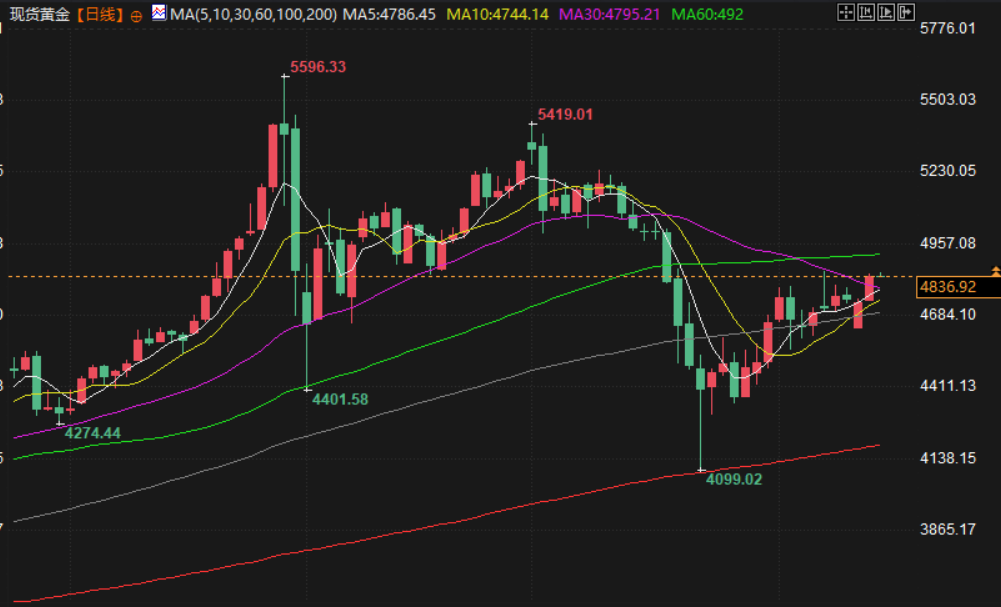
US President Trump indicated that negotiations aimed at ending the war with Iran might resume in Pakistan within the next two days. RJO futures strategists pointed out that gold price movements will depend on the progress of these negotiations, with positive news driving gold prices higher. Currently, a weaker dollar and lower oil prices are providing support for gold. US producer prices rose less than expected in March, but the surge in energy prices caused by the Iran war is exacerbating inflationary pressures. Traders currently estimate a 33% probability of a Federal Reserve rate cut this year.
In other precious metals, spot silver rose 5.2% to $79.48, platinum rose 1.3%, and palladium rose 0.7%.
Oil prices fell significantly on Tuesday, with Brent crude futures closing down 4.6% at $94.79 a barrel and WTI crude futures plunging 7.87% to $91.20, mainly due to market hopes that Iran would resume negotiations with the United States and Israel to end the conflict that led to the closure of the Strait of Hormuz.
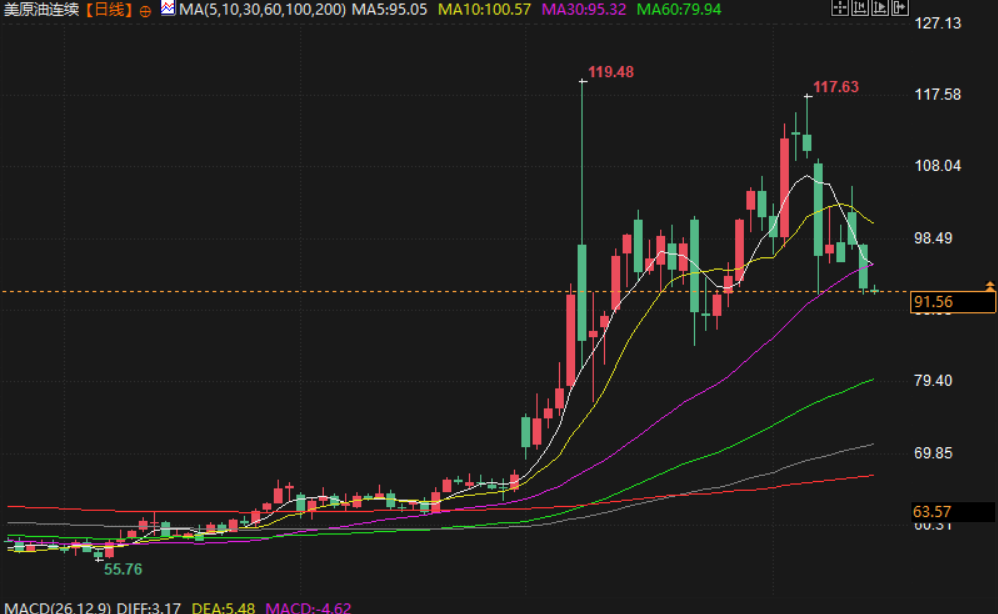
A partner at Again Capital stated that the market seems to be hoping for a better outcome, as Brent crude is more susceptible to global supply disruptions than WTI crude. The International Energy Agency (IEA) monthly report indicated that attacks on Middle Eastern energy facilities and Iran's de facto blockade of the Strait of Hormuz have caused the most severe oil supply disruptions in history, with a supply reduction of 10.1 million barrels per day in March. Restoring oil transport through the strait remains the most critical factor in alleviating pressure on energy supply and oil prices.
The US military has extended its blockade to the Gulf of Oman and the Arabian Sea, and three oil tankers linked to Iran have been granted passage because their destinations are not Iranian ports. Meanwhile, five sources said that the US-Iran negotiating delegation may return to Islamabad this week, and the Pakistani prime minister confirmed that related efforts are still ongoing. The IEA has also significantly lowered its global oil supply and demand growth forecasts, reducing its 2026 demand growth forecast by 80,000 barrels per day and expecting a supply reduction of 1.5 million barrels per day.
The dollar fell for the seventh consecutive trading day on Tuesday, with the dollar index closing down 0.26% at 98.08. It touched 97.968 during the session, its lowest level since March 2, the first trading day of the US-Israel war against Iraq. The decline was mainly driven by market optimism about an impending peace agreement between the US and Iran, as well as lower-than-expected US inflation data.
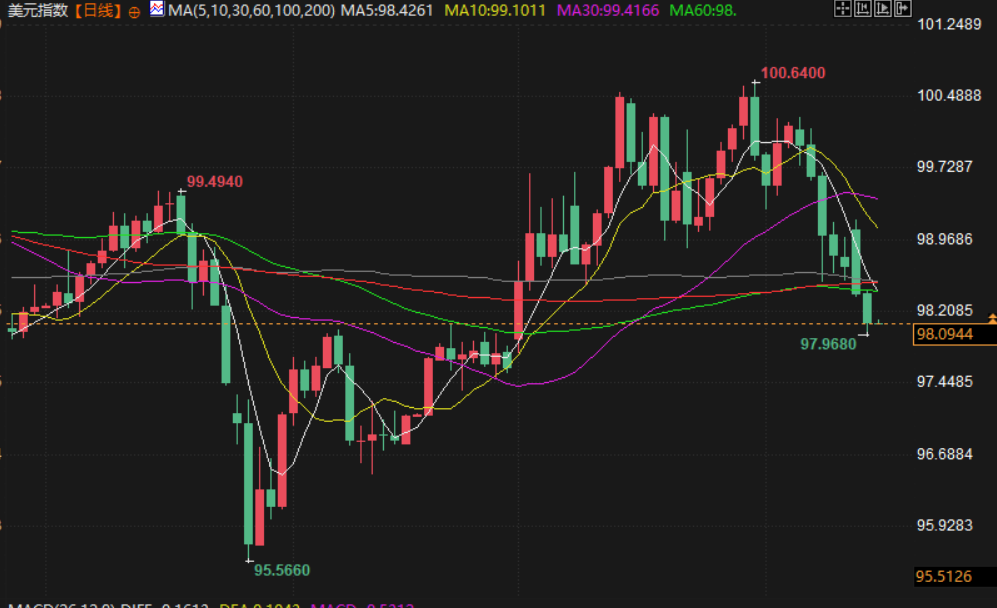
US President Trump indicated that negotiations aimed at ending the war with Iran may resume in Pakistan in the next two days. Corpay's chief market strategist pointed out that the Trump administration is clearly looking for an "exit route." The market expects the US and Iran to eventually reach a symbolic agreement to reopen the Strait of Hormuz. At the same time, traders are reluctant to make large-scale directional bets due to the volatility of White House policies.
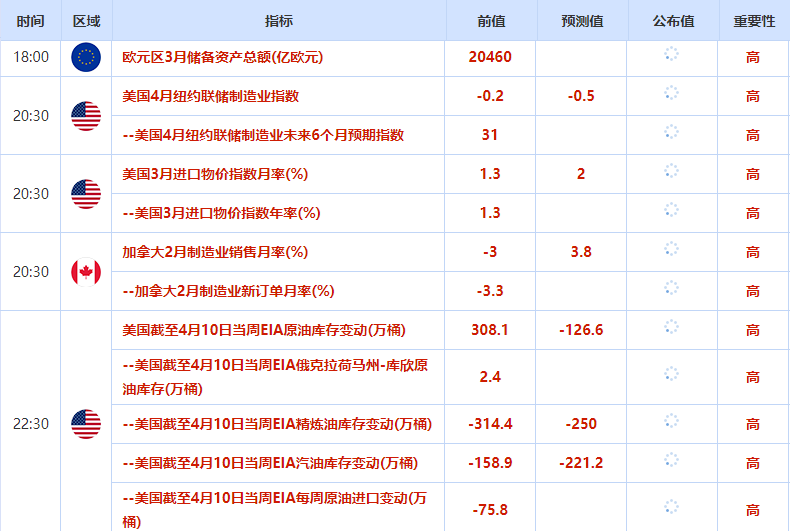
Oil prices plummeted, further dragging down the dollar; the US March PPI rose 0.5% month-on-month, far below the expected 1.1%, and rose 4.0% year-on-year, and the dollar continued its decline after the data was released; Chicago Fed President Goolsby said that interest rate cuts may have to wait until 2027, depending on the duration of high oil prices.
European Central Bank President Christine Lagarde stated that no decision has been made on raising interest rates due to the unclear impact of the Iran war on the Eurozone; the pound rose to $1.3569, a new high since February 17, while the dollar fell 0.45% against the yen to 158.72, as sources indicated that the likelihood of a Bank of Japan rate hike this month has diminished; the euro rose 0.33% to $1.1796, and the Australian and New Zealand dollars also recorded gains.
Pakistan calls for a 45-day extension of the temporary ceasefire between the US and Iran to pave the way for negotiations.
A Pakistani diplomatic source revealed that since the breakdown of US-Iran talks over the weekend, Islamabad has maintained communication with multiple parties, seeking to reach a consensus on extending the ceasefire or resuming technical-level contact between the two sides. Mediators are assisting in facilitating an exchange of views between the two sides on outstanding issues, striving to achieve a ceasefire extension of at least 45 days to pave the way for subsequent negotiations.
U.S. Customs will begin processing tariff refunds on April 20.
U.S. Customs and Border Protection (CBP) announced on March 14 that it has essentially completed the first phase of development for a new customs declaration system feature enabling large-scale refunds to importers, and will begin processing related tariff refunds on March 20. The agency plans to deploy the tariff refund system using a phased development model, adding more features in later phases to address more complex business scenarios. On February 20, the U.S. Supreme Court ruled that the International Emergency Economic Powers Act (IEEPA) did not authorize the president to impose large-scale tariffs. On March 4, a judge of the U.S. Court of International Trade ruled that CBP cannot impose tariffs under the IEPA during tariff settlements. This means that tariffs previously imposed under the IEPA must be refunded. (Xinhua)
Iran is considering a short-term suspension of shipping through the Strait of Hormuz.
Sources say Iran is considering a short-term suspension of shipping through the Strait of Hormuz to avoid testing a potential U.S. blockade and to prevent jeopardizing a new round of peace talks. This potential move is intended to prevent an immediate escalation of the situation at this sensitive diplomatic moment, as the U.S. and Iran coordinate arrangements for a new round of face-to-face talks. Rachel Zimba, a senior fellow at the Center for American Security Affairs, said, "If Iran does suspend shipping, it would indicate that its government is also seeking de-escalation and to avoid a renewed hot war."
Israeli media: Talks between Israeli and Lebanese ambassadors aimed to establish a framework for negotiations; tensions remain high.
Israeli media reported on the 14th that the trilateral talks between Israel, Lebanon, and the United States held that day in Washington, D.C., aimed to establish a framework for subsequent negotiations, amid ongoing tensions between Israel and Lebanon. Israel's Channel 12 television reported that the meeting between the Israeli and Lebanese ambassadors to the U.S. was not to discuss specific issues, but rather a "preparatory meeting" aimed at determining the composition of the delegations and the overall framework for subsequent negotiations. (Xinhua)
White House: 103 oil tankers headed to the US to rush crude oil.
The White House stated that 103 empty oil tankers are en route to U.S. ports to load U.S. crude oil. The White House claims that with record energy production, the U.S. is providing a "critical lifeline" for the global oil and gas crisis. Of the 103 empty vessels, 54 are Very Large Crude Carriers (VLCCs), each capable of carrying approximately 2 million barrels of crude oil. According to the U.S. Energy Information Administration, the U.S. is the world's largest crude oil producer, with a pre-war production of 13 million barrels per day. The U.S. exports approximately 11 million barrels of oil per day and imports 8 million barrels, making it a net oil exporter.
The US Vice President said he was "optimistic" about the current developments in the US-Iran situation.
On April 14 local time, US Vice President Vance expressed optimism about the current situation regarding Iran. He also noted that significant distrust exists between the US and Iran, which cannot be resolved overnight. It was learned on the 14th that sources in the US indicated Vance is expected to lead a possible second round of US-Iran talks. Sources also stated that Trump's special envoy Witkov and his son-in-law Kushner will participate. Trump has assigned the task of promoting a diplomatic solution to these three individuals and is maintaining ongoing contact with Iran and intermediaries. Currently, the US is internally discussing arrangements for a second round of talks, but has not yet determined whether it will be held or its specific timing. (CCTV)
The probability of the Federal Reserve keeping interest rates unchanged in April is 98.4%.
According to CME's "FedWatch": the probability of the Fed raising interest rates by 25 basis points in April is 1.6%, and the probability of keeping rates unchanged is 98.4%. The probability of the Fed cutting rates by a cumulative 25 basis points by June is 1.6%, the probability of keeping rates unchanged is 96.9%, and the probability of raising rates by a cumulative 25 basis points is 1.5%.
Europe is considering developing a post-war plan for Iran, aiming to open the Strait of Hormuz without US involvement.
Several European countries are drafting a plan to form a broad international coalition to assist in clearing the Strait of Hormuz, including deploying minesweepers and other military vessels. However, the plan is only to be implemented after the war and explicitly excludes one country: the United States. French President Emmanuel Macron stated on Tuesday that the plan would create an international defense task force, excluding "belligerents" namely the United States, Israel, and Iran. European diplomats familiar with the plan say that European ships will not be under US command. The goal of this European plan is to encourage shipping companies to use the Strait of Hormuz after the conflict ends. Officials say that a complete end to the conflict is still some time away. A senior German official revealed that the European plan is highly likely to include Germany's participation—Germany has previously been cautious publicly and even regarding any military intervention. Since World War II, Germany has faced significant political and legal obstacles to participating in overseas military operations. The official said Germany could explicitly state its participation as early as Thursday.
US officials: The US government will terminate sanctions waivers for Iranian maritime oil this week.
Two U.S. government officials said Tuesday that the Trump administration will allow a 30-day sanctions waiver for Iranian seaborne oil to expire later this week, as the U.S. currently blocks shipments from Iranian ports. The waiver, issued by the U.S. Treasury Department on March 20, allowed approximately 140 million barrels of oil to enter the global market and eased energy supply pressures during the war with Iran. U.S. Treasury Secretary Bessant stated last month that the waiver would expire on April 19. This move comes amid criticism from lawmakers of both parties for the administration's temporary easing of sanctions against Iran and Russia amid the ongoing U.S.-Israel war and the Russia-Ukraine conflict. One U.S. official stated that Washington has multiple tools at its disposal to target entities purchasing Iranian oil, including “secondary sanctions.” The source added, “Furthermore, with the reinstatement of UN sanctions against Iran and Iran’s history of attempting to cover up its illegal activities with seemingly legitimate ones, any transaction with Iran could trigger additional sanctions.”
The People's Bank of China will conduct 500 billion yuan of outright reverse repurchase operations today.
The People's Bank of China announced on April 14 that it will conduct 500 billion yuan of outright reverse repurchase operations on April 15 through a fixed-quantity, interest rate bidding process with multiple price levels, with a term of 6 months (183 days). Following this operation, both types of outright reverse repurchase operations in April will be rolled over with reduced volumes, resulting in a net withdrawal of 400 billion yuan. (CCTV)
Key Focus Today
stock market
U.S. stocks closed higher on Tuesday, with the Nasdaq rising 2%, the S&P 500 gaining 1.18% and nearing its record closing high, and the Dow Jones Industrial Average posting its highest closing level since early March. This was primarily driven by signs of easing tensions in the Middle East, including hopes for a resumption of U.S.-Iran negotiations and Israel and Lebanon agreeing to begin direct talks. Meanwhile, lower-than-expected U.S. producer price increases in March provided a boost to inflation, and a strong start to the corporate earnings season also supported market sentiment.
Most sectors in the S&P 500 rose, but the energy sector fell due to oil prices, while the technology and semiconductor sectors performed well.
In terms of individual stocks, BlackRock rose 3% on profit growth, Citigroup rose 2.6% to a new high since 2008, Wells Fargo fell due to lower-than-expected interest income, United Airlines and American Airlines rose 2% and 8% respectively on merger rumors, and Globalstar surged 9.6% on the news of being acquired by Amazon.
Gold Market
Gold prices rose 2% on Tuesday, with spot gold settling at $4,831.78 an ounce and U.S. gold futures gaining 1.7% to $4,850.10, mainly driven by a weaker dollar and market hopes for a resumption of U.S.-Iran negotiations.
US President Trump indicated that negotiations aimed at ending the war with Iran might resume in Pakistan within the next two days. RJO futures strategists pointed out that gold price movements will depend on the progress of these negotiations, with positive news driving gold prices higher. Currently, a weaker dollar and lower oil prices are providing support for gold. US producer prices rose less than expected in March, but the surge in energy prices caused by the Iran war is exacerbating inflationary pressures. Traders currently estimate a 33% probability of a Federal Reserve rate cut this year.
In other precious metals, spot silver rose 5.2% to $79.48, platinum rose 1.3%, and palladium rose 0.7%.
oil market
Oil prices fell significantly on Tuesday, with Brent crude futures closing down 4.6% at $94.79 a barrel and WTI crude futures plunging 7.87% to $91.20, mainly due to market hopes that Iran would resume negotiations with the United States and Israel to end the conflict that led to the closure of the Strait of Hormuz.
A partner at Again Capital stated that the market seems to be hoping for a better outcome, as Brent crude is more susceptible to global supply disruptions than WTI crude. The International Energy Agency (IEA) monthly report indicated that attacks on Middle Eastern energy facilities and Iran's de facto blockade of the Strait of Hormuz have caused the most severe oil supply disruptions in history, with a supply reduction of 10.1 million barrels per day in March. Restoring oil transport through the strait remains the most critical factor in alleviating pressure on energy supply and oil prices.
The US military has extended its blockade to the Gulf of Oman and the Arabian Sea, and three oil tankers linked to Iran have been granted passage because their destinations are not Iranian ports. Meanwhile, five sources said that the US-Iran negotiating delegation may return to Islamabad this week, and the Pakistani prime minister confirmed that related efforts are still ongoing. The IEA has also significantly lowered its global oil supply and demand growth forecasts, reducing its 2026 demand growth forecast by 80,000 barrels per day and expecting a supply reduction of 1.5 million barrels per day.
Foreign exchange market
The dollar fell for the seventh consecutive trading day on Tuesday, with the dollar index closing down 0.26% at 98.08. It touched 97.968 during the session, its lowest level since March 2, the first trading day of the US-Israel war against Iraq. The decline was mainly driven by market optimism about an impending peace agreement between the US and Iran, as well as lower-than-expected US inflation data.
US President Trump indicated that negotiations aimed at ending the war with Iran may resume in Pakistan in the next two days. Corpay's chief market strategist pointed out that the Trump administration is clearly looking for an "exit route." The market expects the US and Iran to eventually reach a symbolic agreement to reopen the Strait of Hormuz. At the same time, traders are reluctant to make large-scale directional bets due to the volatility of White House policies.
Oil prices plummeted, further dragging down the dollar; the US March PPI rose 0.5% month-on-month, far below the expected 1.1%, and rose 4.0% year-on-year, and the dollar continued its decline after the data was released; Chicago Fed President Goolsby said that interest rate cuts may have to wait until 2027, depending on the duration of high oil prices.
European Central Bank President Christine Lagarde stated that no decision has been made on raising interest rates due to the unclear impact of the Iran war on the Eurozone; the pound rose to $1.3569, a new high since February 17, while the dollar fell 0.45% against the yen to 158.72, as sources indicated that the likelihood of a Bank of Japan rate hike this month has diminished; the euro rose 0.33% to $1.1796, and the Australian and New Zealand dollars also recorded gains.
International News
Pakistan calls for a 45-day extension of the temporary ceasefire between the US and Iran to pave the way for negotiations.
A Pakistani diplomatic source revealed that since the breakdown of US-Iran talks over the weekend, Islamabad has maintained communication with multiple parties, seeking to reach a consensus on extending the ceasefire or resuming technical-level contact between the two sides. Mediators are assisting in facilitating an exchange of views between the two sides on outstanding issues, striving to achieve a ceasefire extension of at least 45 days to pave the way for subsequent negotiations.
U.S. Customs will begin processing tariff refunds on April 20.
U.S. Customs and Border Protection (CBP) announced on March 14 that it has essentially completed the first phase of development for a new customs declaration system feature enabling large-scale refunds to importers, and will begin processing related tariff refunds on March 20. The agency plans to deploy the tariff refund system using a phased development model, adding more features in later phases to address more complex business scenarios. On February 20, the U.S. Supreme Court ruled that the International Emergency Economic Powers Act (IEEPA) did not authorize the president to impose large-scale tariffs. On March 4, a judge of the U.S. Court of International Trade ruled that CBP cannot impose tariffs under the IEPA during tariff settlements. This means that tariffs previously imposed under the IEPA must be refunded. (Xinhua)
Iran is considering a short-term suspension of shipping through the Strait of Hormuz.
Sources say Iran is considering a short-term suspension of shipping through the Strait of Hormuz to avoid testing a potential U.S. blockade and to prevent jeopardizing a new round of peace talks. This potential move is intended to prevent an immediate escalation of the situation at this sensitive diplomatic moment, as the U.S. and Iran coordinate arrangements for a new round of face-to-face talks. Rachel Zimba, a senior fellow at the Center for American Security Affairs, said, "If Iran does suspend shipping, it would indicate that its government is also seeking de-escalation and to avoid a renewed hot war."
Israeli media: Talks between Israeli and Lebanese ambassadors aimed to establish a framework for negotiations; tensions remain high.
Israeli media reported on the 14th that the trilateral talks between Israel, Lebanon, and the United States held that day in Washington, D.C., aimed to establish a framework for subsequent negotiations, amid ongoing tensions between Israel and Lebanon. Israel's Channel 12 television reported that the meeting between the Israeli and Lebanese ambassadors to the U.S. was not to discuss specific issues, but rather a "preparatory meeting" aimed at determining the composition of the delegations and the overall framework for subsequent negotiations. (Xinhua)
White House: 103 oil tankers headed to the US to rush crude oil.
The White House stated that 103 empty oil tankers are en route to U.S. ports to load U.S. crude oil. The White House claims that with record energy production, the U.S. is providing a "critical lifeline" for the global oil and gas crisis. Of the 103 empty vessels, 54 are Very Large Crude Carriers (VLCCs), each capable of carrying approximately 2 million barrels of crude oil. According to the U.S. Energy Information Administration, the U.S. is the world's largest crude oil producer, with a pre-war production of 13 million barrels per day. The U.S. exports approximately 11 million barrels of oil per day and imports 8 million barrels, making it a net oil exporter.
The US Vice President said he was "optimistic" about the current developments in the US-Iran situation.
On April 14 local time, US Vice President Vance expressed optimism about the current situation regarding Iran. He also noted that significant distrust exists between the US and Iran, which cannot be resolved overnight. It was learned on the 14th that sources in the US indicated Vance is expected to lead a possible second round of US-Iran talks. Sources also stated that Trump's special envoy Witkov and his son-in-law Kushner will participate. Trump has assigned the task of promoting a diplomatic solution to these three individuals and is maintaining ongoing contact with Iran and intermediaries. Currently, the US is internally discussing arrangements for a second round of talks, but has not yet determined whether it will be held or its specific timing. (CCTV)
The probability of the Federal Reserve keeping interest rates unchanged in April is 98.4%.
According to CME's "FedWatch": the probability of the Fed raising interest rates by 25 basis points in April is 1.6%, and the probability of keeping rates unchanged is 98.4%. The probability of the Fed cutting rates by a cumulative 25 basis points by June is 1.6%, the probability of keeping rates unchanged is 96.9%, and the probability of raising rates by a cumulative 25 basis points is 1.5%.
Europe is considering developing a post-war plan for Iran, aiming to open the Strait of Hormuz without US involvement.
Several European countries are drafting a plan to form a broad international coalition to assist in clearing the Strait of Hormuz, including deploying minesweepers and other military vessels. However, the plan is only to be implemented after the war and explicitly excludes one country: the United States. French President Emmanuel Macron stated on Tuesday that the plan would create an international defense task force, excluding "belligerents" namely the United States, Israel, and Iran. European diplomats familiar with the plan say that European ships will not be under US command. The goal of this European plan is to encourage shipping companies to use the Strait of Hormuz after the conflict ends. Officials say that a complete end to the conflict is still some time away. A senior German official revealed that the European plan is highly likely to include Germany's participation—Germany has previously been cautious publicly and even regarding any military intervention. Since World War II, Germany has faced significant political and legal obstacles to participating in overseas military operations. The official said Germany could explicitly state its participation as early as Thursday.
US officials: The US government will terminate sanctions waivers for Iranian maritime oil this week.
Two U.S. government officials said Tuesday that the Trump administration will allow a 30-day sanctions waiver for Iranian seaborne oil to expire later this week, as the U.S. currently blocks shipments from Iranian ports. The waiver, issued by the U.S. Treasury Department on March 20, allowed approximately 140 million barrels of oil to enter the global market and eased energy supply pressures during the war with Iran. U.S. Treasury Secretary Bessant stated last month that the waiver would expire on April 19. This move comes amid criticism from lawmakers of both parties for the administration's temporary easing of sanctions against Iran and Russia amid the ongoing U.S.-Israel war and the Russia-Ukraine conflict. One U.S. official stated that Washington has multiple tools at its disposal to target entities purchasing Iranian oil, including “secondary sanctions.” The source added, “Furthermore, with the reinstatement of UN sanctions against Iran and Iran’s history of attempting to cover up its illegal activities with seemingly legitimate ones, any transaction with Iran could trigger additional sanctions.”
Domestic News
The People's Bank of China will conduct 500 billion yuan of outright reverse repurchase operations today.
The People's Bank of China announced on April 14 that it will conduct 500 billion yuan of outright reverse repurchase operations on April 15 through a fixed-quantity, interest rate bidding process with multiple price levels, with a term of 6 months (183 days). Following this operation, both types of outright reverse repurchase operations in April will be rolled over with reduced volumes, resulting in a net withdrawal of 400 billion yuan. (CCTV)
- Risk Warning and Disclaimer
- The market involves risk, and trading may not be suitable for all investors. This article is for reference only and does not constitute personal investment advice, nor does it take into account certain users’ specific investment objectives, financial situation, or other needs. Any investment decisions made based on this information are at your own risk.