A weakening dollar and escalating tensions in the Middle East have kept the USD/JPY pair range-bound, capped at the 159 level.
2026-04-15 09:47:21
The USD/JPY pair remained range-bound during Wednesday's Asian session, fluctuating narrowly below the 159 level, continuing the consolidation pattern following the previous trading day's decline. Looking at a longer timeframe, the pair remains within the range-bound structure established over the past month, with no clear breakout from the bullish or bearish direction, necessitating caution in short-term trading.

The core variables influencing exchange rates remain the interplay between geopolitical tensions and macroeconomic policy expectations. While the market maintains some optimism regarding the prospects of US-Iran diplomacy, the uncertainty surrounding the Middle East situation continues to exert potential pressure on the Japanese economy. Particularly against the backdrop of ongoing tensions in the Strait of Hormuz, the US Navy's blockade of Iranian ports has further strained already restricted oil shipments. Given Japan's heavy reliance on Middle Eastern oil imports, this situation exacerbates market concerns about its economic prospects, thereby weakening the yen's attractiveness.
Market feedback indicates that this "imported risk" is gradually manifesting in the exchange rate. Investors are concerned that rising energy costs could drag down Japan's economic growth and even affect the trade balance, significantly weakening the yen's fundamental support beyond its safe-haven status. Against this backdrop, the USD/JPY exchange rate has gained some upward momentum.
However, the US dollar also faces pressure. The latest US Producer Price Index (PPI) fell short of market expectations, reinforcing the market's assessment that the Federal Reserve will not raise interest rates in the near term. This cooling of interest rate expectations has put pressure on the dollar index, keeping it near its lowest level since early March , which has limited the upside potential of the dollar against the yen to some extent.
Some analysts point out that the current weakness of the US dollar stems more from adjustments in policy expectations than from a deterioration in economic fundamentals, and therefore its downside potential may be relatively limited.
Meanwhile, global stock markets performed strongly, and risk appetite rebounded, which typically discourages demand for the yen as a safe-haven asset. However, expectations of potential intervention by Japanese authorities continue to constrain the exchange rate. As USD/JPY approaches historical highs, market concerns about possible government intervention have intensified, which has somewhat dampened the bulls' willingness to push the exchange rate higher.
Overall, the market is currently in a phase of intertwined factors: on the one hand, uncertainty surrounding the Middle East situation is weakening the yen; on the other hand, weakening US inflation is suppressing the dollar; coupled with expectations of intervention, this makes it difficult for the exchange rate to form a one-sided trend. This structural divergence is the core reason why the USD/JPY exchange rate is maintaining a range-bound movement.
From a technical perspective, on the daily chart, USD/JPY remains in a high-level consolidation phase, with the trend shifting from a previous one-sided upward movement to sideways trading. The 160 level represents both psychological and policy resistance, while the 155 area forms temporary support. Currently, the price is trading in the upper part of the range, indicating that the bulls still have some advantage, but momentum has clearly slowed.
On the 4-hour chart, the exchange rate has been fluctuating around the 159 level, with short-term moving averages flattening out, indicating a lack of clear market direction. Momentum indicators show repeated crossovers, suggesting a balance between bullish and bearish forces. A decisive break above the 159.50-160 range could reopen upward potential; conversely, a break below the support around 157 could lead to a retest of the lower end of the range. Overall, the short-term trend is mainly consolidation, awaiting new catalysts to drive a directional move.
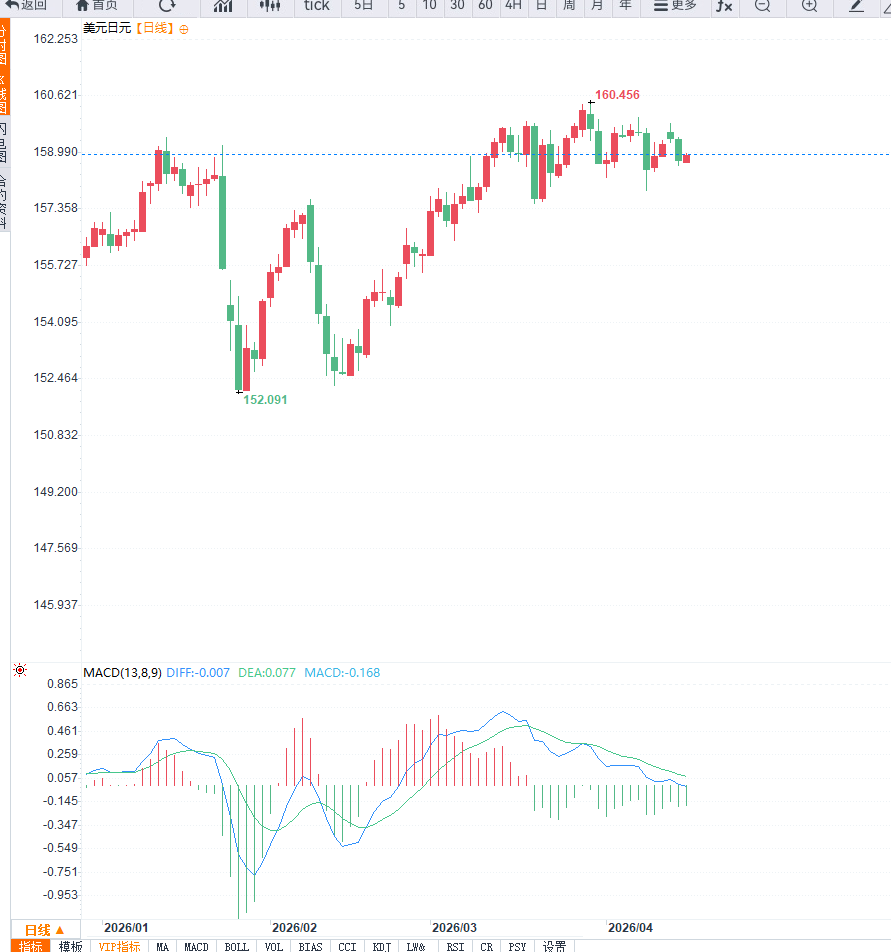
Editor's Summary : The USD/JPY pair is currently in a typical period of "fundamental divergence," with neither bullish nor bearish drivers gaining a decisive advantage. The Middle East situation is weakening the yen through energy channels, while declining US inflation is limiting the dollar's upside, causing the exchange rate to trade within a range. In the short term, a break above the upper limit of the 159-160 range or a drop below the 155 support level will be key signals for determining the trend direction. Until then, the market is more likely to maintain a high-level consolidation pattern. Close attention should be paid to geopolitical developments, expectations regarding Federal Reserve policy, and the potential risk of intervention by Japanese authorities, as these factors will determine the next stage of the exchange rate's movement.
The core variables influencing exchange rates remain the interplay between geopolitical tensions and macroeconomic policy expectations. While the market maintains some optimism regarding the prospects of US-Iran diplomacy, the uncertainty surrounding the Middle East situation continues to exert potential pressure on the Japanese economy. Particularly against the backdrop of ongoing tensions in the Strait of Hormuz, the US Navy's blockade of Iranian ports has further strained already restricted oil shipments. Given Japan's heavy reliance on Middle Eastern oil imports, this situation exacerbates market concerns about its economic prospects, thereby weakening the yen's attractiveness.
Market feedback indicates that this "imported risk" is gradually manifesting in the exchange rate. Investors are concerned that rising energy costs could drag down Japan's economic growth and even affect the trade balance, significantly weakening the yen's fundamental support beyond its safe-haven status. Against this backdrop, the USD/JPY exchange rate has gained some upward momentum.
However, the US dollar also faces pressure. The latest US Producer Price Index (PPI) fell short of market expectations, reinforcing the market's assessment that the Federal Reserve will not raise interest rates in the near term. This cooling of interest rate expectations has put pressure on the dollar index, keeping it near its lowest level since early March , which has limited the upside potential of the dollar against the yen to some extent.
Some analysts point out that the current weakness of the US dollar stems more from adjustments in policy expectations than from a deterioration in economic fundamentals, and therefore its downside potential may be relatively limited.
Meanwhile, global stock markets performed strongly, and risk appetite rebounded, which typically discourages demand for the yen as a safe-haven asset. However, expectations of potential intervention by Japanese authorities continue to constrain the exchange rate. As USD/JPY approaches historical highs, market concerns about possible government intervention have intensified, which has somewhat dampened the bulls' willingness to push the exchange rate higher.
Overall, the market is currently in a phase of intertwined factors: on the one hand, uncertainty surrounding the Middle East situation is weakening the yen; on the other hand, weakening US inflation is suppressing the dollar; coupled with expectations of intervention, this makes it difficult for the exchange rate to form a one-sided trend. This structural divergence is the core reason why the USD/JPY exchange rate is maintaining a range-bound movement.
From a technical perspective, on the daily chart, USD/JPY remains in a high-level consolidation phase, with the trend shifting from a previous one-sided upward movement to sideways trading. The 160 level represents both psychological and policy resistance, while the 155 area forms temporary support. Currently, the price is trading in the upper part of the range, indicating that the bulls still have some advantage, but momentum has clearly slowed.
On the 4-hour chart, the exchange rate has been fluctuating around the 159 level, with short-term moving averages flattening out, indicating a lack of clear market direction. Momentum indicators show repeated crossovers, suggesting a balance between bullish and bearish forces. A decisive break above the 159.50-160 range could reopen upward potential; conversely, a break below the support around 157 could lead to a retest of the lower end of the range. Overall, the short-term trend is mainly consolidation, awaiting new catalysts to drive a directional move.
Editor's Summary : The USD/JPY pair is currently in a typical period of "fundamental divergence," with neither bullish nor bearish drivers gaining a decisive advantage. The Middle East situation is weakening the yen through energy channels, while declining US inflation is limiting the dollar's upside, causing the exchange rate to trade within a range. In the short term, a break above the upper limit of the 159-160 range or a drop below the 155 support level will be key signals for determining the trend direction. Until then, the market is more likely to maintain a high-level consolidation pattern. Close attention should be paid to geopolitical developments, expectations regarding Federal Reserve policy, and the potential risk of intervention by Japanese authorities, as these factors will determine the next stage of the exchange rate's movement.
- Risk Warning and Disclaimer
- The market involves risk, and trading may not be suitable for all investors. This article is for reference only and does not constitute personal investment advice, nor does it take into account certain users’ specific investment objectives, financial situation, or other needs. Any investment decisions made based on this information are at your own risk.