US Dollar Index Outlook: Entering a Consolidation Phase After Several Days of Decline
2026-04-15 19:54:32
On Wednesday (April 15), the US dollar index rose slightly during the European session, reaching 98.2698, a gain of 0.16%. It is currently trading within Tuesday's trading range. After several consecutive days of downward correction, market sentiment has become cautious, with investors not yet showing a clear tendency to hold positions in either direction; the balance of power between bulls and bears is currently at a temporary equilibrium.

Easing geopolitical tensions coupled with weak PPI data put double pressure on the US dollar.
The recent decline in the US dollar is primarily driven by two core factors: waning market risk aversion and easing inflationary pressures. News that the US and Iran may resume negotiations directly eliminated the risk premium of safe-haven assets—typically, when market panic subsides, the dollar, as a traditional safe-haven currency, tends to weaken. Simultaneously, similar geopolitical easing news, coupled with adjustments in market demand expectations, led to a sharp drop in international oil prices; lower oil prices directly weakened upward inflationary momentum, further stripping away one of the key factors that previously supported the dollar.
Euro/Dollar Analysis
The March Producer Price Index (PPI) data showed an actual month-on-month increase of 0.5%, far below the market expectation of 1.1%. This significantly weaker-than-expected performance triggered a reassessment of US inflation momentum. Following the data release, the Federal Reserve had significantly more policy options than the previous week, leading to adjustments in interest rate expectations and a decline in US Treasury yields. Driven by interest rate differentials, funds began flowing into non-US currencies: the euro attracted substantial buying interest, while the pound and yen also strengthened. However, the market remains cautious and has not yet seen large-scale directional bets—after all, a single breaking news event could disrupt the existing market structure. But judging from the overall trading activity this week, the US dollar is clearly no longer the preferred trading target for investors.
The dollar's rebound appears to be a short-term consolidation, with downward pressure remaining unchanged.
The slight rebound this morning is not a signal of a trend reversal, but rather a technical consolidation after several days of decline. Currently, the three core negative factors—low inflation, downward oil prices, and easing geopolitical risks—continue to exert their influence. Unless these three factors undergo a substantial reversal, the US dollar will remain under pressure.
Technical Outlook: US Dollar Index Trend Analysis
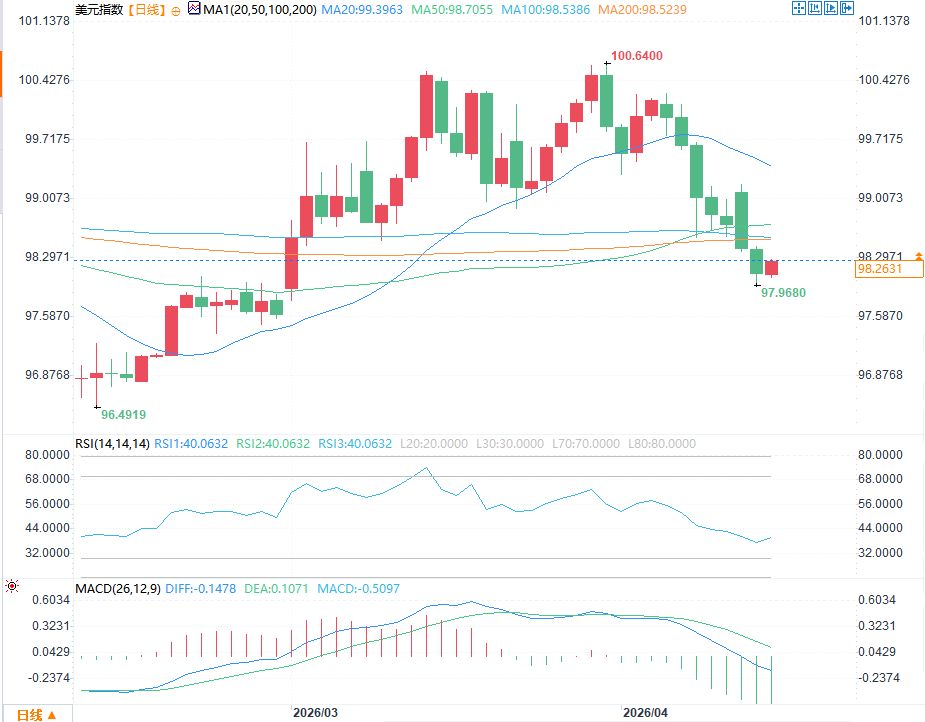
(US Dollar Index Daily Chart Source: FX678)
From the daily chart, the main trend of the US dollar index remains downward.
If the price falls below yesterday's low of 97.968, it will signify the resumption of the downward trend.
Conversely, if the bulls can push the index through short-term resistance, the short-term trend is likely to turn upward.
Looking at the recent trading range, the US dollar index has been fluctuating between 96.491 and 100.640. Currently, the index is hovering around the 50% retracement level of this range. This consolidation around a key level is a normal market reaction, and the battle between bulls and bears at this level will determine today's market direction.
From the perspective of moving average systems:
If the index can hold above the current price (98.263), it may trigger a short-covering rally, pushing the index towards the resistance zone where the MA200 (98.524) and MA50 (98.706) are located.
Conversely, if the current support fails, the market may experience accelerated selling, and the index may quickly fall to the lower support level.
Easing geopolitical tensions coupled with weak PPI data put double pressure on the US dollar.
The recent decline in the US dollar is primarily driven by two core factors: waning market risk aversion and easing inflationary pressures. News that the US and Iran may resume negotiations directly eliminated the risk premium of safe-haven assets—typically, when market panic subsides, the dollar, as a traditional safe-haven currency, tends to weaken. Simultaneously, similar geopolitical easing news, coupled with adjustments in market demand expectations, led to a sharp drop in international oil prices; lower oil prices directly weakened upward inflationary momentum, further stripping away one of the key factors that previously supported the dollar.
Euro/Dollar Analysis
The March Producer Price Index (PPI) data showed an actual month-on-month increase of 0.5%, far below the market expectation of 1.1%. This significantly weaker-than-expected performance triggered a reassessment of US inflation momentum. Following the data release, the Federal Reserve had significantly more policy options than the previous week, leading to adjustments in interest rate expectations and a decline in US Treasury yields. Driven by interest rate differentials, funds began flowing into non-US currencies: the euro attracted substantial buying interest, while the pound and yen also strengthened. However, the market remains cautious and has not yet seen large-scale directional bets—after all, a single breaking news event could disrupt the existing market structure. But judging from the overall trading activity this week, the US dollar is clearly no longer the preferred trading target for investors.
The dollar's rebound appears to be a short-term consolidation, with downward pressure remaining unchanged.
The slight rebound this morning is not a signal of a trend reversal, but rather a technical consolidation after several days of decline. Currently, the three core negative factors—low inflation, downward oil prices, and easing geopolitical risks—continue to exert their influence. Unless these three factors undergo a substantial reversal, the US dollar will remain under pressure.
Technical Outlook: US Dollar Index Trend Analysis
(US Dollar Index Daily Chart Source: FX678)
From the daily chart, the main trend of the US dollar index remains downward.
If the price falls below yesterday's low of 97.968, it will signify the resumption of the downward trend.
Conversely, if the bulls can push the index through short-term resistance, the short-term trend is likely to turn upward.
Looking at the recent trading range, the US dollar index has been fluctuating between 96.491 and 100.640. Currently, the index is hovering around the 50% retracement level of this range. This consolidation around a key level is a normal market reaction, and the battle between bulls and bears at this level will determine today's market direction.
From the perspective of moving average systems:
If the index can hold above the current price (98.263), it may trigger a short-covering rally, pushing the index towards the resistance zone where the MA200 (98.524) and MA50 (98.706) are located.
Conversely, if the current support fails, the market may experience accelerated selling, and the index may quickly fall to the lower support level.
- Risk Warning and Disclaimer
- The market involves risk, and trading may not be suitable for all investors. This article is for reference only and does not constitute personal investment advice, nor does it take into account certain users’ specific investment objectives, financial situation, or other needs. Any investment decisions made based on this information are at your own risk.