The dollar plummeted while the yen remained stable! This extreme divergence is brewing a major market move.
2026-04-17 15:57:06
On Friday (April 17), during the Asian and European sessions, the USD/JPY pair saw a slight rise followed by a fall. Recently, the yen's value has exhibited a very extreme phenomenon, namely, the sharp depreciation of the US dollar has not led to a corresponding appreciation of the yen.
This suggests that the yen is facing significant depreciation pressure in the near term, but if the yen continues to depreciate at an accelerated pace or if negative news fails to cause a depreciation, it may present a good opportunity for bulls to enter the market.
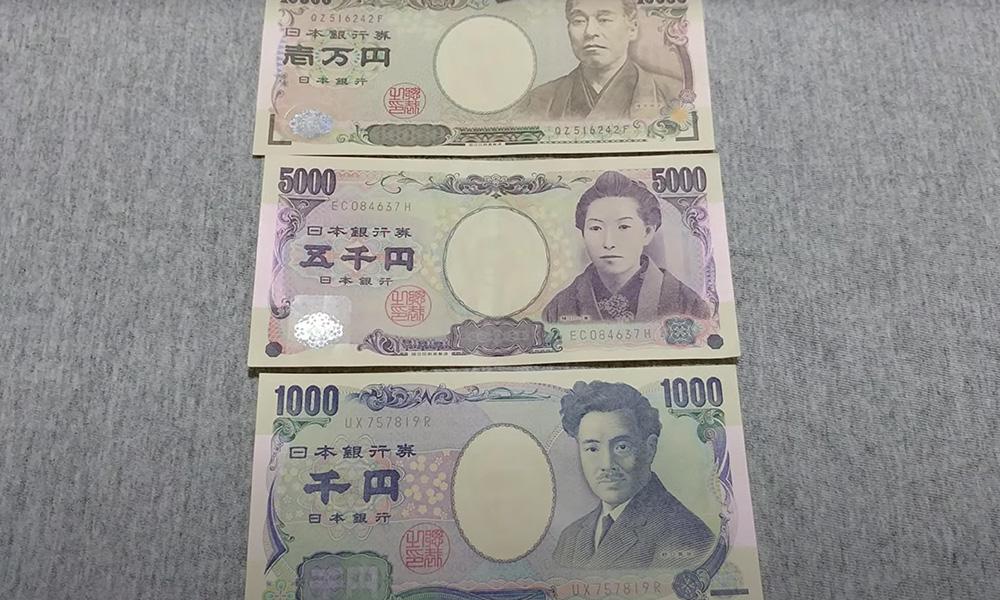
On April 16, Bank of Japan Governor Kazuo Ueda did not provide clear guidance on raising interest rates this month. Instead, he emphasized that Japan's real interest rates are low and corporate profits are robust, which significantly increased the probability that the Bank of Japan will hold rates steady until at least the June policy meeting.
Kazuo Ueda admitted that the current surge in inflation in Japan was triggered by a "negative supply shock." Compared to demand-driven inflation, this type of inflation is more difficult to control through monetary policy, and countries need to formulate response policies based on their own national conditions.
He also stated that the real interest rate at the midpoint of Japan's yield curve remains low, and the overall financial environment remains loose, all of which need to be taken into policy considerations.
This dovish stance has led market traders to remain on the sidelines regarding the timing of an interest rate hike, with the market significantly lowering its bets on a rate hike at the Bank of Japan's April 27-28 policy meeting.
Earlier this month, influenced by the Bank of Japan's hawkish statements, the market's pricing in a rate hike in April rose to 70%.
After Kazuo Ueda's speech on April 13th failed to signal a policy shift and emphasized the potential risks of the Middle East conflict, the probability of a rate hike fell to 30%. Following his latest speech in Washington, the market's pricing in a rate hike in April further declined to around 10%.
This has caused yen traders to hesitate, resulting in price action showing that declining interest rate expectations have not directly contributed to the yen's continued depreciation.
Japanese Finance Minister Satsuki Katayama held in-depth consultations with U.S. Treasury Secretary Scott Bessant yesterday on foreign exchange issues, clarifying that the Japanese monetary authorities are fully prepared to intervene decisively in the foreign exchange market if necessary.
Katayama Satsuki said on Wednesday after bilateral talks in Washington that the two sides had a comprehensive and in-depth discussion on the exchange rate issue and agreed to further strengthen the communication mechanism and maintain closer policy coordination in the future.
She added that, according to the foreign exchange cooperation agreement signed between Japan and the United States in September 2025, the Japanese authorities will take decisive action when necessary. This statement has historically referred to intervention in the foreign exchange market to support the yen. The agreement also explicitly lists intervention as a compliant policy tool for dealing with abnormal exchange rate fluctuations.
At the subsequent G7 finance ministers' meeting, Katayama Satsuki pointed out that many central bank officials believed that the geopolitical situation in the Middle East remained highly volatile, and that a wait-and-see approach was advisable for current monetary policy. He also noted that raising interest rates rashly would have an unpredictable negative impact on the economy.
She made it clear that the talks with Bessant did not touch on monetary policy issues, but both sides reached a high degree of consensus on the risks of exchange rate fluctuations and expressed deep concern.
The yen is currently fluctuating around the key psychological level of 160 yen to the dollar, and Japanese authorities are continuously escalating their verbal warnings.
When the yen fell below this level in the summer of 2024, Japan intervened in the foreign exchange market to reverse the yen's one-sided depreciation trend. Katayama Satsuki also revealed that Bessenter will stop in Japan on his way to China, where the two will meet again. US President Trump also plans to visit China next month.
Furthermore, Bessant's past statements regarding the Bank of Japan have significantly impacted the Japanese market.
In October 2025, he emphasized the independence of the central bank, which was interpreted by the market as support for the Bank of Japan to tighten monetary policy. At that time, the rise of Prime Minister Sanae Takaichi, who advocated fiscal stimulus, also added uncertainty to the normalization of the Bank of Japan's policy.
On the same day, Katayama Satsuki also posted on the social media platform X that Japan had informed the United States about the crude oil purchase situation and the "Asian Energy Resources Supply Capacity Resilience Partnership" initiative, while Bessenter provided a detailed explanation of the latest developments in the Iranian situation.
The core reason for the continued weakening of the yen lies in Japan's structural weakness due to its extreme scarcity of resources, and the resulting deterioration in terms of trade.
Simply put, the terms of trade are the ratio of a country's export prices to its import prices, reflecting the country's exchange capacity in the international market. The formula can be simplified to: Terms of Trade Index = (Export Price Index ÷ Import Price Index) × 100.
When the terms of trade deteriorate, it means that export prices are relatively lower and import prices are significantly higher. The same quantity of exported goods can only be exchanged for fewer imported goods, which usually puts significant downward pressure on the local currency.
Japan is a typical energy importer, with energy accounting for a very high percentage of its imports, while its exports are mainly industrial goods such as automobiles and machinery. When tensions in the Middle East pushed up oil prices, Japan's import price index surged rapidly, but the prices of its exported goods could not be adjusted accordingly, directly leading to a significant deterioration in its terms of trade.
On the one hand, the surge in imported energy costs will increase Japan's demand for foreign currency, prompting companies to sell large amounts of yen and buy US dollars to purchase crude oil, directly depressing the yen's exchange rate. On the other hand, the depreciation of the yen will further push up the price of imported energy denominated in the local currency, creating a vicious cycle of "rising oil prices → deteriorating terms of trade → yen depreciation → higher import costs," while also triggering imported inflation. Domestic depreciation leads to external depreciation, further weakening the yen's credit.
Meanwhile, China's sanctions and export controls on Japan have further exacerbated the deterioration of the yen's creditworthiness.
On one hand, the ongoing turmoil in the Middle East has forced the Bank of Japan to adopt a wait-and-see approach to policy, significantly cooling expectations for interest rate hikes; on the other hand, fluctuations in energy prices have led to a deterioration in terms of trade, putting significant pressure on the yen's fundamentals.
However, given the recent sharp depreciation of the US dollar while the Japanese yen has not appreciated significantly, it suggests that the yen may have already factored in substantial increases in long-term energy import costs, deteriorating terms of trade, and the extreme impact of Chinese sanctions. In the future, with more optimistic developments in US-Iran negotiations (as evidenced by the sharp rebound in global equity markets) and the possibility that Trump's visit to China may improve sanctions against Japan, the yen may have an opportunity to rebound.
With Japanese authorities continuing to issue warnings of foreign exchange market intervention, traders can now focus on trading opportunities that may arise at any time. The future direction of the exchange rate will depend on the Bank of Japan's interest rate meeting in June and further developments in the Middle East.
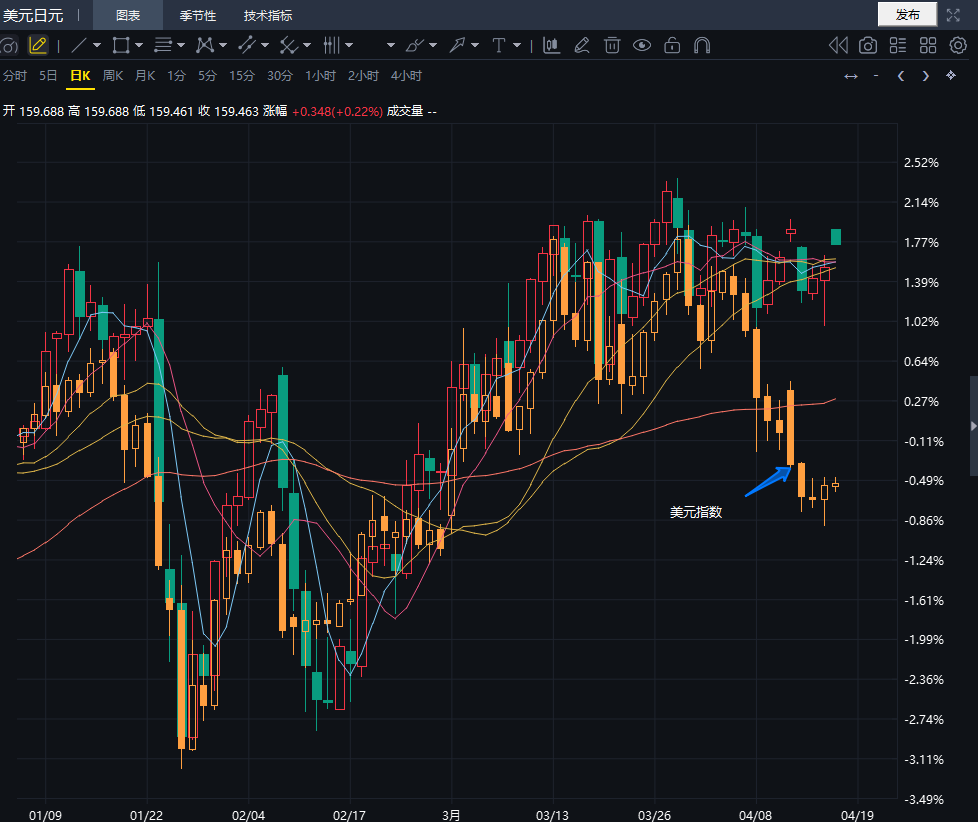
(Overlay chart of USD/JPY and USD/CAD Index daily charts, source: EasyForex)
At 15:55 Beijing time, the USD/CNY exchange rate is currently at 159.34/35.
This suggests that the yen is facing significant depreciation pressure in the near term, but if the yen continues to depreciate at an accelerated pace or if negative news fails to cause a depreciation, it may present a good opportunity for bulls to enter the market.
The Bank of Japan signaled a dovish stance, causing expectations of a rate hike in April to plummet.
On April 16, Bank of Japan Governor Kazuo Ueda did not provide clear guidance on raising interest rates this month. Instead, he emphasized that Japan's real interest rates are low and corporate profits are robust, which significantly increased the probability that the Bank of Japan will hold rates steady until at least the June policy meeting.
Kazuo Ueda admitted that the current surge in inflation in Japan was triggered by a "negative supply shock." Compared to demand-driven inflation, this type of inflation is more difficult to control through monetary policy, and countries need to formulate response policies based on their own national conditions.
He also stated that the real interest rate at the midpoint of Japan's yield curve remains low, and the overall financial environment remains loose, all of which need to be taken into policy considerations.
This dovish stance has led market traders to remain on the sidelines regarding the timing of an interest rate hike, with the market significantly lowering its bets on a rate hike at the Bank of Japan's April 27-28 policy meeting.
Earlier this month, influenced by the Bank of Japan's hawkish statements, the market's pricing in a rate hike in April rose to 70%.
After Kazuo Ueda's speech on April 13th failed to signal a policy shift and emphasized the potential risks of the Middle East conflict, the probability of a rate hike fell to 30%. Following his latest speech in Washington, the market's pricing in a rate hike in April further declined to around 10%.
This has caused yen traders to hesitate, resulting in price action showing that declining interest rate expectations have not directly contributed to the yen's continued depreciation.
Japan and the US jointly issued a statement regarding the foreign exchange market, with Japan threatening to "intervene decisively if necessary."
Japanese Finance Minister Satsuki Katayama held in-depth consultations with U.S. Treasury Secretary Scott Bessant yesterday on foreign exchange issues, clarifying that the Japanese monetary authorities are fully prepared to intervene decisively in the foreign exchange market if necessary.
Katayama Satsuki said on Wednesday after bilateral talks in Washington that the two sides had a comprehensive and in-depth discussion on the exchange rate issue and agreed to further strengthen the communication mechanism and maintain closer policy coordination in the future.
She added that, according to the foreign exchange cooperation agreement signed between Japan and the United States in September 2025, the Japanese authorities will take decisive action when necessary. This statement has historically referred to intervention in the foreign exchange market to support the yen. The agreement also explicitly lists intervention as a compliant policy tool for dealing with abnormal exchange rate fluctuations.
At the subsequent G7 finance ministers' meeting, Katayama Satsuki pointed out that many central bank officials believed that the geopolitical situation in the Middle East remained highly volatile, and that a wait-and-see approach was advisable for current monetary policy. He also noted that raising interest rates rashly would have an unpredictable negative impact on the economy.
She made it clear that the talks with Bessant did not touch on monetary policy issues, but both sides reached a high degree of consensus on the risks of exchange rate fluctuations and expressed deep concern.
The yen is currently fluctuating around the key psychological level of 160 yen to the dollar, and Japanese authorities are continuously escalating their verbal warnings.
When the yen fell below this level in the summer of 2024, Japan intervened in the foreign exchange market to reverse the yen's one-sided depreciation trend. Katayama Satsuki also revealed that Bessenter will stop in Japan on his way to China, where the two will meet again. US President Trump also plans to visit China next month.
Furthermore, Bessant's past statements regarding the Bank of Japan have significantly impacted the Japanese market.
In October 2025, he emphasized the independence of the central bank, which was interpreted by the market as support for the Bank of Japan to tighten monetary policy. At that time, the rise of Prime Minister Sanae Takaichi, who advocated fiscal stimulus, also added uncertainty to the normalization of the Bank of Japan's policy.
On the same day, Katayama Satsuki also posted on the social media platform X that Japan had informed the United States about the crude oil purchase situation and the "Asian Energy Resources Supply Capacity Resilience Partnership" initiative, while Bessenter provided a detailed explanation of the latest developments in the Iranian situation.
The terms of trade continued to deteriorate, and the yen fell into a vicious cycle of depreciation.
The core reason for the continued weakening of the yen lies in Japan's structural weakness due to its extreme scarcity of resources, and the resulting deterioration in terms of trade.
Simply put, the terms of trade are the ratio of a country's export prices to its import prices, reflecting the country's exchange capacity in the international market. The formula can be simplified to: Terms of Trade Index = (Export Price Index ÷ Import Price Index) × 100.
When the terms of trade deteriorate, it means that export prices are relatively lower and import prices are significantly higher. The same quantity of exported goods can only be exchanged for fewer imported goods, which usually puts significant downward pressure on the local currency.
Japan is a typical energy importer, with energy accounting for a very high percentage of its imports, while its exports are mainly industrial goods such as automobiles and machinery. When tensions in the Middle East pushed up oil prices, Japan's import price index surged rapidly, but the prices of its exported goods could not be adjusted accordingly, directly leading to a significant deterioration in its terms of trade.
On the one hand, the surge in imported energy costs will increase Japan's demand for foreign currency, prompting companies to sell large amounts of yen and buy US dollars to purchase crude oil, directly depressing the yen's exchange rate. On the other hand, the depreciation of the yen will further push up the price of imported energy denominated in the local currency, creating a vicious cycle of "rising oil prices → deteriorating terms of trade → yen depreciation → higher import costs," while also triggering imported inflation. Domestic depreciation leads to external depreciation, further weakening the yen's credit.
Meanwhile, China's sanctions and export controls on Japan have further exacerbated the deterioration of the yen's creditworthiness.
Summary and Technical Analysis:
On one hand, the ongoing turmoil in the Middle East has forced the Bank of Japan to adopt a wait-and-see approach to policy, significantly cooling expectations for interest rate hikes; on the other hand, fluctuations in energy prices have led to a deterioration in terms of trade, putting significant pressure on the yen's fundamentals.
However, given the recent sharp depreciation of the US dollar while the Japanese yen has not appreciated significantly, it suggests that the yen may have already factored in substantial increases in long-term energy import costs, deteriorating terms of trade, and the extreme impact of Chinese sanctions. In the future, with more optimistic developments in US-Iran negotiations (as evidenced by the sharp rebound in global equity markets) and the possibility that Trump's visit to China may improve sanctions against Japan, the yen may have an opportunity to rebound.
With Japanese authorities continuing to issue warnings of foreign exchange market intervention, traders can now focus on trading opportunities that may arise at any time. The future direction of the exchange rate will depend on the Bank of Japan's interest rate meeting in June and further developments in the Middle East.
(Overlay chart of USD/JPY and USD/CAD Index daily charts, source: EasyForex)
At 15:55 Beijing time, the USD/CNY exchange rate is currently at 159.34/35.
- Risk Warning and Disclaimer
- The market involves risk, and trading may not be suitable for all investors. This article is for reference only and does not constitute personal investment advice, nor does it take into account certain users’ specific investment objectives, financial situation, or other needs. Any investment decisions made based on this information are at your own risk.