Trump boasted that an Iran deal was imminent, but gold bulls were stunned by the Hormuz naval blockade.
2026-04-17 14:24:19
In the current complex geopolitical environment, gold's role as a traditional safe-haven asset is facing severe challenges. During Friday's (April 17) Asian trading session, spot gold continued its sideways consolidation, fluctuating around $4800 with relatively small price movements throughout the day. Market sentiment was clearly mixed, with increasing diplomatic efforts in the Middle East on one hand, and tensions arising from the US's ongoing naval blockade of Iranian ports on the other. These factors collectively supported the strong position of the US dollar as the global reserve currency, thus putting some pressure on gold, which does not generate returns.
Despite intensifying diplomatic efforts to end the Middle East conflict, tensions between the US and Iran have not completely subsided. The US naval blockade of Iranian ports continues, seen as a key measure to maintain the dollar's dominance and limiting the upside potential for gold. Meanwhile, a 10-day ceasefire agreement between Israel and Lebanon has injected a dose of optimism. Many analysts believe this development could pave the way for a broader peace agreement between the US and Iran.
Speaking to reporters on Thursday, US President Donald Trump expressed a relatively optimistic view, stating that a deal with Iran was imminent. According to the Wall Street Journal, Washington and Tehran have agreed in principle to launch a new round of talks, although specific times and locations have not yet been finalized. These diplomatic signals undoubtedly boosted risk appetite, while the reduced probability of a Federal Reserve rate hike also somewhat limited the dollar's rebound from its late February lows. These factors combined to help gold prices rebound somewhat from the $4767 area.
The U.S. Producer Price Index (PPI) data released earlier this week significantly eased market concerns about war driving up energy prices and triggering inflation. Expectations of further easing tensions in the Middle East also put pressure on oil prices and weakened expectations of a hawkish Federal Reserve policy. Currently, traders estimate a roughly 30% probability of a Fed rate cut before the end of the year. This expectation directly prevents traders from further building bullish positions in the dollar, thus providing necessary support for gold, a non-yielding asset.
Following this week's pullback in gold prices from near one-month highs, market participants are generally cautious. A more prudent strategy is to wait for further sell-off signals before considering establishing short positions. Looking ahead, there are no major US economic data releases on Friday, and the dollar's performance will largely depend on speeches by key Federal Reserve officials. However, market focus will remain firmly on the potential for another round of US-Iran peace talks this weekend. Upcoming headlines are likely to continue injecting volatility into financial markets and creating meaningful opportunities for gold trading. Despite these uncertainties, gold prices are still on track for a third consecutive week of modest gains.
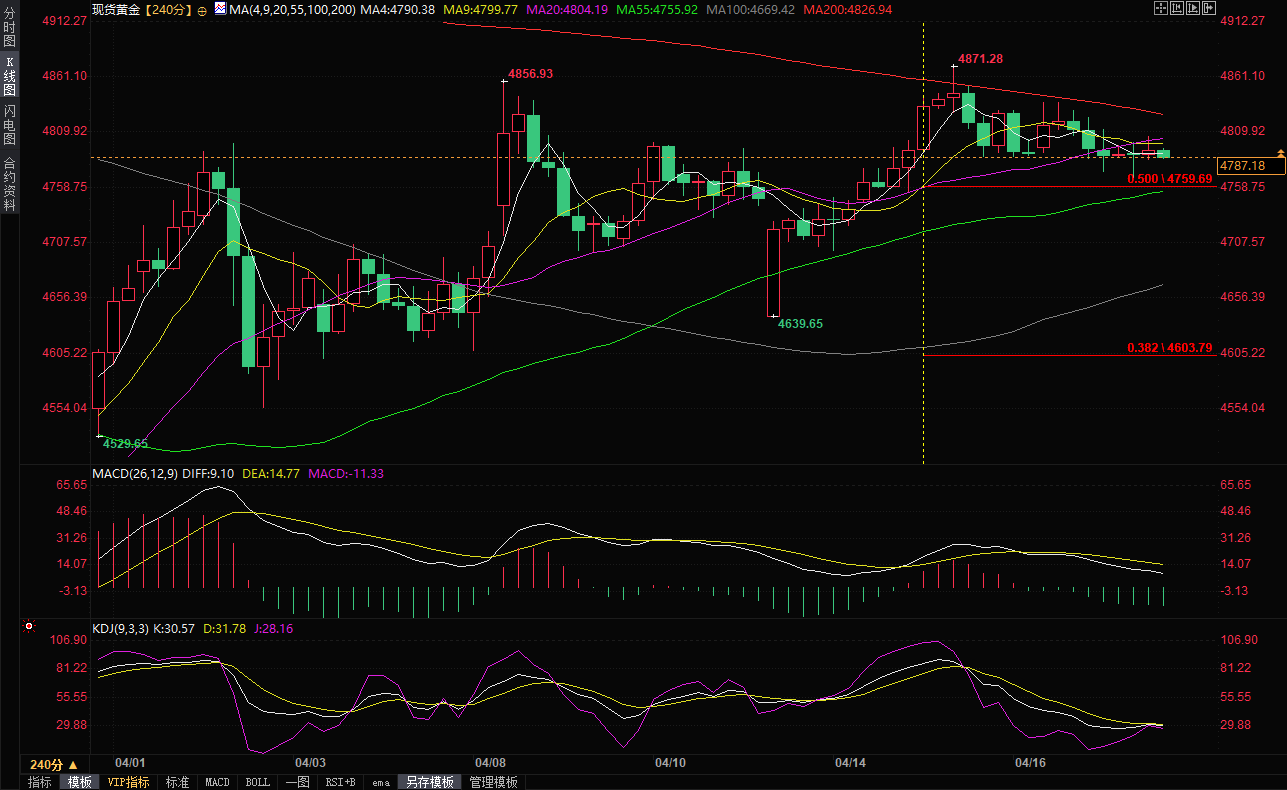
From a technical perspective, gold failed to break through the key resistance level of the 200-period simple moving average (SMA) on the 4-hour chart overnight, currently hovering around 4827, which constitutes a clear warning signal for bullish traders. Although the subsequent price decline stalled before reaching the 50% retracement level of the March drop at 4760, it would be wiser to remain patient and wait for the price to break further below the support area around $4760 before considering establishing further short positions.
Meanwhile, momentum indicators are showing mixed signals: the Relative Strength Index (RSI) is hovering around the neutral level of 50, while the Moving Average Convergence Divergence (MACD) has slipped further below the zero line and remains in negative territory. This suggests that bears currently hold a tactical advantage unless gold prices can effectively recover the key 200-period SMA resistance level (around $4827). Above that, stronger Fibonacci resistance lies near the 61.8% retracement level around $4915. Only a sustained break above these key resistance levels would alleviate the current bearish sentiment and open up upward channels to $5130 and even $5419 for gold prices.
On the downside, initial support lies near the 50.0% Fibonacci retracement level at $4,760. A break below this level could expose further support at the next Fibonacci level of $4,604, followed by $4,414. At these key levels, bulls are expected to enter more aggressively to defend the broader, longer-term uptrend structure.
Overall, the gold market is currently in a delicate balance between offsetting geopolitical risks and hopes for diplomatic peace. Traders need to closely monitor the latest developments in the US-Iran talks and statements from Federal Reserve officials, as these factors will jointly determine the short-term direction of gold. Given the continued uncertainty, caution and patience will be the best strategies for investors in the current market environment. Gold's long-term appeal as a safe-haven asset remains, but short-term volatility may continue to increase, and investors need to be well-prepared for risk management.
At 14:22 Beijing time, spot gold was trading at $4786.12 per ounce.
Geopolitical game: the coexistence of hope for peace and real risks
Despite intensifying diplomatic efforts to end the Middle East conflict, tensions between the US and Iran have not completely subsided. The US naval blockade of Iranian ports continues, seen as a key measure to maintain the dollar's dominance and limiting the upside potential for gold. Meanwhile, a 10-day ceasefire agreement between Israel and Lebanon has injected a dose of optimism. Many analysts believe this development could pave the way for a broader peace agreement between the US and Iran.
Speaking to reporters on Thursday, US President Donald Trump expressed a relatively optimistic view, stating that a deal with Iran was imminent. According to the Wall Street Journal, Washington and Tehran have agreed in principle to launch a new round of talks, although specific times and locations have not yet been finalized. These diplomatic signals undoubtedly boosted risk appetite, while the reduced probability of a Federal Reserve rate hike also somewhat limited the dollar's rebound from its late February lows. These factors combined to help gold prices rebound somewhat from the $4767 area.
Macroeconomic factors: Easing inflation concerns provide support for gold.
The U.S. Producer Price Index (PPI) data released earlier this week significantly eased market concerns about war driving up energy prices and triggering inflation. Expectations of further easing tensions in the Middle East also put pressure on oil prices and weakened expectations of a hawkish Federal Reserve policy. Currently, traders estimate a roughly 30% probability of a Fed rate cut before the end of the year. This expectation directly prevents traders from further building bullish positions in the dollar, thus providing necessary support for gold, a non-yielding asset.
Following this week's pullback in gold prices from near one-month highs, market participants are generally cautious. A more prudent strategy is to wait for further sell-off signals before considering establishing short positions. Looking ahead, there are no major US economic data releases on Friday, and the dollar's performance will largely depend on speeches by key Federal Reserve officials. However, market focus will remain firmly on the potential for another round of US-Iran peace talks this weekend. Upcoming headlines are likely to continue injecting volatility into financial markets and creating meaningful opportunities for gold trading. Despite these uncertainties, gold prices are still on track for a third consecutive week of modest gains.
Technical Analysis: Bulls should cautiously await a key breakout.
From a technical perspective, gold failed to break through the key resistance level of the 200-period simple moving average (SMA) on the 4-hour chart overnight, currently hovering around 4827, which constitutes a clear warning signal for bullish traders. Although the subsequent price decline stalled before reaching the 50% retracement level of the March drop at 4760, it would be wiser to remain patient and wait for the price to break further below the support area around $4760 before considering establishing further short positions.
Meanwhile, momentum indicators are showing mixed signals: the Relative Strength Index (RSI) is hovering around the neutral level of 50, while the Moving Average Convergence Divergence (MACD) has slipped further below the zero line and remains in negative territory. This suggests that bears currently hold a tactical advantage unless gold prices can effectively recover the key 200-period SMA resistance level (around $4827). Above that, stronger Fibonacci resistance lies near the 61.8% retracement level around $4915. Only a sustained break above these key resistance levels would alleviate the current bearish sentiment and open up upward channels to $5130 and even $5419 for gold prices.
On the downside, initial support lies near the 50.0% Fibonacci retracement level at $4,760. A break below this level could expose further support at the next Fibonacci level of $4,604, followed by $4,414. At these key levels, bulls are expected to enter more aggressively to defend the broader, longer-term uptrend structure.
Overall, the gold market is currently in a delicate balance between offsetting geopolitical risks and hopes for diplomatic peace. Traders need to closely monitor the latest developments in the US-Iran talks and statements from Federal Reserve officials, as these factors will jointly determine the short-term direction of gold. Given the continued uncertainty, caution and patience will be the best strategies for investors in the current market environment. Gold's long-term appeal as a safe-haven asset remains, but short-term volatility may continue to increase, and investors need to be well-prepared for risk management.
At 14:22 Beijing time, spot gold was trading at $4786.12 per ounce.
- Risk Warning and Disclaimer
- The market involves risk, and trading may not be suitable for all investors. This article is for reference only and does not constitute personal investment advice, nor does it take into account certain users’ specific investment objectives, financial situation, or other needs. Any investment decisions made based on this information are at your own risk.