Why is Hezbollah's refusal to recognize the ceasefire agreement actually good for gold?
2026-04-15 21:01:27
On Wednesday (April 15), spot gold experienced a surge followed by a pullback during the Asian and European sessions, reaching a high of $4,872 per ounce before currently trading around $4,812.
In addition to the details revealed in the Hezbollah negotiations, market sources indicate that the US and Iran have agreed in principle to extend the ceasefire, while the Iranian Foreign Ministry stated that there is room for dialogue regarding the degree and type of uranium enrichment, which has kept risk appetite on an upward trend.
Against the backdrop of the ongoing US-Iran war, a key variable has been added to the Middle East geopolitical situation—Lebanon and Israel held their first direct diplomatic talks in decades in Washington. This consultation, which US Secretary of State Marco Rubio defined as a "historic opportunity," is essentially an extension of the US-Iran rivalry into the proxy battlefield.
The talks were convened in response to more than a month of intense conflict between Israel and Hezbollah, which is backed by Iran. The root cause of all this is the chain reaction triggered by the US-Israeli coalition's military strikes on Iranian soil.

As the core force of Iran's "Arc of Resistance" strategy, Hezbollah has actively participated in the war since the outbreak of the US-Iran war, becoming a key tool for Iran to contain the US and Israel.
On March 2, Hezbollah launched rockets into northern Israel in support of Iran, directly igniting the conflict between Lebanon and Israel. This action was inseparable from Iran's long-term comprehensive support in terms of funds, weapons, and ideology.
Hezbollah explicitly opposed and refused to participate in the direct talks between Lebanon and Israel. It even intensified its military strikes against northern Israel during the talks, claiming to launch 24 attacks in a single day. Its tough stance is actually deeply tied to Iran's position on negotiations with the United States. Iran has made ending the war in Lebanon and the region a core condition for negotiations with the United States, and Hezbollah has clearly become the leading force in fulfilling this demand, thus increasing Iran's bargaining power.
The talks in Washington revealed a complex power struggle.
Following the talks, the U.S. State Department emphasized that any ceasefire agreement must be reached by the Lebanese and Israeli governments under U.S. mediation, firmly rejecting other channels. This statement was actually intended to weaken Iran's influence on the Lebanese-Israeli situation and to gain the initiative in U.S.-Iran negotiations.
Israeli Ambassador to the United States Yeshir Light stated that the two sides reached a consensus on stripping Hezbollah of its influence in Lebanon, which reflects the strategic intention of the US and Israel to sever Iran's proxy network in the Middle East.
The Lebanese government is eager to end the war through diplomatic means. Ambassador to the United States Nada Hamad Moawaid reiterated the principles of territorial integrity and sovereignty, and called for a ceasefire and a resolution to the humanitarian crisis. However, the Lebanese government's bargaining chips are always constrained by the complex relationship between Iran and Hezbollah. Hezbollah leader Wafiq Safa has made it clear that he will not abide by any agreements reached in the talks.
The severity of the battlefield situation further highlights the spillover risks of the US-Iran war.
Israeli airstrikes have killed at least 2,124 people in Lebanon and displaced more than a million. Last week, Israel launched 100 airstrikes in ten minutes, turning downtown Beirut into ruins.
The Israeli military has invaded southern Lebanon in an attempt to establish a "safe buffer zone," and despite Hezbollah's weakened state in the 2024 conflict, it is still able to launch drones and rockets at Israel daily. Behind its continued combat capability is the constant support from Iran.
More noteworthy is the strategic calculations hidden behind Israel's agreement to the talks. On the one hand, it was to buy time to eliminate Hezbollah militants, and on the other hand, it was to curry favor with the United States. Meanwhile, the United States used the mediation of the Lebanon-Israel talks to put pressure on Iran, attempting to gain a more advantageous position in the US-Iran negotiations.
The US-Iran ceasefire agreement is set to expire on April 22, but there are signs of its extension in several places. The news of the resumption of negotiations is intertwined with the progress of the Lebanon-Israel talks, and geopolitical risks in the Middle East remain high.
Hezbollah's deep ties with Iran, the intractable stalemate in the Lebanon-Israel conflict, and the strategic calculations of the US and Israel together constitute the complex network of power struggles behind the US-Iran war. As a bargaining chip for Iran, Hezbollah's refusal to abide by the negotiation agreement will not have a negative impact on the US-Iran negotiations.
Against the backdrop of this ongoing uncertainty, a recovery in risk appetite is conducive to a rebound in gold prices.
The easing of geopolitical conflicts and the expectation of a rebound in global financial markets will continue to support gold prices. Regardless of the outcome of the US-Iran negotiations, the fluctuating situation in Lebanon and Israel will be a significant catalyst for gold price volatility, making it a core choice for investors to hedge against geopolitical risks.
Hezbollah has always been an important partner of Iran and a key bargaining chip in negotiations. However, due to Hezbollah's significant influence in Lebanon, negotiations with the Lebanese government only demonstrate Israel's respect for the United States and do not have a major impact on the war.
However, this negotiation, which Rubio emphasized and publicized extensively, did indeed suggest that the United States hoped for a smooth US-Iran negotiation and provided a way out for both the US and Iran to continue negotiations. At the same time, Hezbollah, as an important bargaining chip for Iran, still has a deterrent effect because it claims it will not abide by the peace agreement, which is also conducive to Iran continuing negotiations.
With the peace talks breaking through the two-week time limit and Iran's willingness to make concessions on uranium enrichment, gold is expected to continue its volatile rebound.
As I have consistently stated in my previous articles, Iran is likely to compromise on the issue of uranium enrichment and I have maintained my assessment that the US-Iran negotiations are progressing positively. Hezbollah's tough stance this time will not hinder the US-Iran negotiations. Recently, risk assets have continued to strengthen significantly and are facing volatility. Gold is likely to continue its volatile rebound.
From a technical perspective, spot gold is still trading within an upward channel, currently finding support at the middle line of the channel, as well as near the 5-day and 30-day moving averages.
The resistance is at the upper rail of the channel, and a breakout above the upper rail is possible in the near future.
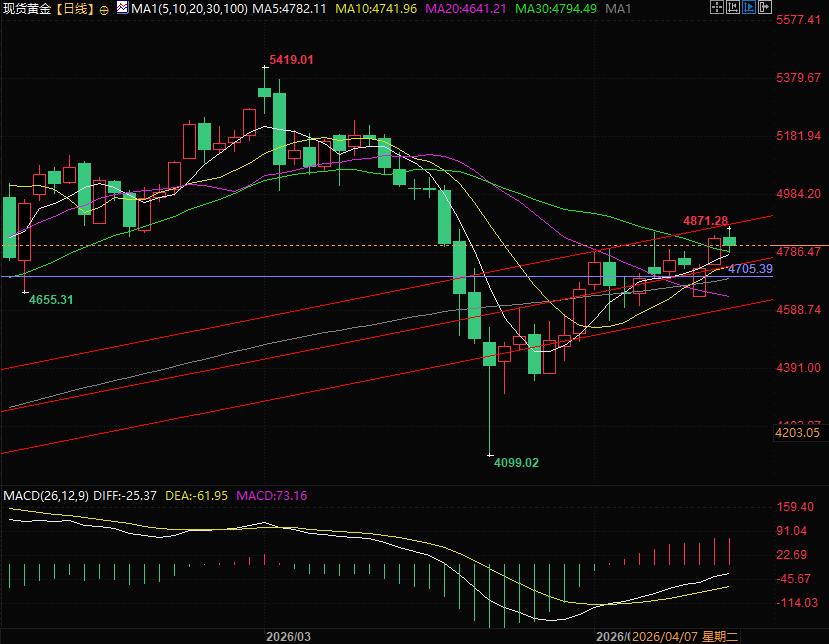
(Spot gold daily chart, source: EasyForex subsidiary)
At 20:56 Beijing time, spot gold is currently trading at $4,812 per ounce.
In addition to the details revealed in the Hezbollah negotiations, market sources indicate that the US and Iran have agreed in principle to extend the ceasefire, while the Iranian Foreign Ministry stated that there is room for dialogue regarding the degree and type of uranium enrichment, which has kept risk appetite on an upward trend.
Against the backdrop of the ongoing US-Iran war, a key variable has been added to the Middle East geopolitical situation—Lebanon and Israel held their first direct diplomatic talks in decades in Washington. This consultation, which US Secretary of State Marco Rubio defined as a "historic opportunity," is essentially an extension of the US-Iran rivalry into the proxy battlefield.
The talks were convened in response to more than a month of intense conflict between Israel and Hezbollah, which is backed by Iran. The root cause of all this is the chain reaction triggered by the US-Israeli coalition's military strikes on Iranian soil.
Hezbollah takes a hard line: the battlefield and negotiations of Iran's proxies are intertwined.
As the core force of Iran's "Arc of Resistance" strategy, Hezbollah has actively participated in the war since the outbreak of the US-Iran war, becoming a key tool for Iran to contain the US and Israel.
On March 2, Hezbollah launched rockets into northern Israel in support of Iran, directly igniting the conflict between Lebanon and Israel. This action was inseparable from Iran's long-term comprehensive support in terms of funds, weapons, and ideology.
Hezbollah explicitly opposed and refused to participate in the direct talks between Lebanon and Israel. It even intensified its military strikes against northern Israel during the talks, claiming to launch 24 attacks in a single day. Its tough stance is actually deeply tied to Iran's position on negotiations with the United States. Iran has made ending the war in Lebanon and the region a core condition for negotiations with the United States, and Hezbollah has clearly become the leading force in fulfilling this demand, thus increasing Iran's bargaining power.
Washington Game: Divergent Claims Between the US, Israel, and Lebanon
The talks in Washington revealed a complex power struggle.
Following the talks, the U.S. State Department emphasized that any ceasefire agreement must be reached by the Lebanese and Israeli governments under U.S. mediation, firmly rejecting other channels. This statement was actually intended to weaken Iran's influence on the Lebanese-Israeli situation and to gain the initiative in U.S.-Iran negotiations.
Israeli Ambassador to the United States Yeshir Light stated that the two sides reached a consensus on stripping Hezbollah of its influence in Lebanon, which reflects the strategic intention of the US and Israel to sever Iran's proxy network in the Middle East.
The Lebanese government is eager to end the war through diplomatic means. Ambassador to the United States Nada Hamad Moawaid reiterated the principles of territorial integrity and sovereignty, and called for a ceasefire and a resolution to the humanitarian crisis. However, the Lebanese government's bargaining chips are always constrained by the complex relationship between Iran and Hezbollah. Hezbollah leader Wafiq Safa has made it clear that he will not abide by any agreements reached in the talks.
Battlefield Spillover: The Humanitarian Crisis in Lebanon and Israel Amid the US-Iran Rivalry
The severity of the battlefield situation further highlights the spillover risks of the US-Iran war.
Israeli airstrikes have killed at least 2,124 people in Lebanon and displaced more than a million. Last week, Israel launched 100 airstrikes in ten minutes, turning downtown Beirut into ruins.
The Israeli military has invaded southern Lebanon in an attempt to establish a "safe buffer zone," and despite Hezbollah's weakened state in the 2024 conflict, it is still able to launch drones and rockets at Israel daily. Behind its continued combat capability is the constant support from Iran.
More noteworthy is the strategic calculations hidden behind Israel's agreement to the talks. On the one hand, it was to buy time to eliminate Hezbollah militants, and on the other hand, it was to curry favor with the United States. Meanwhile, the United States used the mediation of the Lebanon-Israel talks to put pressure on Iran, attempting to gain a more advantageous position in the US-Iran negotiations.
Uncertainty intensifies: Gold becomes a core hedge against geopolitical risks
The US-Iran ceasefire agreement is set to expire on April 22, but there are signs of its extension in several places. The news of the resumption of negotiations is intertwined with the progress of the Lebanon-Israel talks, and geopolitical risks in the Middle East remain high.
Hezbollah's deep ties with Iran, the intractable stalemate in the Lebanon-Israel conflict, and the strategic calculations of the US and Israel together constitute the complex network of power struggles behind the US-Iran war. As a bargaining chip for Iran, Hezbollah's refusal to abide by the negotiation agreement will not have a negative impact on the US-Iran negotiations.
Against the backdrop of this ongoing uncertainty, a recovery in risk appetite is conducive to a rebound in gold prices.
The easing of geopolitical conflicts and the expectation of a rebound in global financial markets will continue to support gold prices. Regardless of the outcome of the US-Iran negotiations, the fluctuating situation in Lebanon and Israel will be a significant catalyst for gold price volatility, making it a core choice for investors to hedge against geopolitical risks.
Summary and Technical Analysis:
Hezbollah has always been an important partner of Iran and a key bargaining chip in negotiations. However, due to Hezbollah's significant influence in Lebanon, negotiations with the Lebanese government only demonstrate Israel's respect for the United States and do not have a major impact on the war.
However, this negotiation, which Rubio emphasized and publicized extensively, did indeed suggest that the United States hoped for a smooth US-Iran negotiation and provided a way out for both the US and Iran to continue negotiations. At the same time, Hezbollah, as an important bargaining chip for Iran, still has a deterrent effect because it claims it will not abide by the peace agreement, which is also conducive to Iran continuing negotiations.
With the peace talks breaking through the two-week time limit and Iran's willingness to make concessions on uranium enrichment, gold is expected to continue its volatile rebound.
As I have consistently stated in my previous articles, Iran is likely to compromise on the issue of uranium enrichment and I have maintained my assessment that the US-Iran negotiations are progressing positively. Hezbollah's tough stance this time will not hinder the US-Iran negotiations. Recently, risk assets have continued to strengthen significantly and are facing volatility. Gold is likely to continue its volatile rebound.
From a technical perspective, spot gold is still trading within an upward channel, currently finding support at the middle line of the channel, as well as near the 5-day and 30-day moving averages.
The resistance is at the upper rail of the channel, and a breakout above the upper rail is possible in the near future.
(Spot gold daily chart, source: EasyForex subsidiary)
At 20:56 Beijing time, spot gold is currently trading at $4,812 per ounce.
- Risk Warning and Disclaimer
- The market involves risk, and trading may not be suitable for all investors. This article is for reference only and does not constitute personal investment advice, nor does it take into account certain users’ specific investment objectives, financial situation, or other needs. Any investment decisions made based on this information are at your own risk.