Was the one-month high in gold a trap? Who's behind it all?
2026-04-15 21:34:16
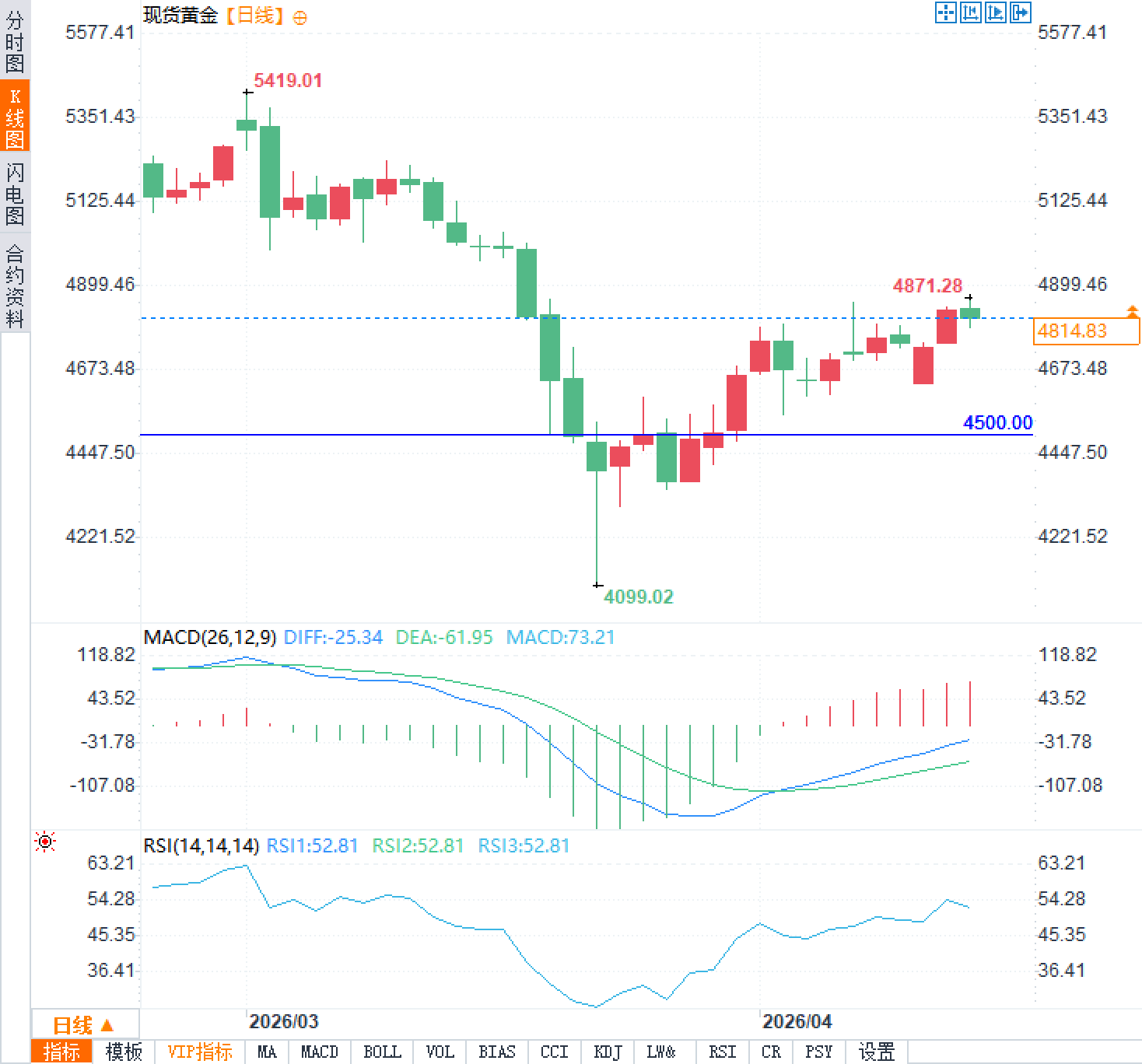
On Wednesday, April 15th, spot gold prices briefly surged during Asian trading hours before quickly retreating. It touched a one-month high of $4871 before pulling back to around $4815. This movement occurred as the US dollar index showed signs of stabilizing after seven consecutive days of decline, with the latest developments in the Middle East continuing to dominate market sentiment. While potential US-Iran negotiations offered some optimism, the continued military deployments and naval blockades kept the overall atmosphere fragile, and gold's appeal as a safe-haven asset was constrained by multiple macroeconomic factors.
US President Trump recently stated that the situation in Iran could end soon, significantly boosting market expectations for a resumption of US-Iran negotiations. It is understood that a second round of peace talks may begin this week, with a diplomatic breakthrough window existing before the current two-week ceasefire expires. However, uncertainty remains. The Pentagon is preparing to deploy thousands more troops to the Middle East in the coming days to increase pressure on Iran and ensure an agreement is reached. This move aligns with statements from Admiral Brad Cooper, commander of US Central Command, who indicated that the US military has blocked Iranian maritime trade and economic access. The Iranian Revolutionary Guard has warned that if the US continues its blockade of Iranian ships, it will cut off import and export routes in the Gulf and the Sea of Oman.
As a traditional safe-haven asset, spot gold should have found support amid geopolitical tensions, but its actual performance reveals a divergence in safe-haven demand. This fragile optimism stems from a contradiction between diplomatic signals and military preparedness: the prospect of negotiations has eased the premium for extreme risks, but the continued blockade leaves the risk of disruption to the oil supply chain unresolved, making it difficult for market sentiment to fully shift towards risk appetite. Consequently, gold prices failed to maintain their upward momentum and instead fell under pressure against the backdrop of a stabilizing US dollar.
The situation in the Middle East has directly impacted the energy market. WTI crude oil prices rebounded after briefly touching a three-week low near $85 in early trading and are currently hovering above $90. Despite the continued US blockade of the Strait of Hormuz, the pullback in oil prices from recent highs has somewhat eased inflation concerns. This has reduced pressure on the Federal Reserve to tighten monetary policy and reignited market expectations for interest rate cuts, potentially providing support for non-interest-bearing assets like gold.
However, high oil prices still pose a two-way risk. On the one hand, supply chain uncertainties support a bottom for oil prices; on the other hand, price corrections provide room for cooling inflation expectations. This marginal change influences the Federal Reserve's decision-making path: energy price shocks are supply-side disturbances, which are difficult to address with traditional monetary policy tools. If oil prices stabilize within the current range, inflationary pressures may gradually become manageable, but any escalation of lockdowns could reverse this trend. Against this backdrop, gold prices exhibit a tug-of-war between safe-haven appeal and interest rate sensitivity, with short-term oil price fluctuations becoming a key variable to observe.
Uncertainty surrounding the Federal Reserve's policy path has further diminished the appeal of gold. Cleveland Fed President Beth Hammark, in her latest remarks, clearly signaled a "patient policy." She noted that interest rates are currently at an appropriate level, and the baseline scenario is that they will remain unchanged for some time. Hammark acknowledged that the Fed has failed to achieve its 2% inflation target for five consecutive years, and consumers face persistent high price pressures, but the labor market is relatively balanced and no longer a major driver of inflation. Energy prices and the economic impact of artificial intelligence pose a two-way risk: high energy prices could push up inflation but simultaneously drag down economic growth; the long-term impact of artificial intelligence on the economy remains unclear.
Hammark emphasized that supply shocks are particularly challenging for monetary policy, and while inflation expectations are generally manageable, policymaking is in a "difficult period." She reiterated the importance of the Federal Reserve's independence and stated that the market is currently pricing in about 10 basis points of easing by the end of the year, a range she is open to. These views are consistent with her recent statements and, while not triggering a significant market reaction, have reinforced expectations that interest rates will remain high.
Middle East geopolitical dynamics test gold's safe-haven properties
US President Trump recently stated that the situation in Iran could end soon, significantly boosting market expectations for a resumption of US-Iran negotiations. It is understood that a second round of peace talks may begin this week, with a diplomatic breakthrough window existing before the current two-week ceasefire expires. However, uncertainty remains. The Pentagon is preparing to deploy thousands more troops to the Middle East in the coming days to increase pressure on Iran and ensure an agreement is reached. This move aligns with statements from Admiral Brad Cooper, commander of US Central Command, who indicated that the US military has blocked Iranian maritime trade and economic access. The Iranian Revolutionary Guard has warned that if the US continues its blockade of Iranian ships, it will cut off import and export routes in the Gulf and the Sea of Oman.
As a traditional safe-haven asset, spot gold should have found support amid geopolitical tensions, but its actual performance reveals a divergence in safe-haven demand. This fragile optimism stems from a contradiction between diplomatic signals and military preparedness: the prospect of negotiations has eased the premium for extreme risks, but the continued blockade leaves the risk of disruption to the oil supply chain unresolved, making it difficult for market sentiment to fully shift towards risk appetite. Consequently, gold prices failed to maintain their upward momentum and instead fell under pressure against the backdrop of a stabilizing US dollar.
The rebound in crude oil prices and the marginal easing of inflation expectations
The situation in the Middle East has directly impacted the energy market. WTI crude oil prices rebounded after briefly touching a three-week low near $85 in early trading and are currently hovering above $90. Despite the continued US blockade of the Strait of Hormuz, the pullback in oil prices from recent highs has somewhat eased inflation concerns. This has reduced pressure on the Federal Reserve to tighten monetary policy and reignited market expectations for interest rate cuts, potentially providing support for non-interest-bearing assets like gold.
However, high oil prices still pose a two-way risk. On the one hand, supply chain uncertainties support a bottom for oil prices; on the other hand, price corrections provide room for cooling inflation expectations. This marginal change influences the Federal Reserve's decision-making path: energy price shocks are supply-side disturbances, which are difficult to address with traditional monetary policy tools. If oil prices stabilize within the current range, inflationary pressures may gradually become manageable, but any escalation of lockdowns could reverse this trend. Against this backdrop, gold prices exhibit a tug-of-war between safe-haven appeal and interest rate sensitivity, with short-term oil price fluctuations becoming a key variable to observe.
Signals from Federal Reserve officials and the interest rate environment exert downward pressure on gold.
Uncertainty surrounding the Federal Reserve's policy path has further diminished the appeal of gold. Cleveland Fed President Beth Hammark, in her latest remarks, clearly signaled a "patient policy." She noted that interest rates are currently at an appropriate level, and the baseline scenario is that they will remain unchanged for some time. Hammark acknowledged that the Fed has failed to achieve its 2% inflation target for five consecutive years, and consumers face persistent high price pressures, but the labor market is relatively balanced and no longer a major driver of inflation. Energy prices and the economic impact of artificial intelligence pose a two-way risk: high energy prices could push up inflation but simultaneously drag down economic growth; the long-term impact of artificial intelligence on the economy remains unclear.
Hammark emphasized that supply shocks are particularly challenging for monetary policy, and while inflation expectations are generally manageable, policymaking is in a "difficult period." She reiterated the importance of the Federal Reserve's independence and stated that the market is currently pricing in about 10 basis points of easing by the end of the year, a range she is open to. These views are consistent with her recent statements and, while not triggering a significant market reaction, have reinforced expectations that interest rates will remain high.
Frequently Asked Questions
Question 1: Why did spot gold prices fall despite escalating geopolitical tensions?
A: The core issue lies in the interplay of multiple factors beyond a single hedging logic. While the situation in the Middle East presents a contradiction between diplomatic optimism and military preparedness, the stabilization of the US dollar index directly suppresses the upside potential of gold prices. Meanwhile, the Federal Reserve's baseline scenario of maintaining high interest rates further weakens the appeal of gold. Hammark's patient policy stance reinforces this judgment; the failure to meet inflation targets for five consecutive years has not triggered immediate easing, and supply-side risks have instead led to more cautious policy decisions.
Question 2: What is the actual significance of the recent statements by Federal Reserve officials for the gold market's expectations?
A: Harmark emphasized that interest rates are at an "appropriate level" and the benchmark remains unchanged, and the market's pricing of a 10 basis point easing range by the end of the year is recognized. However, this does not change the downward pressure on gold from the high-interest-rate environment. Five consecutive years of inflation falling short of expectations, coupled with uncertainties surrounding energy and artificial intelligence, highlight the reality of a "difficult period" for policy. Such signals reinforce a data-dependent approach rather than an immediate shift to easing.
- Risk Warning and Disclaimer
- The market involves risk, and trading may not be suitable for all investors. This article is for reference only and does not constitute personal investment advice, nor does it take into account certain users’ specific investment objectives, financial situation, or other needs. Any investment decisions made based on this information are at your own risk.