Gold prices rose and then fell back as tensions between the US and Iran eased and the Federal Reserve issued hawkish guidance.
2026-04-16 01:00:33
On Wednesday (April 15), international gold prices initially rose but then declined. During the Asian session, gold prices surged, but came under pressure and fell during the European and American sessions, generally exhibiting a high-level consolidation pattern. As of 00:53 Beijing time, spot gold was down 0.81% at $4802.17 per ounce, having reached a high of $4871 during the session, a new high since March 18. US gold futures also weakened, falling 0.55% to $4823.4, a decrease of 0.55%. Given that gold prices had previously risen for three consecutive weeks and reached a new high, the pullback on that day was largely due to short-term profit-taking.
Jim Wyckoff, senior analyst at Kitco Metals, stated that the decline in gold prices after reaching their highs was merely a normal technical profit-taking pullback, not a trend reversal. Overall, the market's bullish and bearish forces were relatively balanced, and there was no concentrated selling pressure.
The safe-haven logic for gold is unusual, and the pricing focus is shifting towards interest rate policy.
The recent gold market has exhibited a completely different trend from conventional wisdom: gold prices rise when risk appetite improves and fall when safe-haven demand intensifies. This phenomenon signifies a fundamental shift in market pricing logic.
In the traditional framework, gold is a typical safe-haven asset, and escalating geopolitical conflicts typically drive up its price. However, the current market focus has shifted to the Federal Reserve's monetary policy and interest rate outlook, with safe-haven sentiment becoming a secondary factor. In a high-interest-rate environment, funds are more inclined to allocate to high-yield assets such as the US dollar and US Treasury bonds, significantly weakening gold's safe-haven function.
Wyckoff explicitly pointed out that recent gold price movements have deviated from its traditional safe-haven role, with traders paying more attention to expectations of monetary policy tightening and inflationary pressures. Interest rates have significantly outweighed geopolitical risks in influencing gold prices.
As tensions between the US and Iran ease, demand for safe-haven assets continues to cool.
On April 15, signs of a clear easing in the US-Iran conflict became a direct factor suppressing gold prices. US President Trump publicly stated that the war with Iran was "nearly over" and predicted significant developments in the next two days, significantly easing market concerns about the escalation of the conflict.
On the diplomatic front, Pakistan, acting as a mediator, sent a delegation to Tehran to push for the resumption of dialogue between the US and Iran, and the market expects the second round of peace talks to take place this week. Although the current two-week ceasefire agreement is about to expire, the probability of a full-scale conflict breaking out again has significantly decreased.
However, uncertainty remains. The US still plans to increase troop deployments to the Middle East and maintain its maritime trade blockade against Iran, while Iran has warned that it will close the Strait of Hormuz if the blockade continues. Affected by shipping restrictions, international oil prices have fluctuated within a limited range, with WTI crude oil oscillating between $85 and $89, neither rising sharply nor falling significantly, leaving room for uncertainty regarding inflation and monetary policy.
The Federal Reserve maintains its hawkish stance, and interest rate cuts may be delayed until 2027.
The Federal Reserve's hawkish stance is the core reason for the current downward pressure on gold prices. Several Fed officials have recently made statements, releasing clear hawkish signals.
Chicago Fed President John Goolsby stated that if persistently high oil prices due to the Middle East situation lead to a slower decline in inflation, the Fed may not cut interest rates until 2027. Cleveland Fed President James Hammark also believes that current interest rates are appropriate and should be maintained in the short term, while continuing to monitor the impact of energy prices on inflation.
Market expectations have adjusted accordingly. CME data shows that the probability of a Fed rate cut in 2026 is only 30%. High interest rates continue to put downward pressure on gold: as a non-interest-bearing asset, the opportunity cost of holding gold increases significantly with high interest rates. Even if there is demand for inflation hedging, it is difficult to offset the negative effects of interest rates.
The US dollar is expected to weaken in the medium term, but the support will be weaker than interest rate pressures.
Despite the decline in gold prices, the medium-term trend of the US dollar has clearly weakened. The dollar index rose 2.4% in March but fell 1.9% in April, reversing the previous pattern. As expectations for US-Iran negotiations intensify, hedge funds have turned pessimistic about the dollar.
Harvard University professor Rogoff believes the US dollar is currently overvalued by at least 20%, and historical experience shows that once an overvaluation reaches this level, major currencies typically depreciate gradually over five to six years. Theoretically, a weaker dollar should support gold, but in the market that day, interest rate pressures significantly outweighed the positive impact of dollar depreciation, and gold ultimately fell.
Technically, the market is trading within a range, and key resistance levels have not yet been broken.
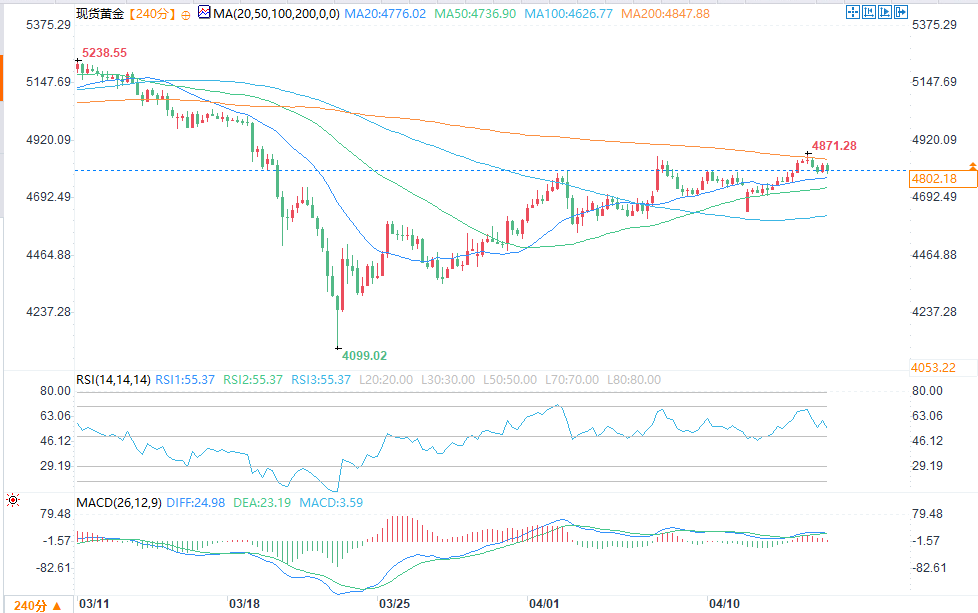
(4-hour chart of spot gold source: EasyForex)
From a 4-hour chart perspective, spot gold is maintaining a high-level range-bound movement, with an overall bullish bias but insufficient upward momentum. Gold prices have repeatedly tested the 200-period simple moving average at $4837, but have failed to hold effectively, forming strong resistance in the near term. Short-term support lies at the psychological level of $4800, with stronger support around the 100-period moving average at $4637.
The RSI indicator is around 57, in the bullish zone but not overbought, and the MACD remains positive, indicating that the medium-term upward trend has not been broken. Technically, if gold prices can hold above $4837, they are likely to open up upward potential and challenge the $5000 mark; if they fall below $4800, short-term downward pressure will increase, but as long as $4637 holds, the medium-term bullish trend will continue.
In summary, the short-term adjustment in gold prices will primarily depend on interest rates and geopolitical balance.
The decline in gold prices on April 15 was the result of multiple factors: rising expectations of US-Iran peace talks led to a decline in safe-haven demand, hawkish statements from the Federal Reserve reinforced expectations of maintaining high interest rates for a longer period, and profit-taking at previous high levels further pushed gold prices down.
The gold market has entered a new phase dominated by interest rates and secondarily by geopolitics. While long-term positive factors such as a weakening dollar and central bank gold purchases remain, short-term gold prices will continue to be constrained by high interest rates. The future direction of gold prices hinges on the progress of US-Iran negotiations, US inflation, and the Federal Reserve's policy path. As long as the high-interest-rate environment remains unchanged, gold is likely to experience a pullback after a surge; however, if the Federal Reserve signals a rate cut or tensions in the Middle East escalate again, gold still has the potential to resume its upward trend and challenge $5,000.
Jim Wyckoff, senior analyst at Kitco Metals, stated that the decline in gold prices after reaching their highs was merely a normal technical profit-taking pullback, not a trend reversal. Overall, the market's bullish and bearish forces were relatively balanced, and there was no concentrated selling pressure.
The safe-haven logic for gold is unusual, and the pricing focus is shifting towards interest rate policy.
The recent gold market has exhibited a completely different trend from conventional wisdom: gold prices rise when risk appetite improves and fall when safe-haven demand intensifies. This phenomenon signifies a fundamental shift in market pricing logic.
In the traditional framework, gold is a typical safe-haven asset, and escalating geopolitical conflicts typically drive up its price. However, the current market focus has shifted to the Federal Reserve's monetary policy and interest rate outlook, with safe-haven sentiment becoming a secondary factor. In a high-interest-rate environment, funds are more inclined to allocate to high-yield assets such as the US dollar and US Treasury bonds, significantly weakening gold's safe-haven function.
Wyckoff explicitly pointed out that recent gold price movements have deviated from its traditional safe-haven role, with traders paying more attention to expectations of monetary policy tightening and inflationary pressures. Interest rates have significantly outweighed geopolitical risks in influencing gold prices.
As tensions between the US and Iran ease, demand for safe-haven assets continues to cool.
On April 15, signs of a clear easing in the US-Iran conflict became a direct factor suppressing gold prices. US President Trump publicly stated that the war with Iran was "nearly over" and predicted significant developments in the next two days, significantly easing market concerns about the escalation of the conflict.
On the diplomatic front, Pakistan, acting as a mediator, sent a delegation to Tehran to push for the resumption of dialogue between the US and Iran, and the market expects the second round of peace talks to take place this week. Although the current two-week ceasefire agreement is about to expire, the probability of a full-scale conflict breaking out again has significantly decreased.
However, uncertainty remains. The US still plans to increase troop deployments to the Middle East and maintain its maritime trade blockade against Iran, while Iran has warned that it will close the Strait of Hormuz if the blockade continues. Affected by shipping restrictions, international oil prices have fluctuated within a limited range, with WTI crude oil oscillating between $85 and $89, neither rising sharply nor falling significantly, leaving room for uncertainty regarding inflation and monetary policy.
The Federal Reserve maintains its hawkish stance, and interest rate cuts may be delayed until 2027.
The Federal Reserve's hawkish stance is the core reason for the current downward pressure on gold prices. Several Fed officials have recently made statements, releasing clear hawkish signals.
Chicago Fed President John Goolsby stated that if persistently high oil prices due to the Middle East situation lead to a slower decline in inflation, the Fed may not cut interest rates until 2027. Cleveland Fed President James Hammark also believes that current interest rates are appropriate and should be maintained in the short term, while continuing to monitor the impact of energy prices on inflation.
Market expectations have adjusted accordingly. CME data shows that the probability of a Fed rate cut in 2026 is only 30%. High interest rates continue to put downward pressure on gold: as a non-interest-bearing asset, the opportunity cost of holding gold increases significantly with high interest rates. Even if there is demand for inflation hedging, it is difficult to offset the negative effects of interest rates.
The US dollar is expected to weaken in the medium term, but the support will be weaker than interest rate pressures.
Despite the decline in gold prices, the medium-term trend of the US dollar has clearly weakened. The dollar index rose 2.4% in March but fell 1.9% in April, reversing the previous pattern. As expectations for US-Iran negotiations intensify, hedge funds have turned pessimistic about the dollar.
Harvard University professor Rogoff believes the US dollar is currently overvalued by at least 20%, and historical experience shows that once an overvaluation reaches this level, major currencies typically depreciate gradually over five to six years. Theoretically, a weaker dollar should support gold, but in the market that day, interest rate pressures significantly outweighed the positive impact of dollar depreciation, and gold ultimately fell.
Technically, the market is trading within a range, and key resistance levels have not yet been broken.
(4-hour chart of spot gold source: EasyForex)
From a 4-hour chart perspective, spot gold is maintaining a high-level range-bound movement, with an overall bullish bias but insufficient upward momentum. Gold prices have repeatedly tested the 200-period simple moving average at $4837, but have failed to hold effectively, forming strong resistance in the near term. Short-term support lies at the psychological level of $4800, with stronger support around the 100-period moving average at $4637.
The RSI indicator is around 57, in the bullish zone but not overbought, and the MACD remains positive, indicating that the medium-term upward trend has not been broken. Technically, if gold prices can hold above $4837, they are likely to open up upward potential and challenge the $5000 mark; if they fall below $4800, short-term downward pressure will increase, but as long as $4637 holds, the medium-term bullish trend will continue.
In summary, the short-term adjustment in gold prices will primarily depend on interest rates and geopolitical balance.
The decline in gold prices on April 15 was the result of multiple factors: rising expectations of US-Iran peace talks led to a decline in safe-haven demand, hawkish statements from the Federal Reserve reinforced expectations of maintaining high interest rates for a longer period, and profit-taking at previous high levels further pushed gold prices down.
The gold market has entered a new phase dominated by interest rates and secondarily by geopolitics. While long-term positive factors such as a weakening dollar and central bank gold purchases remain, short-term gold prices will continue to be constrained by high interest rates. The future direction of gold prices hinges on the progress of US-Iran negotiations, US inflation, and the Federal Reserve's policy path. As long as the high-interest-rate environment remains unchanged, gold is likely to experience a pullback after a surge; however, if the Federal Reserve signals a rate cut or tensions in the Middle East escalate again, gold still has the potential to resume its upward trend and challenge $5,000.
- Risk Warning and Disclaimer
- The market involves risk, and trading may not be suitable for all investors. This article is for reference only and does not constitute personal investment advice, nor does it take into account certain users’ specific investment objectives, financial situation, or other needs. Any investment decisions made based on this information are at your own risk.