Crude oil trading alert: Easing geopolitical tensions lead to continued oil price adjustments; be wary of a downward breakout.
2026-04-16 09:45:40
International oil prices retreated in early Asian trading on Thursday, trading around $87.93 per barrel, mainly influenced by market expectations of easing tensions between the United States and Iran. Market surveys indicate that both sides are considering extending the current ceasefire for approximately two weeks to allow more time to reach a long-term agreement. Meanwhile, mediators are actively pushing for compromises on key issues such as passage through the Strait of Hormuz and the nuclear issue, significantly easing market concerns about oil supply disruptions. The price decline reflects a temporary easing of market risk premiums, especially after the previous rapid rise in oil prices driven by geopolitical tensions, leading some long positions to take profits.

However, macroeconomic uncertainties persist. World Bank President Benjamin Banga stated at an international conference that even if the Strait of Hormuz reopens, the global energy supply system will struggle to return to normal quickly, and is expected to take several months to stabilize. He emphasized that economies affected by the conflict could face months of economic volatility , meaning potential disruptions remain in the energy market.
In terms of policy response, the World Bank has prepared a multi-tiered funding support mechanism, initially providing approximately $20 billion to $25 billion in emergency funds, which could expand to $60 billion should the conflict continue, with long-term support potentially reaching $80 billion to $100 billion . This measure reflects global institutions' expectation that the current situation will be prolonged and also strengthens market focus on economic stability.
Meanwhile, fundamental data provided some support. Data from the U.S. Energy Information Administration showed that U.S. crude oil inventories declined for the first time after eight consecutive weeks of increases, mainly driven by increased exports and decreased imports. This change alleviated downward pressure on oil prices to some extent, but failed to reverse the overall downward trend, indicating that the current market's dominant factors still stem from geopolitical and sentiment-related factors.
From a market sentiment perspective, oil prices are currently in a tug-of-war between a decline in risk premiums and lingering potential risks. On the one hand, expectations of negotiations are weakening the logic of supply shocks; on the other hand, uncertainty surrounding the Middle East situation remains, and oil prices could rebound rapidly if negotiations stall or the situation escalates again. Therefore, funds are generally in a cautious wait-and-see mode, and energy stocks have performed relatively steadily.
From a technical perspective, oil prices are currently in a consolidation phase on the daily chart. After falling from their highs, a trend reversal has not yet formed. The current key level is around $95 , which also serves as a crucial reference for the strength of the medium-term trend. If prices continue to trade below this level, it indicates weakening upward momentum. Key support is concentrated around $82 , which represents a previous consolidation platform and a significant buying support level. A break below this level could open up further downside potential. From a momentum perspective, the RSI is gradually falling back into the neutral zone, indicating that bullish momentum has weakened but has not yet fully turned bearish.
The 4-hour chart shows that oil prices are in a downward channel with limited short-term rebound strength. The MACD indicator has formed a death cross and remains near the zero line, indicating weak market momentum. If prices fail to regain a foothold in the $92-$93 range, there is still a possibility of further declines towards the support area. Conversely, a break above $95 could potentially reactivate the bullish trend.
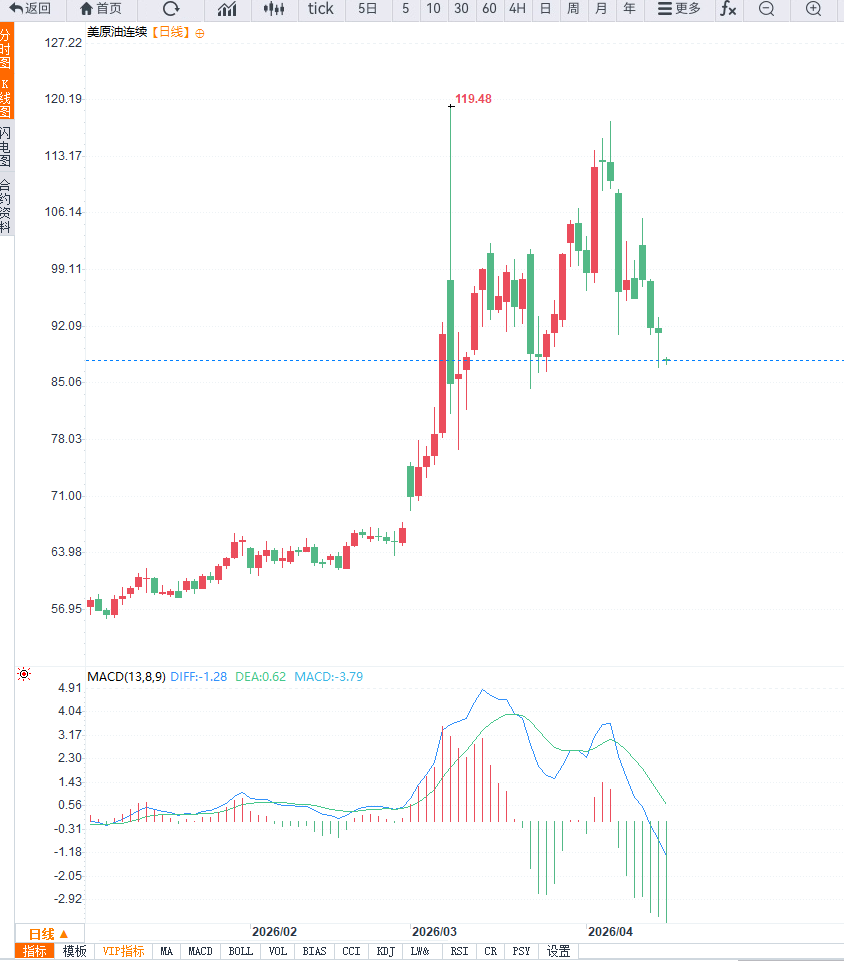
Editor's Summary <br/>Overall, oil prices are currently in a typical "expectation correction phase," a dynamic balance between the pullback brought about by easing geopolitical risks and potential uncertainties. In the short term, the progress of negotiations between the US and Iran will be the core variable driving oil price fluctuations, while fundamental factors such as inventory changes will play a more supporting role. If the negotiations make substantial progress, oil prices may further test key support levels; however, if the situation relapses, market risk premiums will quickly return, pushing oil prices back into a high-level consolidation range. Against this backdrop, investors should pay close attention to the breakout of the $95 resistance and $82 support levels to determine the medium-term trend direction.
However, macroeconomic uncertainties persist. World Bank President Benjamin Banga stated at an international conference that even if the Strait of Hormuz reopens, the global energy supply system will struggle to return to normal quickly, and is expected to take several months to stabilize. He emphasized that economies affected by the conflict could face months of economic volatility , meaning potential disruptions remain in the energy market.
In terms of policy response, the World Bank has prepared a multi-tiered funding support mechanism, initially providing approximately $20 billion to $25 billion in emergency funds, which could expand to $60 billion should the conflict continue, with long-term support potentially reaching $80 billion to $100 billion . This measure reflects global institutions' expectation that the current situation will be prolonged and also strengthens market focus on economic stability.
Meanwhile, fundamental data provided some support. Data from the U.S. Energy Information Administration showed that U.S. crude oil inventories declined for the first time after eight consecutive weeks of increases, mainly driven by increased exports and decreased imports. This change alleviated downward pressure on oil prices to some extent, but failed to reverse the overall downward trend, indicating that the current market's dominant factors still stem from geopolitical and sentiment-related factors.
From a market sentiment perspective, oil prices are currently in a tug-of-war between a decline in risk premiums and lingering potential risks. On the one hand, expectations of negotiations are weakening the logic of supply shocks; on the other hand, uncertainty surrounding the Middle East situation remains, and oil prices could rebound rapidly if negotiations stall or the situation escalates again. Therefore, funds are generally in a cautious wait-and-see mode, and energy stocks have performed relatively steadily.
From a technical perspective, oil prices are currently in a consolidation phase on the daily chart. After falling from their highs, a trend reversal has not yet formed. The current key level is around $95 , which also serves as a crucial reference for the strength of the medium-term trend. If prices continue to trade below this level, it indicates weakening upward momentum. Key support is concentrated around $82 , which represents a previous consolidation platform and a significant buying support level. A break below this level could open up further downside potential. From a momentum perspective, the RSI is gradually falling back into the neutral zone, indicating that bullish momentum has weakened but has not yet fully turned bearish.
The 4-hour chart shows that oil prices are in a downward channel with limited short-term rebound strength. The MACD indicator has formed a death cross and remains near the zero line, indicating weak market momentum. If prices fail to regain a foothold in the $92-$93 range, there is still a possibility of further declines towards the support area. Conversely, a break above $95 could potentially reactivate the bullish trend.
Editor's Summary <br/>Overall, oil prices are currently in a typical "expectation correction phase," a dynamic balance between the pullback brought about by easing geopolitical risks and potential uncertainties. In the short term, the progress of negotiations between the US and Iran will be the core variable driving oil price fluctuations, while fundamental factors such as inventory changes will play a more supporting role. If the negotiations make substantial progress, oil prices may further test key support levels; however, if the situation relapses, market risk premiums will quickly return, pushing oil prices back into a high-level consolidation range. Against this backdrop, investors should pay close attention to the breakout of the $95 resistance and $82 support levels to determine the medium-term trend direction.
- Risk Warning and Disclaimer
- The market involves risk, and trading may not be suitable for all investors. This article is for reference only and does not constitute personal investment advice, nor does it take into account certain users’ specific investment objectives, financial situation, or other needs. Any investment decisions made based on this information are at your own risk.