Strong UK economic data supported the pound, while rising expectations of intervention caused the pound to fluctuate at high levels against the yen.
2026-04-16 15:25:40
The pound remained range-bound against the yen in early European trading on Thursday, trading around 215.60 , after rising for eight consecutive sessions and hitting a record high of 215.91 . Although the gains have temporarily slowed, the pair remains in a strong uptrend, indicating that bullish momentum still prevails.

Economic data released by the UK became a key factor supporting the pound. The data showed that the UK's GDP grew by 0.5% month-on-month in February, significantly higher than the market expectation of 0.1%, and a marked improvement over the previous month. This performance strengthened market confidence in the resilience of the UK economy and provided fundamental support for the pound.
Furthermore, the services sector index rose 0.5% month-on-month over three months, a significant improvement from the previous 0.2%, reflecting stronger momentum in the core sectors of the UK economy. Industrial production also performed positively, growing by 0.5% month-on-month. Although manufacturing declined slightly by 0.1%, the overall economic structure remains relatively robust. These data collectively fueled market expectations that the Bank of England would maintain its tightening policy, thereby supporting the pound sterling exchange rate.
However, the upside potential of the exchange rate was constrained by factors related to the yen. As the pound continued to rise against the yen, expectations of Japanese intervention in the foreign exchange market significantly increased. Japanese Finance Minister Satsuki Katayama stated in May that he had held in-depth discussions with the US Treasury Secretary regarding exchange rate policy and emphasized that decisive action would be taken if necessary. This statement heightened market vigilance regarding potential intervention, limiting further appreciation of the exchange rate.
Meanwhile, the International Monetary Fund (IMF) noted that the Bank of Japan (BOJ) is likely to "tolerate" the rising inflation triggered by the Middle East situation, believing its impact on core inflation will be limited and will not change its gradual policy adjustment path. This implies that Japan's monetary policy will maintain a pace of both easing and gradual tightening, thus providing some support for the yen.
From a market structure perspective, the British pound against the Japanese yen is currently in a "high-level consolidation phase after a strong rise." On the one hand, UK economic data supports the continued strength of the pound; on the other hand, expectations of Japanese intervention and policy factors limit the continued depreciation of the yen, causing the exchange rate to enter a high-level fluctuation pattern.
From a technical perspective, on the daily chart, the GBP/JPY pair maintains a clear upward trend, with prices continuously making new highs and trading above major moving averages, indicating a solid medium-term bullish trend. However, the current price is near historical highs, suggesting a short-term need for technical consolidation. The key resistance level is around 216.00 ; a decisive break above this level could open up further upside potential. Support lies in the 212.80 area, a previous breakout level; a break below this level could trigger a pullback.
In terms of momentum indicators, the RSI is approaching the overbought zone, indicating that although the upward momentum is strong, there is a risk of overextension, suggesting that the market may enter a period of fluctuation or adjustment.
The 4-hour chart shows the price consolidating at higher levels, repeatedly failing to break through the 215.90 level, indicating significant short-term resistance. The MACD indicator is flattening, with momentum converging, suggesting weakening bullish strength. A break below 214.50 could trigger a short-term pullback; conversely, a break above 216.00 could lead to a continuation of the upward trend.
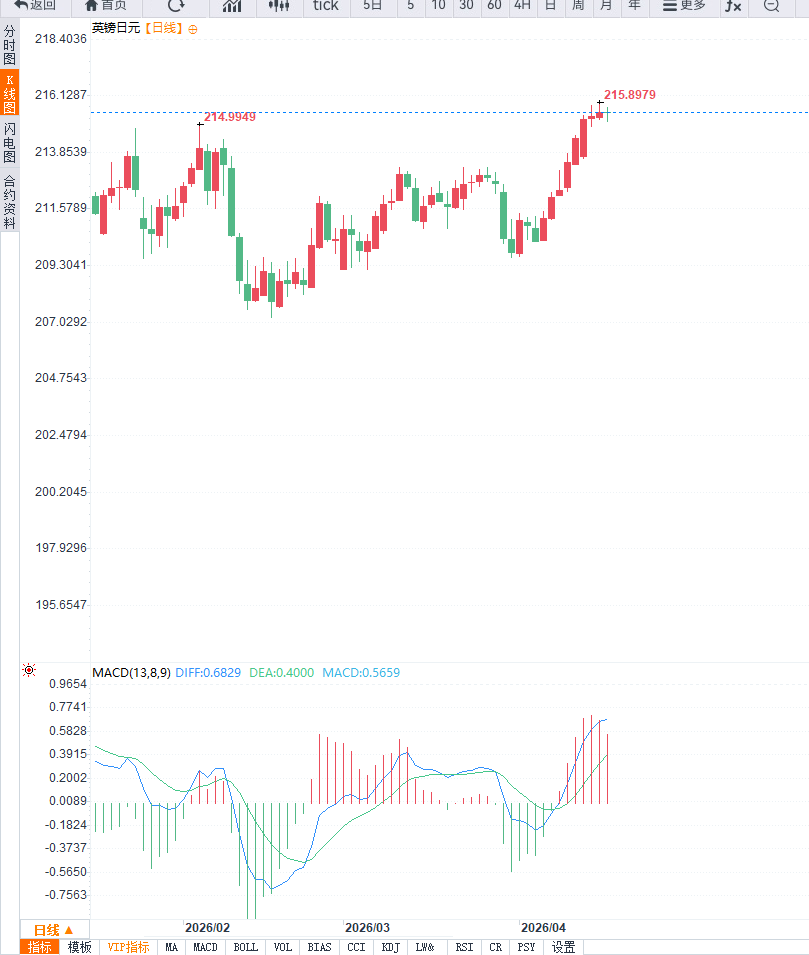
Overall, the GBP/JPY pair is currently in a phase where the trend remains unchanged but momentum is slowing, and it is more likely to fluctuate at high levels in the short term.
Editor's Summary : Overall, the rise in GBP/JPY was mainly driven by better-than-expected UK economic data. However, after approaching historical highs, the market began to face technical pressure and policy uncertainty. Expectations of Japanese intervention became a key factor limiting the exchange rate's upward movement, while UK fundamentals provided support, keeping the exchange rate in a high-level consolidation pattern. Future trends will depend on two core variables: whether UK economic data continues to be strong, and whether Japan actually takes intervention measures. Against this backdrop, the exchange rate may maintain a consolidation phase in the short term, and attention should be paid to the breakout of key resistance and support levels.
Economic data released by the UK became a key factor supporting the pound. The data showed that the UK's GDP grew by 0.5% month-on-month in February, significantly higher than the market expectation of 0.1%, and a marked improvement over the previous month. This performance strengthened market confidence in the resilience of the UK economy and provided fundamental support for the pound.
Furthermore, the services sector index rose 0.5% month-on-month over three months, a significant improvement from the previous 0.2%, reflecting stronger momentum in the core sectors of the UK economy. Industrial production also performed positively, growing by 0.5% month-on-month. Although manufacturing declined slightly by 0.1%, the overall economic structure remains relatively robust. These data collectively fueled market expectations that the Bank of England would maintain its tightening policy, thereby supporting the pound sterling exchange rate.
However, the upside potential of the exchange rate was constrained by factors related to the yen. As the pound continued to rise against the yen, expectations of Japanese intervention in the foreign exchange market significantly increased. Japanese Finance Minister Satsuki Katayama stated in May that he had held in-depth discussions with the US Treasury Secretary regarding exchange rate policy and emphasized that decisive action would be taken if necessary. This statement heightened market vigilance regarding potential intervention, limiting further appreciation of the exchange rate.
Meanwhile, the International Monetary Fund (IMF) noted that the Bank of Japan (BOJ) is likely to "tolerate" the rising inflation triggered by the Middle East situation, believing its impact on core inflation will be limited and will not change its gradual policy adjustment path. This implies that Japan's monetary policy will maintain a pace of both easing and gradual tightening, thus providing some support for the yen.
From a market structure perspective, the British pound against the Japanese yen is currently in a "high-level consolidation phase after a strong rise." On the one hand, UK economic data supports the continued strength of the pound; on the other hand, expectations of Japanese intervention and policy factors limit the continued depreciation of the yen, causing the exchange rate to enter a high-level fluctuation pattern.
From a technical perspective, on the daily chart, the GBP/JPY pair maintains a clear upward trend, with prices continuously making new highs and trading above major moving averages, indicating a solid medium-term bullish trend. However, the current price is near historical highs, suggesting a short-term need for technical consolidation. The key resistance level is around 216.00 ; a decisive break above this level could open up further upside potential. Support lies in the 212.80 area, a previous breakout level; a break below this level could trigger a pullback.
In terms of momentum indicators, the RSI is approaching the overbought zone, indicating that although the upward momentum is strong, there is a risk of overextension, suggesting that the market may enter a period of fluctuation or adjustment.
The 4-hour chart shows the price consolidating at higher levels, repeatedly failing to break through the 215.90 level, indicating significant short-term resistance. The MACD indicator is flattening, with momentum converging, suggesting weakening bullish strength. A break below 214.50 could trigger a short-term pullback; conversely, a break above 216.00 could lead to a continuation of the upward trend.
Overall, the GBP/JPY pair is currently in a phase where the trend remains unchanged but momentum is slowing, and it is more likely to fluctuate at high levels in the short term.
Editor's Summary : Overall, the rise in GBP/JPY was mainly driven by better-than-expected UK economic data. However, after approaching historical highs, the market began to face technical pressure and policy uncertainty. Expectations of Japanese intervention became a key factor limiting the exchange rate's upward movement, while UK fundamentals provided support, keeping the exchange rate in a high-level consolidation pattern. Future trends will depend on two core variables: whether UK economic data continues to be strong, and whether Japan actually takes intervention measures. Against this backdrop, the exchange rate may maintain a consolidation phase in the short term, and attention should be paid to the breakout of key resistance and support levels.
- Risk Warning and Disclaimer
- The market involves risk, and trading may not be suitable for all investors. This article is for reference only and does not constitute personal investment advice, nor does it take into account certain users’ specific investment objectives, financial situation, or other needs. Any investment decisions made based on this information are at your own risk.