Geopolitical bubbles burst overnight! The US dollar broke through a key trend line, non-US currencies launched a collective counterattack, and next week's "terrifying data" and hearings will put pressure on the market. Who is swimming naked on the eve of a market reversal?
2026-04-18 14:30:42
This week, the global foreign exchange market experienced a sharp correction triggered by the waning of geopolitical premiums. Following the announcement of the full reopening of the Strait of Hormuz , market risk aversion quickly subsided, causing the US dollar index to plummet, closing lower for five consecutive trading days at 98.2218. This volatility not only broke the technical upward trend since March but also created pricing space for next week's upcoming key US economic data and policy personnel changes.
The market is currently in a transitional period between the receding geopolitical tensions and the return of macroeconomic data. As major overseas institutions reassess their expectations for a Federal Reserve rate cut, non-US currencies have generally rebounded. However, next week's release of US retail sales data and the hearing for the nomination of the Federal Reserve Chair will be key variables determining whether the US dollar can stabilize at the 98 level.

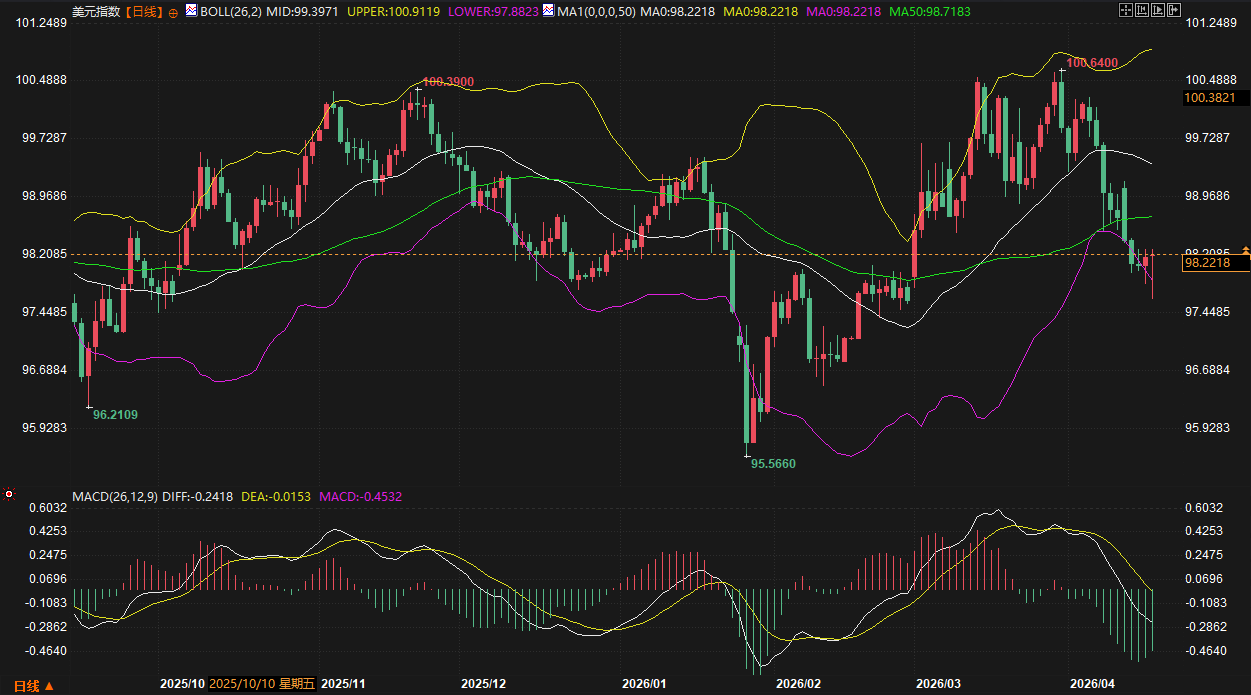
This Week's Market Recap: The US dollar index was extremely weak this week, fluctuating by 1.58% within the week. The daily chart shows that the index has broken decisively below the upward trend that began in March, hitting a seven-week low of 97.632 on Friday. Although it rebounded above the 98 level after the close, the exchange rate is currently under pressure from the 50-day moving average (MA50) (98.7183), and bearish momentum continues to be released.
Economic Data and Event Summary: The core driver stems from the systemic dismantling of geopolitical premiums. As Iran and related parties signaled the resumption of air traffic, the plunge in crude oil prices led to a decline in US Treasury yields, directly weakening the dollar's appeal as a safe-haven currency.
Analyst and institutional views: A well-known foreign media analysis points out that the current decline in the US dollar is more of a "concentrated liquidation of safe-haven positions." Major overseas institutions warn that the retail sales data to be released next Tuesday (commonly known as "the terror data") is crucial. If the data reflects stronger-than-expected domestic demand, the US dollar may find technical support around 97.8 (lower Bollinger Band) and rebound.
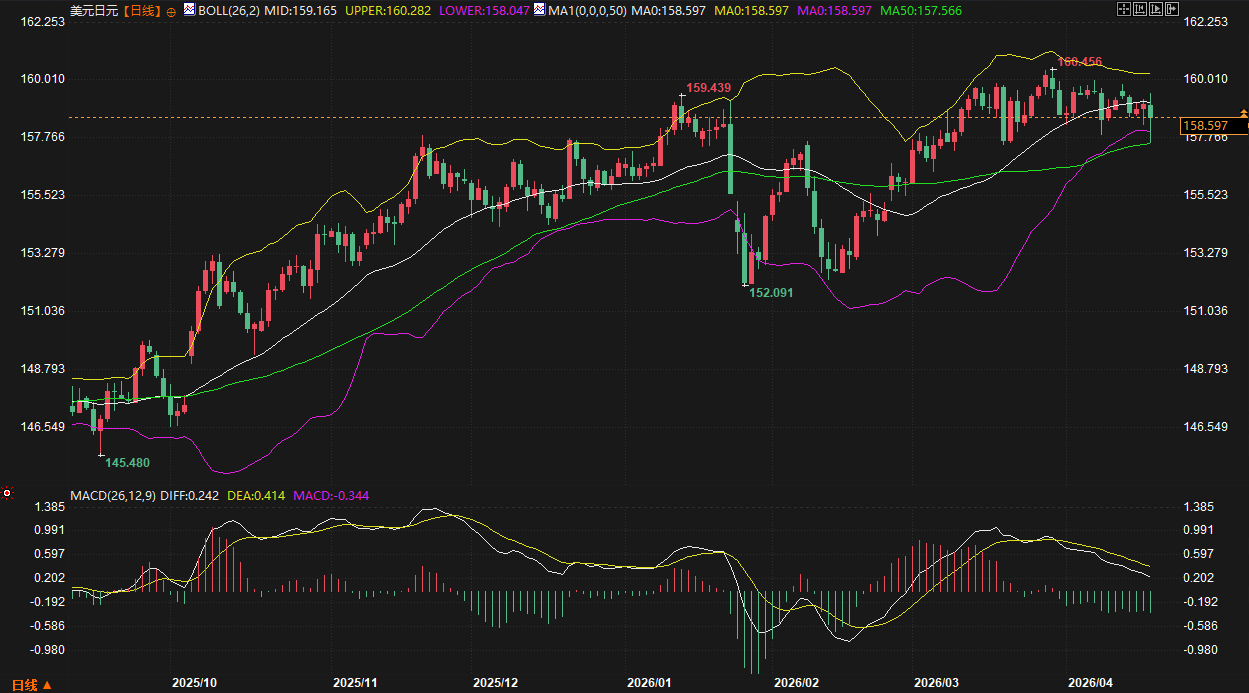
Weekly Market Recap: The USD/JPY pair fell 0.42% this week, closing at 158.597. After failing to break through the 160 level, the exchange rate fluctuated and declined due to the overall weakening of the US dollar index, but it still received strong support from the MA50 (157.566).
Economic Data and Events Summary: Bank of Japan Governor Kazuo Ueda adopted a dovish stance this week, suggesting a low probability of a near-term interest rate hike. However, the upcoming Japanese CPI data, to be released next Friday, is seen by the market as a key indicator influencing the interest rate path, which limits the potential for further yen depreciation.
Analyst and institutional views: Major overseas institutions believe that the yen is currently in a "policy vacuum." Next week's midweek trade data and Friday's inflation data will combine to create a powerful impact; if the inflation data is strong, it will dominate the yen's short-term trend, challenging the support level of 157.
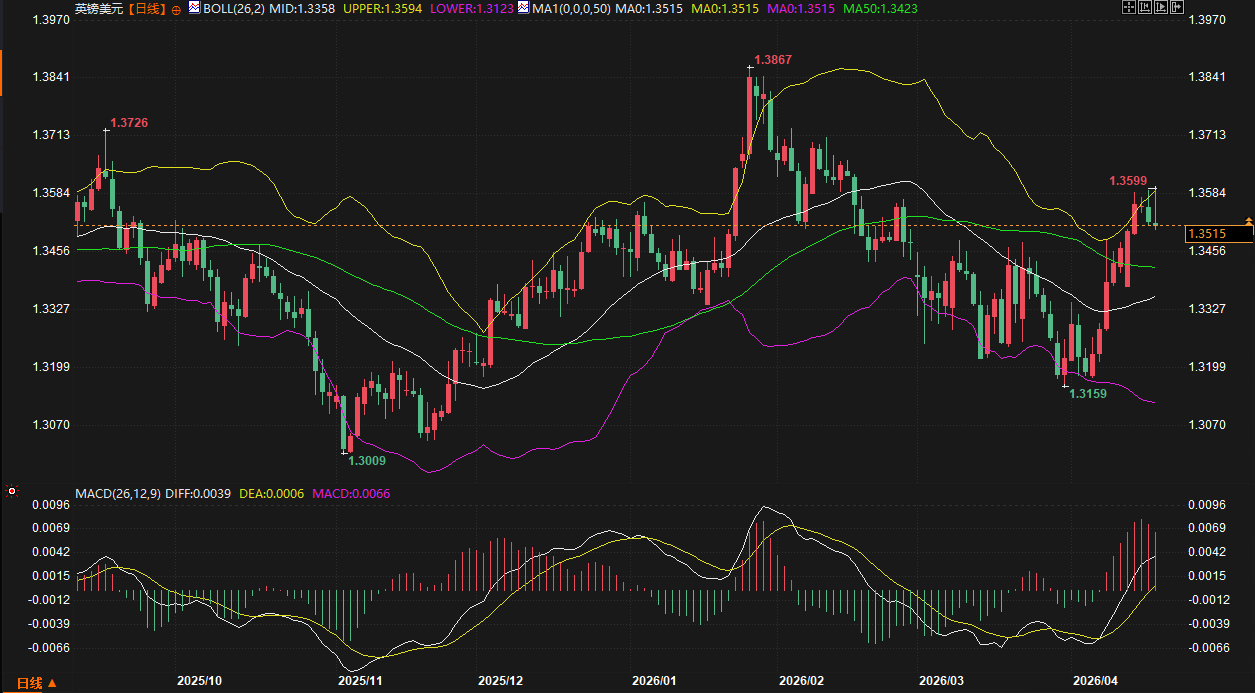
Weekly Market Recap: The British pound rose 0.36% this week, closing at 1.3515. It briefly tested the resistance level of 1.3599 mid-week, exhibiting a consolidation pattern after encountering resistance at higher levels, and has now steadily risen above the key support level of 1.345.
Economic Data and Events Summary: Divergent statements from Bank of England officials regarding their stance on inflation provided support for the pound sterling in terms of interest rate differential expectations. The market is closely watching the UK CPI data to be released next Wednesday.
Analyst and institutional views: According to well-known foreign media analysis, the pound has now recovered most of the losses from late March. Next week's UK PMI and inflation data will determine whether the exchange rate can break through the 1.36 level. If the data is weak, a pullback to the Bollinger Middle Band (1.3358) should be anticipated.
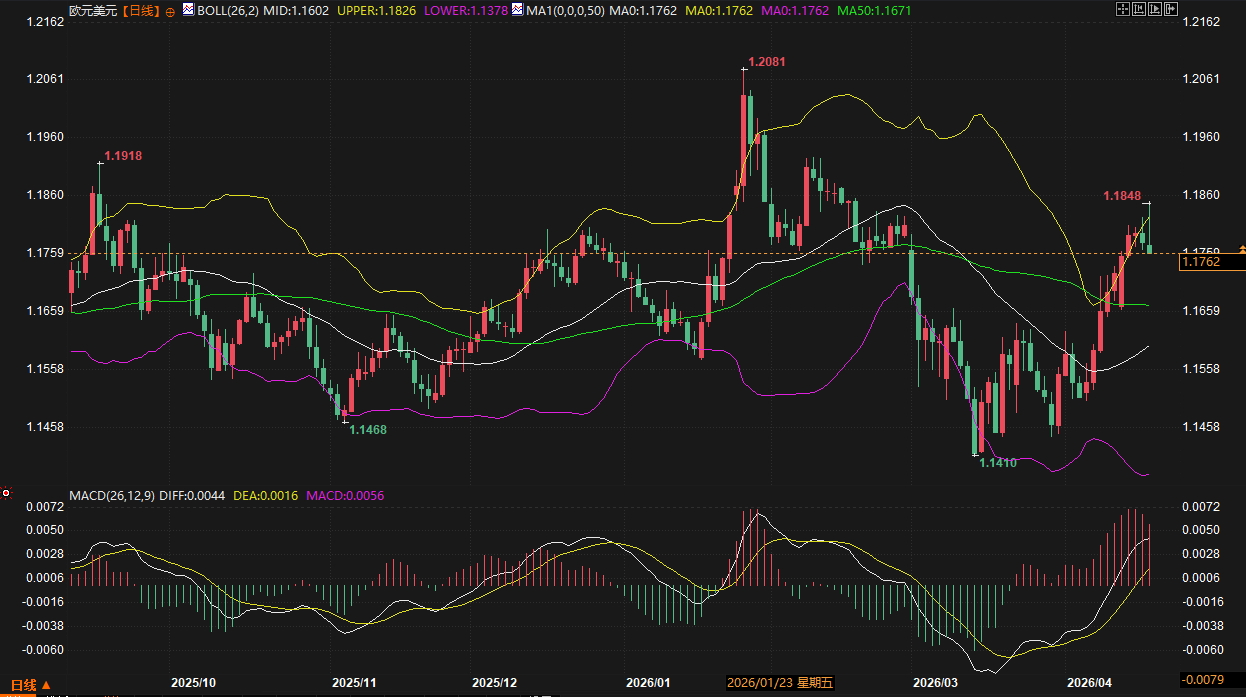
Weekly Market Recap: The euro rebounded 0.28% this week, closing at 1.1762. On the daily chart, after breaking through the middle Bollinger Band, the euro reached an eight-week high of 1.1848, driven by geopolitical positive factors. The MACD indicator shows a continued expansion of the red momentum bars, indicating a clear bullish intent.
Economic Data and Events Summary: Improved market risk appetite boosted the euro. Next Thursday, ECB President Lagarde will speak again, and the release of the Eurozone's April PMI data will directly influence market pricing of the resilience of the European economic recovery.
Analyst and institutional views: Strategists at major overseas institutions point out that the current strength of the euro is mainly driven by the decline of the US dollar. Next week is a "super data day" for the Eurozone, and the performance of the PMI will directly affect the valuation center of the European equity market. If the data falls short of expectations, the euro may encounter pullback pressure at the key resistance level of 1.185.
This week's sharp drop in the currency market has fully priced in the geopolitical premium. Looking ahead to next week, the market will face the "American moment," comprised of retail sales data and the Federal Reserve Chair nomination hearings . Kevin Warsh's policy proposals will directly determine the market's ultimate prediction of the pace of future interest rate cuts.
Furthermore, the potential liquidity shock from Wednesday's WTI crude oil futures rollover and Thursday's collective release of PMI data from major global economies indicate that the foreign exchange market is entering a sensitive period of heightened volatility. With the US dollar index hovering around the 98 level, it is advisable to closely monitor the cross-reference between the "dreaded economic data" and hearing testimonies to guard against position risks caused by rapid shifts in logic.
Q1: Why is the US retail sales data next Tuesday considered the "lifeline" for the US dollar index?
Retail sales data directly reflect the performance of broad-based consumption in the United States, which contributes over 70% to US GDP. Since the main reason for the dollar's decline this week was the dissipation of risk aversion, the fundamentals have not been disproven. If the data released next Tuesday is strong, it will prove that the resilience of the US economic recovery remains ahead of other developed economies, thereby attracting arbitrage funds back to the dollar and helping the dollar index stabilize at the key technical level of 97.8. Conversely, if the data is weak, the dollar will lose its last fundamental support and fall towards the 97.0 level.
Q2: How will Kevin Warsh's nomination hearing for Federal Reserve Chairman logically impact the foreign exchange market?
The Federal Reserve Chair's policy stance directly determines medium- to long-term interest rate expectations. The market will be watching the hearings for signals regarding "inflation tolerance" and "balance sheet reduction." If the testimony leans hawkish, suggesting a tightening of liquidity or a slowdown in the pace of rate cuts, it will directly offset current expectations of rate cuts and drive a significant rebound in the dollar. Conversely, if the Chair advocates for an accelerated policy shift to align with current domestic demand, it will further solidify the dollar's downward trend.
Q3: What are the potential risks to forex traders regarding the rollover of WTI crude oil futures contracts on Wednesday?
Crude oil contract rollovers are often accompanied by sharp fluctuations in premiums and discounts and sudden tightening of liquidity. Given the current high correlation between commodity currencies such as the Canadian dollar and the Australian dollar and oil prices, any unusual gaps in oil prices during the rollover period could trigger a chain reaction of liquidations in cross-currency pairs. Furthermore, the API and EIA inventory data will be released simultaneously on Wednesday. If the inventory decline is less than expected, it could easily trigger a second sharp drop in crude oil prices during the rollover window, subsequently dragging down risk currencies.
Q4: Global PMI data will be released next Thursday. Which region's data will contribute the most to exchange rate fluctuations?
The focus should be on the PMIs of Germany and the Eurozone. As a leading indicator of economic activity, if the Eurozone PMI can remain above the 50-point mark, it will validate the logic of the European recovery and support the euro's challenge of the 1.185 resistance level. Meanwhile, the correlation between the UK PMI and Wednesday's CPI data will also determine the pound's fate. The US PMI needs to be observed in conjunction with the initial jobless claims data released on the same day. If a contradictory signal of "weak employment and strong economic activity" appears, the US dollar index will enter a period of violent, high-frequency fluctuations.
Q5: How to assess the pressure of Japan's CPI data on the USD/JPY 158 support level?
Friday's Japanese CPI data will be crucial in determining the probability of a Bank of Japan interest rate hike. Currently, the USD/JPY pair is showing strong technical resilience around 158. If the CPI data is stronger than expected, it will force Kazuo Ueda to revise his previously cautious stance, triggering a large-scale short covering in the yen, breaking below 158 and targeting 157.5. If the data is lackluster, with expectations of a dollar rebound, the yen may return to its range-bound pattern around the 160 level.
The market is currently in a transitional period between the receding geopolitical tensions and the return of macroeconomic data. As major overseas institutions reassess their expectations for a Federal Reserve rate cut, non-US currencies have generally rebounded. However, next week's release of US retail sales data and the hearing for the nomination of the Federal Reserve Chair will be key variables determining whether the US dollar can stabilize at the 98 level.
Detailed review by variety
1. US Dollar Index
This Week's Market Recap: The US dollar index was extremely weak this week, fluctuating by 1.58% within the week. The daily chart shows that the index has broken decisively below the upward trend that began in March, hitting a seven-week low of 97.632 on Friday. Although it rebounded above the 98 level after the close, the exchange rate is currently under pressure from the 50-day moving average (MA50) (98.7183), and bearish momentum continues to be released.
Economic Data and Event Summary: The core driver stems from the systemic dismantling of geopolitical premiums. As Iran and related parties signaled the resumption of air traffic, the plunge in crude oil prices led to a decline in US Treasury yields, directly weakening the dollar's appeal as a safe-haven currency.
Analyst and institutional views: A well-known foreign media analysis points out that the current decline in the US dollar is more of a "concentrated liquidation of safe-haven positions." Major overseas institutions warn that the retail sales data to be released next Tuesday (commonly known as "the terror data") is crucial. If the data reflects stronger-than-expected domestic demand, the US dollar may find technical support around 97.8 (lower Bollinger Band) and rebound.
2. US Dollar to Japanese Yen
Weekly Market Recap: The USD/JPY pair fell 0.42% this week, closing at 158.597. After failing to break through the 160 level, the exchange rate fluctuated and declined due to the overall weakening of the US dollar index, but it still received strong support from the MA50 (157.566).
Economic Data and Events Summary: Bank of Japan Governor Kazuo Ueda adopted a dovish stance this week, suggesting a low probability of a near-term interest rate hike. However, the upcoming Japanese CPI data, to be released next Friday, is seen by the market as a key indicator influencing the interest rate path, which limits the potential for further yen depreciation.
Analyst and institutional views: Major overseas institutions believe that the yen is currently in a "policy vacuum." Next week's midweek trade data and Friday's inflation data will combine to create a powerful impact; if the inflation data is strong, it will dominate the yen's short-term trend, challenging the support level of 157.
3. British pound against the US dollar
Weekly Market Recap: The British pound rose 0.36% this week, closing at 1.3515. It briefly tested the resistance level of 1.3599 mid-week, exhibiting a consolidation pattern after encountering resistance at higher levels, and has now steadily risen above the key support level of 1.345.
Economic Data and Events Summary: Divergent statements from Bank of England officials regarding their stance on inflation provided support for the pound sterling in terms of interest rate differential expectations. The market is closely watching the UK CPI data to be released next Wednesday.
Analyst and institutional views: According to well-known foreign media analysis, the pound has now recovered most of the losses from late March. Next week's UK PMI and inflation data will determine whether the exchange rate can break through the 1.36 level. If the data is weak, a pullback to the Bollinger Middle Band (1.3358) should be anticipated.
4. Euro to US Dollar
Weekly Market Recap: The euro rebounded 0.28% this week, closing at 1.1762. On the daily chart, after breaking through the middle Bollinger Band, the euro reached an eight-week high of 1.1848, driven by geopolitical positive factors. The MACD indicator shows a continued expansion of the red momentum bars, indicating a clear bullish intent.
Economic Data and Events Summary: Improved market risk appetite boosted the euro. Next Thursday, ECB President Lagarde will speak again, and the release of the Eurozone's April PMI data will directly influence market pricing of the resilience of the European economic recovery.
Analyst and institutional views: Strategists at major overseas institutions point out that the current strength of the euro is mainly driven by the decline of the US dollar. Next week is a "super data day" for the Eurozone, and the performance of the PMI will directly affect the valuation center of the European equity market. If the data falls short of expectations, the euro may encounter pullback pressure at the key resistance level of 1.185.
This week's sharp drop in the currency market has fully priced in the geopolitical premium. Looking ahead to next week, the market will face the "American moment," comprised of retail sales data and the Federal Reserve Chair nomination hearings . Kevin Warsh's policy proposals will directly determine the market's ultimate prediction of the pace of future interest rate cuts.
Furthermore, the potential liquidity shock from Wednesday's WTI crude oil futures rollover and Thursday's collective release of PMI data from major global economies indicate that the foreign exchange market is entering a sensitive period of heightened volatility. With the US dollar index hovering around the 98 level, it is advisable to closely monitor the cross-reference between the "dreaded economic data" and hearing testimonies to guard against position risks caused by rapid shifts in logic.
QA module
Q1: Why is the US retail sales data next Tuesday considered the "lifeline" for the US dollar index?
Retail sales data directly reflect the performance of broad-based consumption in the United States, which contributes over 70% to US GDP. Since the main reason for the dollar's decline this week was the dissipation of risk aversion, the fundamentals have not been disproven. If the data released next Tuesday is strong, it will prove that the resilience of the US economic recovery remains ahead of other developed economies, thereby attracting arbitrage funds back to the dollar and helping the dollar index stabilize at the key technical level of 97.8. Conversely, if the data is weak, the dollar will lose its last fundamental support and fall towards the 97.0 level.
Q2: How will Kevin Warsh's nomination hearing for Federal Reserve Chairman logically impact the foreign exchange market?
The Federal Reserve Chair's policy stance directly determines medium- to long-term interest rate expectations. The market will be watching the hearings for signals regarding "inflation tolerance" and "balance sheet reduction." If the testimony leans hawkish, suggesting a tightening of liquidity or a slowdown in the pace of rate cuts, it will directly offset current expectations of rate cuts and drive a significant rebound in the dollar. Conversely, if the Chair advocates for an accelerated policy shift to align with current domestic demand, it will further solidify the dollar's downward trend.
Q3: What are the potential risks to forex traders regarding the rollover of WTI crude oil futures contracts on Wednesday?
Crude oil contract rollovers are often accompanied by sharp fluctuations in premiums and discounts and sudden tightening of liquidity. Given the current high correlation between commodity currencies such as the Canadian dollar and the Australian dollar and oil prices, any unusual gaps in oil prices during the rollover period could trigger a chain reaction of liquidations in cross-currency pairs. Furthermore, the API and EIA inventory data will be released simultaneously on Wednesday. If the inventory decline is less than expected, it could easily trigger a second sharp drop in crude oil prices during the rollover window, subsequently dragging down risk currencies.
Q4: Global PMI data will be released next Thursday. Which region's data will contribute the most to exchange rate fluctuations?
The focus should be on the PMIs of Germany and the Eurozone. As a leading indicator of economic activity, if the Eurozone PMI can remain above the 50-point mark, it will validate the logic of the European recovery and support the euro's challenge of the 1.185 resistance level. Meanwhile, the correlation between the UK PMI and Wednesday's CPI data will also determine the pound's fate. The US PMI needs to be observed in conjunction with the initial jobless claims data released on the same day. If a contradictory signal of "weak employment and strong economic activity" appears, the US dollar index will enter a period of violent, high-frequency fluctuations.
Q5: How to assess the pressure of Japan's CPI data on the USD/JPY 158 support level?
Friday's Japanese CPI data will be crucial in determining the probability of a Bank of Japan interest rate hike. Currently, the USD/JPY pair is showing strong technical resilience around 158. If the CPI data is stronger than expected, it will force Kazuo Ueda to revise his previously cautious stance, triggering a large-scale short covering in the yen, breaking below 158 and targeting 157.5. If the data is lackluster, with expectations of a dollar rebound, the yen may return to its range-bound pattern around the 160 level.
- Risk Warning and Disclaimer
- The market involves risk, and trading may not be suitable for all investors. This article is for reference only and does not constitute personal investment advice, nor does it take into account certain users’ specific investment objectives, financial situation, or other needs. Any investment decisions made based on this information are at your own risk.