Crude Oil Trading Alert: Uncertainty surrounding US-Iran negotiations coupled with escalating supply concerns drove a slight rebound in oil prices; the medium-term correction structure remains unchanged.
2026-04-17 09:16:51
On Friday during Asian trading hours, WTI crude oil prices fluctuated upwards around $89, with the core driver being renewed tensions in the Middle East. Previously, US President Donald Trump stated that Israel and Lebanon had reached a 10-day ceasefire agreement, but its actual implementation had deviated significantly from expectations. The Lebanese military indicated that multiple violations were recorded shortly after the ceasefire took effect, a statement that quickly sparked market concerns about a further escalation of the situation.

From an energy market perspective, the Middle East has long been at the heart of the global crude oil supply chain, and any escalation of conflict directly impacts market risk pricing. Particularly concerning key shipping routes, the Strait of Hormuz handles approximately 20% of global seaborne crude oil transport ; a deterioration in the situation could have a substantial impact on global supply. Therefore, against the backdrop of an unstable ceasefire, the market quickly re-incorporated a "geopolitical risk premium," becoming a major driver of oil price recovery.
Meanwhile, diplomatic developments between the US and Iran provided the market with another narrative. Trump indicated that a second round of talks between the two sides might be held over the weekend and expressed relative optimism about reaching a long-term agreement. This signal provided some buffer to market sentiment in the short term.
"The United States and Iran may soon hold a new round of contacts." "There is a possibility of reaching a longer-term arrangement before the ceasefire expires."
However, several European and Gulf leaders believe that reaching a comprehensive agreement could take about six months. This means that while there are expectations of easing tensions in the short term, medium- to long-term uncertainty remains high.
Market reactions indicate that current oil price movements exhibit a clear "dual-driven structure": on the one hand, recurring conflicts in the Middle East are pushing up risk premiums; on the other hand, expectations of diplomatic negotiations are limiting the upside potential for oil prices. WTI oil prices are currently forming a temporary equilibrium around $89 , indicating a fierce battle between bullish and bearish forces.
At the global market level, energy price fluctuations are gradually being transmitted to inflation expectations, especially given that major economies are still facing pressure from slowing growth, and rising oil prices may exacerbate macroeconomic uncertainty. Meanwhile, the dollar's performance and interest rate expectations are also influencing overall commodity pricing, making the crude oil market exhibit a more complex interconnected relationship.
From an investor sentiment perspective, the market has clearly shifted to caution. On the one hand, the risk of escalating short-term conflict keeps bulls on their guard; on the other hand, uncertainty surrounding the progress of negotiations prevents bears from making significant downside bets. This divergence in sentiment is causing oil prices to tend to fluctuate at higher levels rather than move in a one-sided direction .
From a technical perspective, on the daily chart, WTI oil prices maintain a slightly bullish consolidation structure, trading within a medium-term upward channel. Key resistance levels to watch are $91.00 and $92.00, while key support levels are around $87.00 and $85.00. Overall momentum has not shown significant signs of weakening. A decisive break above $90 could open up further upside potential; conversely, a break below $87 would likely present downward pressure. On the 4-hour chart, the short-term trend shows a consolidation-driven upward pattern, with moving averages gradually aligning in a bullish direction. However, momentum indicators show a slight divergence, suggesting a slowdown in upward momentum. Short-term caution is warranted regarding the risk of a pullback after a surge, but the overall structure has not yet turned bearish.
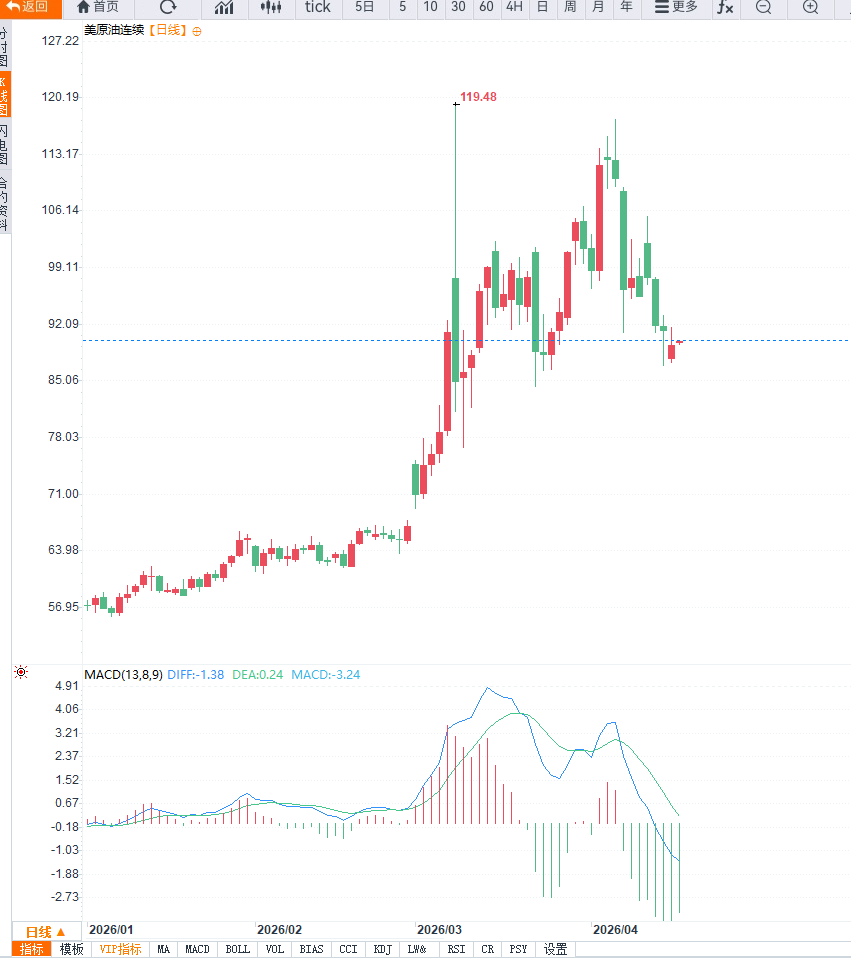
Editor's Summary : Overall, instability in the Middle East remains the core driver of current oil prices, while diplomatic negotiations are, to some extent, offsetting risk premiums. In the short term, the market will continue to oscillate around the two main themes of "conflict escalation" and "negotiation progress." If the situation deteriorates further, oil prices may break through key resistance levels; however, if negotiations make substantial progress, risk premiums may fall rapidly. Overall, oil prices are likely to maintain a high-level consolidation pattern, and investors should pay close attention to marginal changes in geopolitical situations and policy signals.
From an energy market perspective, the Middle East has long been at the heart of the global crude oil supply chain, and any escalation of conflict directly impacts market risk pricing. Particularly concerning key shipping routes, the Strait of Hormuz handles approximately 20% of global seaborne crude oil transport ; a deterioration in the situation could have a substantial impact on global supply. Therefore, against the backdrop of an unstable ceasefire, the market quickly re-incorporated a "geopolitical risk premium," becoming a major driver of oil price recovery.
Meanwhile, diplomatic developments between the US and Iran provided the market with another narrative. Trump indicated that a second round of talks between the two sides might be held over the weekend and expressed relative optimism about reaching a long-term agreement. This signal provided some buffer to market sentiment in the short term.
"The United States and Iran may soon hold a new round of contacts." "There is a possibility of reaching a longer-term arrangement before the ceasefire expires."
However, several European and Gulf leaders believe that reaching a comprehensive agreement could take about six months. This means that while there are expectations of easing tensions in the short term, medium- to long-term uncertainty remains high.
Market reactions indicate that current oil price movements exhibit a clear "dual-driven structure": on the one hand, recurring conflicts in the Middle East are pushing up risk premiums; on the other hand, expectations of diplomatic negotiations are limiting the upside potential for oil prices. WTI oil prices are currently forming a temporary equilibrium around $89 , indicating a fierce battle between bullish and bearish forces.
At the global market level, energy price fluctuations are gradually being transmitted to inflation expectations, especially given that major economies are still facing pressure from slowing growth, and rising oil prices may exacerbate macroeconomic uncertainty. Meanwhile, the dollar's performance and interest rate expectations are also influencing overall commodity pricing, making the crude oil market exhibit a more complex interconnected relationship.
From an investor sentiment perspective, the market has clearly shifted to caution. On the one hand, the risk of escalating short-term conflict keeps bulls on their guard; on the other hand, uncertainty surrounding the progress of negotiations prevents bears from making significant downside bets. This divergence in sentiment is causing oil prices to tend to fluctuate at higher levels rather than move in a one-sided direction .
From a technical perspective, on the daily chart, WTI oil prices maintain a slightly bullish consolidation structure, trading within a medium-term upward channel. Key resistance levels to watch are $91.00 and $92.00, while key support levels are around $87.00 and $85.00. Overall momentum has not shown significant signs of weakening. A decisive break above $90 could open up further upside potential; conversely, a break below $87 would likely present downward pressure. On the 4-hour chart, the short-term trend shows a consolidation-driven upward pattern, with moving averages gradually aligning in a bullish direction. However, momentum indicators show a slight divergence, suggesting a slowdown in upward momentum. Short-term caution is warranted regarding the risk of a pullback after a surge, but the overall structure has not yet turned bearish.
Editor's Summary : Overall, instability in the Middle East remains the core driver of current oil prices, while diplomatic negotiations are, to some extent, offsetting risk premiums. In the short term, the market will continue to oscillate around the two main themes of "conflict escalation" and "negotiation progress." If the situation deteriorates further, oil prices may break through key resistance levels; however, if negotiations make substantial progress, risk premiums may fall rapidly. Overall, oil prices are likely to maintain a high-level consolidation pattern, and investors should pay close attention to marginal changes in geopolitical situations and policy signals.
- Risk Warning and Disclaimer
- The market involves risk, and trading may not be suitable for all investors. This article is for reference only and does not constitute personal investment advice, nor does it take into account certain users’ specific investment objectives, financial situation, or other needs. Any investment decisions made based on this information are at your own risk.