Gold prices surged and then retreated, primarily driven by geopolitical uncertainty; a deeper correction is possible in the short term.
2026-04-17 09:39:10
Gold prices remained range-bound around $4,780 during Friday's Asian trading session, with market sentiment cautious amid a confluence of factors. On one hand, there were signs of a temporary easing of tensions in the Middle East; on the other hand, persistent energy supply risks and inflationary pressures provided support for gold prices.

Israel and Lebanon have reached a 10-day ceasefire agreement, with Israeli Prime Minister Benjamin Netanyahu confirming that the move aims to push both sides towards a "historic peace agreement." Meanwhile, US President Donald Trump stated that the US and Iran may hold a new round of negotiations this weekend and expressed optimism about reaching a long-term ceasefire.
"The US and Iran are expected to reach a longer-term agreement before the ceasefire expires." While this development has eased market tensions in the short term, investors remain cautious. This is because uncertainty surrounding the Middle East situation has not been completely eliminated, particularly regarding key energy transport routes. The Strait of Hormuz handles approximately 20% of global seaborne crude oil shipments ; any potential blockade or disruption could quickly drive up energy prices and indirectly affect gold prices through inflation expectations.
From an inflation perspective, if oil prices rise due to supply concerns, it will strengthen global inflation stickiness, making it more difficult for major central banks to implement interest rate cuts. Since gold itself does not generate interest income, high interest rates typically suppress gold prices. Therefore, the current market exhibits a typical "hedging structure": rising inflation is bullish for gold, but a high-interest-rate environment suppresses it .
Meanwhile, central bank gold purchases are becoming an important medium- to long-term factor supporting gold prices. Major central banks worldwide have been continuously increasing their gold reserves, having done so for 18 consecutive months as of March 2026. This sustained gold purchase activity is seen as a significant manifestation of the global reserve diversification trend and reflects the increasing demand for gold among institutional investors amid rising global uncertainty.
Judging from market reactions, gold prices have not shown a clear upward or downward trend, but rather have remained in a high-level consolidation. This indicates that the weakening of short-term safe-haven demand has been offset by medium- to long-term structural buying, allowing gold prices to maintain overall resilience.
From a technical perspective, on the daily chart, gold prices are trading within a high-level consolidation range, with the overall trend still biased towards the upside, but upward momentum has slowed. Prices have repeatedly encountered resistance near the $4800 level, indicating strong selling pressure above. In terms of momentum indicators, the Relative Strength Index (RSI) has fallen from its highs to neutral territory, and the MACD indicator shows overbought conditions, suggesting weakening upward momentum. Key support levels are located at $4750 and $4680; a break below these levels could trigger further pullbacks. Resistance levels to watch are $4800 and $4850; a decisive break above these levels could open up new upside potential.
From a 4-hour chart perspective, gold is currently consolidating in the short term, with prices fluctuating around short-term moving averages, indicating market uncertainty. The Bollinger Bands are gradually narrowing, suggesting decreasing volatility and a potential directional move. The RSI indicator is oscillating around 50, and the MACD is near the zero line, both indicating a lack of clear trend. The short-term range is roughly between $4750 and $4820 ; a breakout from this range would be a crucial signal for short-term direction.
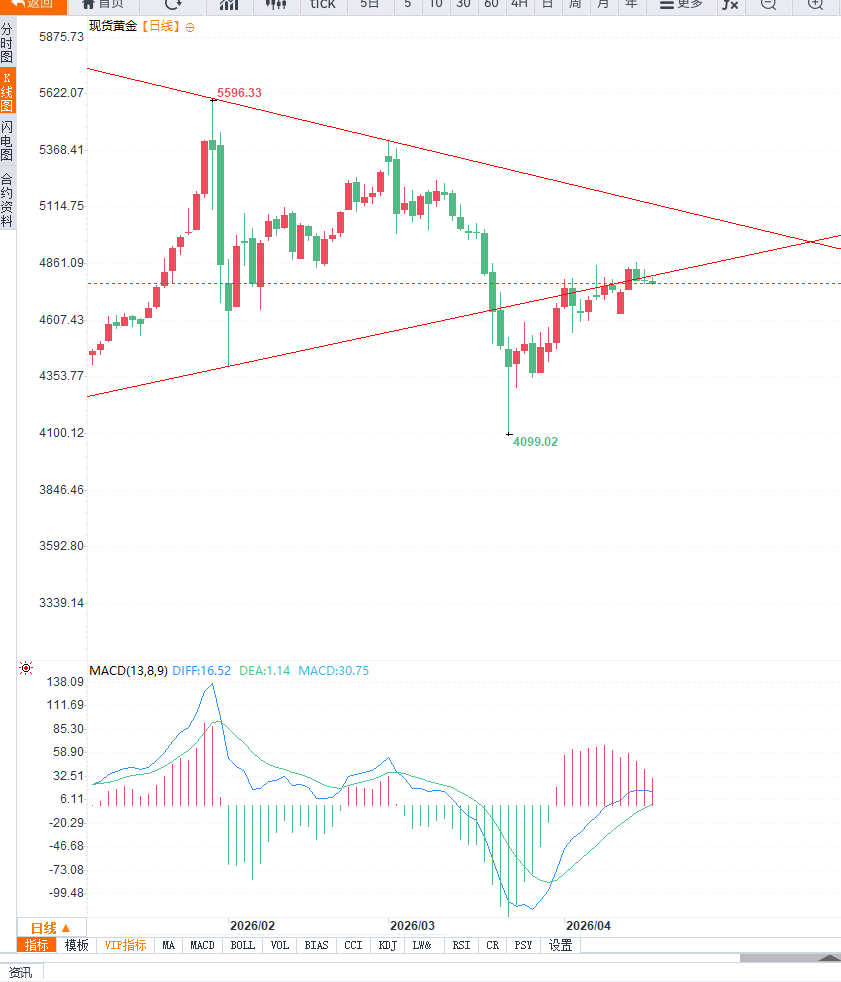
Editor's Summary : The current gold market is in a phase of multiple factors at play: easing geopolitical tensions are weakening safe-haven demand, while energy risks and inflationary pressures are providing support, and continued central bank gold purchases constitute a medium- to long-term bullish factor. In the short term, gold prices may continue to fluctuate at high levels, awaiting new fundamental catalysts; the medium-term trend depends on the interest rate path and changes in inflation. Overall, gold still has structural support, but further upside potential requires confirmation from new driving factors.
Israel and Lebanon have reached a 10-day ceasefire agreement, with Israeli Prime Minister Benjamin Netanyahu confirming that the move aims to push both sides towards a "historic peace agreement." Meanwhile, US President Donald Trump stated that the US and Iran may hold a new round of negotiations this weekend and expressed optimism about reaching a long-term ceasefire.
"The US and Iran are expected to reach a longer-term agreement before the ceasefire expires." While this development has eased market tensions in the short term, investors remain cautious. This is because uncertainty surrounding the Middle East situation has not been completely eliminated, particularly regarding key energy transport routes. The Strait of Hormuz handles approximately 20% of global seaborne crude oil shipments ; any potential blockade or disruption could quickly drive up energy prices and indirectly affect gold prices through inflation expectations.
From an inflation perspective, if oil prices rise due to supply concerns, it will strengthen global inflation stickiness, making it more difficult for major central banks to implement interest rate cuts. Since gold itself does not generate interest income, high interest rates typically suppress gold prices. Therefore, the current market exhibits a typical "hedging structure": rising inflation is bullish for gold, but a high-interest-rate environment suppresses it .
Meanwhile, central bank gold purchases are becoming an important medium- to long-term factor supporting gold prices. Major central banks worldwide have been continuously increasing their gold reserves, having done so for 18 consecutive months as of March 2026. This sustained gold purchase activity is seen as a significant manifestation of the global reserve diversification trend and reflects the increasing demand for gold among institutional investors amid rising global uncertainty.
Judging from market reactions, gold prices have not shown a clear upward or downward trend, but rather have remained in a high-level consolidation. This indicates that the weakening of short-term safe-haven demand has been offset by medium- to long-term structural buying, allowing gold prices to maintain overall resilience.
From a technical perspective, on the daily chart, gold prices are trading within a high-level consolidation range, with the overall trend still biased towards the upside, but upward momentum has slowed. Prices have repeatedly encountered resistance near the $4800 level, indicating strong selling pressure above. In terms of momentum indicators, the Relative Strength Index (RSI) has fallen from its highs to neutral territory, and the MACD indicator shows overbought conditions, suggesting weakening upward momentum. Key support levels are located at $4750 and $4680; a break below these levels could trigger further pullbacks. Resistance levels to watch are $4800 and $4850; a decisive break above these levels could open up new upside potential.
From a 4-hour chart perspective, gold is currently consolidating in the short term, with prices fluctuating around short-term moving averages, indicating market uncertainty. The Bollinger Bands are gradually narrowing, suggesting decreasing volatility and a potential directional move. The RSI indicator is oscillating around 50, and the MACD is near the zero line, both indicating a lack of clear trend. The short-term range is roughly between $4750 and $4820 ; a breakout from this range would be a crucial signal for short-term direction.
Editor's Summary : The current gold market is in a phase of multiple factors at play: easing geopolitical tensions are weakening safe-haven demand, while energy risks and inflationary pressures are providing support, and continued central bank gold purchases constitute a medium- to long-term bullish factor. In the short term, gold prices may continue to fluctuate at high levels, awaiting new fundamental catalysts; the medium-term trend depends on the interest rate path and changes in inflation. Overall, gold still has structural support, but further upside potential requires confirmation from new driving factors.
- Risk Warning and Disclaimer
- The market involves risk, and trading may not be suitable for all investors. This article is for reference only and does not constitute personal investment advice, nor does it take into account certain users’ specific investment objectives, financial situation, or other needs. Any investment decisions made based on this information are at your own risk.