April 20th Financial Breakfast: US and Iran accuse each other of attacking ships; Strait of Hormuz closed again; gold prices battle for the $4750 mark; oil prices rebound nearly 7%.
2026-04-20 07:14:57
On Monday (April 20, Beijing time) in early Asian trading, spot gold opened lower, trading around $4776 per ounce. It may test the $4750 per ounce level during the day. Tensions between the US and Iran escalated again over the weekend, with both countries accusing each other of attacking ships in violation of the ceasefire agreement, and the Strait of Hormuz was closed again. Iran warned that war could resume at any time, and its armed forces are on full alert. Oil prices rebounded more than 7% on Monday, with US crude oil trading around $88 per barrel. The Iranian parliament speaker warned that trading oil based on sentiment is no different from hedging against US Treasury risks—both are "castles in the air."

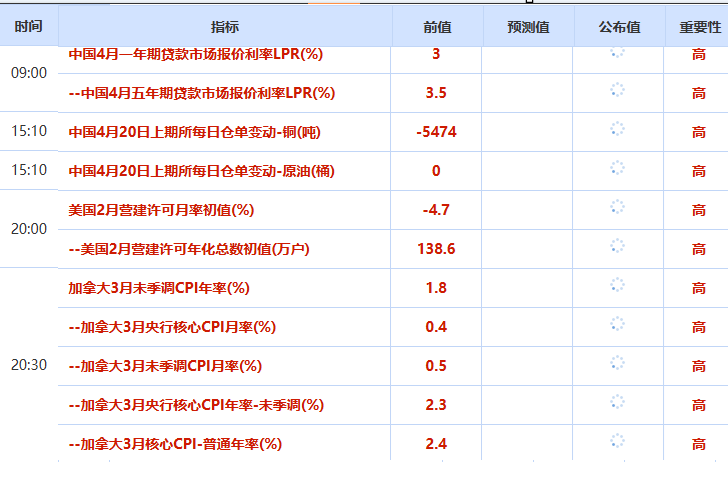
U.S. stocks closed sharply higher on Friday, with the S&P 500 and Nasdaq Composite hitting record closing highs for the third consecutive trading day, while the Dow Jones Industrial Average reached its highest closing level since late February. The S&P 500 rose 1.20% to 7,126.06 points, the Nasdaq Composite gained 1.52% to 24,468.48 points, marking its longest winning streak since 1992, and the Dow Jones Industrial Average rose 1.79% to 49,447.43 points.
The energy sector fell 2.9% due to dragging down oil prices, while consumer discretionary and industrial sectors led the gains. Netflix plunged 9.7% after its earnings guidance fell short of expectations and co-founder Hastings resigned, while Alcoa dropped 6.8% after reporting disappointing earnings.
The Russell 2000 small-cap index also hit record intraday and closing highs. Trading was active, with a total turnover of 20.29 billion shares, above the 20-day average.
Gold prices extended their gains on Friday, with spot gold rising 1.5% to $4,861.32 per ounce, bringing the week's cumulative increase to over 2%; U.S. gold futures closed up 1.5% at $4,879.60. Supported by a weaker dollar and the Iranian Foreign Minister's announcement last week that the Strait of Hormuz would remain open during the ceasefire (the Minister stated ships would follow established coordinated routes), and U.S. President Trump expecting an agreement to end the war with Iran "soon," the market reacted negatively, with tensions in the Middle East escalating again over the weekend.
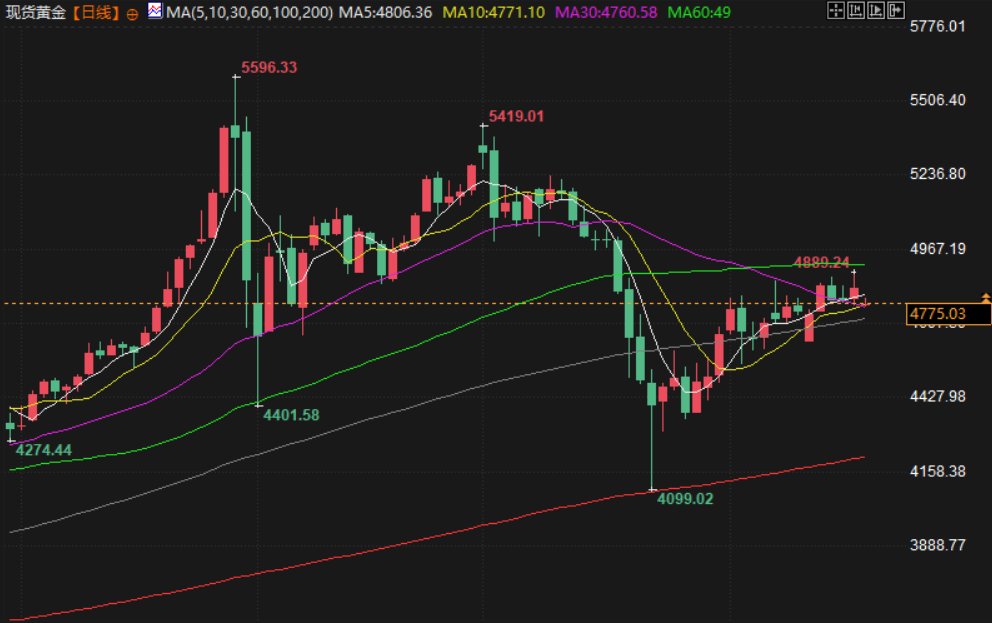
Analysts pointed out that the reopening of the Straits last week put pressure on oil prices, eased inflation concerns and reignited expectations of interest rate cuts, which is beneficial to gold. Gold prices are expected to rebound to above $5,000 in the short term.
In addition, several Indian banks suspended gold and silver imports due to delays in government authorization, leaving tons of precious metals stranded at customs. Spot silver surged 4.2% to $81.71, after rising more than 7% last week; platinum and palladium rose 1.6% each, both showing weekly gains.
International oil prices fell sharply by about 9% last Friday, influenced by news that Iran announced it would open the Strait of Hormuz during the ceasefire and that US-Iran negotiations had made progress. Brent crude futures fell 9.07% to $90.38 per barrel, while US crude futures plummeted 11.45% to $83.85, both marking their biggest single-day drop since April 8.
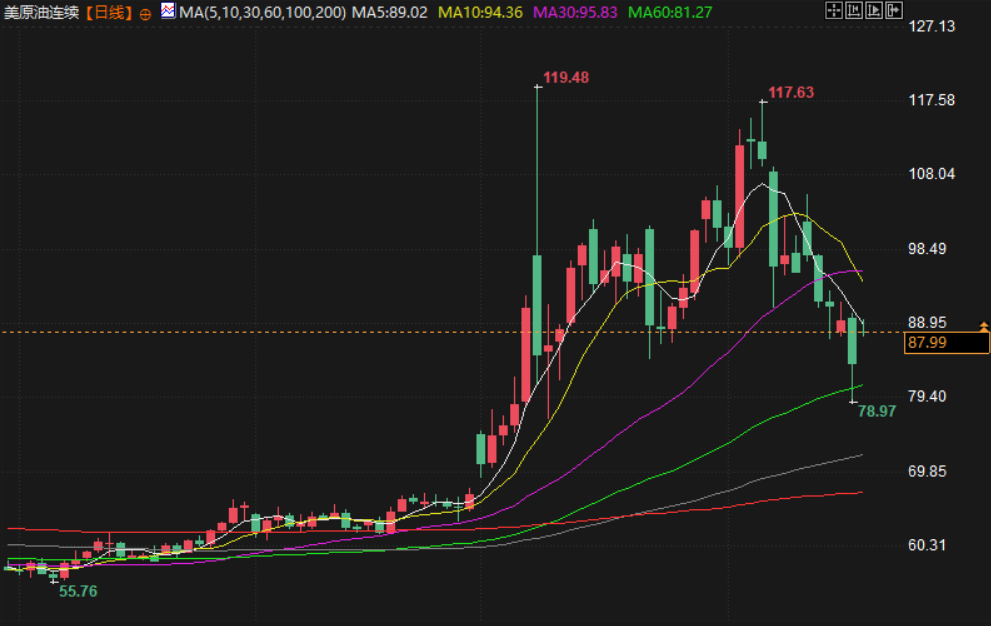
A senior Iranian official stated that all ships can pass through the Strait of Hormuz in coordination with the Islamic Revolutionary Guard Corps, and that unfreezing Iranian funds is part of the agreement. Analysts point out that the market is rapidly absorbing the previously accumulated extreme risk premium, and oil prices are returning to reflect the level of actual supply normalization.
Ship tracking data shows that approximately 20 vessels are sailing from the Persian Gulf through the Strait of Hormuz toward their exit. US President Trump stated that he would enter Iran at a "deliberate pace" to retrieve enriched uranium. Furthermore, US energy companies have cut the number of oil and gas drilling rigs for the second consecutive week.
The dollar index fell 0.3% to 97.96 on Friday, hitting a seven-week low of 97.632 during the session, marking its second consecutive week of decline. Iran announced the opening of the Strait of Hormuz to all merchant ships during the ceasefire, indicating progress in US-Iran negotiations. Oil prices plummeted by more than 10%, US stocks surged, and US Treasury yields fell.
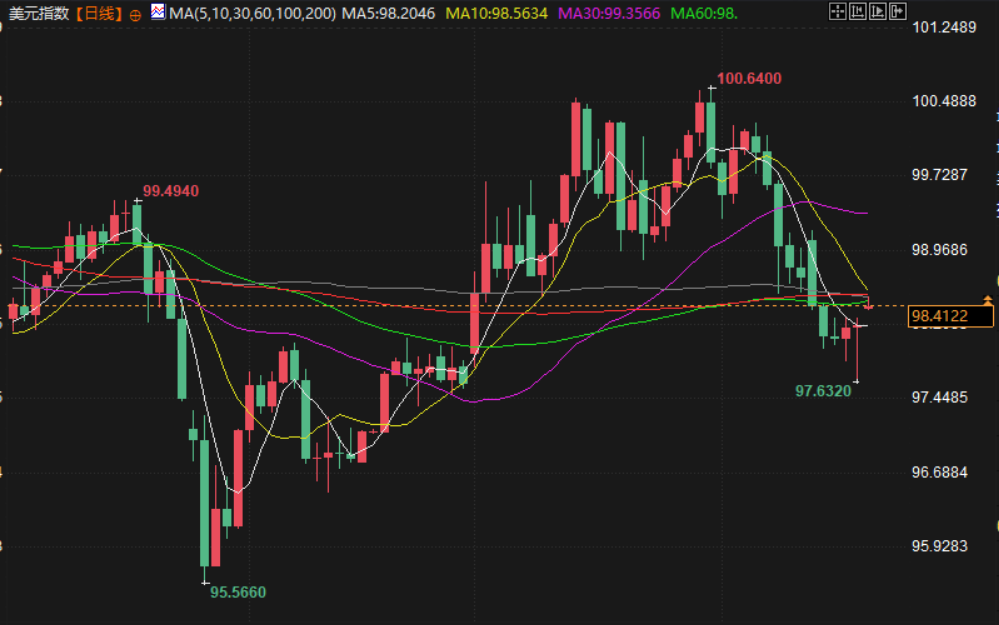
The euro touched an eight-week high of $1.1848 against the dollar, while the pound rose for the second consecutive week; the dollar fell 0.6% against the yen to 158.22. Market expectations for a December rate cut by the Federal Reserve have risen to over 50%, while the first rate hike by the European Central Bank has been postponed to July. The risk-sensitive Australian dollar remained near a four-year high, while the New Zealand dollar was flat. Analysts believe the dollar's weakness mainly reflects the fading geopolitical risk premium, rather than the start of a structural decline in fundamentals.
US military fires on Iranian merchant ship; Iranian military responds and retaliates.
On October 20th local time, a spokesperson for the Hatem Anbia Central Command of the Iranian Armed Forces stated that the United States violated the ceasefire agreement by firing on an Iranian merchant ship in the Gulf of Oman and sending multiple soldiers onto its deck, disabling the ship's navigation system and committing "maritime piracy." The spokesperson warned that the Iranian Armed Forces would soon respond and retaliate against this act of piracy and armed robbery by the US military. Earlier that day, Trump posted on social media that a US guided-missile destroyer intercepted the Iranian cargo ship "TOUSKA" in the Gulf of Oman that day, which was attempting to break through the US naval blockade, opened fire, penetrated the engine room, and forced it to stop. The US Marine Corps has now taken control of the ship. (CCTV)
Trump says US and Iran will resume talks in Islamabad
US President Donald Trump said on April 19 that a US delegation would travel to Islamabad, Pakistan, and would be there "tonight for negotiations." Trump described the proposed solution as "fair and reasonable" and hoped Iran would accept it; otherwise, the US military would bomb Iranian power plants and bridges. (CCTV International News)
Turkish Foreign Minister says Iran-US negotiations are "close to completion" overall, but differences remain.
Turkish Foreign Minister Fedan Ibrahim stated on the 19th local time, while attending the Antalya Diplomatic Forum, that he is "optimistic" about extending the ceasefire agreement in the Middle East and believes the process can continue. Ibrahim said that negotiations between the US and Iran are "generally close to completion," but a few remaining disagreements require further coordination. He pointed out that under the current circumstances, it is necessary to extend the ceasefire to create conditions for subsequent negotiations. (CCTV News)
Iran blocks two oil tankers from passing through the Strait of Hormuz; maritime blockade continues.
According to Iran's Tasnim News Agency on the 19th, as Iran's maritime blockade continued, Iranian armed forces prevented two oil tankers from passing through the Strait of Hormuz that day. The two tankers, flying the flags of Botswana and Angola, reportedly attempted to pass through the Strait of Hormuz but were forced to turn back under Iranian pressure. (Xinhua)
Iran's Foreign Ministry says that unconditional transit through the Strait of Hormuz is "a thing of the past."
Iranian Foreign Ministry spokesman Baghae said early on the 19th that the unconditional passage through the Strait of Hormuz "became history" the moment the US and Israel's aggression brought US military forces into the vicinity of the Strait. In response to EU officials' calls for Iran to abide by international law and unconditionally open the Strait of Hormuz, Baghae posted on social media that while the EU lectures other countries on international law, it condones the aggression launched by the US and Israel and turns a blind eye to the atrocities suffered by the Iranian people. He said that Europe's so-called adherence to "international law" has completely degenerated into a hypocritical performance of words and deeds, revealing the deep-seated problems of Europe's long-standing double standards. Baghae stated that there is no provision in current international law prohibiting Iran, as a littoral state of the Strait of Hormuz, from taking necessary measures to prevent the strait from being used for military aggression against Iran. (Xinhua)
Iranian Parliament Speaker Warns: War Could Resume at Any Time; Armed Forces Maintain Full Combat Readiness
In a speech broadcast on Iranian state television Sunday morning, Iranian Parliament Speaker and chief negotiator Mohammad Ghalibaf stated that Iran distrusts the United States and that its armed forces remain on full alert because fighting could resume at any time. "We do not trust the enemy. Even if we were sitting here right now, war could break out—the armed forces are fully prepared for the battlefield." Despite Iran's active negotiations with the United States to reach a permanent ceasefire agreement, Ghalibaf emphasized that Iran is prepared to respond at any time if the enemy "makes a mistake." This warning indicates that Tehran remains highly vigilant against a renewed conflict, even as diplomatic efforts continue.
The Houthi rebels in Yemen warned that escalating tensions could lead to the closure of the Bab el-Mandeb Strait.
SANAA – Yemen's Houthi rebels warned on the 18th that the strategically vital Bab el-Mandeb Strait could be closed if peace efforts continue to be hampered. Houthi senior official Hussein Izi urged US President Trump and his allies on social media on the 18th to "end all actions and policies that hinder peace" and respect the legitimate rights of the Yemeni people. He also stated that if the decision is made to close the Bab el-Mandeb Strait, "no force can reopen it." This Houthi warning follows Iran's decision on the 18th to again close the Strait of Hormuz. The Iranian Islamic Revolutionary Guard Corps Navy's public relations department issued a statement on the 18th, stating that due to the US violation of its ceasefire commitments and failure to lift the maritime blockade of Iranian ports and ships, the Strait of Hormuz would be closed from that evening. The Bab el-Mandeb Strait connects the Red Sea and the Gulf of Aden, and is a vital passage connecting the Atlantic Ocean, the Mediterranean Sea, and the Indian Ocean. The strait is under the control of the Houthi rebels in Yemen. Data from the US Energy Information Administration shows that before the outbreak of the US-Israel-Iran conflict, approximately 12% of global oil shipments passed through the Bab el-Mandeb Strait. Since the end of March, the Houthi rebels have been launching missiles and drones at Israel to support their allies in the region's "Arc of Resistance." (Xinhua)
The US assesses that Iran still retains about 70% of its pre-war missile stockpile.
According to an assessment by the U.S. military and intelligence agencies cited by The New York Times on April 18, Iran still retains approximately 70% of its pre-war missile stockpile, about 60% of its missile launchers, and about 40% of its attack drone arsenal, "enough to shut down shipping through the Strait of Hormuz in the future." The report stated that Iran is continuing to clear missile stockpiles buried during the U.S. and Israeli strikes. Some U.S. assessment data indicate that once this work is completed, Iran's missile stockpile could be restored to about 70% of its pre-war level. Furthermore, when Iran and the U.S. announced a two-week ceasefire on April 8, Iran had about half of its pre-war missile launchers available. In the following days, Iran unearthed about 100 launchers from underground bunkers, restoring its launcher stockpile to about 60% of its pre-war level. The report said that although opinions differ on Iran's missile reserves, U.S. officials agree that Iran possesses "weaponry sufficient to shut down shipping through the Strait of Hormuz in the future." (Xinhua)
Sources say Trump has consistently refused to send US troops to land and seize Halke Island.
According to reports, Kharg Island is a key transit point for 90% of Iran's oil exports, and Trump has consistently refused to send US troops to land and seize the island. Sources familiar with the matter revealed that although the US military assured them of a guaranteed victory and that capturing the island would give them direct control of the Strait of Hormuz, Trump feared the unbearable casualties inflicted on the US military. The president stated bluntly: "Once we land, US soldiers will become sitting ducks."
Soaring fuel costs are impacting the aviation industry, with several airlines raising fees and cutting routes.
On April 18th local time, it was learned that due to the situation in the Strait of Hormuz pushing up aviation fuel prices, several airlines are coping with cost pressures by raising baggage fees and cutting routes. Chris Sununu, CEO of the Airlines for America (AAA), stated that fuel costs account for approximately 25% to 30% of airline operating costs. The current rise in global oil prices is continuously squeezing industry profit margins, and the industry's losses for the year are expected to reach at least $25 billion. Sununu indicated that compared to European airlines, US airlines are under relatively less pressure, but are still closely monitoring the situation. To avoid a significant increase in ticket prices, many airlines are instead offsetting costs by raising surcharges. (CCTV News)
Iranian Parliament Speaker: Trading oil based on sentiment is no different from hedging US Treasury risks; both are "castles in the air."
The Speaker of the Iranian Parliament stated that trading oil based on sentiment is akin to hedging against US Treasury risks based on subjective feelings when risk aversion in the Strait of Hormuz cools. Both are essentially the same—"paper castles in the air, teetering on the brink of collapse." The Speaker pointed out the difference: oil at least has Brent crude as a real pricing anchor; while US Treasury bonds rely entirely on market sentiment from beginning to end, lacking any underlying anchor. This statement aims to question the pricing logic of the current financial markets and the stability of safe-haven assets.
Half Marathon Drives Sales of Multiple Robot Products to Double
On the morning of April 19th, Honor's robot "Lightning" swept across the finish line with an impressive time of 50 minutes and 26 seconds, winning the championship of the 2026 Beijing Yizhuang Half Marathon and Humanoid Robot Half Marathon. It is reported that this year's event brought together over 100 teams and more than 300 humanoid robots from companies such as Unitree Robotics, Honor, Tiangong, Gaoqing, and Songyan Power to compete. JD.com data shows that during the event, over 100,000 users flocked to the JD.com platform to search for the keyword "robot marathon," driving more than 20 robot brands to double their sales on JD.com. (Xinhua News Agency)
The scope of use of housing provident fund will be expanded again.
To date, over 20 cities in multiple provinces, including Jiangsu, Hebei, Liaoning, Anhui, and Jiangxi, have explicitly issued relevant policies, breaking the old restriction that housing provident funds could only be used for home purchases and mortgage repayments. Specifically, while the policies vary across regions, they are all practical: Suzhou and Taizhou allow withdrawals based on actual property management fees, with an annual limit of 10,000 yuan; Changchun, Bengbu, and Hangzhou have set annual limits ranging from 3,000 to 10,000 yuan. This wave of policy benefits directly impacts everyone with housing needs. First, it directly reduces the daily burden on families; using housing provident funds to offset property management fees reduces cash outlays, especially for young people and new urban residents, essentially providing an additional "hidden subsidy." Second, it helps to revitalize the over 10 trillion yuan of dormant housing provident funds nationwide, putting "dormant" money to work. In fact, allowing housing provident funds to be used for property management fees is just a microcosm of policy adjustments this year, reflecting a clearer reform logic: the housing provident fund is transforming from a single "home purchase tool" into a "comprehensive livelihood account" covering the entire life cycle of housing. (CCTV Finance)
Key Focus Today
stock market
U.S. stocks closed sharply higher on Friday, with the S&P 500 and Nasdaq Composite hitting record closing highs for the third consecutive trading day, while the Dow Jones Industrial Average reached its highest closing level since late February. The S&P 500 rose 1.20% to 7,126.06 points, the Nasdaq Composite gained 1.52% to 24,468.48 points, marking its longest winning streak since 1992, and the Dow Jones Industrial Average rose 1.79% to 49,447.43 points.
The energy sector fell 2.9% due to dragging down oil prices, while consumer discretionary and industrial sectors led the gains. Netflix plunged 9.7% after its earnings guidance fell short of expectations and co-founder Hastings resigned, while Alcoa dropped 6.8% after reporting disappointing earnings.
The Russell 2000 small-cap index also hit record intraday and closing highs. Trading was active, with a total turnover of 20.29 billion shares, above the 20-day average.
Gold Market
Gold prices extended their gains on Friday, with spot gold rising 1.5% to $4,861.32 per ounce, bringing the week's cumulative increase to over 2%; U.S. gold futures closed up 1.5% at $4,879.60. Supported by a weaker dollar and the Iranian Foreign Minister's announcement last week that the Strait of Hormuz would remain open during the ceasefire (the Minister stated ships would follow established coordinated routes), and U.S. President Trump expecting an agreement to end the war with Iran "soon," the market reacted negatively, with tensions in the Middle East escalating again over the weekend.
Analysts pointed out that the reopening of the Straits last week put pressure on oil prices, eased inflation concerns and reignited expectations of interest rate cuts, which is beneficial to gold. Gold prices are expected to rebound to above $5,000 in the short term.
In addition, several Indian banks suspended gold and silver imports due to delays in government authorization, leaving tons of precious metals stranded at customs. Spot silver surged 4.2% to $81.71, after rising more than 7% last week; platinum and palladium rose 1.6% each, both showing weekly gains.
oil market
International oil prices fell sharply by about 9% last Friday, influenced by news that Iran announced it would open the Strait of Hormuz during the ceasefire and that US-Iran negotiations had made progress. Brent crude futures fell 9.07% to $90.38 per barrel, while US crude futures plummeted 11.45% to $83.85, both marking their biggest single-day drop since April 8.
A senior Iranian official stated that all ships can pass through the Strait of Hormuz in coordination with the Islamic Revolutionary Guard Corps, and that unfreezing Iranian funds is part of the agreement. Analysts point out that the market is rapidly absorbing the previously accumulated extreme risk premium, and oil prices are returning to reflect the level of actual supply normalization.
Ship tracking data shows that approximately 20 vessels are sailing from the Persian Gulf through the Strait of Hormuz toward their exit. US President Trump stated that he would enter Iran at a "deliberate pace" to retrieve enriched uranium. Furthermore, US energy companies have cut the number of oil and gas drilling rigs for the second consecutive week.
Foreign exchange market
The dollar index fell 0.3% to 97.96 on Friday, hitting a seven-week low of 97.632 during the session, marking its second consecutive week of decline. Iran announced the opening of the Strait of Hormuz to all merchant ships during the ceasefire, indicating progress in US-Iran negotiations. Oil prices plummeted by more than 10%, US stocks surged, and US Treasury yields fell.
The euro touched an eight-week high of $1.1848 against the dollar, while the pound rose for the second consecutive week; the dollar fell 0.6% against the yen to 158.22. Market expectations for a December rate cut by the Federal Reserve have risen to over 50%, while the first rate hike by the European Central Bank has been postponed to July. The risk-sensitive Australian dollar remained near a four-year high, while the New Zealand dollar was flat. Analysts believe the dollar's weakness mainly reflects the fading geopolitical risk premium, rather than the start of a structural decline in fundamentals.
International News
US military fires on Iranian merchant ship; Iranian military responds and retaliates.
On October 20th local time, a spokesperson for the Hatem Anbia Central Command of the Iranian Armed Forces stated that the United States violated the ceasefire agreement by firing on an Iranian merchant ship in the Gulf of Oman and sending multiple soldiers onto its deck, disabling the ship's navigation system and committing "maritime piracy." The spokesperson warned that the Iranian Armed Forces would soon respond and retaliate against this act of piracy and armed robbery by the US military. Earlier that day, Trump posted on social media that a US guided-missile destroyer intercepted the Iranian cargo ship "TOUSKA" in the Gulf of Oman that day, which was attempting to break through the US naval blockade, opened fire, penetrated the engine room, and forced it to stop. The US Marine Corps has now taken control of the ship. (CCTV)
Trump says US and Iran will resume talks in Islamabad
US President Donald Trump said on April 19 that a US delegation would travel to Islamabad, Pakistan, and would be there "tonight for negotiations." Trump described the proposed solution as "fair and reasonable" and hoped Iran would accept it; otherwise, the US military would bomb Iranian power plants and bridges. (CCTV International News)
Turkish Foreign Minister says Iran-US negotiations are "close to completion" overall, but differences remain.
Turkish Foreign Minister Fedan Ibrahim stated on the 19th local time, while attending the Antalya Diplomatic Forum, that he is "optimistic" about extending the ceasefire agreement in the Middle East and believes the process can continue. Ibrahim said that negotiations between the US and Iran are "generally close to completion," but a few remaining disagreements require further coordination. He pointed out that under the current circumstances, it is necessary to extend the ceasefire to create conditions for subsequent negotiations. (CCTV News)
Iran blocks two oil tankers from passing through the Strait of Hormuz; maritime blockade continues.
According to Iran's Tasnim News Agency on the 19th, as Iran's maritime blockade continued, Iranian armed forces prevented two oil tankers from passing through the Strait of Hormuz that day. The two tankers, flying the flags of Botswana and Angola, reportedly attempted to pass through the Strait of Hormuz but were forced to turn back under Iranian pressure. (Xinhua)
Iran's Foreign Ministry says that unconditional transit through the Strait of Hormuz is "a thing of the past."
Iranian Foreign Ministry spokesman Baghae said early on the 19th that the unconditional passage through the Strait of Hormuz "became history" the moment the US and Israel's aggression brought US military forces into the vicinity of the Strait. In response to EU officials' calls for Iran to abide by international law and unconditionally open the Strait of Hormuz, Baghae posted on social media that while the EU lectures other countries on international law, it condones the aggression launched by the US and Israel and turns a blind eye to the atrocities suffered by the Iranian people. He said that Europe's so-called adherence to "international law" has completely degenerated into a hypocritical performance of words and deeds, revealing the deep-seated problems of Europe's long-standing double standards. Baghae stated that there is no provision in current international law prohibiting Iran, as a littoral state of the Strait of Hormuz, from taking necessary measures to prevent the strait from being used for military aggression against Iran. (Xinhua)
Iranian Parliament Speaker Warns: War Could Resume at Any Time; Armed Forces Maintain Full Combat Readiness
In a speech broadcast on Iranian state television Sunday morning, Iranian Parliament Speaker and chief negotiator Mohammad Ghalibaf stated that Iran distrusts the United States and that its armed forces remain on full alert because fighting could resume at any time. "We do not trust the enemy. Even if we were sitting here right now, war could break out—the armed forces are fully prepared for the battlefield." Despite Iran's active negotiations with the United States to reach a permanent ceasefire agreement, Ghalibaf emphasized that Iran is prepared to respond at any time if the enemy "makes a mistake." This warning indicates that Tehran remains highly vigilant against a renewed conflict, even as diplomatic efforts continue.
The Houthi rebels in Yemen warned that escalating tensions could lead to the closure of the Bab el-Mandeb Strait.
SANAA – Yemen's Houthi rebels warned on the 18th that the strategically vital Bab el-Mandeb Strait could be closed if peace efforts continue to be hampered. Houthi senior official Hussein Izi urged US President Trump and his allies on social media on the 18th to "end all actions and policies that hinder peace" and respect the legitimate rights of the Yemeni people. He also stated that if the decision is made to close the Bab el-Mandeb Strait, "no force can reopen it." This Houthi warning follows Iran's decision on the 18th to again close the Strait of Hormuz. The Iranian Islamic Revolutionary Guard Corps Navy's public relations department issued a statement on the 18th, stating that due to the US violation of its ceasefire commitments and failure to lift the maritime blockade of Iranian ports and ships, the Strait of Hormuz would be closed from that evening. The Bab el-Mandeb Strait connects the Red Sea and the Gulf of Aden, and is a vital passage connecting the Atlantic Ocean, the Mediterranean Sea, and the Indian Ocean. The strait is under the control of the Houthi rebels in Yemen. Data from the US Energy Information Administration shows that before the outbreak of the US-Israel-Iran conflict, approximately 12% of global oil shipments passed through the Bab el-Mandeb Strait. Since the end of March, the Houthi rebels have been launching missiles and drones at Israel to support their allies in the region's "Arc of Resistance." (Xinhua)
The US assesses that Iran still retains about 70% of its pre-war missile stockpile.
According to an assessment by the U.S. military and intelligence agencies cited by The New York Times on April 18, Iran still retains approximately 70% of its pre-war missile stockpile, about 60% of its missile launchers, and about 40% of its attack drone arsenal, "enough to shut down shipping through the Strait of Hormuz in the future." The report stated that Iran is continuing to clear missile stockpiles buried during the U.S. and Israeli strikes. Some U.S. assessment data indicate that once this work is completed, Iran's missile stockpile could be restored to about 70% of its pre-war level. Furthermore, when Iran and the U.S. announced a two-week ceasefire on April 8, Iran had about half of its pre-war missile launchers available. In the following days, Iran unearthed about 100 launchers from underground bunkers, restoring its launcher stockpile to about 60% of its pre-war level. The report said that although opinions differ on Iran's missile reserves, U.S. officials agree that Iran possesses "weaponry sufficient to shut down shipping through the Strait of Hormuz in the future." (Xinhua)
Sources say Trump has consistently refused to send US troops to land and seize Halke Island.
According to reports, Kharg Island is a key transit point for 90% of Iran's oil exports, and Trump has consistently refused to send US troops to land and seize the island. Sources familiar with the matter revealed that although the US military assured them of a guaranteed victory and that capturing the island would give them direct control of the Strait of Hormuz, Trump feared the unbearable casualties inflicted on the US military. The president stated bluntly: "Once we land, US soldiers will become sitting ducks."
Soaring fuel costs are impacting the aviation industry, with several airlines raising fees and cutting routes.
On April 18th local time, it was learned that due to the situation in the Strait of Hormuz pushing up aviation fuel prices, several airlines are coping with cost pressures by raising baggage fees and cutting routes. Chris Sununu, CEO of the Airlines for America (AAA), stated that fuel costs account for approximately 25% to 30% of airline operating costs. The current rise in global oil prices is continuously squeezing industry profit margins, and the industry's losses for the year are expected to reach at least $25 billion. Sununu indicated that compared to European airlines, US airlines are under relatively less pressure, but are still closely monitoring the situation. To avoid a significant increase in ticket prices, many airlines are instead offsetting costs by raising surcharges. (CCTV News)
Iranian Parliament Speaker: Trading oil based on sentiment is no different from hedging US Treasury risks; both are "castles in the air."
The Speaker of the Iranian Parliament stated that trading oil based on sentiment is akin to hedging against US Treasury risks based on subjective feelings when risk aversion in the Strait of Hormuz cools. Both are essentially the same—"paper castles in the air, teetering on the brink of collapse." The Speaker pointed out the difference: oil at least has Brent crude as a real pricing anchor; while US Treasury bonds rely entirely on market sentiment from beginning to end, lacking any underlying anchor. This statement aims to question the pricing logic of the current financial markets and the stability of safe-haven assets.
Domestic News
Half Marathon Drives Sales of Multiple Robot Products to Double
On the morning of April 19th, Honor's robot "Lightning" swept across the finish line with an impressive time of 50 minutes and 26 seconds, winning the championship of the 2026 Beijing Yizhuang Half Marathon and Humanoid Robot Half Marathon. It is reported that this year's event brought together over 100 teams and more than 300 humanoid robots from companies such as Unitree Robotics, Honor, Tiangong, Gaoqing, and Songyan Power to compete. JD.com data shows that during the event, over 100,000 users flocked to the JD.com platform to search for the keyword "robot marathon," driving more than 20 robot brands to double their sales on JD.com. (Xinhua News Agency)
The scope of use of housing provident fund will be expanded again.
To date, over 20 cities in multiple provinces, including Jiangsu, Hebei, Liaoning, Anhui, and Jiangxi, have explicitly issued relevant policies, breaking the old restriction that housing provident funds could only be used for home purchases and mortgage repayments. Specifically, while the policies vary across regions, they are all practical: Suzhou and Taizhou allow withdrawals based on actual property management fees, with an annual limit of 10,000 yuan; Changchun, Bengbu, and Hangzhou have set annual limits ranging from 3,000 to 10,000 yuan. This wave of policy benefits directly impacts everyone with housing needs. First, it directly reduces the daily burden on families; using housing provident funds to offset property management fees reduces cash outlays, especially for young people and new urban residents, essentially providing an additional "hidden subsidy." Second, it helps to revitalize the over 10 trillion yuan of dormant housing provident funds nationwide, putting "dormant" money to work. In fact, allowing housing provident funds to be used for property management fees is just a microcosm of policy adjustments this year, reflecting a clearer reform logic: the housing provident fund is transforming from a single "home purchase tool" into a "comprehensive livelihood account" covering the entire life cycle of housing. (CCTV Finance)
- Risk Warning and Disclaimer
- The market involves risk, and trading may not be suitable for all investors. This article is for reference only and does not constitute personal investment advice, nor does it take into account certain users’ specific investment objectives, financial situation, or other needs. Any investment decisions made based on this information are at your own risk.