Crude oil trading alert: Geopolitical tensions are escalating again, and oil prices may weaken again after a rebound.
2026-04-20 09:13:54
Renewed tensions in the Middle East have become a key driver of recent global market volatility. Iran's announcement of the re-closure of the Strait of Hormuz has plunged this crucial global energy transport route back into uncertainty. The strait handles approximately 20% of global seaborne crude oil shipments; any disruption to its passage will directly impact the global energy supply chain, thereby driving up crude oil risk premiums.

Latest developments show that crude oil futures prices rebounded rapidly after trading resumed over the weekend. NYMEX May WTI crude oil rose to around $90 per barrel, a gain of nearly 7%, while the more active June contract also rose to $88.43 per barrel. Brent crude oil also strengthened, with the June contract reaching $96.86 per barrel. In terms of refined products, ultra-low sulfur diesel (ULSD) and gasoline futures also rebounded significantly, reflecting growing market concerns about refined product supply.
Despite the strong price rebound, it's worth noting that this rally has not fully recovered the previous losses. The market had previously plunged nearly 9% in a single day due to concerns about the potential reopening of the Strait of Hormuz. This sharp fluctuation indicates that current oil price movements are highly dependent on rapid changes in the geopolitical situation, with market sentiment still oscillating between expectations of supply disruptions and diplomatic easing.
In financial markets, rising energy prices quickly translated into inflation expectations. U.S. Treasury yields rose across the board, with the 2-year yield climbing to 3.74% and the 10-year yield to 4.28%, both increasing by about 3 basis points. Meanwhile, the U.S. dollar spot index rose by about 0.2%, indicating increased demand for dollar-denominated assets amid rising inflation expectations. This combination reflects a market reassessment of the impact of energy prices on the macroeconomy.
From a supply and demand perspective, market research indicates that Goldman Sachs believes the current risks to oil prices are roughly balanced. The firm maintains its 2026 average price forecasts for Brent and WTI crude oil at $83/barrel and $78/barrel , respectively, assuming that shipping through the Strait of Hormuz gradually returns to normal by mid-May. However, Goldman Sachs also warns that if supply recovers faster than expected while demand remains weak, oil prices could face further downward pressure.
Changes on the demand side are also noteworthy. High oil prices are suppressing end-user consumption, particularly evident in petrochemical feedstocks and jet fuel. Preliminary estimates suggest that the global demand decline in early 2026 will exceed that of many previous oil price surge cycles, with a particularly pronounced effect in Asian countries and emerging African markets, regions more sensitive to price fluctuations.
Overall, the current crude oil market is in a typical high-volatility phase. On the one hand, the supply side is dominated by geopolitical risks, and any military or political developments could quickly change the direction of prices; on the other hand, weak demand is gradually emerging, exerting medium-term downward pressure on oil prices. This combination of "short-term supply shocks + medium-term weakening demand" has led to a clear structural divergence in the market.
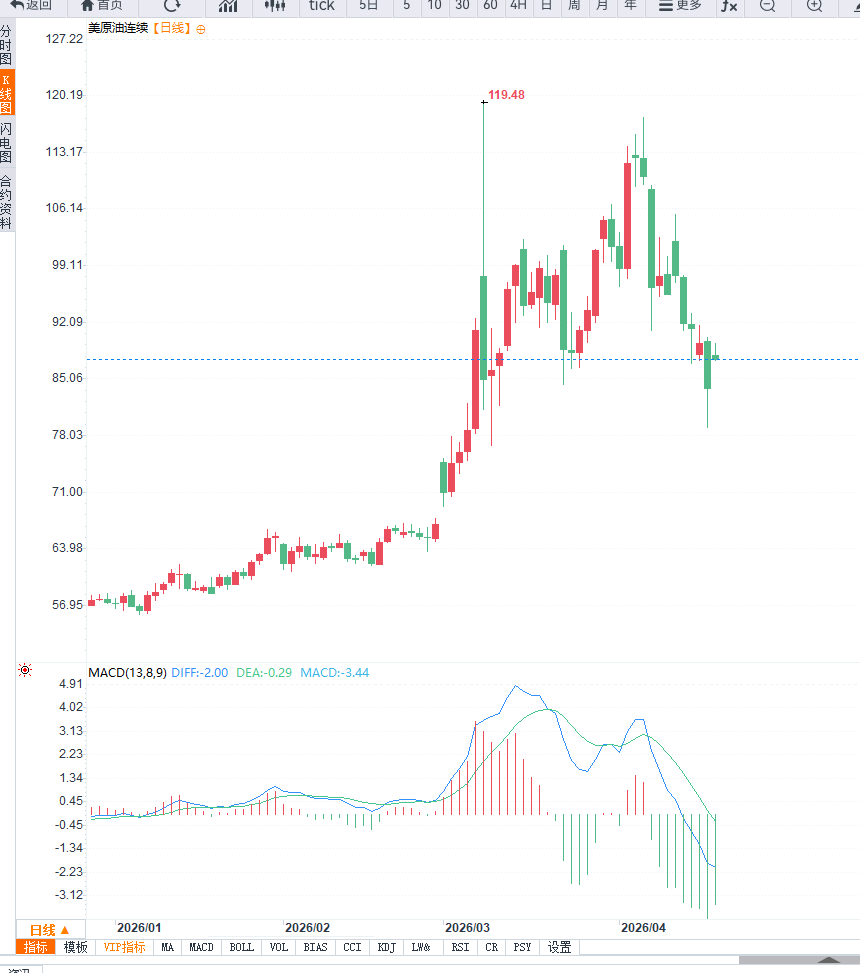
From a technical perspective, on the daily chart, WTI crude oil prices have rebounded above a key range after a significant correction. $90/barrel forms a major short-term resistance level, while the $85/barrel area provides initial support. The overall trend has shifted from consolidation to a slightly bullish bias, with momentum recovering. Looking at the 4-hour chart, prices entered a consolidation phase after a rapid rise, suggesting a potential short-term technical pullback. If the pullback holds above the support level, the rebound structure may continue; conversely, a break below key support could lead to a return to a consolidation range.
Editor's Summary : Overall, the core driver of the current crude oil market remains the impact of geopolitical risks on the supply side. This factor is further reinforcing inflation expectations by pushing up oil prices and putting pressure on the bond market. In the short term, if tensions in the Strait of Hormuz remain high, oil prices may still have upward momentum, but market expectations regarding diplomatic negotiations will limit the upside potential. In the medium to long term, weak demand and the pace of supply recovery will be key variables determining the direction of oil prices. Investors should pay close attention to the progress of transportation recovery and potential inflection points brought about by changes in global demand.
Latest developments show that crude oil futures prices rebounded rapidly after trading resumed over the weekend. NYMEX May WTI crude oil rose to around $90 per barrel, a gain of nearly 7%, while the more active June contract also rose to $88.43 per barrel. Brent crude oil also strengthened, with the June contract reaching $96.86 per barrel. In terms of refined products, ultra-low sulfur diesel (ULSD) and gasoline futures also rebounded significantly, reflecting growing market concerns about refined product supply.
Despite the strong price rebound, it's worth noting that this rally has not fully recovered the previous losses. The market had previously plunged nearly 9% in a single day due to concerns about the potential reopening of the Strait of Hormuz. This sharp fluctuation indicates that current oil price movements are highly dependent on rapid changes in the geopolitical situation, with market sentiment still oscillating between expectations of supply disruptions and diplomatic easing.
In financial markets, rising energy prices quickly translated into inflation expectations. U.S. Treasury yields rose across the board, with the 2-year yield climbing to 3.74% and the 10-year yield to 4.28%, both increasing by about 3 basis points. Meanwhile, the U.S. dollar spot index rose by about 0.2%, indicating increased demand for dollar-denominated assets amid rising inflation expectations. This combination reflects a market reassessment of the impact of energy prices on the macroeconomy.
From a supply and demand perspective, market research indicates that Goldman Sachs believes the current risks to oil prices are roughly balanced. The firm maintains its 2026 average price forecasts for Brent and WTI crude oil at $83/barrel and $78/barrel , respectively, assuming that shipping through the Strait of Hormuz gradually returns to normal by mid-May. However, Goldman Sachs also warns that if supply recovers faster than expected while demand remains weak, oil prices could face further downward pressure.
Changes on the demand side are also noteworthy. High oil prices are suppressing end-user consumption, particularly evident in petrochemical feedstocks and jet fuel. Preliminary estimates suggest that the global demand decline in early 2026 will exceed that of many previous oil price surge cycles, with a particularly pronounced effect in Asian countries and emerging African markets, regions more sensitive to price fluctuations.
Overall, the current crude oil market is in a typical high-volatility phase. On the one hand, the supply side is dominated by geopolitical risks, and any military or political developments could quickly change the direction of prices; on the other hand, weak demand is gradually emerging, exerting medium-term downward pressure on oil prices. This combination of "short-term supply shocks + medium-term weakening demand" has led to a clear structural divergence in the market.
From a technical perspective, on the daily chart, WTI crude oil prices have rebounded above a key range after a significant correction. $90/barrel forms a major short-term resistance level, while the $85/barrel area provides initial support. The overall trend has shifted from consolidation to a slightly bullish bias, with momentum recovering. Looking at the 4-hour chart, prices entered a consolidation phase after a rapid rise, suggesting a potential short-term technical pullback. If the pullback holds above the support level, the rebound structure may continue; conversely, a break below key support could lead to a return to a consolidation range.
Editor's Summary : Overall, the core driver of the current crude oil market remains the impact of geopolitical risks on the supply side. This factor is further reinforcing inflation expectations by pushing up oil prices and putting pressure on the bond market. In the short term, if tensions in the Strait of Hormuz remain high, oil prices may still have upward momentum, but market expectations regarding diplomatic negotiations will limit the upside potential. In the medium to long term, weak demand and the pace of supply recovery will be key variables determining the direction of oil prices. Investors should pay close attention to the progress of transportation recovery and potential inflection points brought about by changes in global demand.
- Risk Warning and Disclaimer
- The market involves risk, and trading may not be suitable for all investors. This article is for reference only and does not constitute personal investment advice, nor does it take into account certain users’ specific investment objectives, financial situation, or other needs. Any investment decisions made based on this information are at your own risk.