Escalating tensions in Iran and expectations of high interest rates dampened safe-haven demand, leading to a slight correction in gold prices.
2026-04-20 09:40:41
International gold prices weakened significantly during Monday's Asian session, with XAU/USD falling back to around $4775 before rebounding to around $4800, indicating a renewed struggle between bullish and bearish forces in the complex macroeconomic environment. Despite escalating tensions in the Middle East, gold failed to continue its previous safe-haven rally and instead experienced a pullback, reflecting a shift in the current market's driving logic.

In the context of this event, Iran announced the closure of the Strait of Hormuz and stated it would take action against vessels approaching the area until the United States lifts its maritime blockade. Meanwhile, market research indicates that Iran denies participating in a new round of negotiations, a clear divergence from diplomatic signals from the United States. This uncertainty has exacerbated market concerns about energy supplies and regional stability.
However, gold did not benefit from this, primarily due to changes in macroeconomic and financial conditions. Market expectations for the Federal Reserve's policy path have clearly shifted towards "higher interest rates for longer," mainly driven by persistent inflationary pressures and geopolitical risks pushing up energy prices. Against this backdrop, high real yields in the United States have significantly increased the opportunity cost of holding gold, a non-interest-bearing asset, thus putting downward pressure on gold prices.
Meanwhile, the relatively strong performance of the US dollar has also put downward pressure on gold, which is priced in US dollars. In a high-interest-rate environment, funds are more inclined to allocate to US dollar assets rather than safe-haven assets like gold, and this shift in fund flows is one of the key drivers of the current decline in gold prices.
The market is currently focusing on the upcoming US retail sales data. The market expects March retail sales to rise by approximately 1.3% month-over-month, higher than the previous reading of 0.6% . Strong data could further reinforce expectations of economic resilience and sticky inflation, thus supporting the dollar and putting downward pressure on gold; conversely, weaker-than-expected data could ease upward pressure on interest rates, providing room for a gold price rebound.
Overall, gold is currently caught in a struggle between its "safe-haven" and "interest rate" attributes. While geopolitical risks provide potential support for the market, changes in the interest rate environment are dominating short-term price movements, causing gold to exhibit signs of temporary downward pressure.
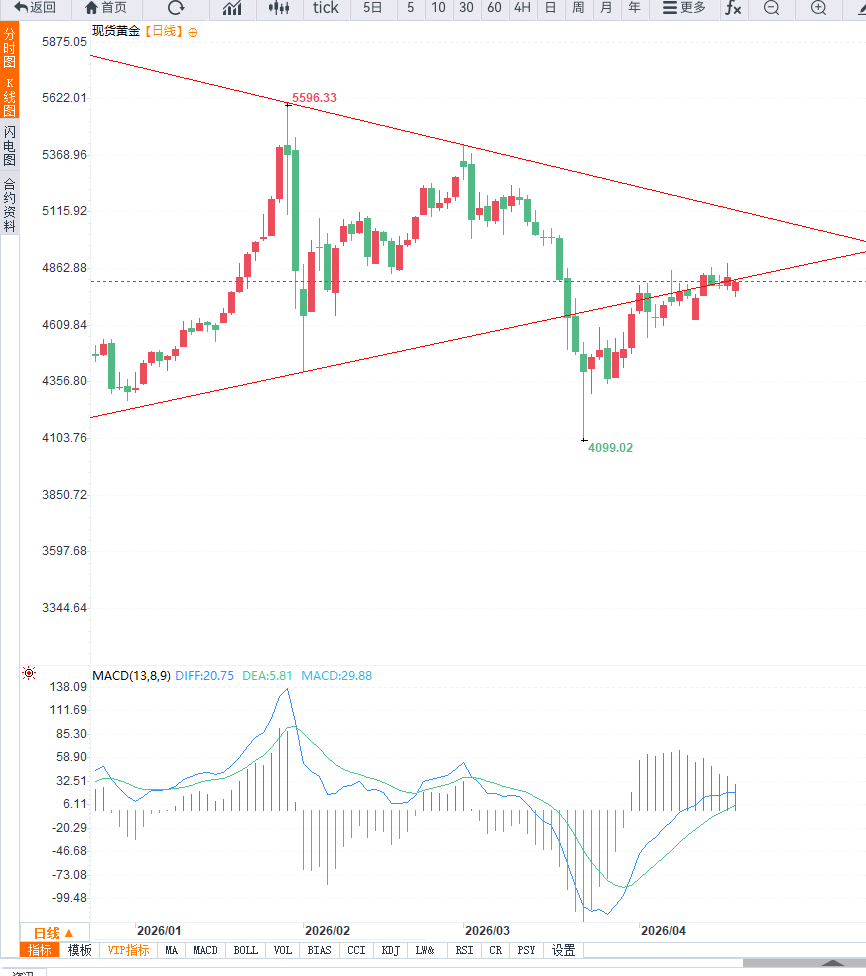
From a technical perspective, the daily chart shows that gold has formed a pullback pattern at high levels, failing to break through the key resistance level of $4850 in the short term, indicating that upward momentum has weakened. The $4720 area below forms important support; a break below this level could open up further downside potential. Looking at the 4-hour chart, the price has broken below the short-term uptrend line and entered a correction channel, with momentum indicators weakening. If the rebound fails to return above $4850, the short-term trend will remain weak and volatile; however, if it stabilizes in the support area, a retest of higher levels cannot be ruled out.
Editor's Summary : In summary, the core contradiction in the current gold market lies in the hedging relationship between safe-haven demand stemming from geopolitical risks and the high-interest-rate environment. In the short term, with the Federal Reserve's policy remaining tight, gold's upside potential is limited, and even tense situations are unlikely to generate a sustained upward trend. Future trends will depend on US economic data and changes in interest rate expectations. If inflationary pressures ease and lead to a policy shift, gold still has the potential to strengthen again, but the risk of suppression from a continuously strengthening US dollar should be noted.
In the context of this event, Iran announced the closure of the Strait of Hormuz and stated it would take action against vessels approaching the area until the United States lifts its maritime blockade. Meanwhile, market research indicates that Iran denies participating in a new round of negotiations, a clear divergence from diplomatic signals from the United States. This uncertainty has exacerbated market concerns about energy supplies and regional stability.
However, gold did not benefit from this, primarily due to changes in macroeconomic and financial conditions. Market expectations for the Federal Reserve's policy path have clearly shifted towards "higher interest rates for longer," mainly driven by persistent inflationary pressures and geopolitical risks pushing up energy prices. Against this backdrop, high real yields in the United States have significantly increased the opportunity cost of holding gold, a non-interest-bearing asset, thus putting downward pressure on gold prices.
Meanwhile, the relatively strong performance of the US dollar has also put downward pressure on gold, which is priced in US dollars. In a high-interest-rate environment, funds are more inclined to allocate to US dollar assets rather than safe-haven assets like gold, and this shift in fund flows is one of the key drivers of the current decline in gold prices.
The market is currently focusing on the upcoming US retail sales data. The market expects March retail sales to rise by approximately 1.3% month-over-month, higher than the previous reading of 0.6% . Strong data could further reinforce expectations of economic resilience and sticky inflation, thus supporting the dollar and putting downward pressure on gold; conversely, weaker-than-expected data could ease upward pressure on interest rates, providing room for a gold price rebound.
Overall, gold is currently caught in a struggle between its "safe-haven" and "interest rate" attributes. While geopolitical risks provide potential support for the market, changes in the interest rate environment are dominating short-term price movements, causing gold to exhibit signs of temporary downward pressure.
From a technical perspective, the daily chart shows that gold has formed a pullback pattern at high levels, failing to break through the key resistance level of $4850 in the short term, indicating that upward momentum has weakened. The $4720 area below forms important support; a break below this level could open up further downside potential. Looking at the 4-hour chart, the price has broken below the short-term uptrend line and entered a correction channel, with momentum indicators weakening. If the rebound fails to return above $4850, the short-term trend will remain weak and volatile; however, if it stabilizes in the support area, a retest of higher levels cannot be ruled out.
Editor's Summary : In summary, the core contradiction in the current gold market lies in the hedging relationship between safe-haven demand stemming from geopolitical risks and the high-interest-rate environment. In the short term, with the Federal Reserve's policy remaining tight, gold's upside potential is limited, and even tense situations are unlikely to generate a sustained upward trend. Future trends will depend on US economic data and changes in interest rate expectations. If inflationary pressures ease and lead to a policy shift, gold still has the potential to strengthen again, but the risk of suppression from a continuously strengthening US dollar should be noted.
- Risk Warning and Disclaimer
- The market involves risk, and trading may not be suitable for all investors. This article is for reference only and does not constitute personal investment advice, nor does it take into account certain users’ specific investment objectives, financial situation, or other needs. Any investment decisions made based on this information are at your own risk.