The yen weakened as expectations of a Bank of Japan interest rate hike cooled, while the pound remained range-bound against the yen.
2026-04-20 15:54:03
The British pound continued its upward trend against the Japanese yen during Monday's European session, rising to around 214.60 , showing an overall strong performance. Looking at the market action, the yen's relative weakness among major currencies provided the main upward momentum for the pound.

From a background perspective, expectations surrounding the Bank of Japan's policy are a key factor influencing the yen's exchange rate. The market generally believes that, given the current economic environment, the likelihood of the Bank of Japan raising interest rates in the short term is limited. Especially against the backdrop of a "negative supply shock" from rising energy prices, inflation is not demand-driven, making traditional monetary policy tools ineffective and thus limiting the scope for policy tightening.
Bank of Japan Governor Kazuo Ueda previously stated that current inflation is more cost-push than an overheated economy, and this structural inflation makes policy adjustments more cautious. As a result, the market lowered its expectations for a Bank of Japan interest rate hike, putting pressure on the yen. Furthermore, looking at the performance of major currencies that day, the yen depreciated by approximately 0.16% against the dollar, indicating that it failed to find significant support in a safe-haven environment.
The market will also be focused on Japan's March inflation data this week, with core CPI (excluding fresh food) expected to rise to 1.8% year-on-year, higher than the previous value of 1.6% . If the data meets or exceeds expectations, it may provide some support for the yen, but if the inflation structure remains unchanged, policy expectations are unlikely to shift significantly.
In contrast, the pound has been relatively stable but somewhat mixed. The UK is set to release a flurry of data, including employment and inflation figures. The market expects wage growth to slow, while the unemployment rate remains at 5.2% , indicating a gradual cooling of the labor market. Meanwhile, inflation is expected to rebound, which could support the Bank of England's continued tightening stance.
However, Bank of England Governor Bailey has recently adopted a cautious stance, emphasizing that he will not rush to adjust policy given the high level of uncertainty. This means that despite expectations of interest rate hikes, the policy path remains uncertain, thus limiting the pound's potential for further appreciation.
Overall, the current GBP/JPY exchange rate movement is primarily driven by the weakening yen, while the pound's own momentum is relatively limited. Given the divergence in policy expectations, the exchange rate is expected to remain relatively strong in the short term, but the risk of volatility due to data and policy changes should still be closely monitored.
From a technical perspective, the GBP/JPY pair maintains an upward trend on the daily chart, with prices continuously hitting new highs. The 215.00 level forms a key short-term resistance; a break above this level could lead to a further test of the 217.00 area. Initial support is provided at 212.50 ; a break below this level could result in a pullback to around 210.80 . Overall, the momentum remains strong. On the 4-hour chart, the pair is trading within an upward channel, with short-term moving averages in a bullish alignment, but momentum has slightly slowed. Failure to break through the 215 level could lead to a consolidation phase at higher levels; however, if the price retraces to support and holds, the trend is likely to continue.
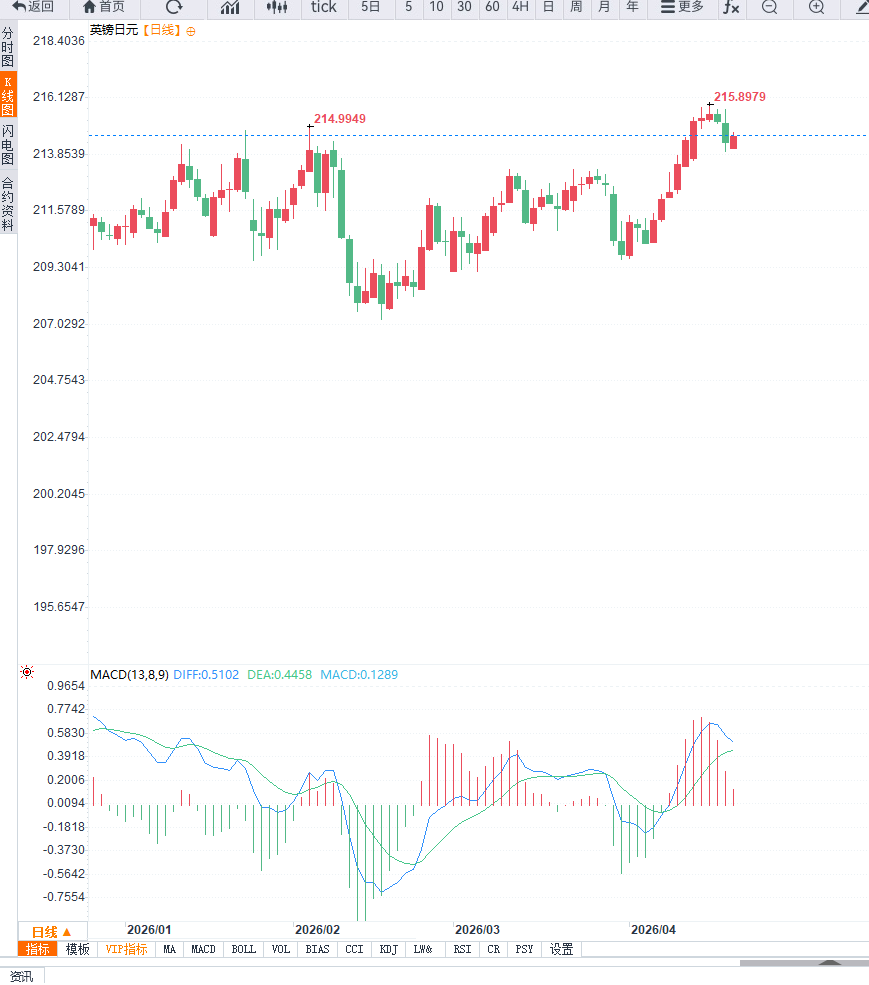
Editor's Summary : Overall, the current GBP/JPY exchange rate is primarily driven by a weakening yen due to declining expectations of a weaker Bank of Japan policy, while policy uncertainty in the UK is limiting the pound's upside potential. In the short term, the exchange rate may maintain a slightly bullish trend, but upward resistance is gradually emerging. Future movements will depend on Japanese inflation data and UK economic data; changes in policy expectations could exacerbate exchange rate volatility. Investors should pay close attention to the directional guidance provided by central bank signals and key data.
From a background perspective, expectations surrounding the Bank of Japan's policy are a key factor influencing the yen's exchange rate. The market generally believes that, given the current economic environment, the likelihood of the Bank of Japan raising interest rates in the short term is limited. Especially against the backdrop of a "negative supply shock" from rising energy prices, inflation is not demand-driven, making traditional monetary policy tools ineffective and thus limiting the scope for policy tightening.
Bank of Japan Governor Kazuo Ueda previously stated that current inflation is more cost-push than an overheated economy, and this structural inflation makes policy adjustments more cautious. As a result, the market lowered its expectations for a Bank of Japan interest rate hike, putting pressure on the yen. Furthermore, looking at the performance of major currencies that day, the yen depreciated by approximately 0.16% against the dollar, indicating that it failed to find significant support in a safe-haven environment.
The market will also be focused on Japan's March inflation data this week, with core CPI (excluding fresh food) expected to rise to 1.8% year-on-year, higher than the previous value of 1.6% . If the data meets or exceeds expectations, it may provide some support for the yen, but if the inflation structure remains unchanged, policy expectations are unlikely to shift significantly.
In contrast, the pound has been relatively stable but somewhat mixed. The UK is set to release a flurry of data, including employment and inflation figures. The market expects wage growth to slow, while the unemployment rate remains at 5.2% , indicating a gradual cooling of the labor market. Meanwhile, inflation is expected to rebound, which could support the Bank of England's continued tightening stance.
However, Bank of England Governor Bailey has recently adopted a cautious stance, emphasizing that he will not rush to adjust policy given the high level of uncertainty. This means that despite expectations of interest rate hikes, the policy path remains uncertain, thus limiting the pound's potential for further appreciation.
Overall, the current GBP/JPY exchange rate movement is primarily driven by the weakening yen, while the pound's own momentum is relatively limited. Given the divergence in policy expectations, the exchange rate is expected to remain relatively strong in the short term, but the risk of volatility due to data and policy changes should still be closely monitored.
From a technical perspective, the GBP/JPY pair maintains an upward trend on the daily chart, with prices continuously hitting new highs. The 215.00 level forms a key short-term resistance; a break above this level could lead to a further test of the 217.00 area. Initial support is provided at 212.50 ; a break below this level could result in a pullback to around 210.80 . Overall, the momentum remains strong. On the 4-hour chart, the pair is trading within an upward channel, with short-term moving averages in a bullish alignment, but momentum has slightly slowed. Failure to break through the 215 level could lead to a consolidation phase at higher levels; however, if the price retraces to support and holds, the trend is likely to continue.
Editor's Summary : Overall, the current GBP/JPY exchange rate is primarily driven by a weakening yen due to declining expectations of a weaker Bank of Japan policy, while policy uncertainty in the UK is limiting the pound's upside potential. In the short term, the exchange rate may maintain a slightly bullish trend, but upward resistance is gradually emerging. Future movements will depend on Japanese inflation data and UK economic data; changes in policy expectations could exacerbate exchange rate volatility. Investors should pay close attention to the directional guidance provided by central bank signals and key data.
- Risk Warning and Disclaimer
- The market involves risk, and trading may not be suitable for all investors. This article is for reference only and does not constitute personal investment advice, nor does it take into account certain users’ specific investment objectives, financial situation, or other needs. Any investment decisions made based on this information are at your own risk.