The situation in Iran failed to support the rally, and the dollar index fluctuated and fell back.
2026-04-21 01:32:15
On Monday (April 20), the US dollar index gradually declined during the US session, completely erasing all of its gains from the morning session. The market opened strongly, continuing the upward trend from Friday's close, but buying power quickly weakened after reaching 98.395. This level is slightly below the 200-day moving average of 98.524 and the 50-day moving average of 98.732. The combination of multiple key technical resistance levels directly suppressed the bulls' upward momentum.

Last Friday, the US dollar index found support in the 98.097-97.496 range, even experiencing a slight rebound towards the end of the session. However, lacking solid and sustained buying support, any short-term rebound is unlikely to break through effectively and is destined to be short-lived. This week, close attention should be paid to price fluctuations within this support range to observe whether short sellers begin to exit and whether buying power gradually increases.
From an upside perspective, for the US dollar index to initiate a strong rebound, it must first firmly establish itself above the moving average. Even if it successfully breaks through the moving average resistance, it will encounter stronger resistance in the short-term pullback range of 99.138 to 99.493. Close attention should be paid to the market's reaction to the 50% retracement level of 98.097 in the closing session; the outcome of the battle between bulls and bears at this level will directly reflect whether new funds entered the market to buy on the dip before the close.
Escalating tensions with Iran briefly boosted demand for the US dollar.
The US dollar index opened stronger on Monday, briefly hitting a near one-week high before retreating. Over the weekend, the US seized an Iranian cargo ship, prompting Iran to declare retaliatory measures and explicitly state it would not participate in a second round of negotiations before Tuesday's ceasefire deadline. This series of unexpected events quickly shattered market optimism regarding a short-term peace agreement, leading to a rapid shift in portfolio allocations towards safe-haven assets.
Previously, market expectations of easing geopolitical tensions had been putting downward pressure on the dollar, leading to its weakness. However, Monday's developments reversed some of the decline. In an environment of sudden escalation of geopolitical uncertainty, funds typically flow into the dollar for safe haven, a classic trading logic that was fully reflected in the morning's trading.
Rising oil prices add uncertainty to inflation expectations.
Shipping in the Strait of Hormuz was disrupted by the situation, causing Brent crude oil spot prices to surge by nearly 5%, and West Texas Intermediate crude oil prices to rise by almost 6%. The sharp rise in oil prices directly exacerbated market concerns about a rebound in inflation and also sparked discussions about how long the Federal Reserve would maintain its high-interest-rate policy. If inflation risks remain high, the Fed's room for interest rate cuts will be significantly reduced, and even if geopolitical risk aversion subsides, the US dollar will receive fundamental support.
The market continued its downward trend, with the dollar giving back all of its gains.
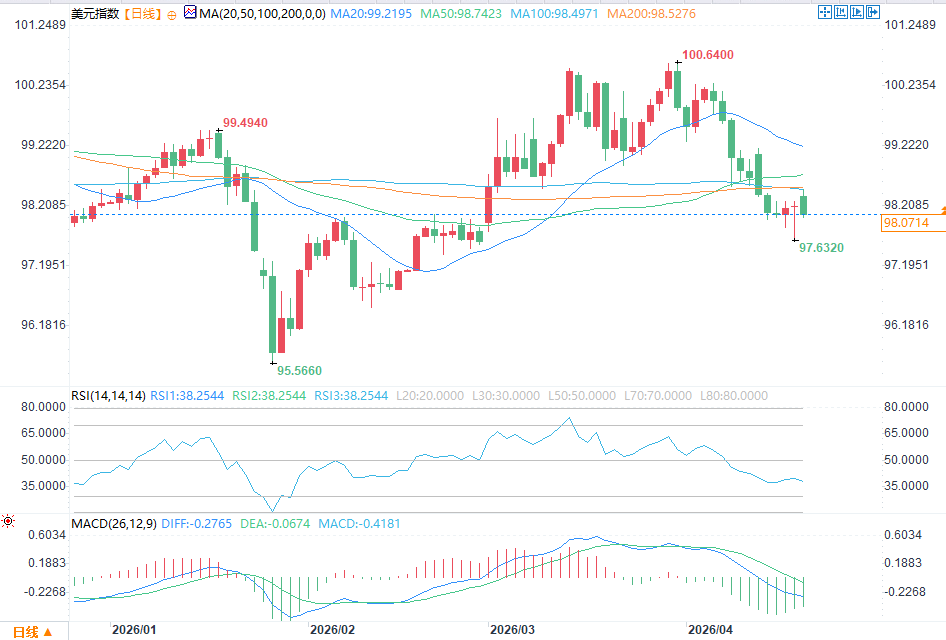
(US Dollar Index Daily Chart Source: FX678)
Despite an early rise driven by risk aversion, the dollar gave back all its gains as trading progressed. This pullback indicates that the market is not entirely convinced that the geopolitical situation will continue to escalate, and some funds still hope for a resumption of diplomatic negotiations. This mixed uncertainty has limited significant volatility in the currency market, temporarily restricting the dollar's rebound.
The currency market saw relatively mild volatility overall. The euro and pound sterling rebounded slightly after falling in the morning session, while the yen weakened but did not reach a key level that could trigger official intervention. Overall market sentiment was cautious. Although geopolitical risks provided support for the dollar, selling on rallies is expected to continue unless the situation escalates further.
Last Friday, the US dollar index found support in the 98.097-97.496 range, even experiencing a slight rebound towards the end of the session. However, lacking solid and sustained buying support, any short-term rebound is unlikely to break through effectively and is destined to be short-lived. This week, close attention should be paid to price fluctuations within this support range to observe whether short sellers begin to exit and whether buying power gradually increases.
From an upside perspective, for the US dollar index to initiate a strong rebound, it must first firmly establish itself above the moving average. Even if it successfully breaks through the moving average resistance, it will encounter stronger resistance in the short-term pullback range of 99.138 to 99.493. Close attention should be paid to the market's reaction to the 50% retracement level of 98.097 in the closing session; the outcome of the battle between bulls and bears at this level will directly reflect whether new funds entered the market to buy on the dip before the close.
Escalating tensions with Iran briefly boosted demand for the US dollar.
The US dollar index opened stronger on Monday, briefly hitting a near one-week high before retreating. Over the weekend, the US seized an Iranian cargo ship, prompting Iran to declare retaliatory measures and explicitly state it would not participate in a second round of negotiations before Tuesday's ceasefire deadline. This series of unexpected events quickly shattered market optimism regarding a short-term peace agreement, leading to a rapid shift in portfolio allocations towards safe-haven assets.
Previously, market expectations of easing geopolitical tensions had been putting downward pressure on the dollar, leading to its weakness. However, Monday's developments reversed some of the decline. In an environment of sudden escalation of geopolitical uncertainty, funds typically flow into the dollar for safe haven, a classic trading logic that was fully reflected in the morning's trading.
Rising oil prices add uncertainty to inflation expectations.
Shipping in the Strait of Hormuz was disrupted by the situation, causing Brent crude oil spot prices to surge by nearly 5%, and West Texas Intermediate crude oil prices to rise by almost 6%. The sharp rise in oil prices directly exacerbated market concerns about a rebound in inflation and also sparked discussions about how long the Federal Reserve would maintain its high-interest-rate policy. If inflation risks remain high, the Fed's room for interest rate cuts will be significantly reduced, and even if geopolitical risk aversion subsides, the US dollar will receive fundamental support.
The market continued its downward trend, with the dollar giving back all of its gains.
(US Dollar Index Daily Chart Source: FX678)
Despite an early rise driven by risk aversion, the dollar gave back all its gains as trading progressed. This pullback indicates that the market is not entirely convinced that the geopolitical situation will continue to escalate, and some funds still hope for a resumption of diplomatic negotiations. This mixed uncertainty has limited significant volatility in the currency market, temporarily restricting the dollar's rebound.
The currency market saw relatively mild volatility overall. The euro and pound sterling rebounded slightly after falling in the morning session, while the yen weakened but did not reach a key level that could trigger official intervention. Overall market sentiment was cautious. Although geopolitical risks provided support for the dollar, selling on rallies is expected to continue unless the situation escalates further.
- Risk Warning and Disclaimer
- The market involves risk, and trading may not be suitable for all investors. This article is for reference only and does not constitute personal investment advice, nor does it take into account certain users’ specific investment objectives, financial situation, or other needs. Any investment decisions made based on this information are at your own risk.