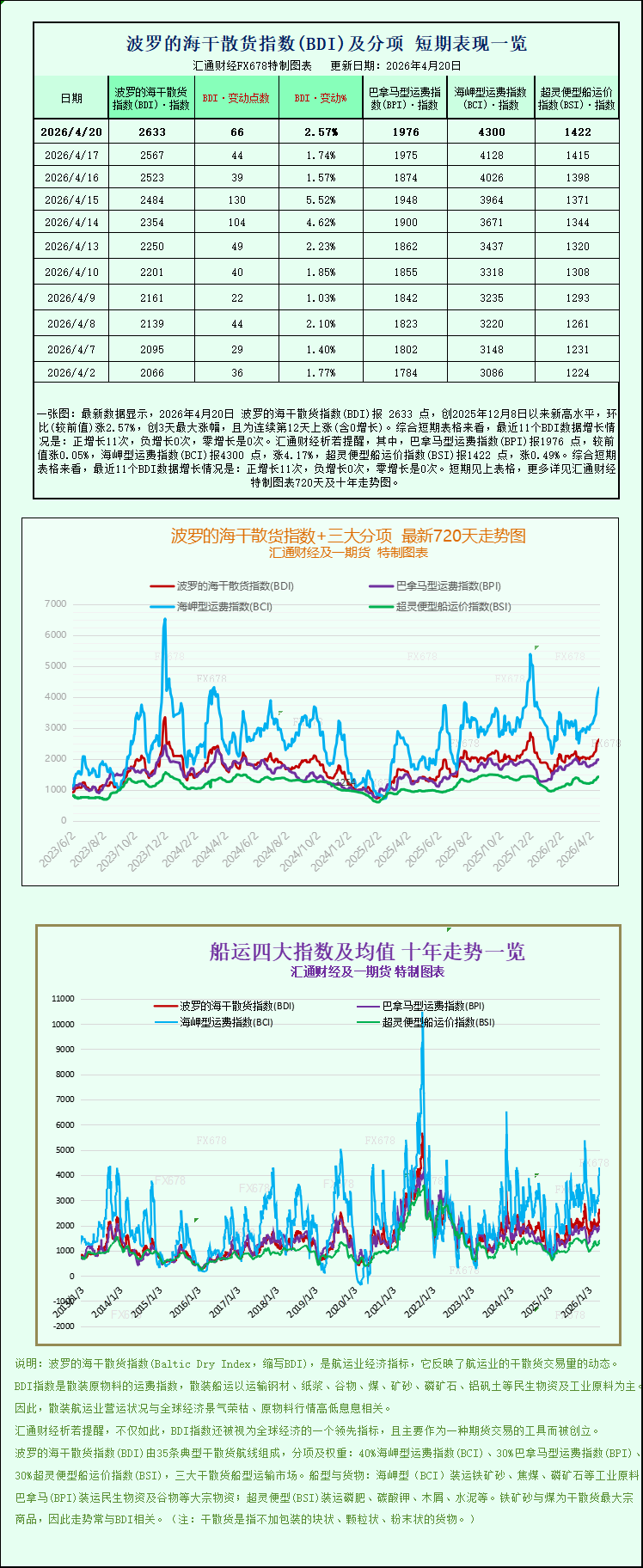
One chart: The Baltic Dry Index continues its upward trend, with rates increasing for all ship types.
2026-04-20 23:15:06
Latest data shows that on April 20, 2026, the Baltic Dry Index (BDI) reached 2633 points, a new high since December 8, 2025, up 2.57% month-on-month, marking the largest increase in three days and the 12th consecutive day of increase (including zero growth). Looking at the short-term charts, the recent 11 BDI data points show: 11 positive increases, 0 negative increases, and 0 zero increases. Specifically, the Panamax Freight Index (BPI) was 1976 points, up 0.05% from the previous value; the Capesize Freight Index (BCI) was 4300 points, up 4.17%; and the Supramax Freight Index (BSI) was 1422 points, up 0.49%. For detailed 720-day and 10-year trend charts of the Baltic Dry Index and its three main sub-indices, please refer to the specially designed charts.
The Baltic Dry Index (BDI) continued its upward trend, firmly maintaining its highest level in over four months, demonstrating strong market performance. All vessel segments within the index simultaneously implemented varying degrees of rate increases, reflecting the overall recovery in the global dry bulk shipping market. As a core indicator of the global dry bulk shipping market, the BDI primarily monitors freight rate fluctuations for vessels transporting dry bulk commodities such as iron ore, coal, and grains. Its continued upward trend sends a positive signal to the global commodity trading market.
Specifically, the Baltic Dry Index, which tracks freight rates for the three core shipping categories of Capesize, Panamax, and Supramax, achieved a steady increase for the twelfth consecutive trading day, rising 66 points, or 2.6%, to close at 2633 points. This figure represents the highest level since early December 2025, and the continuous upward trend fully reflects the sustained release of market demand and the increased activity in the shipping market.
Among them, the Capesize vessel index performed particularly well, surging 172 points, or approximately 4.2%, to close at 4300 points, also setting a new high in over four months and becoming the core driver of the overall index increase. Capesize vessels, as the "giants" of the dry bulk shipping market, primarily undertake the long-distance transport of large dry bulk cargoes, typically with a carrying capacity of up to 150,000 tons. They mainly transport basic industrial raw materials such as iron ore and coal. On that day, the average daily revenue of this type of vessel also increased by $1564, ultimately reaching $35496, significantly improving the profitability of shipping companies.
It is worth noting that the continued strength of iron ore futures prices has also provided strong support for the dry bulk shipping market. Iron ore futures prices rose for the fourth consecutive trading day, driven by multiple factors. Firstly, as the world's largest importer and consumer of iron ore, China's domestic port iron ore inventory levels had previously been relatively high, but recently have begun to decline significantly. This change directly indicates that domestic demand for iron ore remains stable, thus increasing demand for iron ore transportation. Secondly, global iron ore production has remained stable without significant fluctuations, and the stable operation of international oil prices has also supported iron ore transportation costs. These multiple positive factors combined have driven up iron ore futures prices, indirectly leading to an increase in dry bulk shipping rates.
Besides Capesize vessels, the Panamax index also saw a slight increase, rising 1 point, or approximately 0.1%, to close at 1976 points. Although the increase was relatively modest, it continued the overall upward trend. Panamax vessels are mainly used for short- to medium-haul dry bulk shipping, typically carrying between 60,000 and 70,000 tons, primarily transporting commodities such as coal and grain. The average daily earnings for this type of vessel also saw a slight increase, rising by $1.20 to $17,785. While the increase was limited, it reflects the stable and positive trend in this segment of the shipping market.
The Very Large Crude Carrier (VLCC) index also showed an upward trend, rising 7 points, or 0.5%, to close at 1422 points, steadily keeping pace with the overall market. As a crucial component of the dry bulk shipping market, VLCCs primarily handle large-scale dry bulk cargo transportation. The increase in their rates further confirms the comprehensive recovery of the global dry bulk shipping market, with all sub-sectors exhibiting positive development trends.
Meanwhile, changes in the international geopolitical situation have also brought potential impacts to the shipping market. Recently, the US government seized an Iranian cargo ship, a move that has provoked strong dissatisfaction from Iran. Tehran has explicitly vowed to take retaliatory measures and publicly refused to participate in new peace negotiations, further escalating tensions between the two countries and threatening the previously reached ceasefire agreement, which now appears precarious. The Strait of Hormuz, as one of the world's most important oil transportation routes, directly affects global energy trade and the shipping market. Currently, shipping traffic in the strait remains largely at a standstill. This situation may not only affect the normal operation of global oil transportation but also indirectly impact the route layout and transportation costs of the dry bulk shipping market. Continued monitoring of the further impact of geopolitical developments on the shipping market is necessary.
The Baltic Dry Index (BDI) continued its upward trend, firmly maintaining its highest level in over four months, demonstrating strong market performance. All vessel segments within the index simultaneously implemented varying degrees of rate increases, reflecting the overall recovery in the global dry bulk shipping market. As a core indicator of the global dry bulk shipping market, the BDI primarily monitors freight rate fluctuations for vessels transporting dry bulk commodities such as iron ore, coal, and grains. Its continued upward trend sends a positive signal to the global commodity trading market.
Specifically, the Baltic Dry Index, which tracks freight rates for the three core shipping categories of Capesize, Panamax, and Supramax, achieved a steady increase for the twelfth consecutive trading day, rising 66 points, or 2.6%, to close at 2633 points. This figure represents the highest level since early December 2025, and the continuous upward trend fully reflects the sustained release of market demand and the increased activity in the shipping market.
Among them, the Capesize vessel index performed particularly well, surging 172 points, or approximately 4.2%, to close at 4300 points, also setting a new high in over four months and becoming the core driver of the overall index increase. Capesize vessels, as the "giants" of the dry bulk shipping market, primarily undertake the long-distance transport of large dry bulk cargoes, typically with a carrying capacity of up to 150,000 tons. They mainly transport basic industrial raw materials such as iron ore and coal. On that day, the average daily revenue of this type of vessel also increased by $1564, ultimately reaching $35496, significantly improving the profitability of shipping companies.
It is worth noting that the continued strength of iron ore futures prices has also provided strong support for the dry bulk shipping market. Iron ore futures prices rose for the fourth consecutive trading day, driven by multiple factors. Firstly, as the world's largest importer and consumer of iron ore, China's domestic port iron ore inventory levels had previously been relatively high, but recently have begun to decline significantly. This change directly indicates that domestic demand for iron ore remains stable, thus increasing demand for iron ore transportation. Secondly, global iron ore production has remained stable without significant fluctuations, and the stable operation of international oil prices has also supported iron ore transportation costs. These multiple positive factors combined have driven up iron ore futures prices, indirectly leading to an increase in dry bulk shipping rates.
Besides Capesize vessels, the Panamax index also saw a slight increase, rising 1 point, or approximately 0.1%, to close at 1976 points. Although the increase was relatively modest, it continued the overall upward trend. Panamax vessels are mainly used for short- to medium-haul dry bulk shipping, typically carrying between 60,000 and 70,000 tons, primarily transporting commodities such as coal and grain. The average daily earnings for this type of vessel also saw a slight increase, rising by $1.20 to $17,785. While the increase was limited, it reflects the stable and positive trend in this segment of the shipping market.
The Very Large Crude Carrier (VLCC) index also showed an upward trend, rising 7 points, or 0.5%, to close at 1422 points, steadily keeping pace with the overall market. As a crucial component of the dry bulk shipping market, VLCCs primarily handle large-scale dry bulk cargo transportation. The increase in their rates further confirms the comprehensive recovery of the global dry bulk shipping market, with all sub-sectors exhibiting positive development trends.
Meanwhile, changes in the international geopolitical situation have also brought potential impacts to the shipping market. Recently, the US government seized an Iranian cargo ship, a move that has provoked strong dissatisfaction from Iran. Tehran has explicitly vowed to take retaliatory measures and publicly refused to participate in new peace negotiations, further escalating tensions between the two countries and threatening the previously reached ceasefire agreement, which now appears precarious. The Strait of Hormuz, as one of the world's most important oil transportation routes, directly affects global energy trade and the shipping market. Currently, shipping traffic in the strait remains largely at a standstill. This situation may not only affect the normal operation of global oil transportation but also indirectly impact the route layout and transportation costs of the dry bulk shipping market. Continued monitoring of the further impact of geopolitical developments on the shipping market is necessary.
- Risk Warning and Disclaimer
- The market involves risk, and trading may not be suitable for all investors. This article is for reference only and does not constitute personal investment advice, nor does it take into account certain users’ specific investment objectives, financial situation, or other needs. Any investment decisions made based on this information are at your own risk.