Crude oil trading alert: Escalating tensions between the US and Iran, coupled with uncertainty surrounding inventory levels, keep oil prices fluctuating at low levels.
2026-04-21 09:56:35
During Tuesday's Asian trading session, WTI crude oil prices remained around $86 , exhibiting an overall slightly bullish trend. After a rapid rise, oil prices have corrected, and the market is currently in a rebalancing phase. In the current environment, geopolitical tensions and inventory data expectations are the two core variables driving short-term price movements.

From a fundamental perspective, renewed tensions between the US and Iran have become a significant factor supporting oil prices. As the ceasefire deadline approaches, market concerns about further escalation have intensified, and energy supply risks are being priced back into the price system. This is especially true given the continued uncertainty surrounding key shipping routes; the Strait of Hormuz handles approximately 20% of global seaborne crude oil transport , and its passage directly impacts global supply stability. While diplomatic negotiations remain possible, significant differences in positions among the parties make a rapid easing of the situation unlikely in the short term.
Meanwhile, market expectations for a supply recovery remain cautious. Some analysts point out that current oil price fluctuations reflect more policy statements and changes in market sentiment than a significant improvement in actual supply. This "expectation-driven" market makes oil prices highly volatile and increases uncertainty in short-term trading.
Besides geopolitical factors, inventory data has also become a key focus for the market. Investors are generally awaiting the upcoming American Petroleum Institute (API) inventory report to assess short-term supply and demand. If the data shows a larger-than-expected decline in crude oil inventories, it indicates strong demand, which will provide upward momentum for oil prices; conversely, if inventories unexpectedly increase, it may indicate oversupply or weak demand, thus putting downward pressure on prices. Therefore, API data has strong directional guiding significance at the current stage.
From a market structure perspective, current oil prices are in a state of "mixed bullish and bearish factors." On the one hand, geopolitical risks provide a floor for prices; on the other hand, the lack of sustained bullish factors limits upward momentum. Furthermore, uncertainty surrounding the global economic outlook is also suppressing expectations for crude oil demand to some extent, making it difficult for the market to form a unilateral trend.
From a technical perspective, the daily chart shows that oil prices have entered a consolidation phase after a surge and subsequent pullback, maintaining an overall oscillating structure. The $90 level constitutes key resistance above ; if the bulls cannot effectively break through this level in the short term, the upside potential will be limited. On the downside, $85 provides short-term support ; a break below this level could lead to a further test of the key support area around $82 . In terms of momentum indicators, the MACD shows signs of a pullback from its high level, indicating a weakening of upward momentum, but a clear downward trend has not yet formed.
From a 4-hour chart perspective, the short-term trend shows a slightly bullish but weak momentum. The price is fluctuating around $86, and the moving average system is flattening, indicating a lack of clear market direction. The RSI indicator is in the neutral range, without any extreme signals, suggesting that the price may continue to fluctuate within the current range. If it can effectively break above $88, it may retest the $90 resistance level in the short term; conversely, a break below $85 could trigger a further pullback.
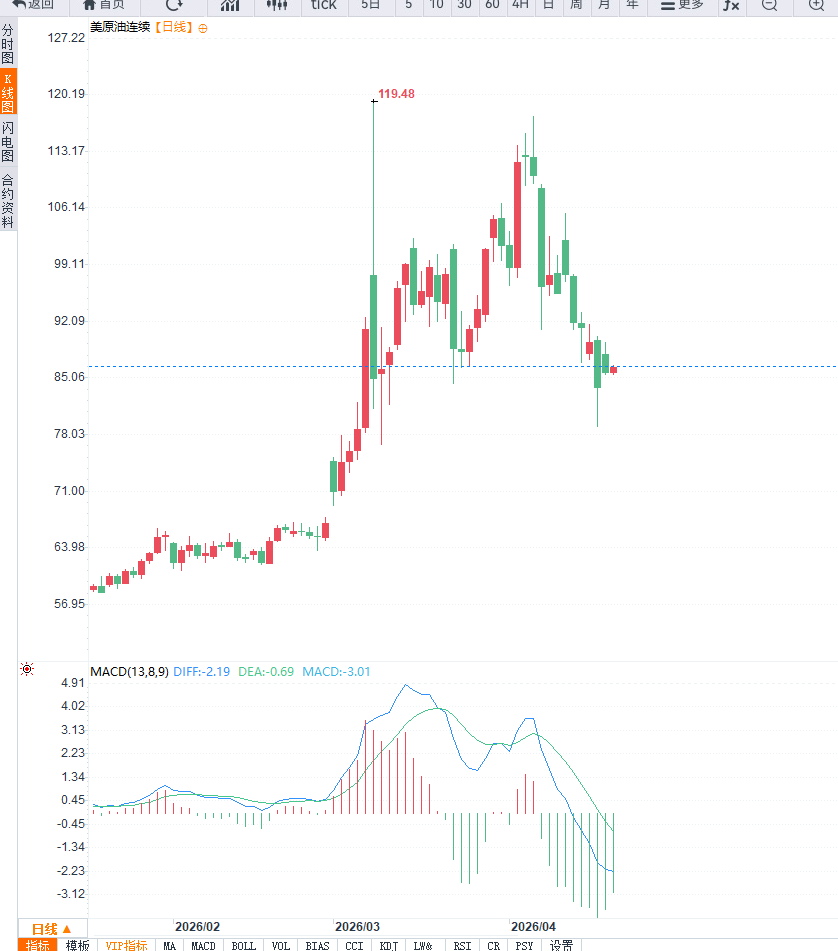
Overall, the current crude oil market is in a phase of interplay among multiple factors, with price fluctuations driven more by expectations than by fundamental trends. Until the API data is released and the geopolitical situation becomes clearer, the market is likely to maintain a volatile pattern.
Editor's Summary:
WTI crude oil is currently trading within a key range, reflecting the market's repeated balancing act between geopolitical risks and supply and demand expectations. On one hand, US-Iran tensions provide a floor for oil prices; on the other hand, inventory data and macroeconomic uncertainties limit upside potential. In the short term, oil prices are likely to remain range-bound, awaiting a new catalyst to break the equilibrium. The medium-term trend will depend on whether geopolitical tensions escalate and whether supply and demand data continue to improve. Investors should pay close attention to key technical levels and the timing of data releases, seizing opportunities while managing risk.
From a fundamental perspective, renewed tensions between the US and Iran have become a significant factor supporting oil prices. As the ceasefire deadline approaches, market concerns about further escalation have intensified, and energy supply risks are being priced back into the price system. This is especially true given the continued uncertainty surrounding key shipping routes; the Strait of Hormuz handles approximately 20% of global seaborne crude oil transport , and its passage directly impacts global supply stability. While diplomatic negotiations remain possible, significant differences in positions among the parties make a rapid easing of the situation unlikely in the short term.
Meanwhile, market expectations for a supply recovery remain cautious. Some analysts point out that current oil price fluctuations reflect more policy statements and changes in market sentiment than a significant improvement in actual supply. This "expectation-driven" market makes oil prices highly volatile and increases uncertainty in short-term trading.
Besides geopolitical factors, inventory data has also become a key focus for the market. Investors are generally awaiting the upcoming American Petroleum Institute (API) inventory report to assess short-term supply and demand. If the data shows a larger-than-expected decline in crude oil inventories, it indicates strong demand, which will provide upward momentum for oil prices; conversely, if inventories unexpectedly increase, it may indicate oversupply or weak demand, thus putting downward pressure on prices. Therefore, API data has strong directional guiding significance at the current stage.
From a market structure perspective, current oil prices are in a state of "mixed bullish and bearish factors." On the one hand, geopolitical risks provide a floor for prices; on the other hand, the lack of sustained bullish factors limits upward momentum. Furthermore, uncertainty surrounding the global economic outlook is also suppressing expectations for crude oil demand to some extent, making it difficult for the market to form a unilateral trend.
From a technical perspective, the daily chart shows that oil prices have entered a consolidation phase after a surge and subsequent pullback, maintaining an overall oscillating structure. The $90 level constitutes key resistance above ; if the bulls cannot effectively break through this level in the short term, the upside potential will be limited. On the downside, $85 provides short-term support ; a break below this level could lead to a further test of the key support area around $82 . In terms of momentum indicators, the MACD shows signs of a pullback from its high level, indicating a weakening of upward momentum, but a clear downward trend has not yet formed.
From a 4-hour chart perspective, the short-term trend shows a slightly bullish but weak momentum. The price is fluctuating around $86, and the moving average system is flattening, indicating a lack of clear market direction. The RSI indicator is in the neutral range, without any extreme signals, suggesting that the price may continue to fluctuate within the current range. If it can effectively break above $88, it may retest the $90 resistance level in the short term; conversely, a break below $85 could trigger a further pullback.
Overall, the current crude oil market is in a phase of interplay among multiple factors, with price fluctuations driven more by expectations than by fundamental trends. Until the API data is released and the geopolitical situation becomes clearer, the market is likely to maintain a volatile pattern.
Editor's Summary:
WTI crude oil is currently trading within a key range, reflecting the market's repeated balancing act between geopolitical risks and supply and demand expectations. On one hand, US-Iran tensions provide a floor for oil prices; on the other hand, inventory data and macroeconomic uncertainties limit upside potential. In the short term, oil prices are likely to remain range-bound, awaiting a new catalyst to break the equilibrium. The medium-term trend will depend on whether geopolitical tensions escalate and whether supply and demand data continue to improve. Investors should pay close attention to key technical levels and the timing of data releases, seizing opportunities while managing risk.
- Risk Warning and Disclaimer
- The market involves risk, and trading may not be suitable for all investors. This article is for reference only and does not constitute personal investment advice, nor does it take into account certain users’ specific investment objectives, financial situation, or other needs. Any investment decisions made based on this information are at your own risk.