Gold prices fall below $4,800! With US-Iran peace talks hanging in the balance and the dollar rebounding, gold bulls face a life-or-death test.
2026-04-21 14:09:32
Gold prices continued their decline in Asian trading on Tuesday (April 21), with spot gold falling below the key psychological level of $4,800, partially erasing gains from the previous day's rebound from a one-week low. This move was a result of a stronger dollar and geopolitical uncertainty. Currently, investors remain highly skeptical about whether the US and Iran can reach a substantial peace agreement, and the escalating tensions in the Strait of Hormuz are the core driver of market volatility.

The US Navy seized an Iranian-flagged cargo ship in the Gulf of Oman, an action seen as part of a blockade against Iran. In direct response, Iran again announced the closure of the Strait of Hormuz, one of the world's most important oil shipping routes. The closure of the strait directly pushed up crude oil prices, triggering renewed concerns about inflationary pressures. The rise in oil prices provided strong support for the US dollar, while gold, as a non-interest-bearing asset, faced significant downward pressure. This chain reaction once again demonstrates that geopolitical events can often dominate the direction of commodity markets in a short period.
Nevertheless, the dollar's strong rise has not been without its challenges. The likelihood of a Federal Reserve rate hike has significantly decreased, with the market generally believing there's a 45% to 50% chance of a rate cut before the end of the year. This expectation limits further appreciation of the dollar and provides significant potential support for gold. Traders are generally cautious in the current environment, avoiding establishing overly aggressive one-sided positions before the outcome of the US-Iran negotiations becomes fully clear. Therefore, investors prefer a wait-and-see approach rather than rushing to predict the next sharp decline in gold until clear and strong follow-through selling occurs.
US President Donald Trump announced on Monday that US negotiators would travel to Pakistan for a new round of talks with Iran, aiming to extend the fragile ceasefire agreement that was scheduled to expire on Wednesday. This news initially brought some optimism to the market. However, Iran's stance remained firm. Iranian officials clearly stated that they had reservations about further peace negotiations due to the ongoing US blockade. Iranian Parliament Speaker Mohammad Bagher Ghalibaf even publicly emphasized that Iran would never accept any negotiations under threat. Meanwhile, Iranian Foreign Minister Abbas Araqchi also pointed out that the US's repeated violations of the ceasefire agreement had become the biggest obstacle to the continuation of the diplomatic process.
Despite significant differences in their positions, the latest reports indicate that the Iranian delegation still plans to travel to Islamabad to participate in the negotiations. This conflicting information makes it difficult for the market to form a consensus. Investors are currently focused on any new developments related to the US-Iran situation, as these headlines could trigger sharp fluctuations in financial markets at any time.
Beyond geopolitical factors, Tuesday's trading will also focus on the congressional testimony of Federal Reserve Chair nominee Kevin Warsh. This testimony could provide additional trading clues for gold prices. Given the mixed fundamental signals, investors must exercise extreme caution when establishing large positions.
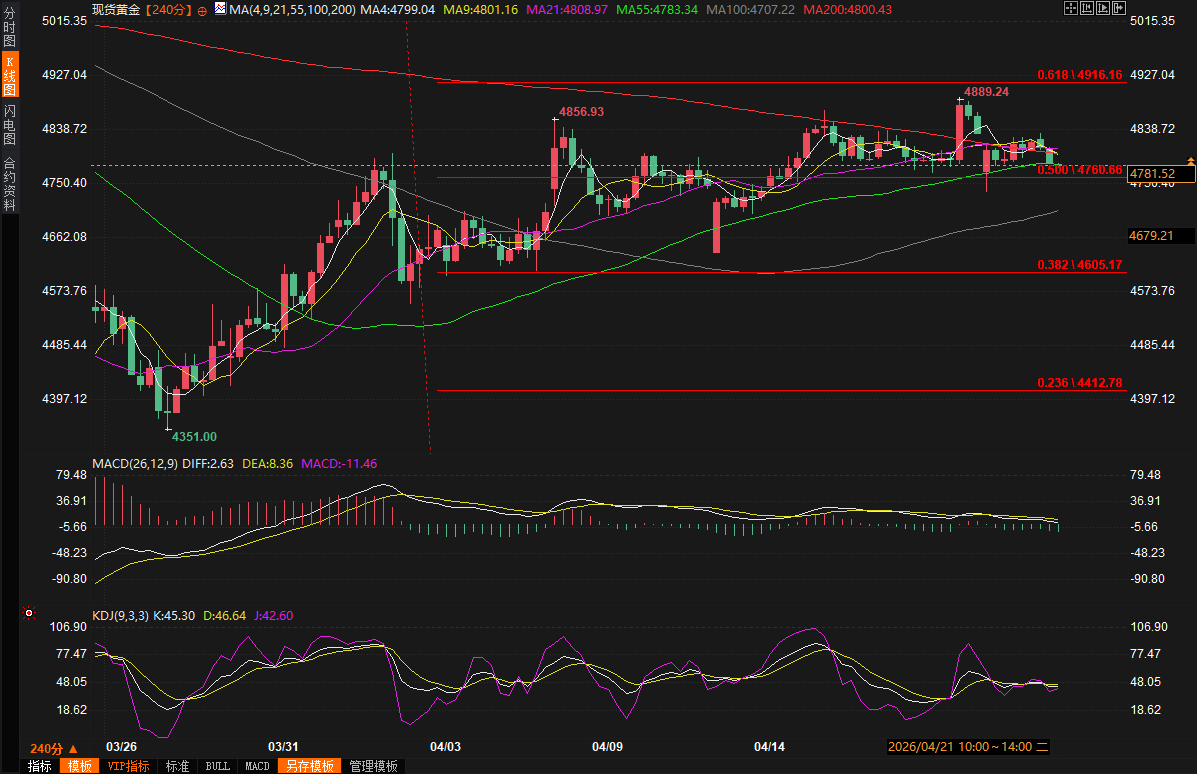
From a technical perspective, gold maintains a short-term constructive bias on the 4-hour chart. Currently, the price is testing support near the 55-period exponential moving average at $4783, a level that constitutes significant short-term support. The 50% Fibonacci retracement level of the March decline is located around $4760, further reinforcing the downside support zone. The Relative Strength Index (RSI) is currently hovering around a neutral level of 51, while the Moving Average Convergence Divergence (MACD) indicator, although slightly negative, does not show strong directional momentum. These signals suggest that while bulls still hold structural control, there is currently a lack of sufficient follow-through buying to drive prices higher.
If gold prices can hold the key support zone of $4,783 to $4,760, the short-term positive outlook may remain intact. A sustained and strong break below this level would open the way to deeper Fibonacci support levels at $4,606 and $4,413, potentially testing the broader swing low of $4,099. On the upside, the 61.8% Fibonacci retracement level at $4,916 provides initial resistance, with further upside facing the 78.6% retracement level at $5,114 and the cycle high at $5,419. If gold encounters significant selling pressure in this area, the current rally is likely to end.
In summary, gold is currently in a complex environment characterized by a strengthening US dollar, geopolitical uncertainty, and expectations surrounding Federal Reserve policy. While the breach of the $4,800 level has exacerbated short-term downward pressure, the expectation of a Fed rate cut still provides significant defensive support for gold. Every development or setback in the US-Iran peace negotiations could potentially trigger sharp market volatility.
Against this backdrop, investors should avoid taking rash and aggressive actions when information is insufficient. Closely monitoring the latest geopolitical headlines, paying attention to statements from Federal Reserve officials, and combining this with a comprehensive assessment of key technical levels will be the most prudent trading strategy at this stage. Only after a clear and sustained trend signal emerges should one consider establishing a position; this is the only way to effectively control risk and seize potential opportunities. The next phase of the gold market's movement will ultimately depend on the actual progress of the US-Iran negotiations and the true strength or weakness of the US dollar.
At 14:08 Beijing time, spot gold was trading at $4784.19 per ounce.
Geopolitical conflict escalates: Strait of Hormuz blockade reignites concerns about oil prices and inflation.
The US Navy seized an Iranian-flagged cargo ship in the Gulf of Oman, an action seen as part of a blockade against Iran. In direct response, Iran again announced the closure of the Strait of Hormuz, one of the world's most important oil shipping routes. The closure of the strait directly pushed up crude oil prices, triggering renewed concerns about inflationary pressures. The rise in oil prices provided strong support for the US dollar, while gold, as a non-interest-bearing asset, faced significant downward pressure. This chain reaction once again demonstrates that geopolitical events can often dominate the direction of commodity markets in a short period.
Nevertheless, the dollar's strong rise has not been without its challenges. The likelihood of a Federal Reserve rate hike has significantly decreased, with the market generally believing there's a 45% to 50% chance of a rate cut before the end of the year. This expectation limits further appreciation of the dollar and provides significant potential support for gold. Traders are generally cautious in the current environment, avoiding establishing overly aggressive one-sided positions before the outcome of the US-Iran negotiations becomes fully clear. Therefore, investors prefer a wait-and-see approach rather than rushing to predict the next sharp decline in gold until clear and strong follow-through selling occurs.
Trump announces new round of negotiations: US-Iran peace process remains uncertain.
US President Donald Trump announced on Monday that US negotiators would travel to Pakistan for a new round of talks with Iran, aiming to extend the fragile ceasefire agreement that was scheduled to expire on Wednesday. This news initially brought some optimism to the market. However, Iran's stance remained firm. Iranian officials clearly stated that they had reservations about further peace negotiations due to the ongoing US blockade. Iranian Parliament Speaker Mohammad Bagher Ghalibaf even publicly emphasized that Iran would never accept any negotiations under threat. Meanwhile, Iranian Foreign Minister Abbas Araqchi also pointed out that the US's repeated violations of the ceasefire agreement had become the biggest obstacle to the continuation of the diplomatic process.
Despite significant differences in their positions, the latest reports indicate that the Iranian delegation still plans to travel to Islamabad to participate in the negotiations. This conflicting information makes it difficult for the market to form a consensus. Investors are currently focused on any new developments related to the US-Iran situation, as these headlines could trigger sharp fluctuations in financial markets at any time.
Fed actions and technical signals: Gold still has structural support in the short term.
Beyond geopolitical factors, Tuesday's trading will also focus on the congressional testimony of Federal Reserve Chair nominee Kevin Warsh. This testimony could provide additional trading clues for gold prices. Given the mixed fundamental signals, investors must exercise extreme caution when establishing large positions.
From a technical perspective, gold maintains a short-term constructive bias on the 4-hour chart. Currently, the price is testing support near the 55-period exponential moving average at $4783, a level that constitutes significant short-term support. The 50% Fibonacci retracement level of the March decline is located around $4760, further reinforcing the downside support zone. The Relative Strength Index (RSI) is currently hovering around a neutral level of 51, while the Moving Average Convergence Divergence (MACD) indicator, although slightly negative, does not show strong directional momentum. These signals suggest that while bulls still hold structural control, there is currently a lack of sufficient follow-through buying to drive prices higher.
If gold prices can hold the key support zone of $4,783 to $4,760, the short-term positive outlook may remain intact. A sustained and strong break below this level would open the way to deeper Fibonacci support levels at $4,606 and $4,413, potentially testing the broader swing low of $4,099. On the upside, the 61.8% Fibonacci retracement level at $4,916 provides initial resistance, with further upside facing the 78.6% retracement level at $5,114 and the cycle high at $5,419. If gold encounters significant selling pressure in this area, the current rally is likely to end.
Overall Outlook: Cautious Trading Strategies Amid Increased Volatility
In summary, gold is currently in a complex environment characterized by a strengthening US dollar, geopolitical uncertainty, and expectations surrounding Federal Reserve policy. While the breach of the $4,800 level has exacerbated short-term downward pressure, the expectation of a Fed rate cut still provides significant defensive support for gold. Every development or setback in the US-Iran peace negotiations could potentially trigger sharp market volatility.
Against this backdrop, investors should avoid taking rash and aggressive actions when information is insufficient. Closely monitoring the latest geopolitical headlines, paying attention to statements from Federal Reserve officials, and combining this with a comprehensive assessment of key technical levels will be the most prudent trading strategy at this stage. Only after a clear and sustained trend signal emerges should one consider establishing a position; this is the only way to effectively control risk and seize potential opportunities. The next phase of the gold market's movement will ultimately depend on the actual progress of the US-Iran negotiations and the true strength or weakness of the US dollar.
At 14:08 Beijing time, spot gold was trading at $4784.19 per ounce.
- Risk Warning and Disclaimer
- The market involves risk, and trading may not be suitable for all investors. This article is for reference only and does not constitute personal investment advice, nor does it take into account certain users’ specific investment objectives, financial situation, or other needs. Any investment decisions made based on this information are at your own risk.