Tensions in US-Iran negotiations coupled with forward-looking retail data kept the US dollar index fluctuating at low levels.
2026-04-21 14:18:23
On Tuesday during Asian trading hours, the US dollar index (DXY) remained within a narrow range around 98.10 , exhibiting a generally mildly bullish trend. In the current market environment, the dollar's fluctuations are primarily driven by both geopolitical tensions and macroeconomic data expectations.

From a fundamental perspective, the progress of US-Iran negotiations has become the current focus of market attention. As the ceasefire deadline approaches, market uncertainty regarding the future of the situation has increased significantly. The US plans to send a high-level delegation to participate in the new round of negotiations, while Iran will also send a team, but the specific arrangements are not yet fully clear. At the same time, the US has signaled that it is unlikely to extend the ceasefire, significantly increasing the urgency of the negotiations.
This uncertainty has fueled risk aversion in the market, thus supporting the US dollar. As the world's main reserve currency, the US dollar typically performs strongly in risky environments; therefore, current geopolitical risks are one of the key factors keeping the dollar index high. However, the market is also weighing the possibility of progress in negotiations, and once the risks ease, the dollar's safe-haven premium could quickly decline.
Meanwhile, macroeconomic data has become another key variable influencing the short-term trend of the US dollar. The market generally expects US retail sales to rise by about 1.4% month-on-month in March , higher than the previous value of 0.6% , reflecting stronger consumer momentum. Strong data will reinforce expectations of US economic resilience and may delay market expectations of interest rate cuts, thus supporting further dollar strength; conversely, weaker-than-expected data could weaken the dollar's attractiveness and bring short-term downward pressure.
From a market structure perspective, the US dollar index is currently in a typical "event-driven oscillation phase." On the one hand, geopolitical risks provide bottom support; on the other hand, policy expectations and data uncertainty limit upside potential, making it difficult for prices to form a trend breakout.
From a technical perspective, the daily chart shows that the US dollar index has entered a consolidation range after rebounding from its previous lows, with an overall oscillating structure. 98.60 is a key resistance level , and multiple tests have failed to break through effectively, indicating insufficient upward momentum. On the downside, 97.80 provides short-term support ; a break below this level could lead to further declines to the 97.40 or even 96.90 area . The MACD indicator is in a corrective phase, with improved momentum but no clear trend signal yet.
From a 4-hour chart perspective, the short-term trend is showing a sideways consolidation pattern, with prices fluctuating repeatedly around the 98 level. The moving average system is converging, indicating a lack of clear market direction. The RSI remains in the neutral range, without any obvious overbought or oversold signals, suggesting that short-term range-bound trading will continue. A break above 98.60 could open up further upside potential; a break below 97.80 could lead to a retest of lower support levels.
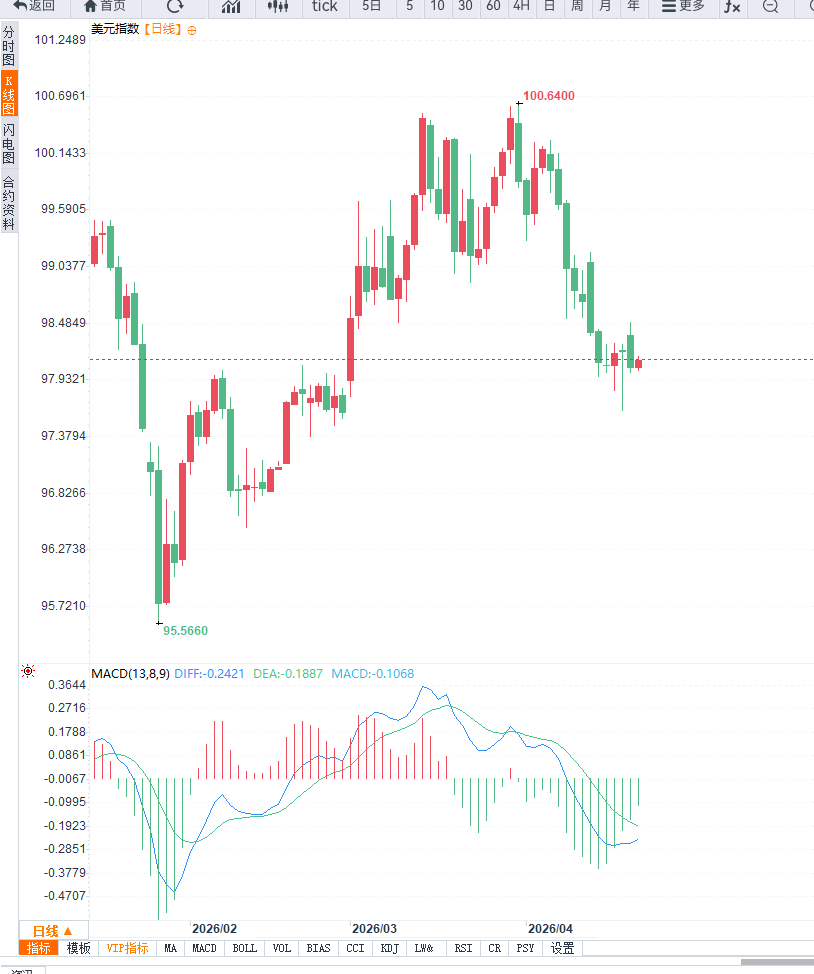
Overall, influenced by a combination of geopolitical tensions and economic data, the US dollar index is expected to remain volatile in the short term, with its direction yet to be confirmed.
Editor's Summary:
The US dollar index is currently at a critical juncture, supported by geopolitical risks, while economic data will determine whether it can maintain its strength. If US-Iran negotiations lack progress and US data remains strong, the dollar is likely to maintain its upward trend; conversely, if risks ease and data weakens, a pullback may occur. Overall, the market remains in a phase of high uncertainty, and investors need to closely monitor events and data changes to capitalize on opportunities arising from range-bound trading.
From a fundamental perspective, the progress of US-Iran negotiations has become the current focus of market attention. As the ceasefire deadline approaches, market uncertainty regarding the future of the situation has increased significantly. The US plans to send a high-level delegation to participate in the new round of negotiations, while Iran will also send a team, but the specific arrangements are not yet fully clear. At the same time, the US has signaled that it is unlikely to extend the ceasefire, significantly increasing the urgency of the negotiations.
This uncertainty has fueled risk aversion in the market, thus supporting the US dollar. As the world's main reserve currency, the US dollar typically performs strongly in risky environments; therefore, current geopolitical risks are one of the key factors keeping the dollar index high. However, the market is also weighing the possibility of progress in negotiations, and once the risks ease, the dollar's safe-haven premium could quickly decline.
Meanwhile, macroeconomic data has become another key variable influencing the short-term trend of the US dollar. The market generally expects US retail sales to rise by about 1.4% month-on-month in March , higher than the previous value of 0.6% , reflecting stronger consumer momentum. Strong data will reinforce expectations of US economic resilience and may delay market expectations of interest rate cuts, thus supporting further dollar strength; conversely, weaker-than-expected data could weaken the dollar's attractiveness and bring short-term downward pressure.
From a market structure perspective, the US dollar index is currently in a typical "event-driven oscillation phase." On the one hand, geopolitical risks provide bottom support; on the other hand, policy expectations and data uncertainty limit upside potential, making it difficult for prices to form a trend breakout.
From a technical perspective, the daily chart shows that the US dollar index has entered a consolidation range after rebounding from its previous lows, with an overall oscillating structure. 98.60 is a key resistance level , and multiple tests have failed to break through effectively, indicating insufficient upward momentum. On the downside, 97.80 provides short-term support ; a break below this level could lead to further declines to the 97.40 or even 96.90 area . The MACD indicator is in a corrective phase, with improved momentum but no clear trend signal yet.
From a 4-hour chart perspective, the short-term trend is showing a sideways consolidation pattern, with prices fluctuating repeatedly around the 98 level. The moving average system is converging, indicating a lack of clear market direction. The RSI remains in the neutral range, without any obvious overbought or oversold signals, suggesting that short-term range-bound trading will continue. A break above 98.60 could open up further upside potential; a break below 97.80 could lead to a retest of lower support levels.
Overall, influenced by a combination of geopolitical tensions and economic data, the US dollar index is expected to remain volatile in the short term, with its direction yet to be confirmed.
Editor's Summary:
The US dollar index is currently at a critical juncture, supported by geopolitical risks, while economic data will determine whether it can maintain its strength. If US-Iran negotiations lack progress and US data remains strong, the dollar is likely to maintain its upward trend; conversely, if risks ease and data weakens, a pullback may occur. Overall, the market remains in a phase of high uncertainty, and investors need to closely monitor events and data changes to capitalize on opportunities arising from range-bound trading.
- Risk Warning and Disclaimer
- The market involves risk, and trading may not be suitable for all investors. This article is for reference only and does not constitute personal investment advice, nor does it take into account certain users’ specific investment objectives, financial situation, or other needs. Any investment decisions made based on this information are at your own risk.