Improved UK employment data supported policy expectations, and the pound traded sideways against the dollar around 1.3525, awaiting inflation guidance.
2026-04-21 14:26:49
On Tuesday during the European session, the British pound (GBP/USD) remained relatively firm after the release of UK employment data, but was still under slight pressure overall, trading around 1.3525 . Despite some positive signals from the data, the market reaction was relatively restrained, indicating that investors are still awaiting more macroeconomic clues.
Data shows that the UK labor market is generally showing signs of improvement. The ILO unemployment rate fell to 4.9% , significantly lower than the market expectation of 5.2%, reflecting the continued resilience of the job market. Meanwhile, employment increased by approximately 25,000 in the three months to February, although lower than the previous figure, it still represents positive growth, indicating that the economic fundamentals have not deteriorated significantly.
Regarding salaries, key wage growth indicators showed mixed performance. Average salaries excluding bonuses increased by 3.6% year-on-year , slightly higher than expected but lower than the previous figure, indicating a slowdown in wage growth. Salaries including bonuses, however, grew by 3.8% , exceeding market expectations, suggesting that income levels remain relatively supported. Overall, while salary data did not show a comprehensive strengthening, it remained within a relatively stable range.
Improved employment data reinforced market expectations that the Bank of England will keep interest rates unchanged in the near term. A lower unemployment rate suggests a resilient economy, giving policymakers room to observe inflation trends rather than immediately adjusting rates. This expectation provided some support for the pound, but also limited its potential for significant gains.
Looking ahead, market focus has quickly shifted to the upcoming inflation data. The UK's March CPI is expected to rise to 3.3% year-on-year , higher than the previous 3.0% , primarily driven by rising energy prices. Given the current Middle East situation's impact on the energy market, rising inflation could further influence the Bank of England's policy path. Higher-than-expected inflation could strengthen expectations of maintaining high interest rates, thus supporting the pound; conversely, lower-than-expected inflation could weaken its performance.
In addition, the UK's preliminary PMI and retail sales data will be released this week, which will further reflect economic activity and consumption, providing the market with more clues about the economic outlook.
From a technical perspective, the daily chart shows that the GBP/USD pair is maintaining an upward trend, with the price remaining above the medium- and long-term moving averages, indicating an overall bullish structure. The 1.3600 area forms a key resistance level , having been tested multiple times without a breakthrough, suggesting weakening upward momentum. On the downside, 1.3500 is a significant short-term support level ; a break below this level could lead to a further pullback to the 1.3420 area . In terms of momentum indicators, the MACD has retreated from its highs, indicating weakening bullish momentum.
From a 4-hour chart perspective, the short-term trend shows a consolidation structure, with prices fluctuating repeatedly within the 1.3500 to 1.3600 range. The moving average system is flattening, indicating a lack of clear market direction. The RSI is in the neutral range, without any extreme signals, suggesting that short-term range-bound trading will continue. A break above 1.3600 could lead to further upward movement; a break below 1.3500 could trigger a deeper correction.
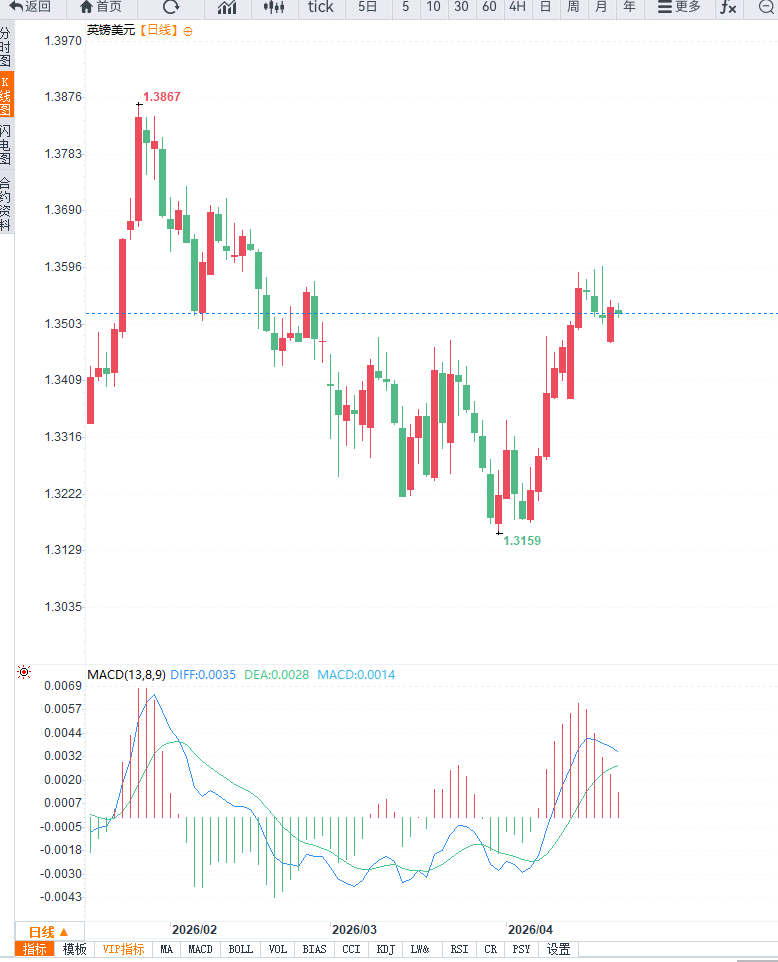
Overall, the pound/dollar exchange rate is currently in a data-driven phase, supported by employment data, but inflation and subsequent economic data will determine the next direction.
Editor's Summary:
Better-than-expected UK employment data provided some support for the pound, but slower job growth and declining wage growth limited its upside potential. The market is currently more focused on upcoming inflation data, as it will directly impact the Bank of England's policy path. In the short term, the pound/dollar exchange rate is expected to remain range-bound, awaiting directional guidance from key data. Investors should pay close attention to breakouts from the 1.3500 and 1.3600 ranges.
Data shows that the UK labor market is generally showing signs of improvement. The ILO unemployment rate fell to 4.9% , significantly lower than the market expectation of 5.2%, reflecting the continued resilience of the job market. Meanwhile, employment increased by approximately 25,000 in the three months to February, although lower than the previous figure, it still represents positive growth, indicating that the economic fundamentals have not deteriorated significantly.
Regarding salaries, key wage growth indicators showed mixed performance. Average salaries excluding bonuses increased by 3.6% year-on-year , slightly higher than expected but lower than the previous figure, indicating a slowdown in wage growth. Salaries including bonuses, however, grew by 3.8% , exceeding market expectations, suggesting that income levels remain relatively supported. Overall, while salary data did not show a comprehensive strengthening, it remained within a relatively stable range.
Improved employment data reinforced market expectations that the Bank of England will keep interest rates unchanged in the near term. A lower unemployment rate suggests a resilient economy, giving policymakers room to observe inflation trends rather than immediately adjusting rates. This expectation provided some support for the pound, but also limited its potential for significant gains.
Looking ahead, market focus has quickly shifted to the upcoming inflation data. The UK's March CPI is expected to rise to 3.3% year-on-year , higher than the previous 3.0% , primarily driven by rising energy prices. Given the current Middle East situation's impact on the energy market, rising inflation could further influence the Bank of England's policy path. Higher-than-expected inflation could strengthen expectations of maintaining high interest rates, thus supporting the pound; conversely, lower-than-expected inflation could weaken its performance.
In addition, the UK's preliminary PMI and retail sales data will be released this week, which will further reflect economic activity and consumption, providing the market with more clues about the economic outlook.
From a technical perspective, the daily chart shows that the GBP/USD pair is maintaining an upward trend, with the price remaining above the medium- and long-term moving averages, indicating an overall bullish structure. The 1.3600 area forms a key resistance level , having been tested multiple times without a breakthrough, suggesting weakening upward momentum. On the downside, 1.3500 is a significant short-term support level ; a break below this level could lead to a further pullback to the 1.3420 area . In terms of momentum indicators, the MACD has retreated from its highs, indicating weakening bullish momentum.
From a 4-hour chart perspective, the short-term trend shows a consolidation structure, with prices fluctuating repeatedly within the 1.3500 to 1.3600 range. The moving average system is flattening, indicating a lack of clear market direction. The RSI is in the neutral range, without any extreme signals, suggesting that short-term range-bound trading will continue. A break above 1.3600 could lead to further upward movement; a break below 1.3500 could trigger a deeper correction.
Overall, the pound/dollar exchange rate is currently in a data-driven phase, supported by employment data, but inflation and subsequent economic data will determine the next direction.
Editor's Summary:
Better-than-expected UK employment data provided some support for the pound, but slower job growth and declining wage growth limited its upside potential. The market is currently more focused on upcoming inflation data, as it will directly impact the Bank of England's policy path. In the short term, the pound/dollar exchange rate is expected to remain range-bound, awaiting directional guidance from key data. Investors should pay close attention to breakouts from the 1.3500 and 1.3600 ranges.
- Risk Warning and Disclaimer
- The market involves risk, and trading may not be suitable for all investors. This article is for reference only and does not constitute personal investment advice, nor does it take into account certain users’ specific investment objectives, financial situation, or other needs. Any investment decisions made based on this information are at your own risk.