Will the negotiations break down or will tariffs persist? What drama will unfold for gold prices?
2026-04-21 17:56:42
Spot gold prices retreated on Tuesday, April 21, primarily due to a stronger US dollar and market focus on the latest developments in US-Iran peace talks. Brent crude oil prices were slightly pressured around $94.40 per barrel, still about one-third higher than pre-conflict levels, but signals of peace talks temporarily eased extreme concerns about disruptions to the energy supply chain. Meanwhile, a meeting between the US Trade Representative and Mexican auto and steel industry representatives sent a clear signal that the Trump administration's tariff policy would not completely revert to a zero-tariff era.
This combination of factors led traders to repric the safe-haven premium for gold, with spot gold falling 0.7% to around $4,785 per ounce and U.S. gold futures for June delivery declining 0.5% to $4,803.60 per ounce. The Senate hearings of Federal Reserve nominee Kevin Warsh also came into the market's view, further exacerbating short-term volatility.
The US-Iran ceasefire agreement is set to expire Wednesday evening Washington time. US President Trump stated that Vice President Vance is ready to depart for Pakistan for a second round of negotiations, possibly accompanied by Jared Kushner and special envoy Steve Witkov. In a recent interview, Trump emphasized that he would not rush into a bad deal, and that the US blockade of Iranian ports would continue until an agreement is signed. On the Iranian side, a delegation led by Speaker Mohammad Bagher Ghalibaf, while considering participation, explicitly refused to negotiate under the shadow of threats, and condemned the US interception of the Iranian cargo ship "Tuska" over the weekend. The Strait of Hormuz, which accounts for approximately one-fifth of the world's oil and liquefied natural gas exports, remains effectively closed, after Iran briefly announced its reopening, which was quickly reversed.
Although crude oil prices fell by more than 1% due to expectations of peace talks, the conflict has led to a continued accumulation of inflationary pressures. Gold, as a traditional hedge against inflation, is under significant pressure due to its non-yielding nature in a high-interest-rate environment. Analysts point out that although the Middle East conflict has lasted for more than a month and pushed up oil prices, progress in peace talks has led to a partial erosion of risk premiums, and the strengthening of the US dollar has further amplified this effect.
U.S. Trade Representative Jamison Greer, meeting with representatives from the auto and steel industries in Mexico City, made it clear that tariffs "will not disappear," that President Trump "likes tariffs," and that the world will not return to a zero-tariff era. This statement signals a hardline U.S. stance ahead of the sixth-anniversary review of the U.S.-Mexico-Canada Agreement (USMCA), with formal negotiations set to begin the week of May 25 and the review to be completed by July 1. The U.S. has proposed raising the North American origin rules for key auto components such as engines, major electronic devices, and software to 100%, far exceeding the current requirement of approximately 75% regional value content.
Mexico's automotive industry is heavily reliant on the US market; of the 4 million vehicles produced in 2024, 2.8 million were purchased from the US. In 2025, affected by the 25% tariff, exports declined by nearly 3%, and the industry has already lost approximately 60,000 jobs. The steel industry also faces a 50% tariff on commodity steel and aluminum, and a 25% tariff on derivatives. Greer also hinted at possible other ways to help Mexico maintain its competitiveness, but did not provide specific details. This persistent tariff will drive the North American supply chain inward, raising manufacturing costs in the short term and creating imported inflationary pressure. Historical data shows that similar trade frictions often indirectly affect commodity pricing logic through cost transmission; in this environment, gold needs to balance the tension between inflationary support and concerns about economic growth.
A stronger US dollar index directly increased the cost of holding dollar-denominated commodities, becoming one of the core drivers of the gold price correction. Federal Reserve nominee Kevin Warsh emphasized his commitment to maintaining strict independence in monetary policy during his prepared remarks at his Senate hearing, a statement particularly crucial given the high oil price environment. Traders are assessing that if energy costs continue to push up core inflation, the Fed's policy path may face greater uncertainty, thereby affecting real interest rate expectations and impacting gold valuations.
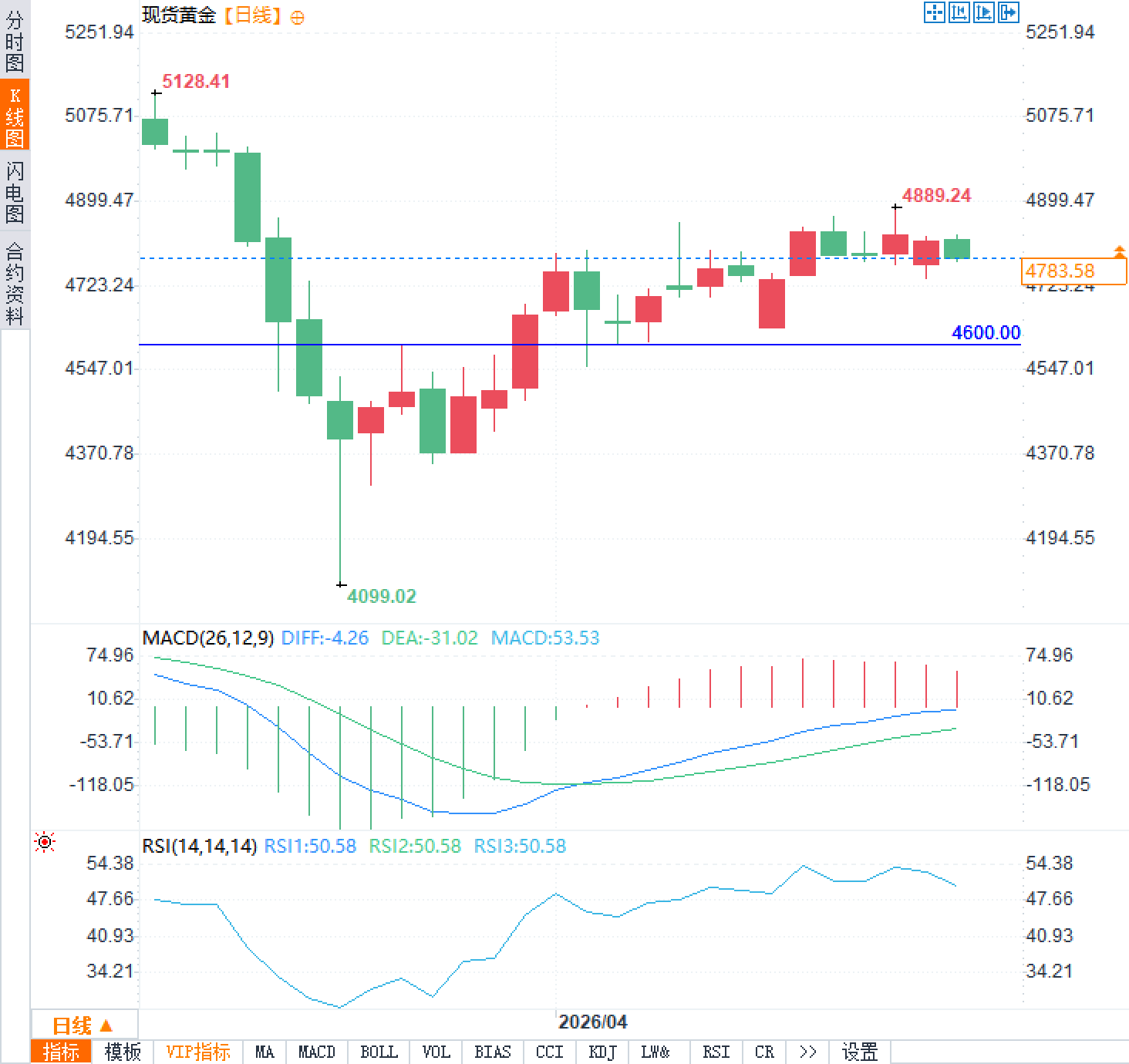
This combination of factors led traders to repric the safe-haven premium for gold, with spot gold falling 0.7% to around $4,785 per ounce and U.S. gold futures for June delivery declining 0.5% to $4,803.60 per ounce. The Senate hearings of Federal Reserve nominee Kevin Warsh also came into the market's view, further exacerbating short-term volatility.
Geopolitical uncertainty is reshaping gold's safe-haven pricing.
The US-Iran ceasefire agreement is set to expire Wednesday evening Washington time. US President Trump stated that Vice President Vance is ready to depart for Pakistan for a second round of negotiations, possibly accompanied by Jared Kushner and special envoy Steve Witkov. In a recent interview, Trump emphasized that he would not rush into a bad deal, and that the US blockade of Iranian ports would continue until an agreement is signed. On the Iranian side, a delegation led by Speaker Mohammad Bagher Ghalibaf, while considering participation, explicitly refused to negotiate under the shadow of threats, and condemned the US interception of the Iranian cargo ship "Tuska" over the weekend. The Strait of Hormuz, which accounts for approximately one-fifth of the world's oil and liquefied natural gas exports, remains effectively closed, after Iran briefly announced its reopening, which was quickly reversed.
Although crude oil prices fell by more than 1% due to expectations of peace talks, the conflict has led to a continued accumulation of inflationary pressures. Gold, as a traditional hedge against inflation, is under significant pressure due to its non-yielding nature in a high-interest-rate environment. Analysts point out that although the Middle East conflict has lasted for more than a month and pushed up oil prices, progress in peace talks has led to a partial erosion of risk premiums, and the strengthening of the US dollar has further amplified this effect.
The trade tariff dispute between the US and Mexico has intensified the pressure on supply chain restructuring.
U.S. Trade Representative Jamison Greer, meeting with representatives from the auto and steel industries in Mexico City, made it clear that tariffs "will not disappear," that President Trump "likes tariffs," and that the world will not return to a zero-tariff era. This statement signals a hardline U.S. stance ahead of the sixth-anniversary review of the U.S.-Mexico-Canada Agreement (USMCA), with formal negotiations set to begin the week of May 25 and the review to be completed by July 1. The U.S. has proposed raising the North American origin rules for key auto components such as engines, major electronic devices, and software to 100%, far exceeding the current requirement of approximately 75% regional value content.
Mexico's automotive industry is heavily reliant on the US market; of the 4 million vehicles produced in 2024, 2.8 million were purchased from the US. In 2025, affected by the 25% tariff, exports declined by nearly 3%, and the industry has already lost approximately 60,000 jobs. The steel industry also faces a 50% tariff on commodity steel and aluminum, and a 25% tariff on derivatives. Greer also hinted at possible other ways to help Mexico maintain its competitiveness, but did not provide specific details. This persistent tariff will drive the North American supply chain inward, raising manufacturing costs in the short term and creating imported inflationary pressure. Historical data shows that similar trade frictions often indirectly affect commodity pricing logic through cost transmission; in this environment, gold needs to balance the tension between inflationary support and concerns about economic growth.
| Trading partners | Automobile tariff levels | Impact Description |
|---|---|---|
| Mexico | 25% | Exports declined by nearly 3%, resulting in a loss of approximately 60,000 jobs. |
| Japan | 15% | More competitive than Mexico |
| EU | 15% | Supply chain restructuring accelerates |
| South Korea | 15% | Similar agreements have taken effect. |
The combined effects of a strong dollar and personnel changes at the Federal Reserve
A stronger US dollar index directly increased the cost of holding dollar-denominated commodities, becoming one of the core drivers of the gold price correction. Federal Reserve nominee Kevin Warsh emphasized his commitment to maintaining strict independence in monetary policy during his prepared remarks at his Senate hearing, a statement particularly crucial given the high oil price environment. Traders are assessing that if energy costs continue to push up core inflation, the Fed's policy path may face greater uncertainty, thereby affecting real interest rate expectations and impacting gold valuations.
Frequently Asked Questions
Question 1: Why did the progress in US-Iran peace talks directly lead to a pullback in spot gold prices?
A: The peace talks signal reduced the risk of a prolonged closure of the Strait of Hormuz, while a slight decline in oil prices eased inflation expectations. Coupled with a stronger dollar, this weakened gold's safe-haven and inflation-hedging appeal. Although the conflict has disrupted the energy market, progress in negotiations led to a rapid erosion of risk premiums, prompting traders to take profits and pushing gold prices down from recent highs.
Question 2: What indirect impact will the persistence of US-Mexico tariffs have on the fundamentals of gold?
A: Tariffs will not be reduced to zero and rules of origin may be strengthened to 100%, which will increase the cost of North American manufacturing and create imported inflationary pressure, theoretically supporting gold's anti-inflationary properties; however, it may also trigger concerns about the restructuring of the global supply chain, strengthen the dollar's strong position, and suppress the upside potential of gold prices.
Question 3: How will the Federal Reserve nominee hearings affect gold pricing in the short to medium term?
A: Warsh emphasized policy independence, sending a cautious signal in a high oil price environment. If energy inflation persists, the market will reassess the likelihood of interest rate hikes or maintaining high interest rates, directly impacting the real yield curve and transmitting to the valuation of non-yielding assets. Considering trade tariffs and geopolitical factors, gold will likely remain in a tug-of-war between bulls and bears in the short term, and the market's repricing of the Fed's path after the hearing needs to be observed.
- Risk Warning and Disclaimer
- The market involves risk, and trading may not be suitable for all investors. This article is for reference only and does not constitute personal investment advice, nor does it take into account certain users’ specific investment objectives, financial situation, or other needs. Any investment decisions made based on this information are at your own risk.